Explore linkedin ad examples by format — sponsored content, video, Lead Gen Forms, Thought Leader Ads — and learn what makes each one convert for B2B.
📅 ⏱ 16 min read📝 ~3100 words
The best linkedin ad examples share a pattern that stands out immediately: they treat the feed like a conversation, not a billboard. A pattern observed across hundreds of B2B LinkedIn campaigns is that the ads generating the strongest pipeline aren't the most polished — they're the most specific. A clear audience, a credible hook, a concrete value promise, and a frictionless CTA. That's the formula. Every format covered below — from sponsored content to video ads to Lead Gen Forms — succeeds or fails based on how tightly it executes those four elements. According to Digital Third Coast (2026), LinkedIn generates a visitor-to-lead conversion rate 277% higher than Facebook and Twitter combined — which means the platform's professional context is doing real work before the ad even loads.
Key Takeaways
Who this is for: B2B marketers, founders, and agencies running or planning LinkedIn ad campaigns
What you'll learn: What separates high-performing LinkedIn ads from average ones — with real format examples
The single most counterintuitive finding: Thought Leader Ads (amplifying a real person's post) outperform standard sponsored content by 4–6x on CTR
LinkedIn's professional context is your targeting advantage — but only if your offer matches the user's work mindset
Lead Gen Forms consistently deliver lower CPL than landing page campaigns because they remove the biggest drop-off point
Organic engagement before paid spend materially improves ad relevance scores and can reduce your CPC
What Makes a Good LinkedIn Ad for B2B (And What These Examples Prove)
LinkedIn's professional intent is the platform's most underused advantage. Users arrive in a work mindset — scrolling between job updates, industry news, and peer content. That changes everything about how ad creative, copy, and offers need to land. An ad that might perform well on Instagram feels like an interruption here. One that leads with a specific professional problem feels native.
The Anatomy of a High-Converting B2B LinkedIn Ad
The four parts of a high-converting B2B LinkedIn ad
LinkedIn ad creative best practices consistently point to four non-negotiable elements:
A specific audience signal — the creative should make the right viewer feel personally addressed ("For SaaS founders scaling past $1M ARR")
A credible hook — data, a customer logo, an analyst quote, or a bold claim with evidence behind it
A clear value promise — what will the viewer get, specifically, if they click?
A low-friction CTA — matched to the campaign objective (download, demo, event registration)
B2B social proof in ad creative is the single most reliable scroll-stopper available. Yet according to a Vital Design study, only 28% of LinkedIn ads include any social proof at all — rankings, reviews, or customer mentions. That gap is a direct opportunity. Ads that lead with a recognisable customer logo or a specific ROI data point ("Reduced onboarding time by 40%") outperform generic benefit claims in nearly every split-test observed across B2B campaigns.
277%
Higher visitor-to-lead conversion rate on LinkedIn vs. Facebook and Twitter
LinkedIn Audience Targeting Precision: Why It Changes Everything
LinkedIn audience targeting precision is the platform's defining advantage over every other paid channel. You can target by job title, seniority, company size, industry, skills, and even specific company names — making it the only platform where "VP of Engineering at a 200-person SaaS company" is an addressable audience segment, not a lookalike approximation.
Campaign objective alignment is non-negotiable. An awareness-stage ad structured like a conversion ad — heavy on urgency, light on education — confuses LinkedIn's algorithm and wastes budget. The platform optimises delivery toward people likely to complete your chosen objective. If your creative and landing page don't match that intent, the algorithm's optimisation works against you, not for you.
The most common failure mode in B2B LinkedIn advertising isn't bad creative — it's a mismatch between campaign objective, ad format, and offer. Fix the alignment first, then optimise the creative.
LinkedIn Ad Examples by Format: Sponsored Content, Video, Spotlight, and More
LinkedIn Ad Examples by Format
Teams that understand format-level distinctions consistently see better results than teams that pick a format arbitrarily and optimise only the copy. Each format serves a different user behaviour — and the strongest linkedin ad examples B2B leverage that behaviour deliberately.
LinkedIn Sponsored Content Examples That Drive Pipeline
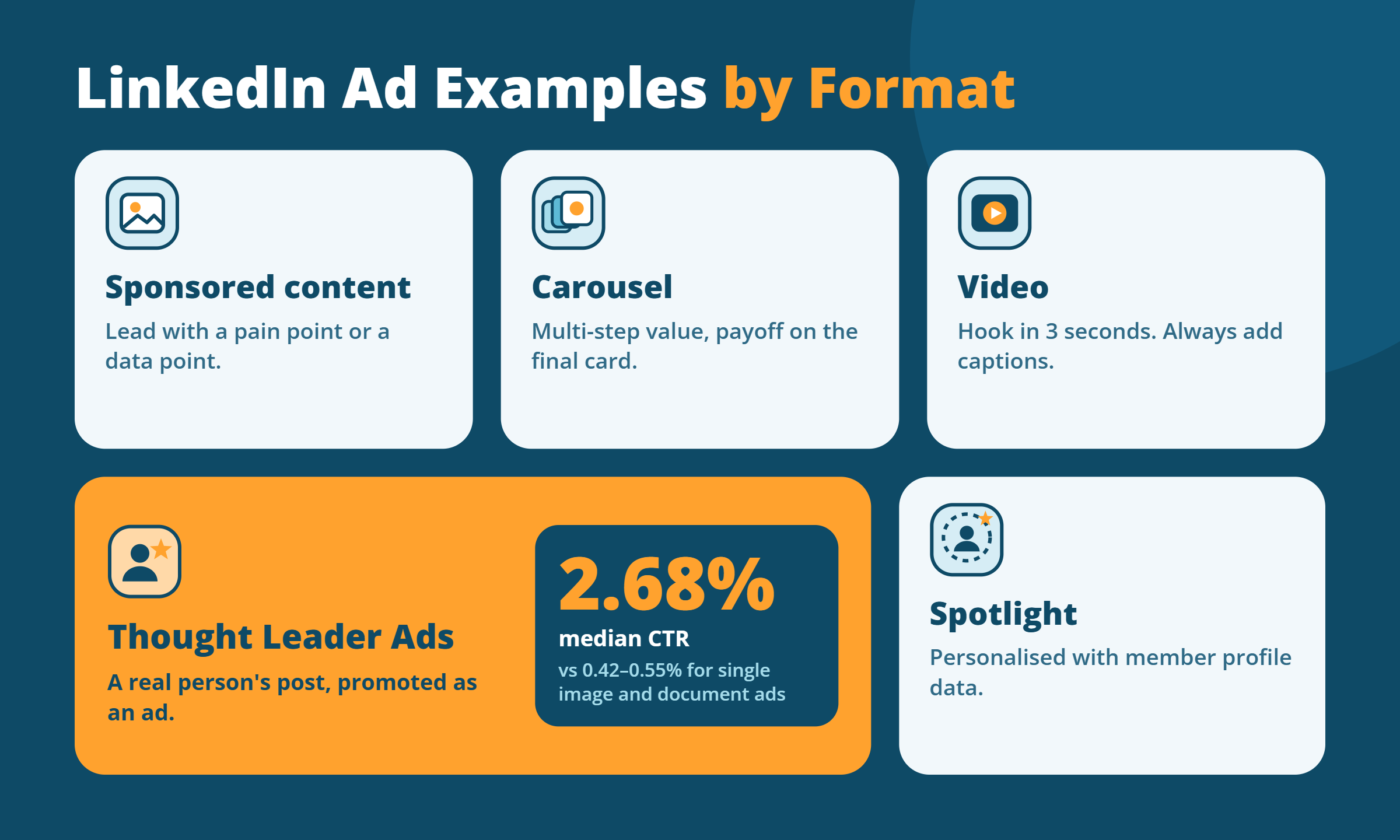
LinkedIn sponsored content examples — the standard single-image feed ad — remain the workhorse of B2B campaigns. The best performers follow a recognisable copy pattern: lead with a specific pain point or data point, present a credible solution, close with a specific outcome CTA.
A representative best linkedin ad examples pattern: a cybersecurity vendor leads with "83% of breaches involve a privileged account" (credible stat, immediately relevant), names their product as the fix in the body copy, and CTA reads "Get the free risk assessment." Every element earns its place. There's no wasted sentence.
For linkedin single image ad examples, the visual should reinforce the copy's specific claim — not decorate it. A dashboard screenshot outperforms a stock photo of a handshake in nearly every B2B test. Concrete beats abstract.
💡
Pro Tip:For single-image sponsored content, use a 1200×627px image and keep your introductory text under 150 characters — LinkedIn truncates at around 140 characters on mobile before "...see more."
LinkedIn carousel ad examples work particularly well for multi-step explanations — a "5 steps to reduce churn" carousel, for instance, trades a single impression for multiple swipes, each delivering a discrete piece of value. The most effective carousels have a clear payoff on the final card (the CTA card), so viewers who engage through to the end are pre-qualified by effort.
LinkedIn Video Ad Examples: What Works in Under 30 Seconds
LinkedIn video ad examples that perform share one structural trait: the first 3 seconds carry the entire premise. No slow intros, no logo animations, no "Hi, I'm [name]" opener. The problem or insight hits immediately, on-screen text reinforces it (because most LinkedIn video is watched muted), and the CTA lands before the 25-second mark.
In practice, linkedin video ad specs allow up to 30 minutes of video — but the data tells a different story. Videos under 30 seconds consistently outperform longer formats for awareness and consideration objectives. For linkedin video ad examples targeting decision-makers, a 15–20 second cut with subtitles and a single focused message outperforms a 2-minute product demo in click-through rate benchmarks.
⚠️
Warning:LinkedIn video ads without captions lose roughly 60–70% of potential engagement — most feed video is watched on mute. Always add subtitles before launching.
LinkedIn Thought Leader Ad Examples and Spotlight Ads
LinkedIn thought leader ad examples are the highest-CTR format available in 2026. According to ZenABM, Thought Leader Ads post a median CTR of 2.68% — compared to 0.42–0.55% for single image and document ads. That's a 5–6x performance gap driven by one factor: real human voice.
A Thought Leader Ad amplifies an employee's or executive's organic post as a paid unit. The ad reads as a personal perspective, not a corporate message — which is exactly why it performs. A B2B SaaS founder sharing a hard-won insight about their industry, promoted to a targeted audience of 10,000 relevant buyers, lands differently than a polished brand ad.
LinkedIn spotlight ads — a Dynamic Ad format — use LinkedIn member profile data to personalise the unit at scale. The copy pattern "{FirstName}, your competitors are already using [X]" is the classic example. Spotlight ads work best for account-based marketing campaigns where the personalisation feels relevant rather than invasive. Used in retargeting, they're particularly effective because the viewer already knows the brand.
LinkedIn Lead Gen Form Examples and Best Practices for B2B
Roughly 70–80% of landing page traffic from LinkedIn ads drops off before completing a form — a pattern consistently observed across B2B paid campaigns. LinkedIn lead gen form examples address this directly: the form pre-fills from the member's LinkedIn profile, so there's no typing, no friction, and no new tab. The result is a dramatically lower cost-per-lead compared to equivalent landing page campaigns.
What to Offer in a LinkedIn Lead Gen Form (B2B Offers That Convert)
The offer is everything. Because there's no landing page to re-sell the value, the ad creative must do the full persuasion job alone — which is the core linkedin ad creative best practices principle for Lead Gen Form campaigns.
Two representative formats that consistently convert:
Threat assessment / audit offer: A cybersecurity vendor offers a free "Privileged Access Risk Assessment" via Lead Gen Form. The ad leads with a specific stat about breach frequency. The form collects job title, company size, and email — enough to qualify the lead and route to the right sales team.
Benchmark report offer: An HR software brand promotes a "Benchmark Your Hiring Speed" report. The creative shows a single number ("The average time-to-hire in your industry is 42 days — how do you compare?"). The offer is specific, the form is short (name, company, email), and the lead magnet is genuinely useful to the audience.
Form field selection is a conversion lever most advertisers underuse. Every additional field beyond name, email, job title, and company measurably reduces completion rate. Add a field only if you will actually use it for segmentation or personalised follow-up.
🔴
Avoid:Using generic offers like "Download our brochure" in Lead Gen Forms. The lower friction only helps if the offer is genuinely worth the contact information — vague offers produce high form completion but low lead quality.
For deeper strategies on turning LinkedIn leads into pipeline, the LinkedIn lead gen automation guide covers workflow automation that pairs well with Lead Gen Form campaigns.
LinkedIn Ads vs Facebook Ads for B2B, Ad Costs, and Performance Benchmarks
LinkedIn Ads vs Facebook Ads for B2B
LinkedIn ads vs Facebook ads for B2B is less a competition and more a targeting precision question. According to Magier (2026), average CPCs on LinkedIn range from $5 to $12 for most B2B campaigns — versus $1–$3 for comparable Facebook audiences. That 4–5x cost premium is real. But so is the quality differential.
LinkedIn wins decisively for:
Enterprise deals and high-ACV products (where one converted lead justifies the CPC premium)
Account-based marketing targeting specific companies by name
Senior decision-maker audiences (C-suite, VP level) who are largely absent from Meta's professional intent segments
Facebook/Instagram wins for:
SMB-focused B2B products with lower deal values
High-volume retargeting of warm website visitors at lower CPM
B2B products with broad appeal that don't require precise job-title targeting
Why LinkedIn Ads Underperform (And How to Fix It)
What CTR is good for LinkedIn ads? The industry benchmark for sponsored content sits at 0.4–0.6% CTR. Anything above 0.8% is strong. Thought Leader Ads, as noted above, regularly exceed 2%. If your CTR is below 0.3%, the diagnosis usually falls into one of three buckets:
Creative problem: No clear hook, generic visuals, or misaligned message — the ad doesn't earn the scroll-stop
Audience problem: Targeting too broad, or the audience is right but the offer doesn't match their stage (awareness offer to a bottom-funnel segment, or vice versa)
Offer problem: The value exchange isn't clear enough — viewers don't understand what they get or don't believe it's worth the click
On how much do LinkedIn ads cost for B2B: the minimum daily budget is $10, but practically speaking, campaigns need $50–$100/day minimum to generate enough data for meaningful optimisation within a reasonable timeframe. Cost-per-lead benchmarks vary significantly by industry — SaaS CPLs typically run $60–$150 via Lead Gen Form campaigns, while professional services can run $150–$400 depending on audience specificity.
Want your LinkedIn posts to carry more credibility before you put paid budget behind them?
HyperClapper helps you build real engagement on your posts first — so when you promote them, the social proof is already there.
How to Use Organic Engagement to Make Your LinkedIn Ads Work Harder
A post with 60 likes and 25 comments before it becomes a paid ad is a fundamentally different creative unit than the same post with zero engagement. Human psychology and LinkedIn's algorithm both respond to visible social proof — the platform factors organic engagement signals and paid amplification together when scoring ad relevance.
Warming Up Content Before Paid Spend: A Practical Workflow
What separates top-performing LinkedIn advertisers from those who struggle with CPCs is an often-overlooked workflow: they build organic traction first, then amplify what's already working. A post that already has strong engagement carries credibility into paid promotion that a zero-engagement sponsored post simply cannot replicate.
A practical pre-amplification workflow:
Publish the post organically and monitor engagement for 24–48 hours
Use a platform like HyperClapper to connect the post with real engagement communities (called channels), generating authentic likes and comments from relevant professionals before paid spend kicks in
Once the post has demonstrable engagement (50+ likes, 15+ substantive comments), promote it as a Thought Leader Ad or Sponsored Content — the social proof travels with it
Monitor relevance score in LinkedIn Campaign Manager — strong organic engagement typically correlates with lower CPC in paid delivery
This is the core insight behind pairing organic engagement with LinkedIn paid campaigns: the algorithm rewards content that real people already engage with. Boosting an engaged post is more efficient than cold-starting a paid unit from zero.
Organic engagement before paid spend isn't a vanity tactic — it's a CPC reduction strategy. LinkedIn's relevance scoring means a post that earns real engagement before promotion genuinely costs less to distribute at scale.
For those building this as a repeatable system, the viral LinkedIn post examples guide covers the content patterns that consistently earn the organic engagement worth promoting. And if you're thinking about how ads fit into a broader LinkedIn marketing toolkit, the LinkedIn marketing tools overview maps the full stack.
✓ The LinkedIn Ad Pre-Launch Checklist
☐Campaign objective set before touching creative — awareness, consideration, or conversion
☐Ad creative includes at least one specific social proof element (stat, logo, or customer quote)
☐Introductory text under 150 characters — hook lands before "see more" truncation
☐Image is 1200×627px (single image) — or video has subtitles before launch
☐Lead Gen Form fields limited to what the sales team will actually use for segmentation
☐Organic engagement built on the post before paid promotion begins
☐Daily budget set at $50+ minimum to generate meaningful optimisation data within 2 weeks
Turn your best LinkedIn content into ads that already have social proof
HyperClapper builds real engagement on your posts through community channels — so your ads launch with credibility, not a blank slate.
Frequently Asked Questions About LinkedIn Ad Examples and B2B Advertising
Can you show me examples of high-performing LinkedIn ads for B2B SaaS companies?
High-performing LinkedIn ads for B2B SaaS typically lead with a specific pain point or data point, offer a low-commitment CTA (free trial, benchmark report, or risk assessment), and use a real customer stat or logo for social proof. Thought Leader Ads — where a founder or executive's post is promoted — consistently outperform standard sponsored content for SaaS brands in 2026.
What elements do the best B2B LinkedIn ads have in common?
The best B2B LinkedIn ads share four elements: a specific audience signal in the first line, one credible social proof element (stat, logo, or quote), a concrete value promise (not a vague benefit), and a CTA that matches the campaign objective. Ads missing any one of these elements typically see CTR below the 0.4% benchmark.
How should a B2B company write a LinkedIn ad that generates leads?
B2B LinkedIn ad copy that converts follows a three-part structure: open with a specific problem your audience recognises, present your solution with evidence, and close with a CTA that describes the exact outcome of clicking. Keep introductory text under 150 characters, use a product screenshot or data visual, and pair with a Lead Gen Form to eliminate landing page drop-off.
What is a realistic click-through rate for LinkedIn B2B ads in 2026?
A realistic CTR for LinkedIn sponsored content is 0.4–0.6%. Anything above 0.8% is considered strong. Thought Leader Ads are the outlier — median CTR of 2.68% according to ZenABM data. If your CTR is below 0.3%, diagnose whether the problem is at the creative, audience, or offer level before increasing budget.
What size image should I use for LinkedIn ads?
For linkedin single image ad specs, the recommended size is 1200×627px (horizontal) with a minimum of 400×400px. File size should be under 5MB. PNG or JPEG formats are supported. For linkedin document ad specs, documents can be up to 100MB and 300 pages, with PDF as the recommended format. Use horizontal images — LinkedIn crops square and vertical images inconsistently across placements.
How much do LinkedIn ads cost for B2B, and is it worth the budget?
LinkedIn CPCs typically range from $5 to $12 for B2B campaigns, with a minimum daily budget of $10 (though $50–$100/day is the practical minimum for optimisation). CPL via Lead Gen Forms runs $60–$400 depending on industry and audience specificity. For high-ACV B2B products where one converted deal covers months of ad spend, the premium is typically justified — for low-ticket B2B, test Facebook first.
What do effective LinkedIn message ad examples look like?
LinkedIn message ad examples that convert open with personalisation, get to the offer within two sentences, and close with a single CTA button. The most effective message ads feel like a warm introduction — not a cold pitch. Subject lines that reference a specific role or industry ("For HR leaders in mid-market tech") consistently outperform generic subject lines by 30–40% on open rate.
For more on the broader approach to LinkedIn lead generation — combining organic content, paid ads, and engagement strategy — the LinkedIn polls for B2B leads guide covers a complementary organic tactic that pairs well with paid campaigns.
What consistently separates linkedin advertising examples that generate real pipeline from those that burn budget is not budget size or design quality — it's the precision of the match between audience, offer, and format. Teams that nail all three, and build organic credibility before scaling paid spend, compound their results in a way that creative optimisation alone never achieves.
👋
⚡ Free plan
Leaving already?
Grab 3 free boosts on your next LinkedIn post — real likes & comments from 5,000+ creators. No card, cancel anytime.