The complete B2B SaaS lead generation playbook: channels, funnel structure, tools, and LinkedIn strategy for founders and marketers building pipeline in 2026.
📅 ⏱ 17 min read📝 ~3300 words
Most B2B SaaS teams don't have a lead volume problem — they have a fit-and-intent problem. A recurring pattern among SaaS founders and marketers trying to scale pipeline is that they're generating MQLs that never convert to SQL, chasing volume metrics while the real bottleneck is qualification. Lead generation for SaaS is the process of attracting and capturing potential buyers who have enough intent to enter your sales process — and in 2026, the channels, tools, and sequencing decisions that determine success look very different depending on your stage, budget, and go-to-market motion.
Key Takeaways
Volume ≠ pipeline: Most SaaS lead gen struggles stem from poor ICP fit, not insufficient volume — diagnose before adding more channels.
Channel mix should follow your go-to-market motion, not trend reports — bootstrapped teams and funded scale-ups should prioritize very differently.
Demand generation and lead generation are not the same thing — conflating them causes teams to invest in the wrong activity at the wrong stage.
LinkedIn is the highest-intent organic channel for B2B SaaS in 2026 — engagement velocity on posts directly drives inbound demo requests.
Timeline expectations matter: SEO takes 6–12 months, outbound takes weeks, paid takes days — premature channel abandonment kills most lead gen programs.
The conversion benchmarks to know: MQL-to-SQL ~13–20%, free trial-to-paid ~15–25% — if you're below these, qualification is the problem, not top-of-funnel.
What B2B SaaS Lead Generation Actually Means in 2026
SaaS lead generation is the disciplined process of identifying, attracting, and capturing potential buyers who have enough awareness and intent to enter your sales or product funnel. The distinction that matters most — and that gets collapsed constantly — is the difference between demand generation and lead generation.
Demand Generation vs. Lead Generation: Why the Distinction Matters for SaaS
Demand generation creates the desire that makes someone raise their hand. Lead generation captures them once they do. The demand generation funnel — awareness → consideration → intent → conversion — is the scaffolding. Lead generation is what you do at the intent and conversion stages. Teams that invest heavily in lead capture before building demand end up with forms full of unqualified contacts who barely understand the product category.
According to Martal (2026), the lead generation industry is projected to reach $295 billion by 2027 at a ~17% CAGR — which signals how much budget is flowing into this space. The problem is that budget concentration does not correlate with pipeline quality unless the underlying ICP definition and channel selection are sound.
2.3%
Of B2B SaaS leads ultimately close as customers — meaning 1,000 leads yield roughly 23 new customers across the full funnel
According to Callbox (2026), across the full B2B SaaS funnel, roughly 2.3% of leads ultimately close as customers: 1,000 leads generate approximately 390 MQLs, 148 SQLs, and 62 opportunities before reaching closed-won. In practice, this means the funnel leaks most at qualification — not at the top.
What Is a Good Lead Generation Conversion Rate for SaaS?
Industry benchmarks put MQL-to-SQL conversion at 13–20% and free trial-to-paid at 15–25%. But these averages obscure more than they reveal. What consistently separates top-performing SaaS teams from average ones is not beating the industry average — it is tracking your own cohort trends over time. A team converting MQLs at 12% but improving quarter-over-quarter is in a better position than one at 18% that is plateauing. The benchmark tells you where to aim; your cohort trend tells you whether the machine is working.
The real question is never "are we generating enough leads?" — it is "are the leads we're generating worth anything once they hit sales?"
The Best B2B SaaS Lead Generation Channels (and How to Choose Yours)
B2B SaaS Lead Generation Channel Categories
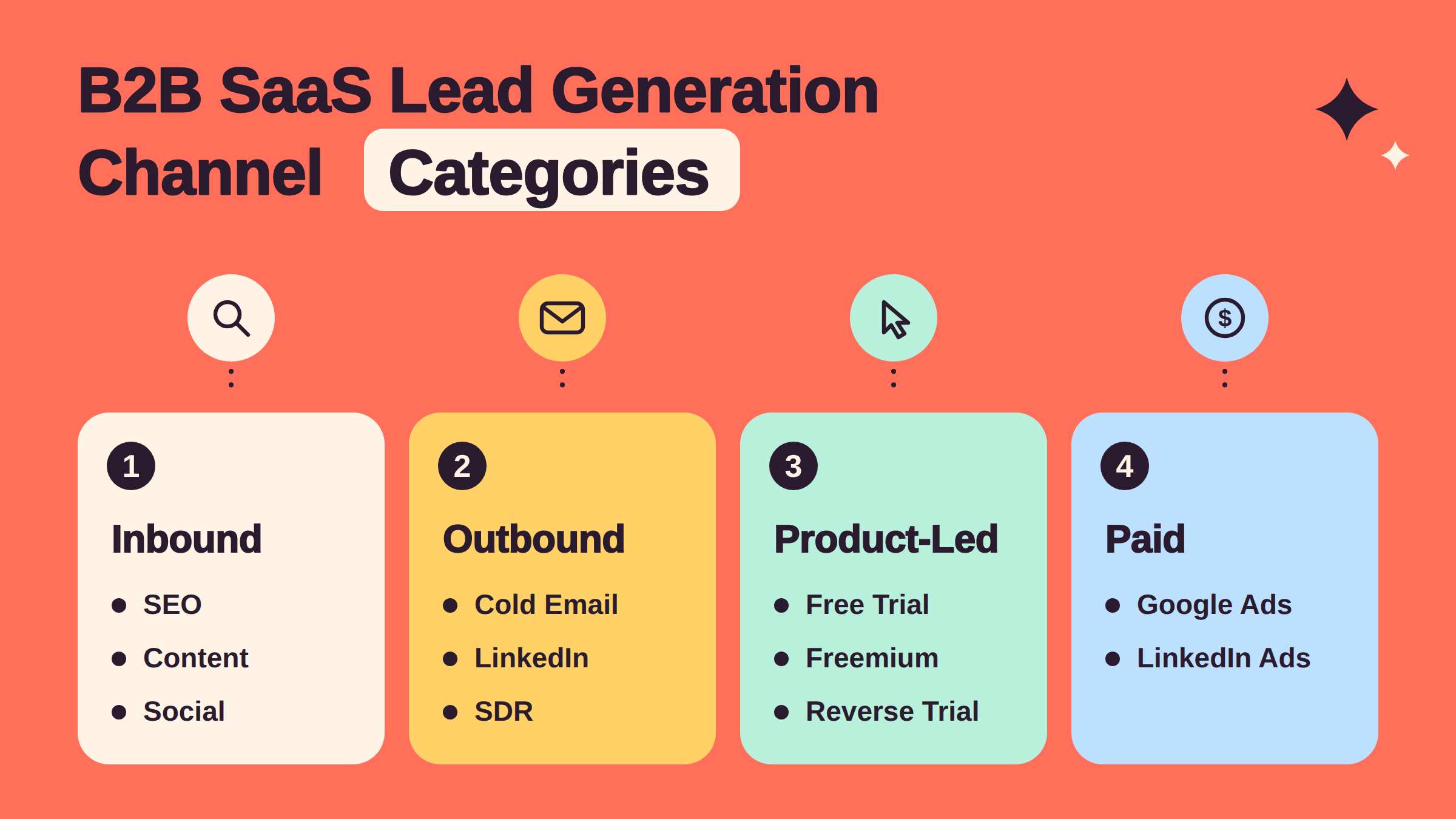
There are three broad channel categories for B2B SaaS lead generation, and the right mix is almost always determined by stage and budget — not by what's trending on marketing Twitter.
SaaS Inbound Lead Generation Strategy: SEO, Content, and Social
According to G2 (2026), 74% of B2B marketers say content marketing helped generate demand or leads in the last 12 months. SEO-driven content builds compounding traffic — the unit economics improve over time as pages accumulate authority. The tradeoff is time: SEO takes 6–12 months to produce meaningful pipeline. For early-stage SaaS with no brand authority, leading with inbound-only is a slow path to zero.
Social — particularly LinkedIn — closes that gap. Posts that generate early engagement pull in profile views and inbound DMs within 48 hours, not 6 months. This is why a growing number of founders treat LinkedIn as their primary inbound-led outbound channel: publish useful content, build an engaged audience, then reach out to people who've already interacted with your ideas.
💡
Pro Tip:Use LinkedIn content to warm ICPs before outreaching. Prospects who've engaged with your posts convert 3–5x better than cold contacts in a sequence — this is the core mechanic of inbound-led outbound.
Outbound Lead Generation for SaaS: Cold Email, LinkedIn, and SDR Motions
Outbound produces the fastest time-to-first-lead — typically within weeks when executed with a clean list and tested messaging. The SDR motion (cold email + LinkedIn touchpoints) is the standard playbook for mid-market and enterprise SaaS, but it requires real investment: data, tooling, headcount, and iteration cycles on copy.
For bootstrapped or early-stage teams, outbound lead generation for SaaS is often the best first channel precisely because it tests ICP assumptions before you invest in inbound infrastructure. You learn what messaging converts by talking to real prospects — not by publishing content and waiting.
The most common failure mode in outbound is using it as a volume game rather than a fit game. Teams that send 10,000 emails a month with generic pitches see lower reply rates than teams sending 500 highly personalized sequences to a tightly defined ICP. Spray-and-pray outbound does not scale — it just produces more ignored emails.
Product-Led Growth Lead Generation: Turning Users Into Pipeline
Product-qualified leads (PQLs) — users who have hit a meaningful activation milestone within a free trial or freemium product — represent the highest-intent signal in the SaaS funnel. A PQL is not defined by demographics or behavior on your marketing site; it is defined by behavior inside the product itself. Teams that wire PQL signals into their CRM and route them to sales see conversion rates that outperform MQLs by a significant margin, in most cases by 2–4x based on patterns observed across product-led SaaS companies.
The challenge with product-led growth lead generation is activation rate. A free trial that doesn't get users to the "aha moment" within the first session produces a leaky funnel regardless of how much top-of-funnel volume you generate. Fix activation before scaling PLG acquisition.
How to Build a B2B SaaS Lead Generation Funnel From Scratch
Building a B2B SaaS lead generation funnel from scratch
Building a B2B SaaS lead generation funnel from scratch follows a clear sequence — but the order matters as much as the steps. Each stage gates the next, and skipping ahead produces a funnel that looks complete on paper but leaks in practice.
Define your ICP: Job title, company size, industry, pain trigger, and the specific outcome they're trying to achieve. If your ICP definition is "SMBs in tech," it's not a definition — it's a category.
Select one primary channel: Choose based on budget, time-to-first-lead, and where your ICP concentrates. Validate it before adding a second. (30–60 days minimum.)
Build your lead capture mechanism: Demo request page, free trial, lead magnet, or direct LinkedIn DM — whatever fits your motion. Keep friction appropriate to intent.
Qualify with a scoring framework: Behavioral scoring (page visits, feature usage, email clicks) outperforms demographic scoring alone. A prospect visiting your pricing page twice is a different signal than someone who downloaded a whitepaper.
Nurture the middle of funnel: Email sequences, retargeting, and LinkedIn content for warm leads who aren't ready to buy yet.
Hand off to sales at the right moment: Define the SQL criteria explicitly so sales reps aren't wasting time on leads that should still be in nurture.
⚠️
Warning:Skipping ICP definition to move faster on channel execution is the single most expensive mistake in SaaS lead gen. Teams that skip it typically spend 3–6 months generating leads that sales rejects — then blame the channel rather than the targeting.
How to Generate Leads for a SaaS Startup With No Brand Authority
The conventional advice — publish content, build SEO, wait — is simply too slow for an early-stage company. What works consistently for zero-brand SaaS startups is direct outbound first: identify 50–100 ICP accounts manually, reach out with a problem-specific message (not a product pitch), and have genuine conversations. These conversations validate your messaging faster than any analytics tool, and they frequently turn into first customers. Once you know what resonates, you then build the inbound infrastructure to scale that message.
You can also accelerate awareness through LinkedIn — specifically by building the founder's personal brand on the platform. See the LinkedIn B2B lead generation guide for a structured approach to compressing that learning curve.
Common B2B SaaS Lead Generation Mistakes to Avoid
Running too many channels before validating one — channel dilution kills attribution and spreads budget too thin.
Optimizing for MQL volume instead of MQL quality — more leads that never convert just creates more work for sales.
Abandoning channels prematurely — SEO takes 6–12 months, outbound takes weeks, paid takes days. Judging SEO at 60 days is like judging a marathon at mile two.
Handing off leads to sales without qualification criteria — vague handoff definitions create friction and finger-pointing between marketing and sales.
Best Lead Generation Tools for B2B SaaS in 2026
Teams that consistently build strong pipeline tend to have simple tool stacks with sharp use cases — not large stacks with overlapping functions. The tool landscape breaks down by function:
Apollo is the AI sales platform rebuilt as one connected AI GTM system: data, intelligence, and execution for the entire go-to-market motion.
Apollo vs ZoomInfo for SaaS Lead Generation
This is the most common tool decision for SaaS teams entering outbound, and the answer is simpler than the debate suggests. Apollo wins on price-to-data-quality for SMB and mid-market SaaS — the contact database is solid for most ICP definitions, the sequencing is built-in, and the cost is a fraction of ZoomInfo. ZoomInfo wins when you're targeting senior enterprise buyers (VP/C-suite at 5,000+ employee companies) and need intent data layered on top of contact data.
The right choice depends on your average contract value and ICP seniority. If your ACV is under $20K and you're selling to Director-level buyers, Apollo is likely sufficient. If you're selling $100K+ deals to CISOs at Fortune 1000 accounts, ZoomInfo's depth justifies its price.
B2B SaaS Lead Generation Agency vs. In-House: Which Is Right for Your Stage?
Working with a saas lead generation agency makes sense at two specific points: before you have the internal headcount to run outbound, or when you need to test a new ICP or market quickly without committing to hiring. A saas lead generation company brings tested playbooks and existing data infrastructure — the upside is speed, the downside is that they rarely build institutional knowledge inside your team.
In-house wins long-term once you've validated your ICP and messaging — your team knows the product nuance, customer language, and objection patterns that an agency can only approximate. The pattern observed across early-stage SaaS teams is that those who outsource too early often inherit a lead gen program they can't maintain or improve once the engagement ends.
Build LinkedIn Pipeline Without Paid Ads
HyperClapper helps B2B SaaS teams increase LinkedIn post visibility through real community engagement — turning content into inbound demo requests.
LinkedIn as a B2B SaaS Lead Generation Engine in 2026
LinkedIn lead gen in 2026
LinkedIn has become the highest-intent organic channel for B2B SaaS leads — decision-makers actively consume and engage with content, making post visibility directly correlated with inbound pipeline. What separates top performers here is not posting frequency; it is understanding how the LinkedIn algorithm distributes content and engineering for that mechanism.
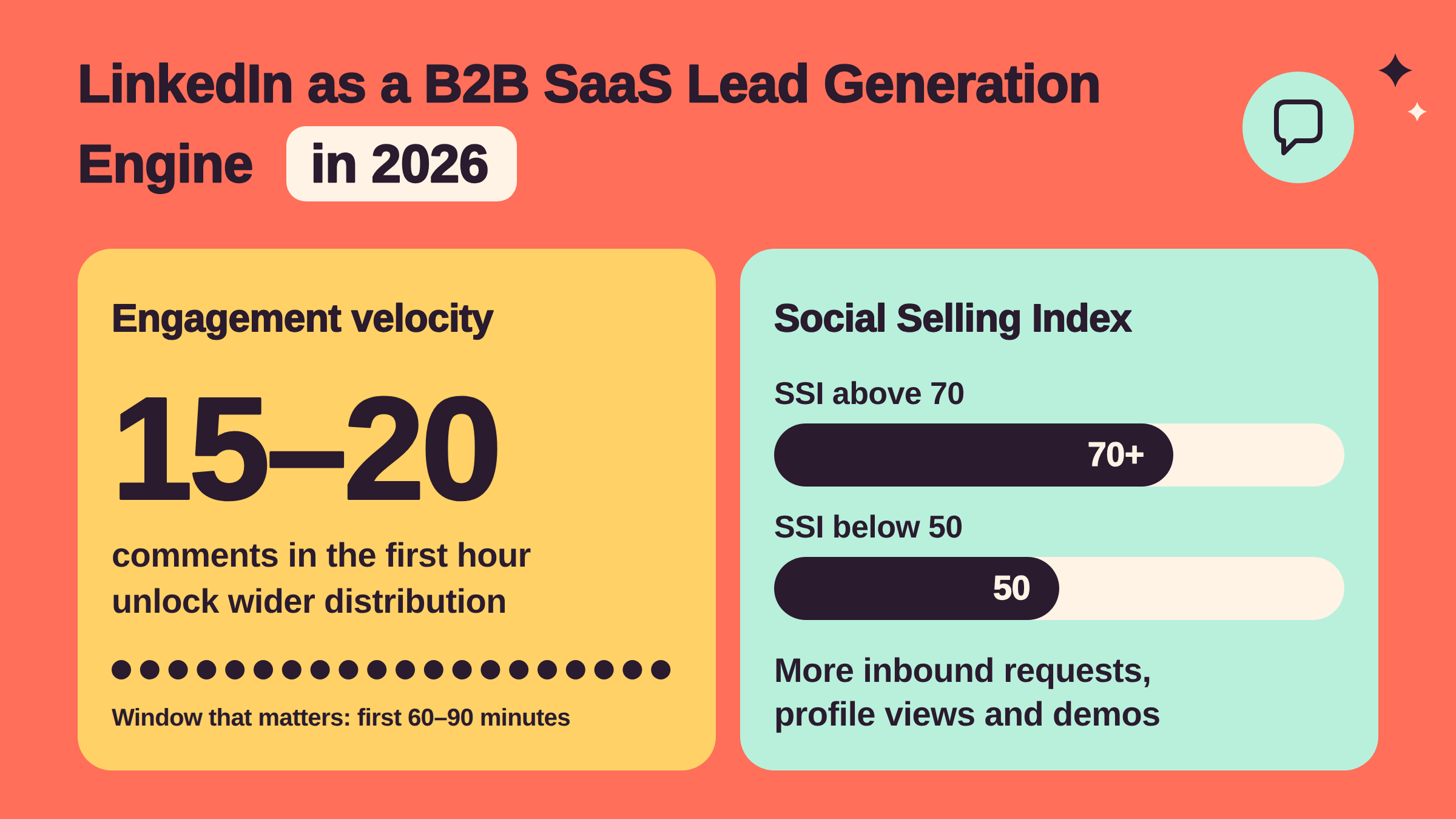
The LinkedIn Social Selling Index (SSI) — LinkedIn's own metric measuring how well a user builds their professional brand, finds the right people, engages with insights, and builds relationships — functions as a north-star proxy for reach. Teams with SSI scores above 70 consistently see more inbound connection requests, profile views, and unsolicited demo requests than teams with scores below 50, even when their follower counts are similar.
The core algorithmic mechanic: engagement velocity in the first 60–90 minutes after posting is the primary signal LinkedIn uses to determine how widely a post gets distributed. A post that collects 15–20 meaningful comments in the first hour enters a broader distribution tier than an identical post that sits idle. This is the mechanic that community engagement platforms like HyperClapper are built around — ensuring posts receive real engagement from relevant professionals at the moment it matters most, creating a compounding visibility advantage.
How HyperClapper Supports B2B SaaS Lead Generation on LinkedIn
Outbound lead generation services for B2B SaaS often overlook the LinkedIn content layer entirely — focusing on InMail and connection requests while ignoring the fact that a founder or marketer with a visible, engaged content presence closes cold outreach 3–5x more effectively than someone with a dormant profile.
HyperClapper addresses this by connecting users with real engagement channels — groups of relevant professionals who interact with posts authentically. When a B2B SaaS team publishes a post and activates HyperClapper channels, that post collects early engagement that triggers wider algorithmic distribution, which drives profile views from decision-makers who were never explicitly targeted. The result is inbound-led outbound: warm ICPs who've seen your content before you reach out.
The teams generating real inbound pipeline from LinkedIn in 2026 are not the ones posting the most — they're the ones whose posts consistently reach beyond their existing followers, triggering the algorithmic distribution that brings in buyers they've never directly targeted.
🔴
Avoid:Using aggressive LinkedIn automation (bulk connection requests, automated InMails at scale) before building a visible content presence. Cold automation without warm content context converts poorly and risks account restrictions — the opposite of what B2B SaaS lead gen requires.
✓ The B2B SaaS Lead Generation Readiness Checklist
☐ICP defined to job title, company size, pain trigger, and desired outcome level
☐Primary channel selected and budget/timeline committed for at least 60 days
☐MQL and SQL criteria defined and agreed upon by marketing and sales
☐Lead scoring model in place (behavioral signals, not just demographics)
☐LinkedIn profile optimized and posting cadence committed to (minimum 3x/week)
☐Funnel conversion rates tracked at each stage (MQL-to-SQL, SQL-to-opportunity, opportunity-to-close)
☐Nurture sequence live for leads not yet ready for sales handoff
Turn LinkedIn Visibility Into Qualified Pipeline
HyperClapper's engagement channels ensure your B2B SaaS content reaches decision-makers at the moment the algorithm distributes it — compounding your inbound lead flow over time.
Frequently Asked Questions About B2B SaaS Lead Generation
What lead generation channels work best for early-stage B2B SaaS companies?
For early-stage B2B SaaS, direct outbound (cold email + LinkedIn) is typically the fastest channel to first pipeline because it validates ICP and messaging before you invest in slower inbound infrastructure. LinkedIn content compounds over 3–6 months and drives inbound DMs. Add paid only once outbound messaging is proven — paid scales what works; it doesn't fix what doesn't.
How should a B2B SaaS company build a lead generation playbook from scratch?
Start with ICP definition, select one channel, validate messaging through direct outbound, then build inbound infrastructure around what converts. Define MQL and SQL criteria explicitly before generating volume — handoff ambiguity kills conversion. Once one channel produces consistent pipeline, add a second. The demand generation tactics guide covers the LinkedIn layer of this in detail.
What is the difference between demand generation and lead generation in SaaS?
Demand generation creates awareness and desire — it makes people realize they have a problem your product solves. Lead generation captures people who already have that awareness and are ready to evaluate solutions. Demand gen sits at the top of the funnel (content, brand, community); lead gen sits at intent and conversion stages. Most SaaS teams invest in lead gen before sufficient demand gen exists, which is why conversion rates disappoint.
Which B2B SaaS lead generation strategies have the highest ROI?
SEO-driven content delivers the strongest long-term ROI as traffic compounds with no ongoing cost-per-click. LinkedIn organic content has strong ROI for founder-led and product-led SaaS because a single high-performing post can drive weeks of inbound. Outbound email has the fastest payback but requires ongoing list and copy investment. Paid has the lowest ROI without strong conversion rate optimization downstream.
How long does B2B SaaS lead generation take to work?
Timeline varies sharply by channel: paid advertising produces leads within days; outbound sequences produce replies within 2–4 weeks of launch; LinkedIn content builds meaningful inbound in 3–6 months with consistent posting; SEO takes 6–12 months before producing significant organic traffic. Premature channel abandonment — quitting before the channel's natural timeline plays out — is the most common lead gen mistake in early-stage SaaS.
What is a product-qualified lead (PQL) and how is it different from an MQL?
A product-qualified lead (PQL) is a user who has hit a meaningful activation milestone inside your free trial or freemium product — signaling genuine intent based on product behavior, not marketing engagement. An MQL is qualified by marketing activity (content downloads, email opens, page visits). PQLs convert at 2–4x the rate of MQLs because the intent signal is rooted in actual product usage rather than interest in content.
What is saas lead gen and why does it differ from traditional B2B lead generation?
SaaS lead gen differs from traditional B2B lead generation primarily because SaaS buyers can self-serve — they trial, explore, and often decide before talking to sales. This makes product-led signals (PQLs) and digital content channels (LinkedIn, SEO) more central than in hardware or services sales, where relationship-led outbound is still dominant. SaaS funnels also move faster, requiring tighter qualification criteria at each stage.
After seeing the B2B SaaS demand generation playbook play out across dozens of teams and stages, the pattern that holds most consistently is this: teams that diagnose why their leads aren't converting before adding more acquisition channels outperform those that treat every pipeline problem as a volume problem. The channel is rarely the issue. The fit, the timing, and the handoff almost always are.
👋
⚡ Free plan
Leaving already?
Grab 3 free boosts on your next LinkedIn post — real likes & comments from 5,000+ creators. No card, cancel anytime.