
Snov.io is an all-in-one email prospecting platform that combines a B2B email finder, lead enrichment, and cold outreach automation in a single workflow. A pattern observed across hundreds of sales tool evaluations is that buyers come to Snov.io after being burned by tools that promised the world and delivered a bloated dashboard — so this review cuts through the vendor narrative and looks at what actually happens when real teams run real campaigns. The short answer: Snov.io is genuinely useful for small-to-mid-volume outreach, but it has real ceilings that matter at scale.
- Who it's for: Solo sellers and small-to-mid B2B teams who want one tool instead of a four-tool stack
- What you'll learn: Verified email accuracy rates, real pricing trade-offs, and where Snov.io breaks down at scale
- Why it matters: A bad email finder tanks deliverability and destroys sender reputation — picking the wrong tool is expensive
- Most counterintuitive finding: Snov.io's biggest competitor isn't Hunter or Apollo — it's the decision to build a stack vs. use one tool
- Honest bottom line: Solid ROI for low-to-mid volume; diminishing returns above ~2,000 contacts/month without careful credit management
- Best alternative signal: If you need deep conditional sequencing or a database above 200M contacts, look at Apollo first
- What Is Snov.io and How Does It Work?
- Snov.io Email Finder Accuracy and Data Quality
- Snov.io Pricing Plans: What You Actually Get at Each Tier
- Snov.io Pros and Cons: Honest Limitations You Should Know
- Snov.io vs Apollo.io vs Hunter.io: How Do the Alternatives Stack Up?
- Frequently Asked Questions About Snov.io in 2026
What Is Snov.io and How Does It Work?
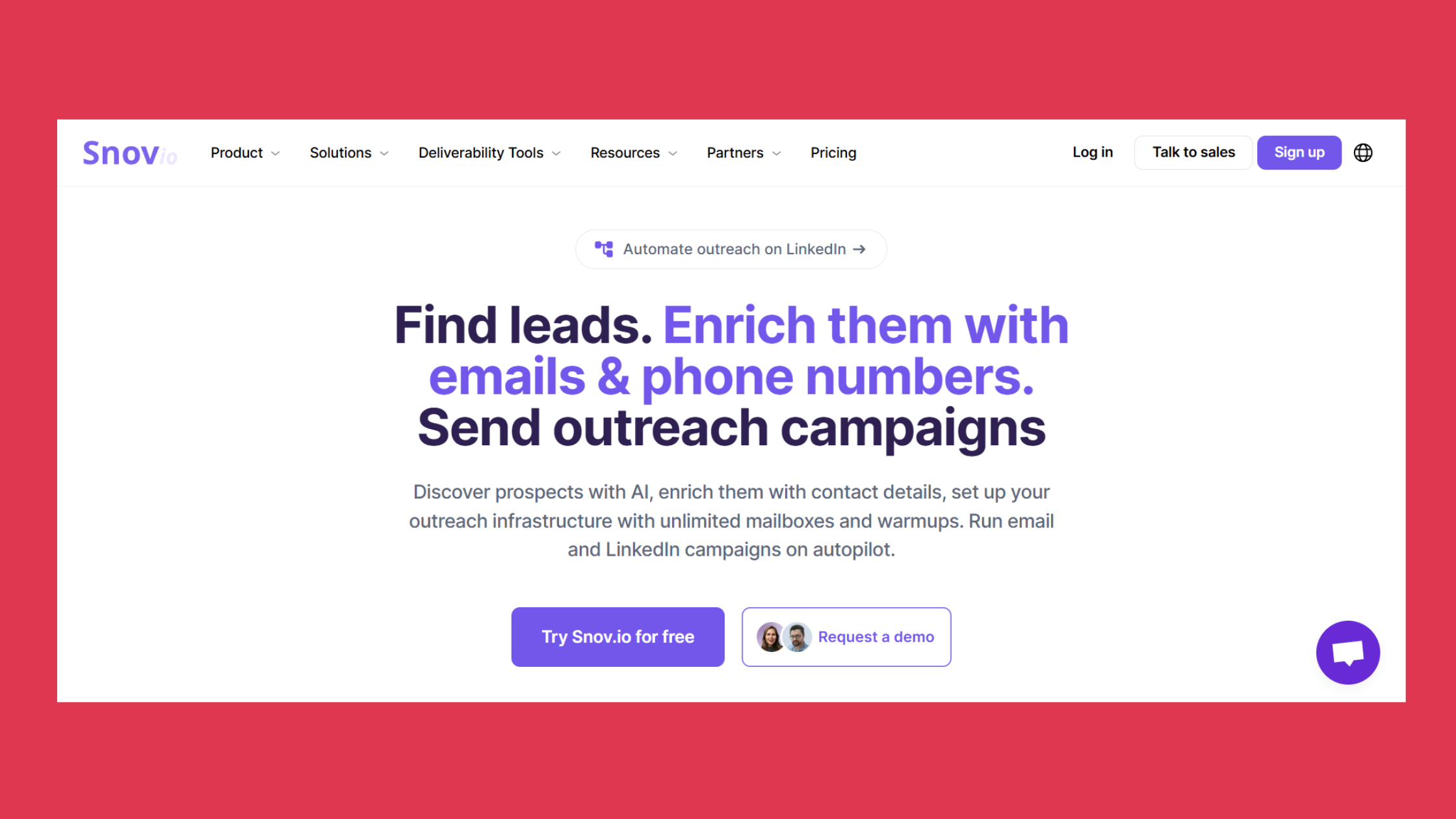
Snov.io is a B2B prospecting platform that handles three jobs in one place: finding verified contact data, enriching those leads with company and role details, and running cold outreach sequences. The core mechanism is linear and low-friction — search by domain or LinkedIn profile, get a list of contacts with verification confidence scores, then push them into a drip sequence without switching tabs. For teams running on a lean stack, that consolidation is the entire value proposition.
Cold outreach deliverability — the ability of your emails to land in the primary inbox rather than spam — starts with list quality. Snov.io addresses this at the data layer with three confidence tiers: valid, risky, and unverifiable. The intent is right. The execution is mostly solid, though "risky" addresses still clear verification at a rate that warrants a secondary check before any high-volume send.
Core Features: Email Finder, Lead Enrichment, and Outreach Automation
Snov.io's feature set covers the full prospecting loop:
- Email Finder: Search by domain, company name, or LinkedIn URL via Chrome extension; returns names, titles, and emails with verification status
- Lead Enrichment: Appends firmographic data — company size, industry, location, tech stack — to fill out lead profiles automatically
- Drip Campaigns: Multi-step email sequences with open/click/reply triggers and basic conditional logic
- Email Verifier: Standalone or bulk verification tool you can use independently of the finder
- Chrome Extension: One-click contact capture while browsing LinkedIn or company websites
- AI-assisted copy: Template suggestions and subject line generation baked into the campaign builder
The outreach sequence personalization options are serviceable for most small team use cases — first name, company name, custom variables. Where it shows its limits is conditional branching: "if replied, stop; if no open after 3 days, send variant B" works fine. Multi-path logic with different branch destinations does not.
Does Snov.io Integrate with CRMs?
Yes — Snov.io integrates directly with HubSpot, Salesforce, Pipedrive, and several others via native connectors plus Zapier. The practical caveat: sync is largely one-directional on lower tiers (contacts push from Snov.io to CRM but CRM activity doesn't always enrich back). Teams expecting bidirectional, real-time sync at the Starter tier will hit friction. That limitation resolves on higher plans, but it's worth stress-testing in the trial before committing. If you're evaluating tools alongside LinkedIn outreach, the LinkedIn Sales Navigator review here covers how that data layer fits into a multichannel stack.
Snov.io Email Finder Accuracy and Data Quality
Accuracy is the make-or-break metric for any email prospecting tool — a bounce rate above 5% begins degrading sender reputation, and above 10% it can land your domain on blocklists within weeks. Independent user reports across B2B forums and sales communities consistently place Snov.io's verified email accuracy at 75–85% depending on the target domain, which is solid for a generalist tool but short of specialist finders in specific niches.
According to Mailforge's 2026 cold email benchmarks, emails optimised for deliverability can see response rates increase by as much as 30.5%. In practice, this means that investing in a cleaner list — even if it means fewer contacts — returns more replies than blasting a larger, dirtier one. That framing changes how you should think about Snov.io's credit model: fewer verified contacts sent well outperform more risky contacts sent at volume.
How Accurate Is Snov.io Email Data Compared to Alternatives?
Lead enrichment accuracy varies noticeably by industry. SaaS and tech companies — where email formats are standardised and LinkedIn profiles are up-to-date — return cleaner verified contact data consistently. SMBs, regional markets, and non-English-speaking territories show meaningfully lower hit rates, sometimes dropping to 60–65% on certain domains.
Compared to Hunter.io (which focuses on domain-specific accuracy) and Apollo.io (which prioritises database depth over per-contact precision), Snov.io sits in the middle: broader coverage than Hunter in terms of contact volume, but not quite Apollo's scale. For teams targeting tech companies in North America and Europe, the accuracy gap is manageable. For everyone else, that secondary verification step isn't optional.
Snov.io Pricing Plans: What You Actually Get at Each Tier
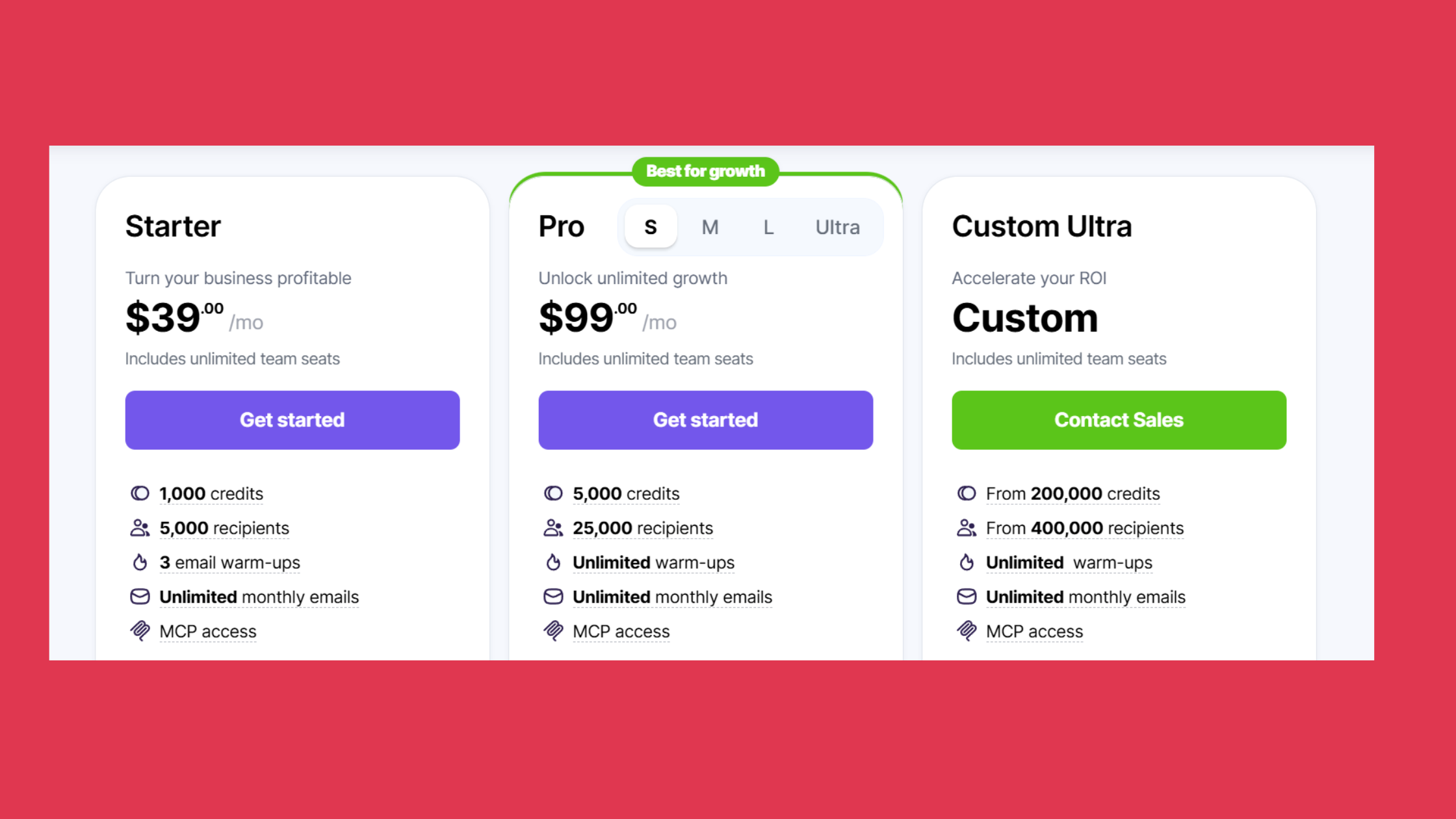
Snov.io uses a credit-based pricing model — each email found or verified costs credits, which are allocated per billing period and don't carry over indefinitely. This makes monthly spend predictable at low volume but creates a ceiling problem for teams that prospect aggressively mid-quarter.
| Plan | Approx. Monthly Cost | Credits | Best For | Key Limit |
|---|---|---|---|---|
| Free Trial | $0 | 50 | Testing accuracy before buying | No drip campaigns |
| Starter | ~$30–39/mo | 1,000 | Solo prospectors, light outreach | 1 seat, basic sequences |
| Pro / Growth | ~$75–149/mo | 5,000–10,000 | Small sales teams, agencies | Multi-seat; best ROI tier |
| Custom / Enterprise | Quote-based | Unlimited | High-volume teams, API users | Requires negotiation |
Is Snov.io Worth It? ROI Calculation by Use Case
The ROI math is straightforward when you anchor it to outcomes. On the Growth tier (~$100/mo), a team generating 300 qualified outreach contacts per month, converting at a 2% reply rate, and closing at 15% of replies needs roughly 10 replies to generate 1–2 deals. If your average deal value is $2,000+, Snov.io pays for itself within the first closed deal of the month. Below that deal value, the calculus tightens — and that's when free cold email software options become worth testing before committing to a paid plan.
The teams that get the best ROI from Snov.io aren't the ones with the biggest credit allowances — they're the ones who run small, clean, highly targeted lists rather than blasting large dirty ones.
The free trial's 50 credits are enough to verify one target company's contact list end-to-end. That's the right evaluation method: test accuracy on your actual targets, not a generic sample.
Snov.io Pros and Cons: Honest Limitations You Should Know
The Snov.io pros and cons picture is more nuanced than most review sites admit. The all-in-one workflow genuinely reduces friction — no API keys, no separate billing, no data-format mismatches between a finder and a sequencer. The UI is clean enough for non-technical users to be productive in under an hour. These aren't small wins.
Pros:
- Single platform for finding, enriching, verifying, and sequencing — eliminates tool-switching
- Chrome extension makes LinkedIn prospecting one-click fast
- Credit model is predictable and budget-friendly for low-to-mid volume
- Beginner-friendly interface; no technical setup required
- AI-assisted email templates reduce copy time
Cons:
- Email accuracy at 75–85% means a non-trivial bounce rate without secondary verification
- Outreach automation lacks multi-path conditional branching for complex sequences
- CRM sync has one-directional limitations on lower tiers
- Credit costs escalate quickly for high-volume teams
- Customer support response times reportedly slow during peak periods
What Are Snov.io's Limitations for Agencies and High-Volume Teams?
Teams that consistently send more than 2,000 outreach emails per month will feel the credit model working against them. Agencies managing multiple client campaigns hit a specific compounding problem: each client's domain needs separate tracking, separate warming, and often separate sending infrastructure — none of which Snov.io's current architecture handles elegantly at scale.
The most common failure mode observed among power users is treating Snov.io's outreach automation as equivalent to a dedicated sequencer. It isn't. Lemlist, Instantly, and Smartlead have purpose-built sending infrastructure with deliverability features — dedicated IP pools, send-time optimisation, inbox rotation — that Snov.io doesn't match. Using Snov.io to find contacts and export to a dedicated sender is often the better high-volume workflow.
Want More LinkedIn Visibility Alongside Your Email Outreach?
HyperClapper boosts LinkedIn post reach with real community engagement and AI-powered replies — the channel that works while your cold email warms up.
See How HyperClapper WorksSnov.io vs Apollo.io vs Hunter.io: How Do the Alternatives Stack Up?
No single email prospecting tool dominates every use case — the real question is which tool's trade-offs fit your specific workflow, volume, and budget. Here's how the three most compared options break down in 2026.
| Tool | Best For | Database Size | Sequencing Depth | Entry Price |
|---|---|---|---|---|
| Snov.io | Small-mid teams, one-tool simplicity | Mid-tier (~150M) | Basic-to-moderate | ~$30/mo |
| Apollo.io | High-volume B2B prospecting + CRM depth | Large (275M+) | Advanced | Free tier / ~$49/mo |
| Hunter.io | Domain-specific research, clean data | Smaller, domain-focused | Basic (no native sequencer) | Free tier / ~$34/mo |
Snov.io vs Apollo.io: Apollo carries a larger database, more granular filtering (intent data, technographics), and purpose-built sequencing at scale. Snov.io wins on onboarding speed, UI simplicity, and lower entry cost. Teams with one SDR and fewer than 500 monthly outreach contacts often find Snov.io sufficient. Teams running 2,000+ monthly contacts with complex multi-step sequences consistently outgrow it and move to Apollo.
How does Snov.io compare to Hunter.io? Hunter remains the cleaner, more focused email finder — its per-domain accuracy is consistently higher for companies with published email patterns. The trade-off is that Hunter provides no built-in sequencing, so teams using it need a separate sender. Snov.io's built-in automation is a genuine differentiator here, even if it's not the deepest sequencer on the market.
The best email finder tools in 2026 aren't competing on features alone — they're competing on which workflow they make easier. A tool that does 80% of the job with zero context-switching often outperforms a specialist tool that requires three integrations to achieve 100%.
Snov.io Alternatives 2026: When to Look Elsewhere
Consider moving beyond Snov.io when:
- Your monthly outreach volume consistently exceeds 3,000 contacts (Apollo or Instantly become more cost-efficient)
- You need true conditional multi-branch sequences (Lemlist or Smartlead)
- Your target market is primarily SMB or non-English-speaking regions where Snov.io's database thins out
- You need fully bidirectional CRM sync without workarounds
For teams evaluating broader sales tool stacks, the Amplemarket pricing breakdown and the LinkBoost review are useful comparisons for understanding where specialised tools justify their premium over all-in-one platforms.
The best email outreach tools for 2026 aren't necessarily the most feature-rich — they're the ones that match your team's actual volume, workflow complexity, and budget ceiling. The free cold email software options (Apollo's free tier, Hunter's free tier, even Snov.io's 50-credit trial) are genuinely adequate for testing accuracy before spending anything. Use them. What consistently separates teams that succeed with email prospecting from those that don't is not the tool they pick — it's whether they tested list quality before scaling volume.
Running a Multi-Channel Outreach Strategy?
Pair your email outreach with LinkedIn visibility. HyperClapper gets your LinkedIn posts in front of the same prospects your cold email is reaching — real engagement, AI replies, and measurable post reach.
Start Free on HyperClapper✓ Snov.io Evaluation Checklist Before You Buy
- ☐Use the 50-credit free trial on your actual target domain — not a generic test
- ☐Calculate your monthly contact volume target before choosing a pricing tier
- ☐Run a secondary verification pass on any "risky" flagged emails before sending
- ☐Test CRM sync direction on your specific CRM before committing to a plan
- ☐Map your sequence complexity — if you need multi-path branching, test Lemlist or Instantly alongside
- ☐Check bounce rate on a 50–100 contact pilot send before scaling to full list
- ☐Confirm whether your industry (SaaS vs. SMB vs. regional) falls in Snov.io's accuracy sweet spot
Frequently Asked Questions About Snov.io in 2026
Is Snov.io a good tool for cold email outreach in 2026?
Yes — Snov.io is a solid cold email outreach tool for small-to-mid B2B teams who want a single platform for finding, verifying, and sequencing contacts. Its 75–85% verified email accuracy is reliable for tech and SaaS targets, though high-volume teams and agencies handling complex multi-path sequences will likely outgrow it and need a dedicated sender tool alongside it.
What is the ROI of using Snov.io for lead generation?
ROI is positive for teams with deal values above ~$1,500 and monthly outreach volumes under 2,000 contacts. On a Growth plan at ~$100/month, one closed deal from outreach typically covers 1–3 months of cost. ROI compresses at scale — once credit ceilings push you into enterprise pricing, the cost-per-contact rises sharply and alternatives like Apollo become more efficient.
How does Snov.io work for B2B prospecting?
Snov.io works by letting you search contacts by domain, company, or LinkedIn URL, then verifying those emails in a three-tier confidence system (valid, risky, unverifiable), enriching leads with firmographic details, and running them through drip sequences — all within one platform. The Chrome extension captures contacts directly from LinkedIn or company websites in one click, keeping the prospecting workflow fast and low-friction.
Which is better for outreach, Snov.io or Apollo?
Apollo is better for high-volume B2B prospecting teams that need a larger contact database (275M+ contacts), advanced sequencing with conditional logic, and deep CRM integration. Snov.io is better for smaller teams prioritising simplicity, faster onboarding, and lower entry cost. For most solo SDRs and small sales teams, Snov.io's trade-offs are entirely acceptable. For scaling teams above 2,000 contacts/month, Apollo typically wins on unit economics.
Does Snov.io actually deliver results or is it overhyped?
Snov.io delivers real results within its intended use case — it is not overhyped for small-to-mid teams running clean, targeted lists. It is overhyped when positioned as an enterprise-grade sequencer or a replacement for specialised tools at high volume. Teams that go in with accurate expectations — a reliable finder and a basic sequencer, not a one-tool sales machine — consistently report positive outcomes.
How accurate is Snov.io email data?
Snov.io's verified email accuracy sits at approximately 75–85% depending on the target domain and industry. SaaS and tech company contacts return the highest accuracy; SMB and regional markets return lower. Always run "risky" flagged emails through a secondary verifier before sending — this single step can reduce bounce rates from 15%+ to below 3%, protecting your sender domain.
What are the top 5 tools for email marketing?
The most consistently cited email marketing and prospecting tools in 2026 are Apollo.io (database depth and sequencing), Hunter.io (domain accuracy), Snov.io (all-in-one simplicity), Instantly or Smartlead (high-volume cold email sending infrastructure), and Mailchimp or ActiveCampaign for newsletter and nurture-sequence use cases. The right tool depends entirely on whether your primary need is prospecting, cold outreach, or ongoing nurture.
What is the best email outreach tool?
There is no single best email outreach tool — but Apollo.io is the strongest all-rounder for mid-to-large B2B teams, Instantly leads for pure cold email deliverability at volume, and Snov.io is the best starting point for solo sellers and small teams who want one platform without a steep learning curve. The best tool is the one that matches your team size, volume, and CRM requirements — not the one with the longest feature list.
What are the top alternatives to Snov.io for email prospecting in 2026?
The strongest Snov.io alternatives in 2026 are Apollo.io (for scale and database depth), Hunter.io (for domain-specific accuracy), Instantly or Smartlead (for dedicated cold email sending infrastructure), and Lemlist (for personalised, multimedia sequences). Each solves a different bottleneck — the best alternative depends on which specific limitation of Snov.io is costing your team the most.



