Should You Buy Lead Lists? Risks, Costs and Better Options
Thinking of buying a list of leads? Understand the real legal risks, true costs, conversion rates, and smarter alternatives for B2B teams in 2026.
📅 ⏱ 12 min read📝 ~2400 words
Buying a list of leads sounds like a shortcut to pipeline — pay a vendor, import contacts, start selling. A recurring pattern among B2B teams that try this is immediate disappointment: high bounce rates, spam complaints, zero replies, and a sending domain that now sits on a blacklist. The core problem is that when you buy a list of leads, what you actually purchase is cold, unverified contact data with no relationship attached — not qualified interest. Whether that list is worth the risk depends on the vendor, your jurisdiction, your outreach strategy, and your tolerance for compliance exposure. Most of the time, the math doesn't work.
Key Takeaways
Buying lead lists gives you cold contact data — not warm prospects or expressed interest.
Legal exposure is real: GDPR, CAN-SPAM, and CASL each carry different rules, and most vendors understate the risk.
Typical B2B list conversion rates run under 1% — making the true cost of buying leads far higher than the list price alone.
The most common buyer regret is discovering after purchase that data was outdated or improperly sourced.
Intent-based tools (Apollo, ZoomInfo, LinkedIn Sales Navigator) and organic LinkedIn strategies consistently outperform purchased lists on ROI and compliance.
If you do buy, vendor due diligence — bounce rate guarantees, sourcing transparency, segmentation depth — is non-negotiable.
A lead list is a pre-compiled database of contact records — names, emails, phone numbers, job titles, company names — assembled by a third-party vendor and sold in bulk. The buy leads online market splits into two very different product types, and confusing them is where most buyers go wrong.
How Lead Database Providers Source and Sell Data
Raw bulk lists — often the cheapest leads for sale products — are scraped from public directories, LinkedIn profiles, or aggregated from data brokers with little verification or consent documentation. Intent-based prospecting databases, by contrast, layer in behavioral signals (content consumption, job changes, technology usage) and refresh their records regularly. The difference matters enormously for both data quality and legal standing.
Contact data decay — the rate at which contact records become inaccurate due to job changes, company moves, or email address updates — runs at roughly 25–30% annually across B2B databases. A list purchased today can be significantly stale by the time your outreach sequence launches, let alone six months later.
💡
Pro Tip:Always ask a vendor for a sample of 25–50 records before purchasing. Run them through an email validation tool (NeverBounce or ZeroBounce). If more than 5% come back invalid, the full list will underperform — and your sending domain will pay the price.
Understanding what you're actually buying sets the foundation for every risk calculation that follows. And those risks are more serious than most vendor sales pages let on.
The Real Risks of Buying Lead Lists (Legal, Deliverability and Reputation)
The Real Risks of Buying Lead Lists
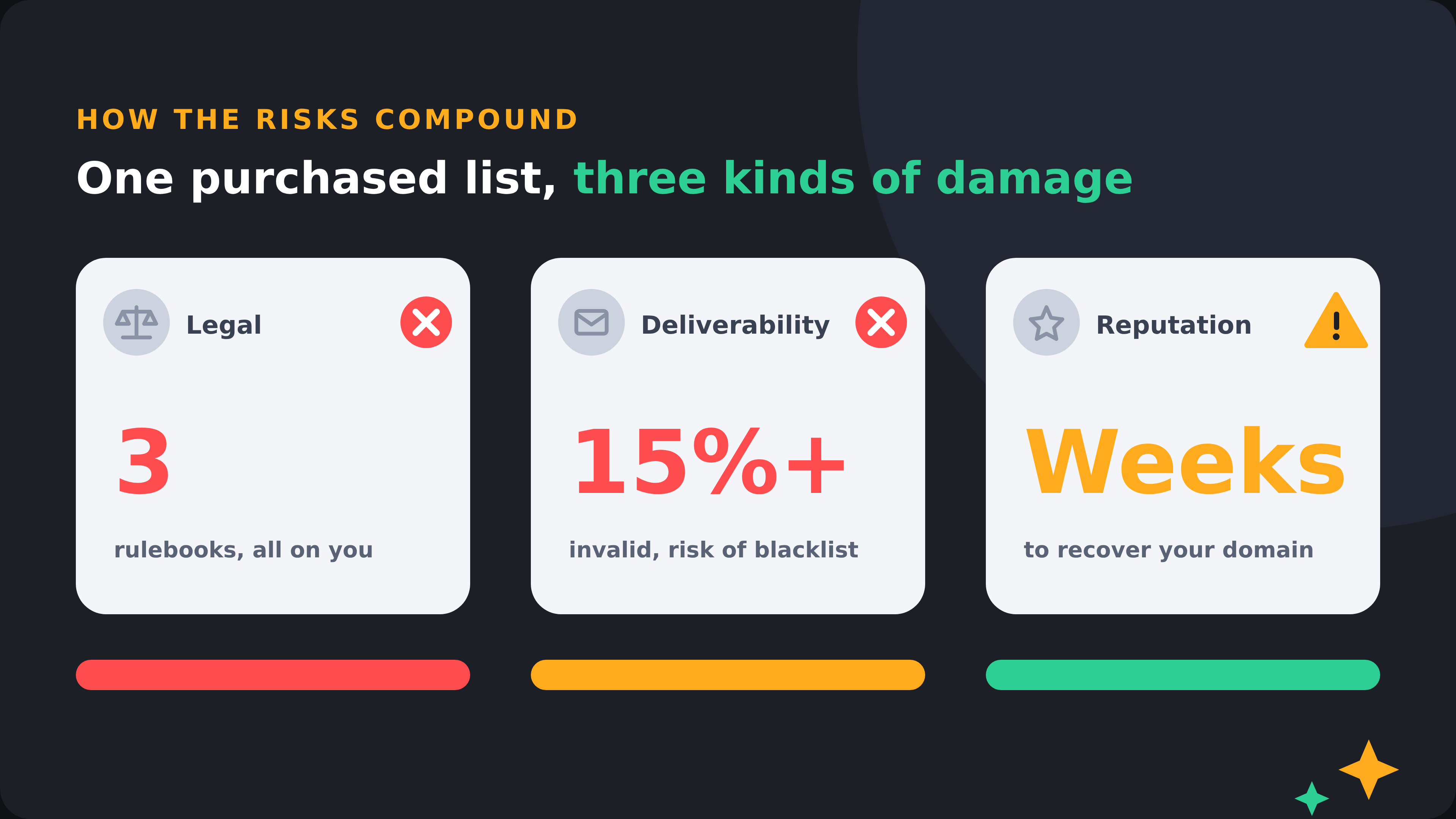
The lead list risks that matter most fall into three categories: legal exposure, deliverability damage, and brand reputation — and they compound each other quickly once an outreach campaign starts.
What Happens When You Buy an Email List: A Realistic Timeline
Legal risk is the least understood and most serious. The question "is buying leads legal?" has a nuanced answer. In the US, CAN-SPAM permits cold commercial email with opt-out mechanisms, so bulk purchased lists aren't automatically illegal — but they must comply with specific labeling and opt-out rules. In the EU, GDPR requires a lawful basis for processing personal data and, for marketing emails, typically demands prior consent. In Canada, CASL goes further, requiring express or implied consent before sending commercial messages. Email list purchase GDPR compliance is a genuine minefield: most bulk list vendors sell pan-European data without credible consent documentation, leaving you — not the vendor — legally liable for violations.
Most vendors are legally careful about what they promise and legally casual about what they deliver. The compliance risk transfers to you the moment you hit send.
Deliverability damage is faster and more measurable. Email bounce rate thresholds — the level at which inbox providers like Gmail and Microsoft flag your sending domain — sit around 2–5% for hard bounces. A purchased list with 15%+ invalid addresses can trigger domain blacklisting within a single campaign. Recovering a blacklisted sending domain takes weeks and directly impacts legitimate email sent to opted-in contacts. Teams that import a raw purchased list directly into their ESP without email validation routinely learn this the hard way.
133%
More revenue from targeted lead generation vs. non-optimized approaches
According to Martal Group (2026), targeted lead generation yields up to 133% more revenue compared to non-optimized outreach — which underscores why how you generate leads matters as much as how many you generate. This means cold bulk lists, which are by definition untargeted, sit at the lowest end of the return spectrum.
Once you understand what the risks actually look like in practice, the cost question becomes more than just the vendor's price tag.
How Much Do Lead Lists Cost — and Are They Worth It?
Lead list pricing varies by data quality, targeting, and verification.
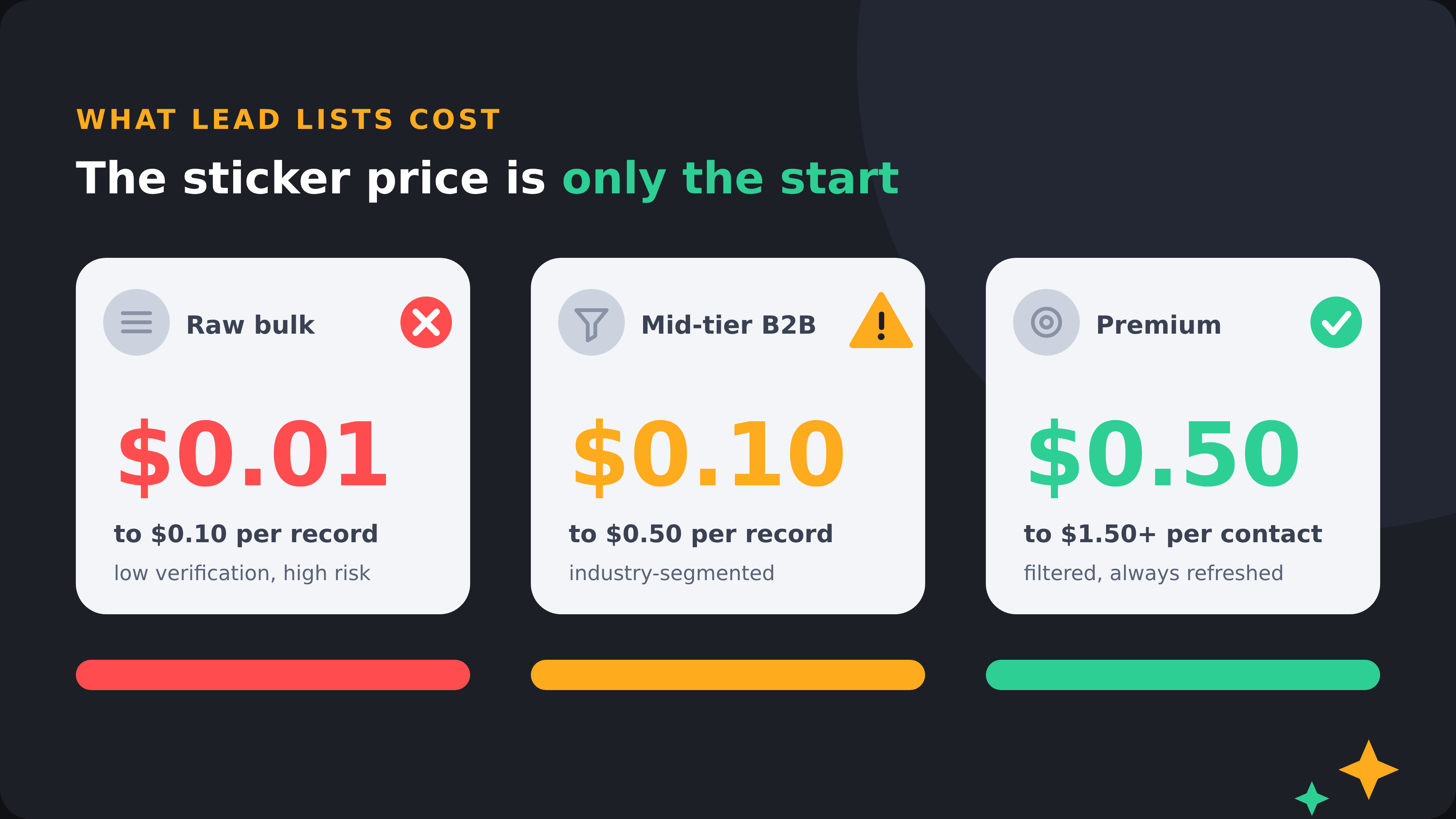
The sticker price is only the beginning. How much do lead lists cost depends on the tier of vendor and the specificity of targeting:
Raw bulk lists: $0.01–$0.10 per record — high volume, low verification, significant compliance risk
Mid-tier B2B lists: $0.10–$0.50 per record — typically industry-segmented, modest freshness guarantees
Premium intent-based databases (ZoomInfo, Apollo subscription): $0.50–$1.50+ per contact when annualized — but with filtering, intent signals, and continuous data refresh
The true cost of buying lead lists includes the list price plus email validation tools, ESP warm-up time, staff hours managing bounces and complaint responses, and potential legal consultation fees if your jurisdiction flags a campaign. For most small B2B teams, that total cost — measured against a realistic conversion rate under 1% for cold purchased contacts — makes the ROI difficult to defend.
How to Vet a Lead List Vendor Before You Spend
What separates top performers here is that they treat vendor due diligence as a pre-purchase requirement, not a post-purchase regret. Before committing budget, ask every vendor these specific questions:
✓ Lead List Vendor Due Diligence Checklist
☐Ask for documented data sourcing methodology — where do the records come from?
☐Request a written bounce rate guarantee (under 5% hard bounces is the minimum threshold to accept)
☐Confirm the data refresh cadence — records updated monthly vs. annually is a massive quality gap
☐Request consent documentation for any EU or Canadian contacts (GDPR / CASL compliance)
☐Ask for a free sample of 25–50 records to validate independently before purchasing
☐Confirm segmentation depth — can they filter by seniority, company size, and technology stack?
If a vendor can't answer these questions clearly, that itself is an answer. Now here's where the smarter path begins.
Better Alternatives: Lead Generation Tools and Strategies That Actually Convert
The most effective lead generation alternatives to buying lists fall into two buckets: intent-based prospecting tools that replace the cold bulk list with verified, targeted outreach data, and organic LinkedIn strategies that attract inbound interest without any list at all.
Using LinkedIn Engagement to Replace Cold List Outreach
On the tools side, the lead database providers comparison looks like this for most B2B teams:
Option
Best For
Data Freshness
Compliance Posture
Approx. Cost
Raw bulk list (buy leads online)
Almost nothing
Low — often 12–24 months stale
High risk
$50–$500/list
Apollo.io
SMB and mid-market B2B
Good — continuous refresh
Moderate (better with care)
From ~$49/mo
LinkedIn Sales Navigator
B2B targeting with intent signals
Excellent — live data
Strong (first-party)
~$99/mo
ZoomInfo
Enterprise outbound teams
Very good
Good (GDPR-aware)
$10,000+/yr
HyperClapper (LinkedIn organic)
Inbound visibility + engagement
N/A — attracts live audience
Zero compliance risk
From free
On the ZoomInfo vs buying a lead list comparison specifically: ZoomInfo wins on data hygiene and targeting depth, but its price point makes it enterprise-only. For most growing teams, Apollo or LinkedIn Sales Navigator deliver 80% of the benefit at a fraction of the cost. You can learn more about extracting high-quality contacts directly from LinkedIn in this guide to downloading lead lists from LinkedIn Sales Navigator.
The organic LinkedIn path is where the best lead generation tools conversation shifts away from databases entirely. According to GrowthList (2026), content marketing delivers 3x more leads than outbound approaches — and on LinkedIn specifically, the mechanism is straightforward: consistent, visible content creates inbound interest from exactly the audience you'd otherwise be cold-calling.
Tools like HyperClapper accelerate this by boosting post visibility through real engagement channels — getting your content in front of the right professional audience without any outreach list required. Instead of interrupting strangers with cold outreach with purchased leads, the goal is to become visible enough that those strangers come to you. You can explore this approach further in HyperClapper's guide to demand generation tactics on LinkedIn.
Stop paying for cold lists. Start attracting warm leads on LinkedIn.
HyperClapper boosts your LinkedIn post visibility through real community engagement — so decision-makers find you, not the other way around.
Common Mistakes to Avoid When Buying or Using Lead Lists
The most common failure mode isn't buying a list — it's buying one without doing the work that makes it usable. These four mistakes account for the majority of wasted budget and deliverability damage observed across teams that go down this path.
Mistake 1: Buying on price alone. Skipping vendor due diligence to save $200 on a list that costs $2,000 to clean up is a trade teams consistently regret. The vendor evaluation checklist above exists for exactly this reason.
Mistake 2: Importing without validation. A raw purchased list goes through an email validation service first — always. Importing directly into your ESP is the fastest path to domain blacklisting. Use ZeroBounce, NeverBounce, or Kickbox before a single send.
Mistake 3: Sending a direct pitch to cold purchased contacts.Cold outreach with purchased leads without a value-first warm-up sequence accelerates unsubscribes and spam reports. Even if the data is good, the relationship is zero — and the messaging needs to account for that.
Mistake 4: Ignoring jurisdiction-specific compliance. CAN-SPAM compliance is not enough when your list includes EU contacts. Email list purchase GDPR compliance requires a lawful basis for processing — and "I bought it from a vendor" is not a lawful basis under GDPR Article 6. Teams building a prospecting list that converts in 2026 are treating compliance as a pre-condition, not an afterthought.
⚠️
Warning:GDPR fines for unlawful email marketing can reach €20 million or 4% of global annual turnover — whichever is higher. A purchased list without documented consent is not a compliant list, regardless of what the vendor claims.
What separates teams that get value from any prospecting approach — bought or built — is treating data hygiene practices as ongoing maintenance, not a one-time purchase decision. The best alternative is to use tools that make this a non-issue from the start. See how LinkedIn Boolean search strings can help you build targeted prospect lists without buying anything.
Build a pipeline without the risk of purchased lists
HyperClapper helps you get seen by the right people on LinkedIn — no cold lists, no deliverability damage, no compliance headaches.
Frequently Asked Questions About Buying Lead Lists
Should I buy a lead list for my small business?
For most small businesses, no — the math rarely justifies it. Conversion rates from cold purchased contacts typically run under 1%, while the costs of data cleaning, validation tools, and compliance risk add up quickly. Intent-based tools like Apollo or organic LinkedIn strategies deliver better ROI without the compliance exposure of buying lead lists.
Does buying leads violate GDPR or CAN-SPAM?
Under CAN-SPAM (US), purchased lists aren't automatically illegal, but must comply with opt-out and labeling rules. Under GDPR (EU), marketing to purchased contacts without documented consent typically violates the law — regardless of what your vendor claims. Email list purchase GDPR compliance is the buyer's legal responsibility, not the vendor's.
What are the risks of purchasing email lists for marketing?
The primary lead list risks are: legal penalties under GDPR/CASL, deliverability damage from high bounce rates, domain blacklisting by email service providers, and brand reputation damage from spam complaints. Stale data compounds all of these — contact data decay means even a fresh list degrades quickly without ongoing verification.
Why do purchased leads have low conversion rates?
Why do purchased leads have low conversion rates? Because they represent no expressed interest — they're strangers who never asked to hear from you. Without a prior relationship, trust signal, or relevant trigger, cold outreach to purchased contacts gets ignored or reported as spam. Intent-based prospecting, which targets people showing buying signals, consistently outperforms raw list outreach.
What are better alternatives to buying lead lists for B2B sales?
The strongest lead generation alternatives to buying lists are: LinkedIn Sales Navigator for targeted, live B2B data; Apollo.io for affordable intent-based prospecting; and organic LinkedIn content strategies that generate inbound interest. Tools like BetterContact and HyperClapper help you build pipeline without any outbound list at all.
How do I evaluate a lead list vendor before buying?
Request a sample of 25–50 records and validate them independently. Ask for written bounce rate guarantees (under 5%), documented data sourcing methodology, refresh cadence, and consent records for any EU contacts. Any vendor who can't provide these upfront is selling data you cannot safely use.
What should I look for in mailing list providers?
The best mailing list providers and best mailing list companies share three traits: transparent data sourcing, regular refresh cycles (monthly at minimum), and segmentation granular enough to match your ICP by role, industry, and company size. Melissa Data and Salesgenie are established names, but always validate sample data independently before committing to any email leads list purchase.
👋
⚡ Free plan
Leaving already?
Grab 3 free boosts on your next LinkedIn post — real likes & comments from 5,000+ creators. No card, cancel anytime.