LinkedIn is owned by Microsoft, which acquired the platform in December 2016 for $26.2 billion — the largest deal in Microsoft's history at the time. The platform was co-founded by Reid Hoffman and four colleagues in December 2002 (incorporated) and publicly launched in May 2003. That two-date reality is exactly why the founding year debate persists online: both 2002 and 2003 are technically correct, depending on what you're measuring. A pattern observed across community discussions about LinkedIn company history is that almost no existing article resolves this cleanly — most just pick one year and move on.
- LinkedIn was incorporated in December 2002 and publicly launched in May 2003 — both dates are correct for different reasons
- Five co-founders built LinkedIn: Reid Hoffman, Allen Blue, Konstantin Guericke, Eric Ly, and Jean-Luc Vaillant
- Microsoft acquired LinkedIn in 2016 for $26.2 billion and continues to operate it as an independent subsidiary
- Ryan Roslansky has served as LinkedIn's CEO since June 2020, succeeding Jeff Weiner
- LinkedIn has surpassed 1.3 billion registered members as of 2026 — and generates over $17 billion in annual revenue
- Most surprising finding: Microsoft bought LinkedIn for enterprise data and CRM integration, not social reach
- LinkedIn Company History: From 2002 Startup to Global Platform
- LinkedIn Founders: Who Created LinkedIn and Reid Hoffman's Vision
- Who Owns LinkedIn? Microsoft's Acquisition, Price, and Why It Happened
- Who Is the CEO of LinkedIn Today?
- What LinkedIn's Ownership Means for Professionals and Creators
- Frequently Asked Questions About LinkedIn Company History
LinkedIn Company History: From 2002 Startup to Global Platform
When was LinkedIn created? Reid Hoffman and his co-founding team incorporated LinkedIn in December 2002, but the platform did not open to the public until May 5, 2003. That distinction — incorporation date vs. public launch — explains virtually every "2002 vs. 2003" debate you'll encounter. Both answers are defensible; neither is wrong.
When Was LinkedIn Founded? The 2002 vs. 2003 Debate Settled
Think of it the same way you'd distinguish a company's registration date from its store opening day — the legal entity exists before anyone walks through the door. LinkedIn was legally registered in 2002. The public walked through the door in May 2003, when the platform launched with roughly 4,500 members in its first week.
Key Milestones: Growth, IPO, and Business Model Evolution
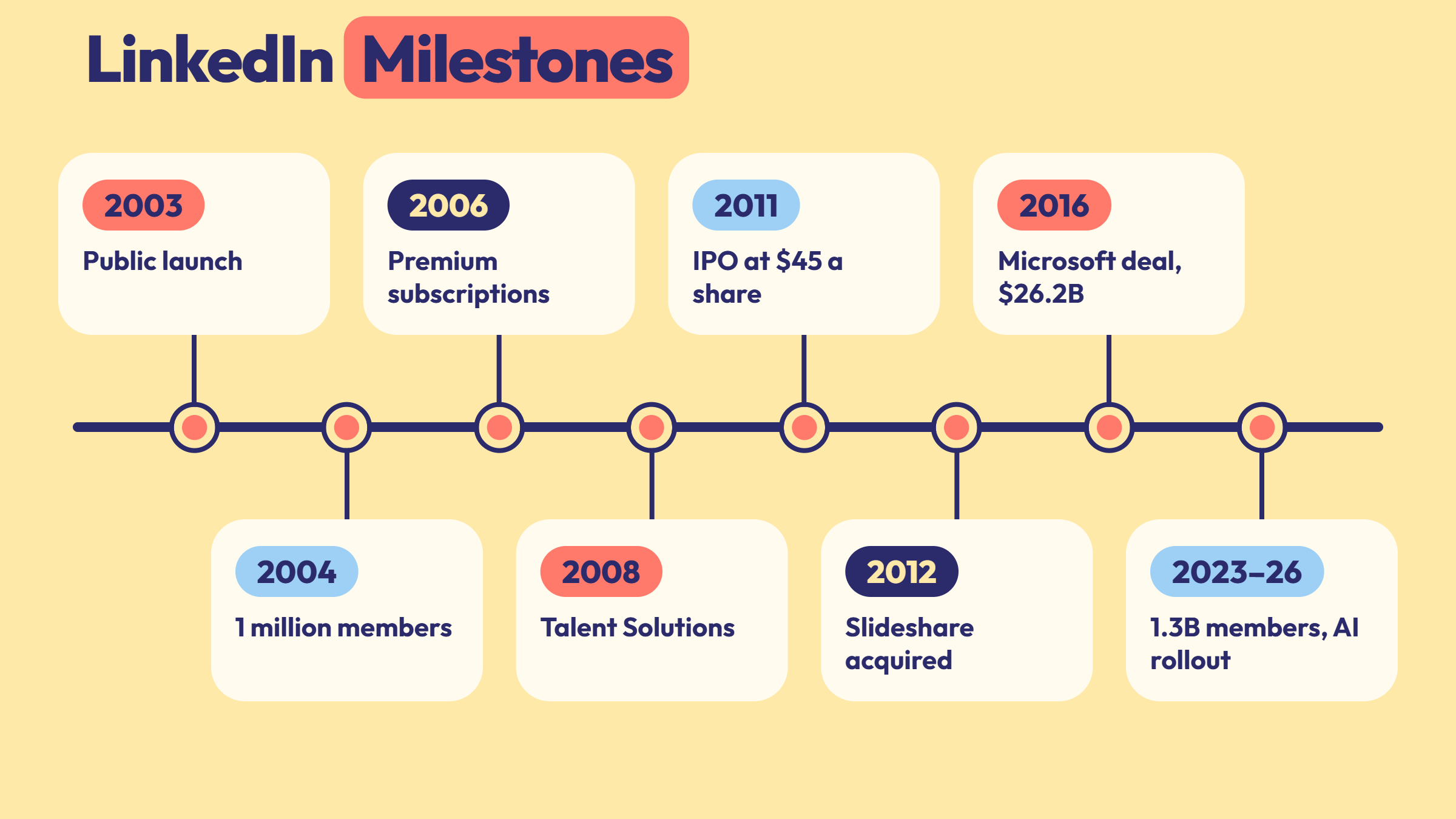
LinkedIn's growth was not linear — it was shaped by deliberate strategic pivots at each stage:
- 2003: Public launch; approximately 4,500 members in week one
- 2004: Reached 1 million members; early focus on professional directory functionality
- 2006: Launched premium subscriptions — the first step in the B2B social network monetization model
- 2008: Introduced LinkedIn Talent Solutions (now the company's largest revenue segment)
- 2011: IPO on the New York Stock Exchange at $45/share; closed its first trading day at $94.25 — one of the biggest tech IPOs of the era
- 2012: Acquired Slideshare, signalling a push into professional content
- 2016: Microsoft acquisition completed for $26.2 billion
- 2023–2026: Surpassed 1 billion, then 1.3 billion registered members; aggressive AI feature rollout
According to Business of Apps (2026), LinkedIn surpassed 1.3 billion registered users in 2026, with revenue growing 9.2% year-over-year. That scale makes linkedin history one of the more remarkable arcs in Silicon Valley startup funding rounds — from a scrappy professional directory funded by Sequoia Capital and Greylock Partners to a $17.81 billion revenue business in fiscal year 2025, per Charle Agency (2026).
What separated LinkedIn from every consumer social network that launched in the same era was a deliberate decision to build around professional identity — real names, real jobs, real credentials — at a time when the rest of the industry was chasing anonymous engagement.
LinkedIn Founders: Who Created LinkedIn and What Drove Reid Hoffman's Vision
Five co-founders built LinkedIn — not one. Crediting the platform solely to Reid Hoffman is the most common oversimplification in its history, and it misses the specific skills each person contributed to the MVP.
Who Founded LinkedIn and When: The Co-Founder Breakdown
The founding team that incorporated LinkedIn in December 2002 was:
- Reid Hoffman — Executive chairman and primary vision-setter; brought the social graph concept from his PayPal experience
- Allen Blue — Co-founder focused on product design and user experience
- Konstantin Guericke — Led marketing and drove early growth strategy
- Eric Ly — Engineering lead responsible for core platform architecture
- Jean-Luc Vaillant — Engineering co-founder who shaped the technical infrastructure
Reid Hoffman's entrepreneurial vision was rooted in a specific insight: professional relationships were consistently underleveraged assets. At PayPal, he had watched how trust networks accelerated business outcomes — and he believed a dedicated professional graph could systematise that. The decision to require real identities and verified career information was not a conservative product choice; it was Hoffman's deliberate bet that authenticity would prove more durable than pseudonymous social entertainment. That bet proved correct.
Who Owns LinkedIn? Microsoft's Acquisition, Price, and Why It Happened
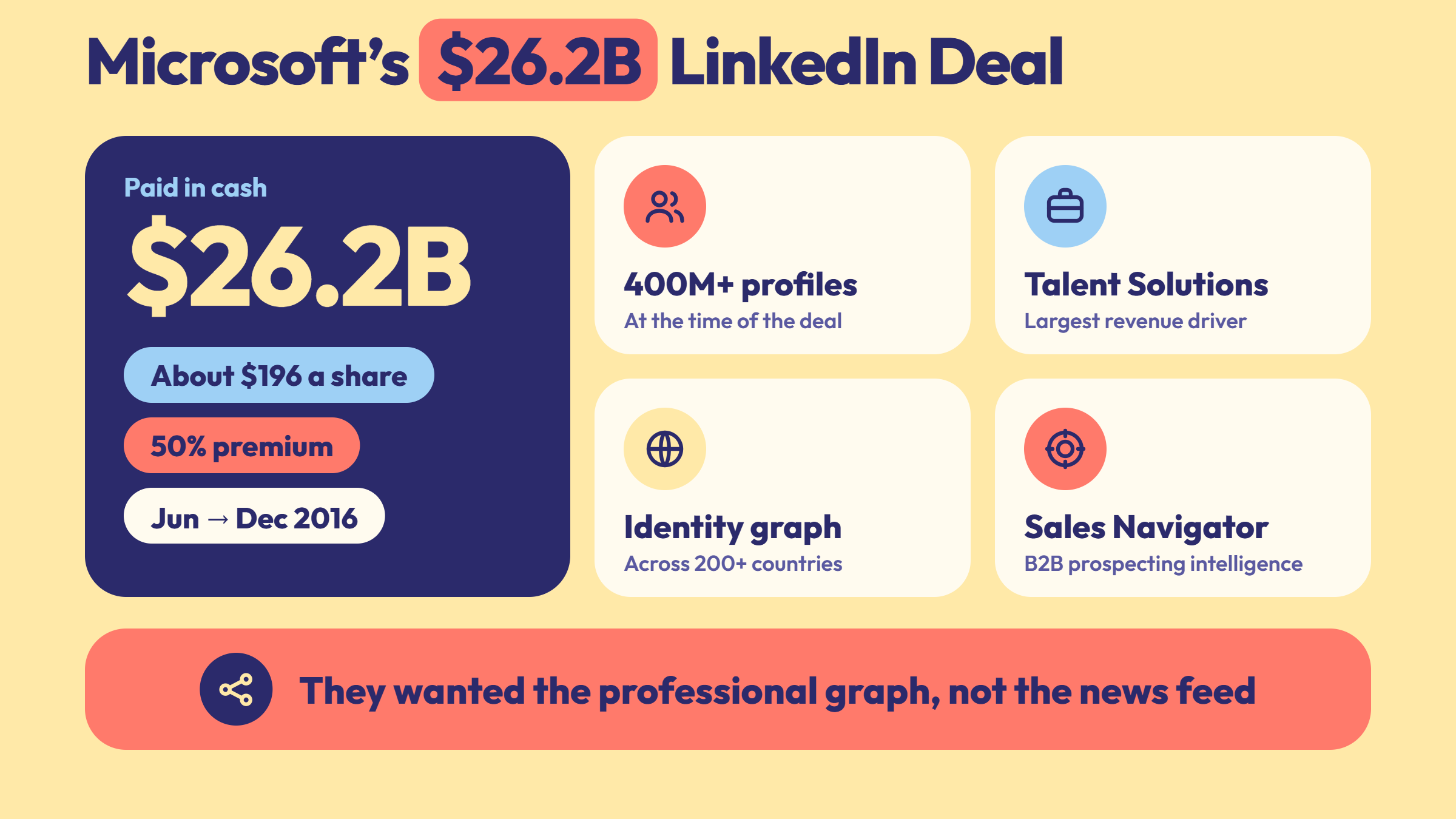
LinkedIn is owned by Microsoft. The acquisition closed in December 2016 after Microsoft announced the deal in June of that year. The purchase price was $26.2 billion in cash — at the time, the largest acquisition in Microsoft's corporate history.
How Much Did Microsoft Pay for LinkedIn and What Did They Get?
The $26.2 billion figure breaks down to roughly $196 per share — a 50% premium over LinkedIn's trading price before the announcement. In return, Microsoft acquired:
- Over 400 million professional profiles (at time of acquisition)
- LinkedIn's Talent Solutions business — its largest revenue driver
- A professional identity graph integrated into 200+ countries
- The Sales Navigator product (B2B prospecting intelligence)
The Microsoft acquisition of LinkedIn was not about social media reach. Teams that analyse enterprise acquisition strategy consistently see the same pattern: Microsoft wanted the professional graph, not the news feed. Satya Nadella's stated rationale centred on integrating LinkedIn's relationship data into Microsoft 365, Dynamics CRM, and Azure Active Directory — connecting work software with real professional identity data in ways no competitor could replicate.
Is LinkedIn Still Owned by Microsoft? How the Relationship Works in 2026
Yes — LinkedIn remains a wholly owned Microsoft subsidiary in 2026. However, it operates with significant operational independence. LinkedIn maintains its own brand, leadership team, product roadmap, and headquarters in Sunnyvale, California. Major strategic decisions — monetisation shifts, data policy, acquisitions — require Microsoft-level sign-off, but day-to-day product and engineering decisions remain under LinkedIn's own leadership.
Who Is the CEO of LinkedIn Today?
Ryan Roslansky is the CEO of LinkedIn as of 2026. He succeeded Jeff Weiner in June 2020 — a planned leadership transition in which Weiner moved into an executive chairman role. Roslansky had previously served as LinkedIn's SVP of Product, giving him deep familiarity with the platform's architecture before taking the top seat.
Roslansky's tenure has been defined by three clear priorities: building out LinkedIn's creator economy features (newsletters, video, audio events), deepening AI integration across recruiting and content tools, and expanding LinkedIn Learning as a standalone revenue stream. Each reflects the broader professional networking platform evolution from directory to media to AI-powered career infrastructure. Roslansky reports to Microsoft's executive leadership, meaning his strategic decisions exist within Microsoft's enterprise and AI roadmap — a governance dynamic that shapes LinkedIn's product direction more than most users realise.
What LinkedIn's Ownership Means for Professionals and Creators
Microsoft's ownership of LinkedIn is not just corporate trivia — it has direct implications for how professionals should think about building a presence on the platform. The most common failure mode among creators is treating LinkedIn like a neutral publishing platform when it is, in practice, a Microsoft product optimised for specific commercial outcomes.
What consistently separates effective LinkedIn creators from those who plateau is an understanding of the B2B social network monetization model. LinkedIn's algorithm rewards engagement that drives time-on-platform and signals professional value — because that engagement feeds into Talent Solutions targeting, advertising relevance, and premium subscription retention. Posts that generate genuine conversations outperform passive like-collections at the distribution level. To explore how to use LinkedIn's features with that model in mind, this deep-dive on LinkedIn features and benefits breaks down exactly what drives organic reach.
For professionals building on LinkedIn's company pages, the same logic applies — engagement signals on company posts affect how broadly they're distributed. Tools like HyperClapper are built specifically for this: real community engagement through channels, AI-powered replies, and company page boosting that works with LinkedIn's engagement signals rather than against them. Creators and founders who want to see strong examples of what effective company pages look like can reference these LinkedIn company page examples.
Grow Your LinkedIn Visibility With Real Engagement
HyperClapper connects your posts with real people in relevant channels — boosting reach through genuine interactions, not bots.
Try HyperClapper FreeFrequently Asked Questions About LinkedIn Company History
Is LinkedIn still owned by Microsoft?
Yes. LinkedIn has been a wholly owned Microsoft subsidiary since December 2016 and remains so in 2026. It operates with significant day-to-day independence — its own brand, leadership team, and product roadmap — but major strategic decisions require Microsoft-level approval. It is not a standalone public company.
How much did Reid Hoffman sell LinkedIn for?
Microsoft paid $26.2 billion in total for LinkedIn. Reid Hoffman held a significant equity stake at the time of the acquisition — reported estimates place his personal proceeds in the range of $2–3 billion — though the exact figure was never officially disclosed by either party. The deal closed in December 2016 at $196 per share.
Who were the original co-founders of LinkedIn?
LinkedIn was co-founded by five people: Reid Hoffman, Allen Blue, Konstantin Guericke, Eric Ly, and Jean-Luc Vaillant. They incorporated the company in December 2002. Hoffman is the most publicly prominent LinkedIn founder, but all five played distinct roles in building the original platform.
When was LinkedIn founded?
LinkedIn was incorporated in December 2002 and publicly launched on May 5, 2003. The 2002 vs. 2003 debate exists because both dates are technically accurate — 2002 is the legal founding, 2003 is the public launch. Most historical timelines use 2003 as the operational founding date.
Why did Microsoft acquire LinkedIn instead of other social networks?
Microsoft's enterprise acquisition strategy targeted professional identity and B2B data, not consumer social reach. LinkedIn's professional graph — verified career data, hiring relationships, B2B intent signals — integrated directly into Microsoft 365, Dynamics CRM, and Azure. No consumer social network offered that enterprise infrastructure layer.
Who owns LinkedIn and what is its relationship with Microsoft?
Microsoft owns LinkedIn outright as a wholly owned subsidiary. LinkedIn operates independently at the product and leadership level but is financially and strategically accountable to Microsoft. It is not a joint venture or minority investment — Microsoft acquired 100% of LinkedIn's outstanding shares in the 2016 deal.
Does Microsoft operate LinkedIn independently or as a fully merged division?
LinkedIn operates as an independent subsidiary, not a merged division. It retains its own brand, CEO, headquarters, and product organisation. In practice, deep integrations with Microsoft 365, Teams, and Dynamics CRM exist — but LinkedIn has not been absorbed into Microsoft's product divisions. This model mirrors how Activision Blizzard and GitHub operate within Microsoft.
What consistently separates platforms with lasting professional relevance from those that fade is not any single acquisition or leadership change — it is whether the original founding philosophy survives at scale. Two decades on, LinkedIn's insistence on real identity and professional trust, baked in by its LinkedIn founders in 2002, remains the structural reason the platform holds a position no competitor has managed to displace.