A recurring pattern among sales teams evaluating CRM costs is that HubSpot's pricing feels reasonable at first — until it doesn't. The free tier is genuinely capable, but once you need automation, more contacts, or a second seat, costs compound fast. Teams of 2–10 reps commonly report paying $10,000–$19,000+ annually by the time they layer in Sales Hub, Marketing Hub, and contact tier upgrades. The question isn't whether HubSpot is a good product — it clearly is. The question is whether a small sales team needs to pay enterprise prices for features they use maybe 40% of. In most cases, the answer is no. This guide breaks down the hubspot alternatives sales teams actually switch to, with honest pricing, migration realities, and the tradeoffs nobody warns you about.

- For small teams (2–10 reps): Pipedrive and Zoho CRM deliver the strongest cost-to-feature ratio — often 80–90% less annually than HubSpot Sales Hub.
- Best free option: Brevo covers CRM + email marketing on a free plan with no credit card required — the closest free alternative to HubSpot's free tier.
- Migration is easier than feared: HubSpot exports contacts, companies, and deals as CSV; most alternatives offer import wizards that map fields automatically.
- What you actually lose: HubSpot's unified data model is its real moat — not any single feature — and no single tool replicates it at lower prices.
- Counterintuitive finding: Most teams switching to cheaper CRMs report they were using fewer than half of HubSpot's paid features — meaning the "downgrade" barely registers day-to-day.
- LinkedIn still drives pipeline: While your CRM handles follow-up, LinkedIn visibility generates top-of-funnel leads — a gap worth filling separately.
- Why So Many Teams Are Ditching HubSpot in 2026
- What to Look for in an Affordable HubSpot Alternative
- The Best HubSpot Alternatives for Small Sales Teams in 2026
- Head-to-Head: HubSpot Competitor Pricing Comparison for 2026
- How to Switch from HubSpot to a Cheaper Tool Without Losing Your Data
- Risks and Limitations: What You Actually Lose When You Leave HubSpot
- Growing on LinkedIn While You Scale Your CRM Stack
- Frequently Asked Questions: HubSpot Alternatives in 2026
Why So Many Teams Are Ditching HubSpot in 2026
HubSpot pricing too expensive is the single most common complaint on Reddit's r/CRM and r/smallbusiness threads — and it's not baseless frustration. It reflects a structural reality: HubSpot was built as an enterprise platform and its pricing architecture reflects that. Small teams get pulled in by an excellent free tier, then face a steep cliff the moment they need more than the basics.
Is HubSpot Worth the Cost for Small Business?
For most small businesses with under 10 reps, HubSpot is not worth the cost at its paid tiers. The free CRM is genuinely competitive, but the paid jump — Sales Hub Starter at $20/seat/month, Pro at $100/seat/month — quickly reaches $10,000–$19,000+ annually when you factor in seat count, contact tier upgrades, and the near-mandatory add-ons like Operations Hub and Marketing Hub. According to a widely cited Reddit thread in r/CRM, teams routinely discover they're paying for Marketing Hub, CMS Hub, and Operations features they've never opened.
The trap is psychological as much as financial. Once your contacts, workflows, and email history live in HubSpot, switching feels expensive even when staying is more expensive. The Reddit and Quora consensus lands consistently: the value stops making sense somewhere around the 5–10 user mark on Sales Hub Pro.
The core question isn't just "is HubSpot so expensive?" — it's whether you can get comparable sales pipeline visibility, contact management, and email automation for a fraction of the cost. The answer, as the tools below demonstrate, is yes.
What to Look for in an Affordable HubSpot Alternative
Teams that shop for HubSpot alternatives purely on headline price almost always regret it within six months. The monthly fee is one input. CRM total cost of ownership — the real metric — includes per-seat fees, contact tier pricing, add-on costs for automation, and support tier pricing. A $15/seat/month tool that requires three $50/month integrations to match HubSpot's native stack isn't actually saving you money.
Free CRM vs. Paid: Where the Real Tradeoffs Live
Free CRM plans are genuinely useful for solopreneurs and teams under three people. But most free tiers gate the two features small sales teams use most: email sequences and automation workflows. A free CRM with marketing automation that actually delivers both — not just one or the other — is rare. Brevo comes closest, and it's covered in detail below.
The capabilities worth benchmarking against HubSpot specifically:
- Sales activity tracking without bloat — can your reps log calls, emails, and meetings without navigating six menus?
- Deal pipeline visibility — drag-and-drop Kanban boards, deal probability, and stage-based forecasting
- Email sequences — automated follow-up cadences triggered by deal stage or contact behavior
- Reporting dashboards — team leaderboards, pipeline velocity, and conversion rates at a glance
- Native integrations — Gmail, Outlook, Slack, Zapier, and your existing outreach stack
The CRM onboarding learning curve is a cost most comparison articles ignore entirely. Pipedrive takes most reps an afternoon to get productive. Zoho CRM's full suite can take 1–2 weeks to configure properly. For a small team without a dedicated CRM admin, that difference is real money in lost productivity.
The most common failure mode when switching CRMs isn't picking the wrong tool — it's picking based on price alone and discovering three months later that the team won't log anything because the UI requires too many clicks to do basic sales tasks.
The Best HubSpot Alternatives for Small Sales Teams in 2026
Six tools consistently surface as the strongest affordable HubSpot alternatives for teams of 2–10 reps. Each has a distinct strength — no single tool beats HubSpot across every dimension at lower cost, but each wins decisively in its lane.
| Tool | Best For | Starting Price | Free Plan | G2 Rating |
|---|---|---|---|---|
| Pipedrive | Pipeline UX, small sales teams | $14/seat/mo | No (14-day trial) | 4.2/5 |
| Zoho CRM | All-in-one value, scaling teams | $14/seat/mo | Yes (3 users) | 4.1/5 |
| Brevo | Email marketing + CRM, budget teams | Free → $25/mo | Yes (unlimited contacts) | 4.5/5 |
| ActiveCampaign | Marketing automation depth | $29/mo (1 user) | No (14-day trial) | 4.5/5 |
| Freshsales | AI-assisted selling, mid-market | Free → $15/seat/mo | Yes | 4.5/5 |
| folk CRM | Solopreneurs, freelancers, founder-led | $20/seat/mo | No (14-day trial) | 4.7/5 |
Pipedrive — Best for Sales Pipeline Visibility Without Bloat

Pipedrive is purpose-built for sales pipeline management — no marketing modules, no service hub, no CMS to navigate around. The drag-and-drop deal board is among the cleanest implementations in any CRM at any price point. Teams that prioritize sales pipeline visibility and minimal admin overhead consistently rate it highest on usability. According to Pipedrive's own comparison analysis, it's one of the most commonly cited HubSpot replacements for sales-focused teams.
What it does well: deal stages, activity reminders, email sync, and sales reporting. What it lacks: native marketing automation and landing page builders — you'll need Zapier or a dedicated email tool to replicate that. For a pure sales team, that's rarely a problem.
Zoho CRM — Best All-in-One Value (HubSpot vs Zoho CRM Cost)
The HubSpot vs Zoho CRM cost gap is the starkest in the market. Zoho CRM Standard runs approximately $14/seat/month; HubSpot Sales Hub Pro runs $100/seat/month. For a five-person team, that's roughly $840/year versus $6,000/year for the core CRM alone — before contact tier upgrades. Zoho's free plan supports up to three users and covers contact management, basic pipeline, and limited automation.
The tradeoff: Zoho's interface is dense. Contact management for small sales teams works well once configured, but the initial setup — custom fields, workflow rules, role hierarchies — takes longer than most competitors. Teams without a technical admin often find the first two weeks frustrating. Those who push through consistently report strong satisfaction after the ramp-up.
Brevo — Best Free CRM with Marketing Automation (HubSpot vs Brevo)
In the HubSpot vs Brevo for email marketing comparison, Brevo wins on price for any team that primarily needs email sequences and basic CRM rather than deep sales pipeline features. Brevo's free plan allows unlimited contacts (with a daily send cap), basic automation, and a built-in CRM — making it the most complete free CRM with marketing automation available in 2026.
The paid Business plan at approximately $65/month (flat rate, not per-seat) includes marketing automation, A/B testing, and advanced reporting. For a five-person team sending under 100,000 emails/month, this is dramatically cheaper than HubSpot Marketing Hub Starter.
ActiveCampaign — Best for Marketing Automation Depth (ActiveCampaign vs HubSpot Pricing)
On ActiveCampaign vs HubSpot pricing, ActiveCampaign's Plus plan at $49/month (for up to three users) covers automation workflows, CRM pipeline, email sequences, and lead scoring that would require HubSpot Marketing Hub Pro to replicate — a plan that starts at $800/month. The automation builder is widely considered the most powerful in this price range, with conditional logic and branching that rivals enterprise platforms.
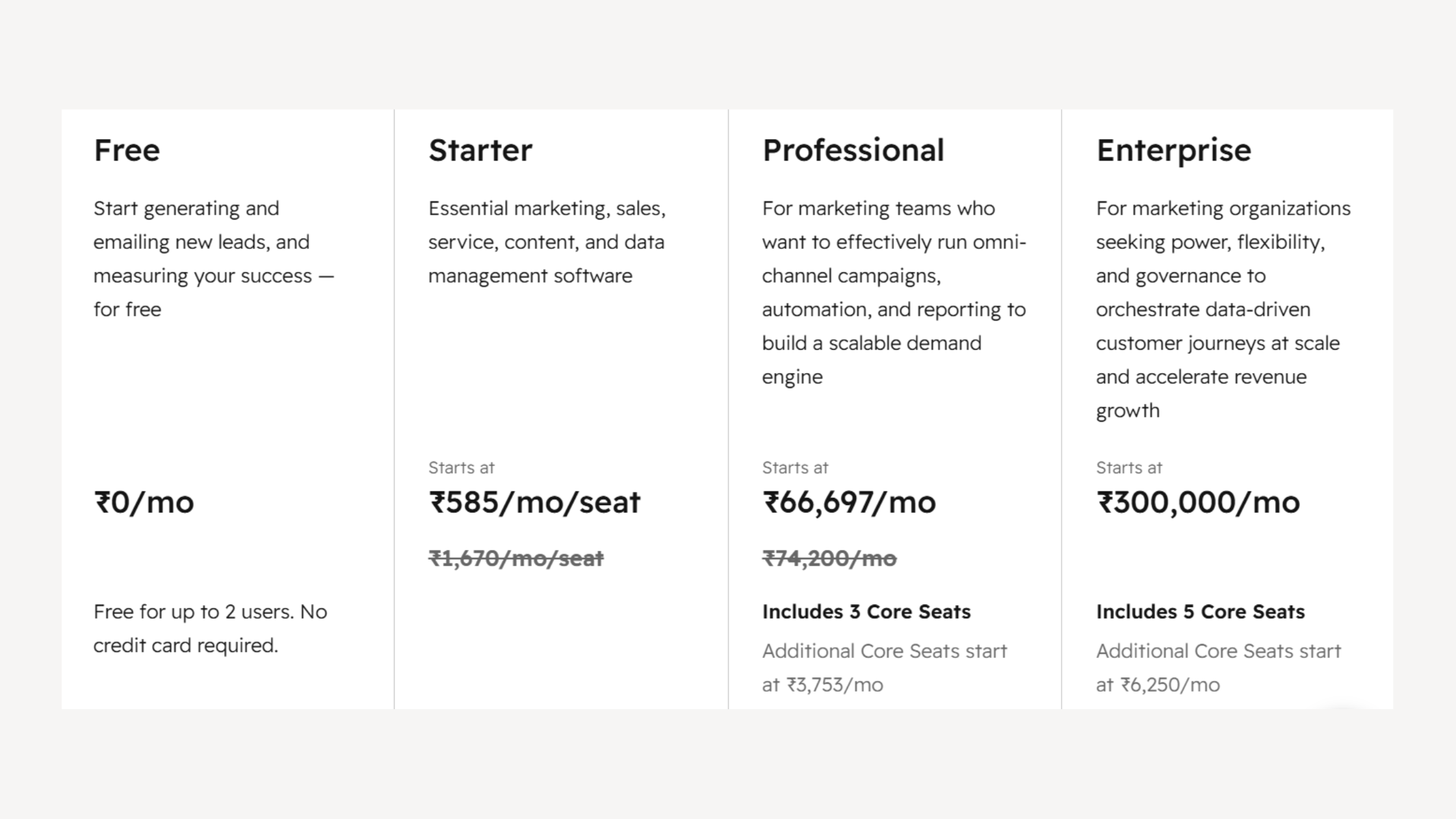
Where it falls short: the sales CRM component is functional but not as polished as Pipedrive's pipeline UX. Teams that need deep automation and are comfortable with a slightly steeper interface curve will find it the strongest value in the best cheap marketing automation software category.
Head-to-Head: HubSpot Competitor Pricing Comparison for 2026
Numbers tell the story better than descriptions here. The table below models realistic annual cost for a five-person sales team with 5,000 contacts — the scenario where most small teams first feel HubSpot's pricing pressure.
| Tool | Plan | Est. Annual Cost (5 users) | Contact Pricing Model | Setup Time |
|---|---|---|---|---|
| HubSpot Sales Hub Pro | Pro | ~$6,000–$19,200+ | Per seat + contact tiers | 1–3 days |
| Pipedrive | Essential | ~$840/yr | Per seat only | Half a day |
| Zoho CRM | Standard | ~$840/yr | Per seat only | 1–2 weeks |
| ActiveCampaign | Plus | ~$1,188/yr | By email volume | 1–3 days |
| Brevo | Business | ~$780/yr | By email volume | Half a day |
HubSpot's per-contact pricing model is its biggest cost driver at scale. Brevo and ActiveCampaign charge by email volume instead — a structure that benefits teams with large contact lists but lower send frequency. In practice, a team with 10,000 contacts who sends two campaigns per month pays far less with Brevo than with HubSpot, even on a paid tier.
Which HubSpot Alternative Is Best for Startups?
For startups, the answer depends on which hubspot alternatives for small business need they're solving first. Pipeline-first startups (outbound sales motion, SDR team) should start with Pipedrive. Marketing-led startups (content, email, inbound) get more from ActiveCampaign or Brevo. Founder-led sales with under 500 contacts: folk CRM or HubSpot's free tier itself — there's no reason to pay for anything at that stage. The moment you hire a second or third rep and need shared pipeline visibility, Pipedrive at $14/seat/month becomes the clear answer.
How to Switch from HubSpot to a Cheaper Tool Without Losing Your Data
What separates teams that migrate successfully from those who regret it is almost always preparation, not the choice of destination tool. HubSpot data export is technically straightforward — the platform is intentionally open about data portability. The risk lives in the details.
The migration process in practice:
- Export your HubSpot data — Contacts, Companies, and Deals export as CSV natively. Allow 15–30 minutes for a large database.
- Audit before you migrate — In most cases, 30–50% of HubSpot contact databases contain stale or duplicate records. Importing bloat into a new tool means paying for it at the new tool's contact tier too.
- Map custom properties manually — HubSpot's custom contact and deal properties don't transfer automatically. Build your field mapping in a spreadsheet before importing.

HubSpot Alternatives That Won't Break Your Budget
Frequently Asked Questions: HubSpot Alternatives in 2026
What is the most affordable alternative to HubSpot for a small business with under 1000 contacts?
Zoho CRM and Pipedrive are the most affordable options for small businesses under 1,000 contacts, both starting under $15 per seat per month with no contact-tier pricing penalties. Either saves a typical 5-person team $8,000–$15,000 annually compared to HubSpot Sales Hub Pro with equivalent pipeline and automation features.
Which HubSpot alternative includes CRM and email marketing on a free plan?
Brevo offers both CRM and email marketing on a genuinely free plan with no credit card required. You get contact management, deal pipelines, and up to 300 emails per day at no cost — making it the closest free equivalent to HubSpot's free tier for teams that need both tools in one place.
Is there a HubSpot alternative that is easier to use and cheaper?
Pipedrive is consistently rated easier to use than HubSpot and costs significantly less. Its interface is built around a visual deal pipeline with minimal setup friction, and most reps are productive within a day. At $14–$24 per seat per month, it runs 60–80% cheaper than HubSpot Sales Hub Pro.
What do I lose if I switch from HubSpot to a cheaper CRM?
You primarily lose HubSpot's unified data model — the seamless connection between marketing, sales, and service data in one platform. Individual features like pipelines or email sequences exist elsewhere, but no single cheaper tool replicates that cross-hub data coherence. Most teams discover they were using under half of HubSpot's paid features anyway.
Which HubSpot alternative is best for a solopreneur or freelancer?
Brevo or Zoho CRM's free tier works best for solopreneurs — both offer contact management and email tools at no cost. If you need a paid upgrade, Pipedrive's Essential plan at $14 per seat per month gives a solo operator a clean pipeline without paying for multi-seat enterprise features you will never use.
Is HubSpot worth the cost for a startup or early-stage team?
HubSpot's free CRM is worth it for early-stage teams, but the paid tiers rarely are before you hit 10-plus reps with complex automation needs. Most startups hit $10,000+ annually before their sales process justifies it. Cheaper alternatives cover 80–90% of the workflow at a fraction of the cost during early growth stages.
How does ActiveCampaign compare to HubSpot on pricing?
ActiveCampaign is meaningfully cheaper than HubSpot when email marketing automation is your priority, with plans starting around $15 per month for 1,000 contacts versus HubSpot's Marketing Hub Starter. The tradeoff is that ActiveCampaign's CRM is lighter — it excels at automation sequences but offers less native sales pipeline depth than HubSpot.