
Endorsements on LinkedIn are one-click peer confirmations that a connection possesses a specific skill — and a pattern observed across thousands of professional profiles is that most people either over-index on collecting them or dismiss them entirely. Neither extreme is right. When someone endorses you on LinkedIn, they are publicly attaching their name to your claimed ability, adding a layer of social proof that recruiters and hiring managers do notice — even if they never admit it drives a hiring decision. The honest reality: endorsed skills improve your profile's search visibility and completeness score, but they are a baseline credibility signal, not a career differentiator on their own.
- LinkedIn endorsements are one-click validations of a specific skill — faster and lighter than written recommendations.
- Profiles with endorsed skills receive significantly more recruiter views — making them a real, if understated, search ranking factor.
- The most counterintuitive finding: 10–15 curated, highly endorsed skills outperform 50 unendorsed ones every time.
- Endorsements and recommendations serve different purposes — you need both for a complete professional reputation signal.
- You can manage, reorder, and hide endorsements you have received — and should, to keep your profile credible.
- For job seekers in 2026, endorsed hard skills are a necessary baseline; written recommendations are what actually differentiate you.
- What Are LinkedIn Endorsements (And What Do They Actually Mean)?
- How LinkedIn Endorsements Work — And Whether They Actually Matter
- Why Someone Endorses You — and What You Should Do About It
- How to Get More LinkedIn Endorsements (And Which Skills to Prioritize)
- LinkedIn Endorsements for Job Search: Honest Benefits, Real Limits, and What to Fix First
- Frequently Asked Questions About LinkedIn Endorsements
What Are LinkedIn Endorsements (And What Do They Actually Mean)?

LinkedIn endorsements are a one-click feature that lets your connections publicly confirm you have a skill listed on your profile. That is it — no written context, no star rating, no elaboration. The result is a count next to each skill showing how many people have validated it. The endorsement on LinkedIn meaning in practical terms: peer validation replaces pure self-reporting. Instead of just claiming "I know Python," your profile now shows "47 people agree."
Understanding what are endorsements on LinkedIn requires separating what they claim to measure from what they actually measure. They claim to measure skill. What they actually measure is how well-networked you are with people willing to click a button — which is correlated with skill, but not identical to it. That nuance is why the professional community remains divided on their value.
LinkedIn Endorsements vs. Recommendations: What's the Real Difference?

LinkedIn endorsements vs recommendations is not a close comparison. Recommendations are written, relationship-driven testimonials — a manager explaining how you led a product launch, a client describing results you delivered. Endorsements are a single click. The effort differential is enormous, and hiring managers know it.
- Endorsements: Skill-level, one-click, require zero context or effort from the endorser
- Recommendations: Written, relationship-specific, require real thought and professional credibility from the author
- Weight in hiring: Recommendations carry significantly more weight because they are harder to fake and harder to give casually
The most common failure mode is treating endorsements as a substitute for recommendations. They are not. Think of endorsements as a digital nod across the room — useful for recognition, not useful for closing a deal. Recommendations are the handshake with context.
A LinkedIn profile with three well-written recommendations from direct managers will outperform a profile with 99+ endorsements on every soft skill and no recommendations — every time, in every hiring context observed.
Now that the foundation is clear, here is how the endorsement mechanism actually works inside LinkedIn's system — and whether it measurably affects your visibility.
How LinkedIn Endorsements Work — And Whether They Actually Matter
LinkedIn's algorithm treats profile completeness — the degree to which your profile fills all available sections — as a ranking signal in search results. Skills with endorsements count toward that completeness score. According to LinkedIn's own member blog, people with at least five skills listed receive up to 17x more profile views. In practice, endorsed skills amplify this effect because they contribute both to completeness and to keyword matching when recruiters search by skill.
This 17x figure comes directly from LinkedIn's own platform data and is the strongest case for taking endorsements seriously. In practice, it means a recruiter searching for "Paid Media" is more likely to surface a profile where that skill is listed and endorsed than one where it appears only in a job description buried in experience. What this tells you: endorsed skills are functional SEO for your LinkedIn profile, not just vanity metrics.
Do Recruiters Look at LinkedIn Endorsements — or Ignore Them?
Do recruiters look at LinkedIn endorsements? The honest answer: they notice them in aggregate rather than reading them carefully. A recruiter scanning 30 profiles in 20 minutes is not counting individual endorsers — but a skills section with healthy endorsement counts reads as "credible" versus one with zero. According to Cognism's 2026 LinkedIn statistics report, profiles with multiple skill endorsements receive 17 times more views from recruiters. That is the same stat from a different angle: endorsements affect visibility before a human ever makes a judgment.
Do LinkedIn endorsements matter to employers? They matter at the screening stage — when an algorithm or a fast-scrolling recruiter is deciding whether to click. They matter less in the interview stage, where specific accomplishments and written recommendations take over. The mistake is expecting them to do a job they were never designed for.
How many endorsements per skill appear credible? A pattern observed across high-performing profiles is that 10+ endorsements on a core skill starts to read substantively; 99+ on a top skill signals a strong, active professional network. Below 5, the number barely registers.
Why Someone Endorses You — and What You Should Do About It
Not every endorsement carries the same intent. LinkedIn actively prompts users to endorse connections based on mutual interactions and listed skills — so a significant portion of endorsements you receive are platform-triggered, not deliberate professional judgments. Understanding why would someone endorse you on LinkedIn helps you respond appropriately and manage your profile's credibility.
Common reasons people endorse:
- LinkedIn prompts: The platform suggests endorsements during browsing — many are reflex clicks
- Genuine appreciation: A colleague or client confirming a skill they directly observed
- Reciprocity: You endorsed them, so they endorse back — the most common pattern in loose networks
- Relationship maintenance: A warm touch to stay on your radar without a full message
Should you endorse people back on LinkedIn? Only endorse skills you can genuinely vouch for. Blanket reciprocal endorsing — clicking every skill on someone's profile because they clicked yours — inflates profiles with unearned validation and quietly degrades the professional reputation signals that endorsements are meant to provide. Endorse one or two skills you actually observed. That is more credible than ten reflexive clicks.
Can you endorse someone you have never worked with? Technically yes. Ethically, it is problematic. Endorse based on observable work, public output you have engaged with, or credible shared context — not as a social transaction. The endorsement carries your name. If someone later questions it, you should be able to explain how you know the person can do the thing.
Can You Remove or Manage LinkedIn Endorsements You've Received?
Can you remove a LinkedIn endorsement? Yes — and you should use this actively. LinkedIn lets you hide individual endorsements, hide all endorsements for a specific skill, or remove a skill entirely. Go to your profile → Skills → Edit → toggle visibility per endorser or per skill. This matters because an endorsement from a low-credibility connection on a skill you want to be known for can actually dilute the signal. Curating what appears is as important as accumulating volume.
How to Get More LinkedIn Endorsements (And Which Skills to Prioritize)
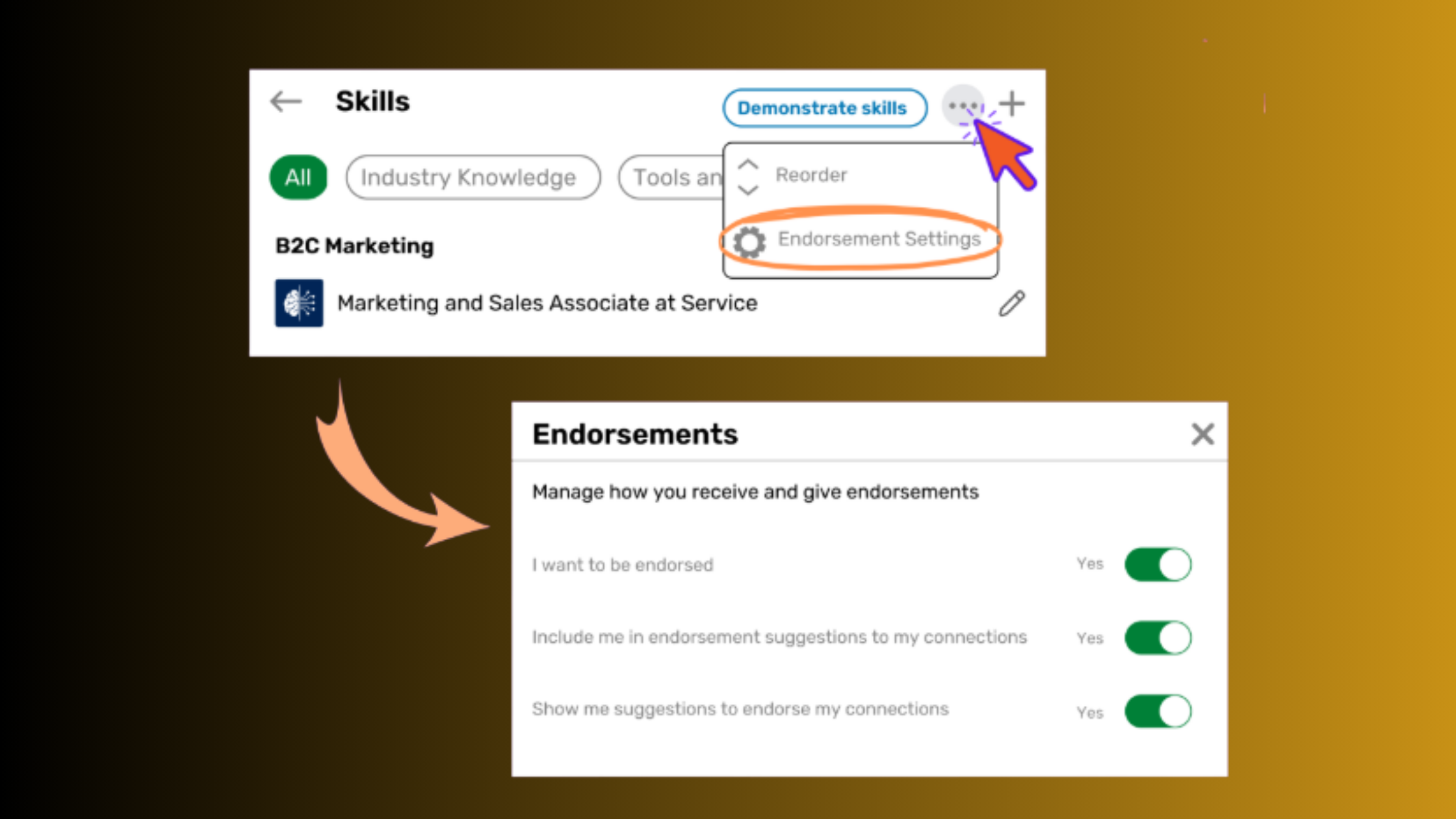
Teams that approach endorsements strategically — curating their skills list before asking anyone — consistently see better results than those who ask first and organise later. Here is the sequence that works.
How to Request Endorsements on LinkedIn
Learning how to request endorsements on LinkedIn and how to ask for endorsements on LinkedIn comes down to one principle: be specific. A generic "please endorse my skills" message gets ignored. A targeted ask — "Hey [Name], I'm focusing on positioning myself around data analytics — if you felt comfortable endorsing that skill based on our work on [Project], I'd really appreciate it" — lands. According to JobWizard's data-backed guide, a realistic endorsement conversion rate for a well-networked professional sending personalised requests is roughly 5–15%. That means reaching out to 20 relevant colleagues could yield 1–3 endorsements per skill — so target the right people, not just the most people.
How to add endorsements on LinkedIn for someone else: visit their profile, scroll to Skills, hover over the skill, and click the thumbs-up icon. It takes under five seconds. How to endorse someone on LinkedIn step-by-step:
- Go to the person's LinkedIn profile
- Scroll down to their Skills section
- Click the + icon or thumbs-up next to the skill you want to endorse
- Confirm when prompted — done
Best skills to list for maximum endorsements by industry: lead with role-specific hard skills over generic soft skills. Recruiters filter LinkedIn search by skill terms — "SEO," "Python," "Financial Modelling," "Talent Acquisition" are searchable; "Leadership" and "Teamwork" are not filtered for. A pattern observed across high-performing profiles is that hard skills in the top three positions attract both more endorsements and more recruiter clicks than any soft skill, regardless of endorsement count.
✓ LinkedIn Skill Endorsement Optimisation Checklist
- ☐Trim your skills list to 10–15 role-relevant skills — remove anything you would not want to be tested on
- ☐Reorder skills so your top 3 are your most endorsed, most relevant hard skills
- ☐Send personalised endorsement requests to 10–20 direct colleagues or clients, skill-specific
- ☐Endorse 2–3 skills on each connection's profile before asking them to endorse you
- ☐Hide or remove endorsements from connections who are not credible in the relevant field
- ☐Follow up every endorsement received with a brief thank-you DM — use it to plant the seed for a written recommendation
Want stronger LinkedIn visibility beyond endorsements?
HyperClapper boosts your posts with real engagement from relevant professionals — so your content reaches more people even before your endorsement count grows.
Try HyperClapper Free
LinkedIn Endorsements for Job Search: Honest Benefits, Real Limits, and What to Fix First
LinkedIn skills endorsements for job search occupy a specific, bounded role: they improve how discoverable your profile is, and they provide fast social proof during the 10-second recruiter scan. What they do not do is persuade anyone to hire you. The gap between those two functions is where most job seekers misallocate their energy.
Are LinkedIn endorsements worth anything in 2026? Yes — but as infrastructure, not as strategy. A profile without endorsed core skills looks incomplete against the LinkedIn algorithm's profile completeness scoring. That incompleteness depresses your appearance in recruiter search results before any human reviews your background. Endorsed skills fix that. They are the floor, not the ceiling.
Creators who skip this step typically find their profiles ranking below less-experienced candidates who simply have better-structured skills sections — not because of content quality, but because of completeness signals. For a deeper look at how this plays out, see our breakdown of what LinkedIn endorsements really mean for your profile.
The practical framework — call it The Endorsement Baseline Rule — works like this:
- Step 1 — Baseline: Get 10+ endorsements on your top 3 hard skills. This clears the credibility threshold recruiters expect.
- Step 2 — Differentiate: Secure 2–3 written recommendations from direct managers or senior clients for those same skills.
- Step 3 — Amplify: Use consistent, high-quality LinkedIn content to build context around your expertise — so endorsements are corroborated by visible, public proof of work.
LinkedIn endorsements meaning shifts depending on which step you are at. At step one, they are table stakes. At step three, they are supporting evidence for a much stronger overall signal. What actually moves the needle in hiring is never endorsements alone — it is endorsements plus recommendations plus demonstrated expertise in the public feed. Tools like boosting your post visibility on LinkedIn can accelerate step three by ensuring your content reaches the right professional audience.
LinkedIn endorsements meaning in 2026 is this: they are the professional equivalent of a dress code — not following it disqualifies you, but following it does not get you the job.
What consistently separates profiles that generate inbound recruiter interest from those that sit dormant is not the endorsement count — it is whether the entire profile tells a coherent, corroborated story. Endorsed skills, written recommendations, consistent content, and a clear positioning statement work together as a system. Optimise any one piece in isolation and you hit a ceiling fast. For actionable guidance on getting endorsements without the awkwardness, see how to get LinkedIn endorsements without looking spammy.
Frequently Asked Questions About LinkedIn Endorsements
Do endorsements on LinkedIn mean anything?
Yes — LinkedIn endorsements signal peer validation of a specific skill and contribute to profile completeness, which affects recruiter search visibility. They are not a deep measure of expertise, but profiles with endorsed skills receive significantly more recruiter views than those without. Think of them as a credibility floor, not a differentiator.
What does it mean when someone endorses a skill on your LinkedIn profile?
When someone endorses a skill, they are publicly confirming — with their LinkedIn identity attached — that they believe you possess that ability. It is a one-click signal, not a written testimonial. The endorsement meaning depends on who gave it: a direct manager's endorsement carries real weight; a loose connection's carries less.
Do LinkedIn endorsements actually help you get hired or found by recruiters?
Endorsed skills improve your visibility in LinkedIn's recruiter search by contributing to profile completeness and keyword matching — so they help you get found. They are unlikely to directly influence a hiring decision on their own. The combination of endorsed hard skills plus written recommendations is what moves recruiters from "found" to "interested."
What is the difference between a LinkedIn endorsement and a recommendation?
An endorsement is a one-click confirmation of a skill — fast, effortless, and common. A recommendation is a written testimonial describing your work, impact, and character — it requires real effort and professional credibility from the author. Recommendations carry significantly more weight in hiring decisions because they are harder to give casually.
Can people see who endorsed you on LinkedIn?
Yes. LinkedIn shows the names and profile pictures of the people who endorsed each skill on your profile, visible to anyone who views it. You can hide individual endorsers or the entire endorsement count for a skill — but by default, endorsers are publicly visible. This is why the quality of your endorsers matters alongside the quantity.
Does the number of LinkedIn endorsements affect profile ranking or visibility?
Yes — endorsed skills contribute to LinkedIn's profile completeness score, which is a confirmed factor in how prominently your profile appears in recruiter search results. LinkedIn's own data shows members with at least five skills listed receive up to 17x more profile views. More endorsed skills, especially relevant hard skills, strengthen this effect meaningfully.
How do you get endorsements in LinkedIn?
The most effective approach is to send personalised requests to direct colleagues or clients, specifying which skill you'd like endorsed and why. Endorse their skills first — LinkedIn's reciprocity prompts often return the favour. Keep your skills list curated to 10–15 relevant abilities so requests feel focused, not desperate. Learn more in this guide to getting endorsements on LinkedIn.
Build the LinkedIn profile that gets found — then seen, then chosen.
HyperClapper pairs endorsement credibility with real post engagement — so your expertise is visible across the entire platform, not just on your profile page.
Start Growing on LinkedIn


