Creative Job Titles on LinkedIn: When They Help and When They Hide You
Creative job titles on LinkedIn can boost your brand or kill recruiter visibility. Learn exactly when to use them, when to avoid them, and what to put instead.
📅 ⏱ 12 min read📝 ~2400 words
Creative job titles on LinkedIn — think "Chief Storyteller," "Growth Ninja," or "People Champion" — are either a personal branding superpower or a searchability trap, depending entirely on what you're trying to achieve. A pattern observed consistently across high-performing LinkedIn profiles is that the most visible professionals aren't the most creative with their titles — they're the most strategic. Getting this decision wrong costs real recruiter visibility: according to a widely-cited Reddit thread from LinkedIn's own algorithm research, LinkedIn only understands 25–30% of job titles entered on the platform, because the title field is free-form and unstructured. That gap is where creative titles either work for you or quietly erase you.
Key Takeaways
Who this is for: Professionals debating whether a creative LinkedIn title helps or hurts their visibility.
LinkedIn's search algorithm is keyword-driven — if your title isn't a recognized term, recruiters won't find you.
Creative titles boost engagement and click-through when you're building inbound authority; they actively damage searchability when you're job hunting.
The safe strategy: use the Experience field for a standard, searchable title and the 220-character headline for personality and branding.
Counterintuitive finding: some of the most clicked-on profiles use the least creative titles — combined with strong post visibility.
Tools like HyperClapper can amplify content reach so your profile gets found through posts, not just search filters.
What Are Creative Job Titles on LinkedIn (and Why Do People Use Them)?
A creative job title is any non-standard professional label that replaces or supplements a conventional role name — trading "Marketing Manager" for "Brand Architect," or "HR Director" for "People Champion." They exist on a spectrum, from mildly distinctive ("Senior Growth Strategist") to completely unrecognizable to outsiders ("Vibe Curator" or "Chief Imagination Officer").
The appeal is real. On a platform where thousands of "Marketing Managers" compete for the same eyeballs, a distinctive title does stop the scroll. It signals personality, reinforces personal branding on LinkedIn, and positions someone as a thought leader rather than just another job title in a database. For founders, coaches, solopreneurs, and LinkedIn creators, that differentiation has genuine value — their audience finds them through content and referrals, not recruiter keyword searches.
The Spectrum: Mildly Creative to Completely Unrecognizable
Not all creative titles carry the same risk. Consider these tiers:
Descriptive but non-standard: "Revenue Strategist | SaaS Sales Leader" — personality without keyword sacrifice.
Fully opaque: "Growth Ninja," "Sales Sherpa," "Happiness Engineer" — engaging in a feed, invisible in search.
The tier you choose should depend on whether you're optimizing for discovery through search or discovery through content. Most professionals need both — which is why the choice is rarely as simple as "creative vs. standard."
How LinkedIn's Algorithm Ranks Job Titles — and Why It Matters for Your Visibility
LinkedIn job title visibility in search is entirely keyword-driven. When a recruiter opens LinkedIn Recruiter and filters by "Sales Manager," the algorithm scans Experience section titles and headline text for that exact string — or close semantic matches. It does not interpret "Revenue Rockstar" as a synonym for "Account Executive." The match simply doesn't happen.
25–30%
Of LinkedIn job titles are actually recognized by the platform's own algorithm
This matters because how the LinkedIn algorithm ranks job titles determines whether your profile surfaces at all. The Experience section title carries significant independent weight in LinkedIn's ranking signals — separate from, and often more heavily weighted than, your headline alone. If both fields use creative language, your profile is effectively invisible to keyword-based recruiter searches.
⚠️
Warning:If your Experience section uses a fully opaque creative title with no standard keyword equivalent, recruiters running Boolean searches or LinkedIn Recruiter filters will never see your profile — even if every other field is perfect.
Headline vs. Experience Title: Which Field Carries More Search Weight?
Both fields matter, but differently. The Experience title is treated as a structured data field for search indexing — it's the primary signal for recruiter filters. The headline (220 characters) also contributes to search, but it's weighted more toward content discoverability and profile-visit click-through. Think of the Experience title as your SEO metadata and the headline as your ad copy. You need both to do their respective jobs.
Understanding this distinction is what separates profiles that get found from profiles that get overlooked — and it's the foundation for every title decision that follows.
When Creative Job Titles Actually Help Your LinkedIn Profile
When Creative Job Titles Actually Help Your LinkedIn Profile
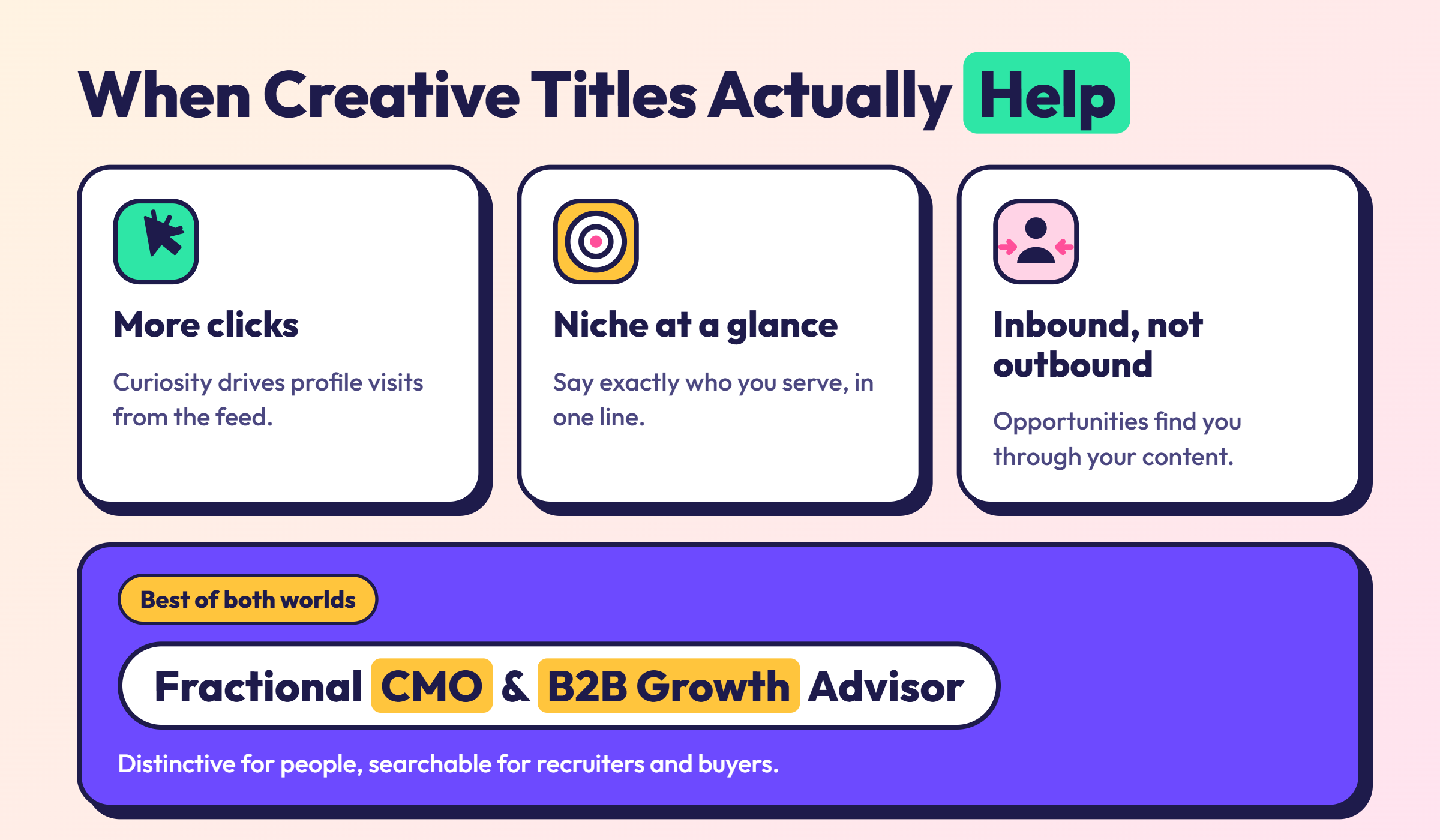
Teams that build inbound authority through content — coaches, consultants, fractional executives, and creators — consistently see creative titles lift their profile click-through rates when posts surface in the feed. The mechanism is simple: curiosity drives clicks. "Chief Storyteller at [Brand]" is more likely to get a profile visit from someone who enjoyed a post than "Content Marketing Manager."
The creators who benefit most from creative titles are those whose audience finds them through content and word-of-mouth — not through recruiter filters. For them, the title is marketing copy, not a search keyword.
For personal branding on LinkedIn, a well-crafted distinctive title also signals niche expertise at a glance. "Executive Coach for First-Time CTOs" is creative, specific, and immediately communicates who you serve — it's doing real work. This kind of title attracts inbound opportunities rather than waiting for outbound applications.
Blending Creativity with Keywords: The Best of Both Worlds
The sweet spot — and the approach most high-performing profiles use — is a title that is both distinctive and keyword-rich. "Fractional CMO & B2B Growth Advisor" reads as a human-crafted identity, not a corporate job code. But it also contains "CMO" and "B2B Growth" — terms recruiters and buyers actually search.
💡
Pro Tip:Use your Experience title for discoverability (standard keywords) and your headline for personality. If you must be creative in the Experience field, include at least one standard industry keyword the way a recruiter would type it — e.g., "Head of Growth | Former VP Marketing."
Boosting post visibility also compounds this effect. When your content reaches more people through organic and assisted amplification, your profile gets visited regardless of search rank — which is why tools like increasing post engagement work as a parallel lever to title optimization.
When Creative Job Titles Hurt You — Risks, Recruiter Blindspots, and Common MistakesWhen Creative Job Titles Hurt You
When Creative Job Titles Hurt You
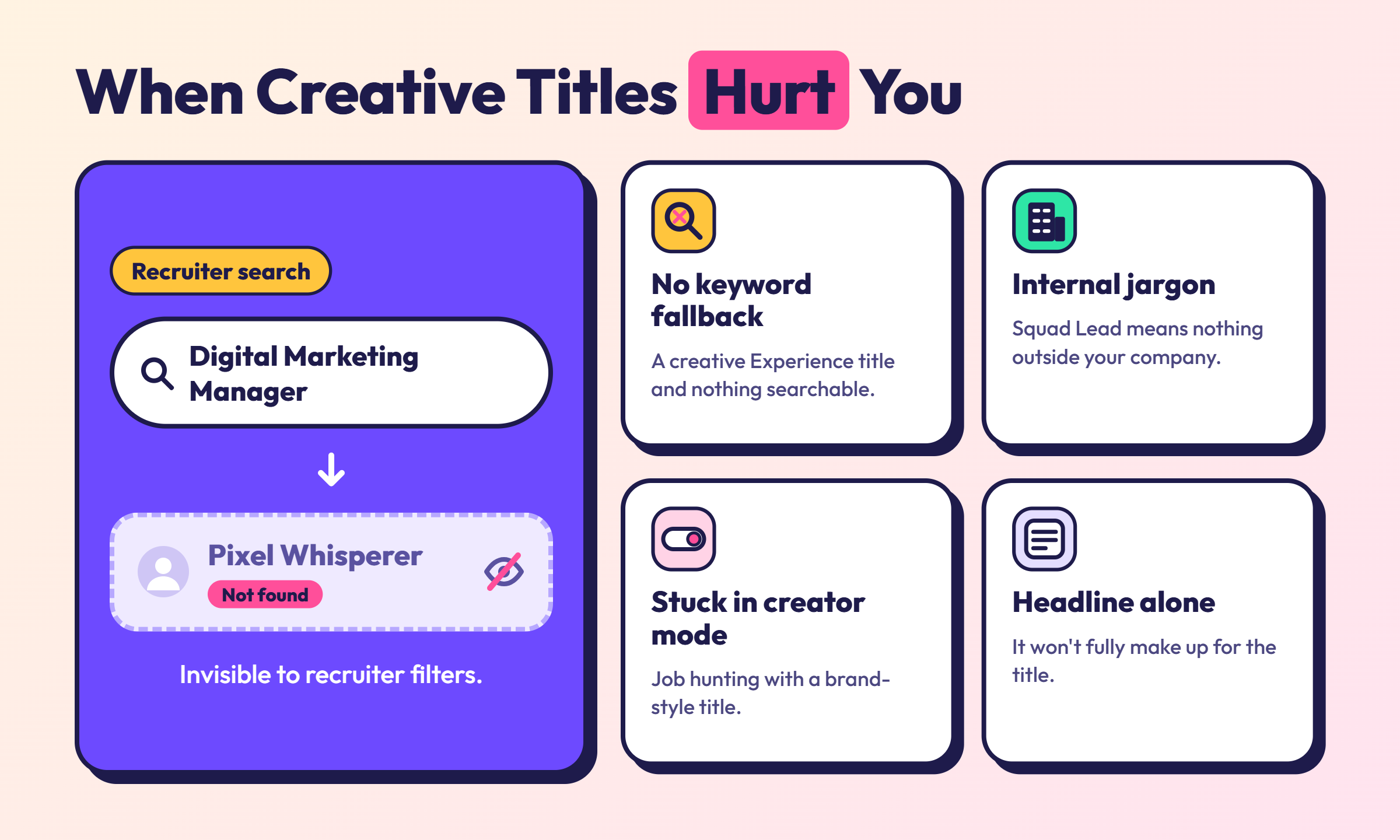
If you're actively job searching, a purely creative job title is a searchability liability. Full stop. Unconventional job titles in recruiter searches simply don't match the Boolean strings or platform filters that hiring teams rely on. A recruiter running a search for "Digital Marketing Manager" will never see the profile of someone whose Experience section reads "Pixel Whisperer," no matter how strong the rest of the profile is.
The question "why can't recruiters find me on LinkedIn" comes up repeatedly among active job seekers — and in a large proportion of cases, the answer traces back to a creative title that made sense for content visibility but destroyed search discoverability. This is especially true in industries like finance, legal, and enterprise technology, where quirky titles can also trigger a professional identity and perception problem: they signal poor judgment to conservative hiring committees, regardless of actual competence.
Does Your LinkedIn Title Affect Recruiter Searches? (Yes — Here's How Much)
Yes — and does your LinkedIn title affect recruiter searches is not a small concern. According to LinkedIn's own 2026 talent research, nearly 80% of people feel unprepared to find a job in the current market, and two-thirds of recruiters say finding quality candidates is harder than ever. In that environment, making your profile harder to find with an unrecognizable title is a costly self-imposed barrier.
Common mistakes that compound this problem:
Putting a creative title only in the Experience field with no keyword fallback anywhere on the profile.
Using internal company jargon that means nothing outside that organization ("Squad Lead," "Tribe Captain").
Forgetting to update the title when switching from creator/content mode to active job-seeker mode.
Assuming the headline alone will compensate for a non-searchable Experience title — it won't, fully.
🔴
Avoid:Using a creative title exclusively in the Experience section while job hunting. If your official title is "Growth Ninja," you are functionally invisible to every recruiter searching for "Marketing Manager," "Growth Manager," or "Demand Generation Specialist."
What Job Title Should You Actually Put on LinkedIn? A Practical Decision Framework
What Job Title Should You Actually Put on LinkedIn
The answer to what job title should I put on LinkedIn depends on one primary variable: are you optimizing for search discoverability or content-driven inbound? Here's a clear decision path:
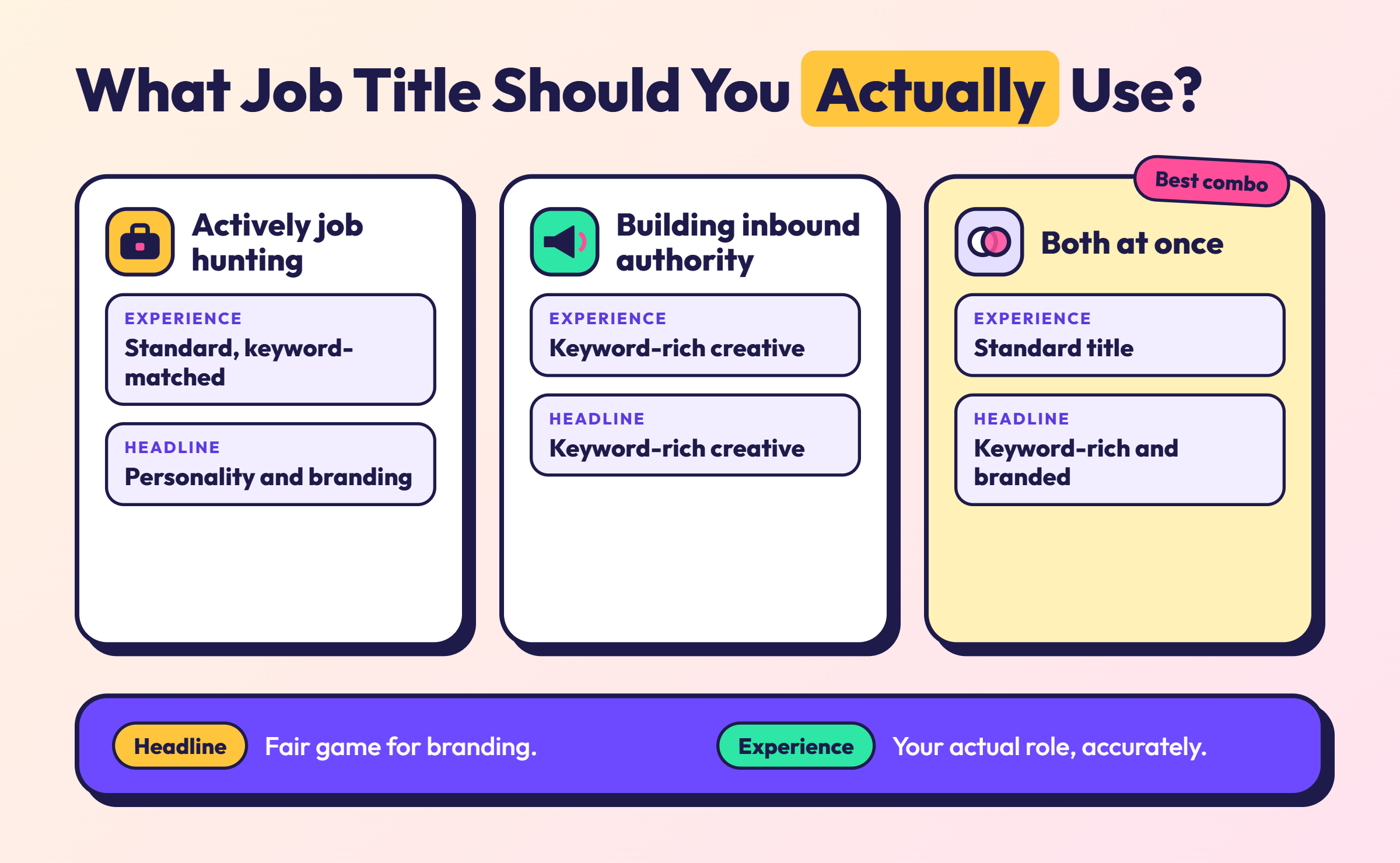
Actively job hunting → Use a standard, keyword-matched title in the Experience section. Put personality in the headline only.
Building inbound authority (coach, consultant, creator) → A keyword-rich creative title in both fields is defensible. Prioritize searchable terms within the creative framing.
Both simultaneously → Standard Experience title + keyword-rich, branded headline. This is the highest-leverage combination.
On the question of can you use a different job title on LinkedIn than your actual title: yes, in the headline — that field is fair game for any branding language. But the Experience section title should reflect your actual role accurately. Misrepresenting your official title there creates credibility and trust issues that can surface during background checks or recruiter conversations.
hyperclapper.com
Copy-Paste LinkedIn Headline Formulas That Get Views
Unlock LinkedIn success with proven headline formulas, 120+ examples, and tools to boost profile views and attract top opportunities.
LinkedIn Profile Optimization Checklist for Job Titles in 2026
Use this checklist whether you're tweaking for the first time or auditing an existing profile. LinkedIn profile optimization for job titles is a 10-minute fix with long-term search impact.
✓ LinkedIn Job Title Optimization Checklist (2026)
☐Experience section title contains at least one standard keyword a recruiter would type into search filters.
☐Headline (220 chars) uses personality, niche keywords, and differentiation — not just your job title repeated.
☐Experience title matches or closely reflects your actual official role title (no fabrications).
☐No internal jargon that only makes sense within your current company's culture.
☐If job hunting, title has been updated from any creator/brand mode to searchable mode.
☐Post visibility strategy (content + engagement) is active so profile gets found through content, not just search.
For professionals whose title sits in the middle ground — not purely searchable, not purely creative — post visibility becomes an essential secondary lever. When your content reaches a wider audience, your profile accumulates visits and signals that LinkedIn's algorithm uses to surface you in "People You May Know" and similar feeds. Getting found through LinkedIn search isn't just about titles — it's about the full visibility picture. Tools like HyperClapper help professionals amplify post reach through real community engagement, so their profile gets momentum even when their title sits in mid-funnel territory rather than pure keyword match.
Get your LinkedIn posts seen by more of the right people
HyperClapper connects your content with real engagement so your profile builds visibility through every post — not just search rankings.
Frequently Asked Questions About Creative Job Titles on LinkedIn
Should I use a creative job title or a standard one on LinkedIn to get found by recruiters?
Use a standard, keyword-matched title in your Experience section to get found by recruiters, and reserve creative language for your headline. Recruiter search tools filter by recognized job title keywords — if your Experience title is "Growth Ninja," it won't appear in searches for "Sales Manager" or "Marketing Manager," regardless of how strong the rest of your profile is.
What are the pros and cons of using an unconventional job title on LinkedIn?
Pros: higher profile click-through from feed posts, stronger personal brand differentiation, and better fit for coaches, creators, and consultants building inbound audiences. Cons: near-zero visibility in recruiter keyword searches, potential credibility concerns in conservative industries, and the risk of being permanently invisible to hiring teams running Boolean filters.
How do LinkedIn recruiters search for candidates by job title?
Recruiters using LinkedIn Recruiter enter keyword strings — "Product Manager," "Data Analyst," "Senior DevOps Engineer" — and filter results by those exact terms as they appear in the Experience and headline fields. They also use Boolean strings like "Marketing Manager" OR "Brand Manager". Titles that don't match any of those strings simply don't appear in filtered results.
Can a funny or creative LinkedIn title hurt my job search?
Yes — in two distinct ways. First, it makes you algorithmically invisible to recruiter search filters that rely on standard keyword matching. Second, in formal or conservative industries (finance, legal, enterprise tech), a playful title can signal poor professional judgment to hiring managers reviewing profiles. The closer you are to actively applying, the higher both risks become.
Can you use a different job title on LinkedIn than your actual title?
Yes, in the headline — which is branding copy and not a verified field. No, in the Experience section — where misrepresenting your official title creates trust and credibility issues that surface during recruiter conversations and background checks. The standard guidance is: be accurate in Experience, be expressive in the headline.
Why can't recruiters find me on LinkedIn even with a complete profile?
The most common cause is a job title in the Experience section that doesn't match how recruiters actually search. If your title uses internal jargon, creative language, or company-specific terminology, it falls outside LinkedIn's recognized keyword set — and according to LinkedIn's own algorithm, only 25–30% of free-form job titles are properly interpreted. Check your Experience title first, then verify your LinkedIn profile settings and visibility.
What consistently separates profiles that attract real inbound opportunities from those that don't is not how creative the title is — it's whether the title does the right job in the right field. The Experience title earns discoverability. The headline earns the click. Mixing up which field does which is the single most common — and most fixable — visibility mistake on the platform.
👋
⚡ Free plan
Leaving already?
Grab 3 free boosts on your next LinkedIn post — real likes & comments from 5,000+ creators. No card, cancel anytime.

 hyperclapper.com