Master cold email best practices that get real replies. Covers structure, personalization, follow-up sequences, subject lines, and deliverability for 2025–2026.
📅 ⏱ 16 min read📝 ~3100 words
Cold email copywriting — the craft of writing unsolicited outreach messages that earn attention, trust, and replies from strangers — is one of those skills where the gap between average and excellent is enormous. A pattern observed across thousands of outreach campaigns is that most cold emails fail not because the offer is bad, but because the copy treats prospects as targets rather than people. The fix is not a clever trick. It is a disciplined combination of relevance, brevity, value framing, a clear call to action, and deliverability hygiene. Get all five right and your reply rates climb. Miss even one and the whole sequence underperforms.
Key Takeaways
Cold email best practices in 2025 and 2026 centre on relevance and brevity — 50–125 words is the proven sweet spot.
Average cold email reply rates sit at 3–5%; well-personalized campaigns regularly reach 15–25%.
Subject lines, the opening hook, and a low-friction CTA are the three highest-leverage elements in any cold email.
Deep personalization (triggers like job changes, recent posts, funding rounds) consistently outperforms surface personalization (first name only).
Most replies come from follow-ups — a 3–5 touch sequence over 2–3 weeks is the standard for B2B email outreach in 2026.
Counterintuitive finding: longer subject lines and heavy automation often hurt reply rates more than they help.
What Is Cold Email Copywriting (And Why Most Outreach Fails)
Cold email copywriting is the discipline of constructing an outreach message — sent to someone with no prior relationship — that earns a genuine reply rather than a quick delete. It sits at the intersection of persuasion, empathy, and tactical formatting. Most professionals who struggle with it are not bad writers. They are writing the wrong things in the wrong order.
The most common failure mode is leading with the sender rather than the recipient. Subject line: "Introducing [Company]." Opening line: "We help businesses like yours…" These emails communicate nothing of immediate value. They signal that this is about the sender's quota, not the prospect's problem. In 2026, buyers receive hundreds of these weekly — and they have developed near-perfect filters for ignoring them.
🔴
Avoid:Opening your cold email with your company name, your product description, or the phrase "I hope this email finds you well." All three signal mass outreach immediately and reduce reply probability before the prospect even reads the first sentence.
The core tension in cold email best practices is between volume and quality. High-volume spray-and-pray campaigns generate a handful of replies but destroy deliverability and domain reputation over time. Quality-first outreach — smaller lists, tighter targeting, sharper copy — produces reply rates 4–6x higher and protects the sending infrastructure that makes future campaigns possible.
The Psychology Behind Prospect Personalization
Prospect personalization psychology is the study of why a prospect decides to reply to one email and delete another that makes a near-identical offer. The mechanism is simple: people respond to signals that they were actually seen, not processed. When a cold email references something specific and recent — a talk they gave, a challenge their industry is navigating, a post they published — it activates a different cognitive response than a generic pitch. It says: "this person paid attention." That perception of attention is what earns a reply.
Surface personalization (inserting first name and company name via a merge field) no longer moves the needle. It is table stakes. Deep personalization — referencing the specific, recent, relevant thing — is what separates campaigns that average 15%+ reply rates from those stuck at 1–2%.
Now that the psychology is clear, the structure of an effective email becomes a direct application of it — which is where most outreach either wins or loses.
How to Write a Cold Email That Gets Replies: Structure, Length, and Timing
The proven structure for a cold email that earns a reply follows four beats: a pattern-interrupt opening line → a one-sentence value proposition → a line of social proof or context → a low-friction CTA. Each beat has a specific job, and removing any one of them measurably reduces reply rate.
Cold Email Structure That Gets Replies
Cold Email Subject Lines That Get Opened
Cold email subject lines that get opened share one trait: they read like something a real person would write, not something a marketing team approved. Short, specific, and slightly unexpected outperforms long and polished every time. "Quick question about your onboarding" beats "Introducing Our Revolutionary SaaS Platform for Growth-Stage Teams."
Pattern interrupt subject lines — subject lines that break the visual rhythm of a crowded inbox — tend to outperform predictable formulations. A subject line that references a specific detail ("Saw your post on SDR hiring — thought this might help") forces the prospect to pause and evaluate whether they actually know you. That pause is the open.
Keep subject lines under 50 characters. Seven words or fewer. Avoid title case (it reads like an ad). Avoid emojis in B2B unless you have strong evidence your audience responds to them.
Reply-Worthy Call to Action Design
Reply-worthy call to action design comes down to one principle: reduce the friction of saying yes. "Would you be open to a quick 15-minute call this week or next?" asks for a low-commitment decision. "Schedule a demo with our team at your earliest convenience" asks for a high-commitment one. The former consistently outperforms the latter in B2B outreach.
One CTA per email. No more. Multiple CTAs create decision paralysis and signal that the sender is not confident in their own ask.
💡
Pro Tip:Phrase your CTA as a yes/no question rather than an open-ended ask. "Is this relevant to what you're working on right now?" is easier to answer than "Let me know if you'd like to connect." Easier answers get more replies.
How long should a cold email be? Research consistently points to 50–125 words as the sweet spot. Long enough to establish credibility, short enough to respect the recipient's attention. Emails that exceed 200 words see diminishing reply rates — every extra sentence gives the prospect another reason to defer reading until later (which means never).
When is the best time to send cold emails? Aggregated open-rate data points to Tuesday through Thursday mornings, specifically 8–10 AM in the recipient's local time zone. Monday sends compete with the weekend backlog; Friday sends get buried before the weekend. Tuesday and Wednesday consistently outperform.
Understanding when and how to send is only half the equation — who you send to, and how specifically you address them, determines whether even a perfectly timed email earns a reply.
Cold Email Personalization Tips That Actually Scale
Scaling personalization without sacrificing quality is the central challenge of modern email outreach. The solution that works consistently is modular templating: build a strong structural template and reserve one variable sentence — the "custom line" — for a prospect-specific observation. That single sentence does the heavy lifting. The rest of the email remains consistent and optimized.
The single biggest leverage point in cold email copywriting is not the subject line, not the CTA — it is the first sentence. If it reads like it could be sent to anyone, it will be treated like it was sent to everyone.
The trigger-based personalization framework organises outreach around observable prospect events: a recent job change, a LinkedIn post, a funding announcement, a product launch, or a public statement about a challenge they're facing. These triggers make an email feel timely rather than random. A message that arrives within days of a prospect's promotion signals genuine attention. The same message sent six months later reads as coincidence at best.
There is, however, a line. Over-personalization — referencing details that feel surveillance-adjacent (hometown, personal social media posts, family details) — damages trust rather than building it. The goal is to signal relevance, not to demonstrate how much you know about someone. Teams that push past professional context into personal territory consistently see reply rates drop and complaint rates climb.
Cold Email Deliverability and Copy Alignment
Email deliverability and copy alignment is the relationship between what your email says and whether it actually reaches the inbox. Spam filters in 2026 evaluate not just technical signals (SPF, DKIM, DMARC records) but also copy patterns: excessive links, aggressive promotional language, all-caps phrases, and deceptive subject lines all trigger filtering before a human ever sees the email.
Deliverability hygiene includes:
Warming sending domains for at least 4–6 weeks before launching campaigns
Verifying contact lists before sending to reduce bounce rates below 3%
Avoiding spam-trigger words ("FREE," "guaranteed," "no risk," "act now")
Keeping sending volume gradual — rapid volume spikes flag new domains quickly
Monitoring blacklist status weekly during active campaigns
Copy and deliverability are not separate concerns. An email with weak copy that gets low engagement teaches inbox providers that your domain sends unwanted mail — which throttles future deliverability even when the copy improves. This is why how to avoid cold emails going to spam is not purely a technical question — it is also a copy quality question.
Cold Email Follow-Up Sequence: How Many Emails Before You Stop
Cold email follow-up sequence timing
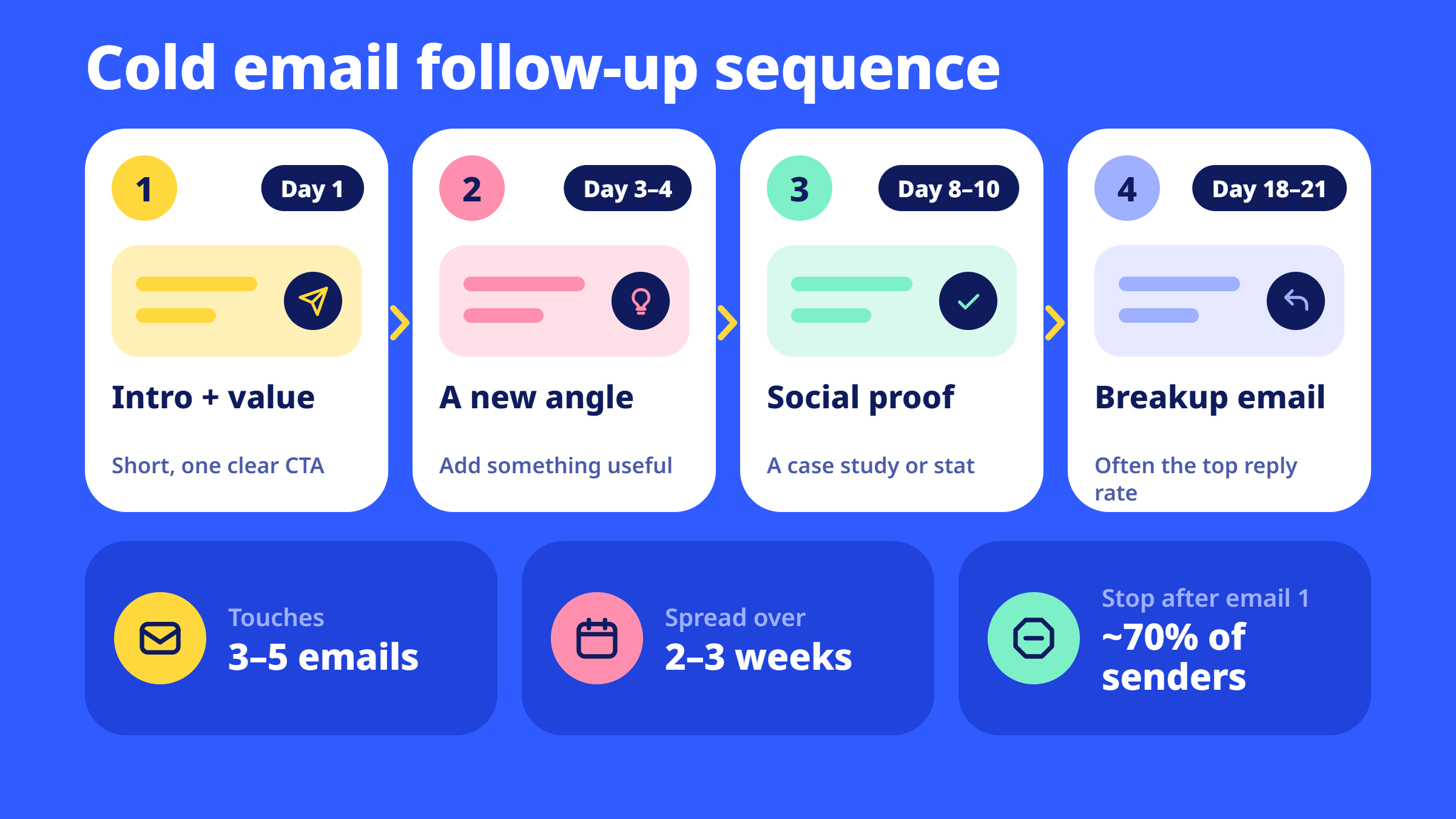
The data is unambiguous: most replies come from follow-ups, not the first email. A 3–5 touch sequence spread over 2–3 weeks is the proven standard for B2B email outreach in 2026. Stopping after one email — which roughly 70% of senders do — means abandoning the majority of available replies before they happen.
A structured cold email follow up sequence looks like this:
Email 1 (Day 1): Intro + clear value proposition. Short, specific, single CTA.
Email 2 (Day 3–4): A new angle or relevant insight — not "just following up." Add something useful.
Email 3 (Day 8–10): A brief case study, stat, or social proof relevant to their context.
Email 4 (Day 18–21): A low-pressure breakup email — "I'll stop reaching out after this, but wanted to leave this here in case the timing is better later."
The breakup email — counterintuitively — often generates the highest reply rate of the sequence. It removes the awkwardness of ignoring someone and gives prospects a safe moment to re-engage without feeling obligated.
If prospects are not opening at all, the problem is deliverability or subject lines — not the body copy. If they are opening but not replying, the problem is the value proposition or CTA. Diagnosing by open rate first saves enormous time troubleshooting the wrong variable. For a deeper dive on combining cold email automation with LinkedIn research to boost sales, that guide walks through the diagnostic process in detail.
⚠️
Warning:Sending follow-ups that only ask "Did you see my last email?" with no new value added is one of the fastest ways to get marked as spam. Every follow-up must justify its existence with something the prospect did not already receive.
Cold Email Response Rate Benchmarks for 2026
What is a good cold email reply rate? According to SalesHandy's analysis of 30.31 million cold emails sent in the first half of 2026, the average cold email reply rate was 4.5%. Separately, Martal's B2B cold email benchmarks report that approximately 95% of cold emails fail to generate any reply at all, with average response rates between 1% and 5%.
4.5%
Average cold email reply rate across 30M+ emails analyzed in 2026 — well-personalized campaigns regularly reach 15–25%
In practice, a 3–5% reply rate is average. A 8–12% reply rate is strong. Anything above 15% indicates excellent copy, targeting, and deliverability alignment — campaigns at this level typically combine deep personalization, trigger-based timing, and a heavily cleaned contact list. This means even modest improvements to your copy and targeting can double or triple results from the same sending volume.
Best Cold Email Software and Tools for Outreach in 2026
Choosing the right tool matters less than most people assume — but choosing the wrong one creates real problems. The best cold email software for outreach in 2026 falls into a few clear categories, each serving a different stage of maturity.
Tool
Best For
Key Strength
Risk Level
Instantly
High-volume B2B outreach
Inbox rotation, deliverability
Medium if warmed properly
Lemlist
Personalization at scale
Dynamic images, video snippets
Low–Medium
Smartlead
Agencies managing multiple clients
Multi-account management
Low–Medium
Apollo.io
Prospecting + sending combined
Built-in contact database
Medium
This cold email tools comparison comes down to a few evaluation criteria that actually predict results:
Inbox rotation: Can it spread sending across multiple inboxes to protect domain reputation?
Sending limits per inbox: Safe sending is typically 30–50 emails per inbox per day during warm-up.
Personalization features: Does it support custom variables, conditional copy blocks, or dynamic images?
Analytics depth: Can you see open rates, reply rates, and bounce rates at the sequence level?
GDPR and CAN-SPAM compliance: Does the tool support unsubscribe links and contact deletion?
The instantly cold email platform has become a popular choice specifically for its inbox warm-up infrastructure and deliverability-first design. A full breakdown is available in this Instantly AI cold outreach review.
What consistently separates teams that scale cold email successfully from those that plateau is not the tool — it is the discipline to master fundamentals before automating. Complexity added on top of weak copy does not fix the copy. It hides the problem long enough to damage your domain.
Want to amplify your outreach with stronger LinkedIn visibility?
HyperClapper helps founders, sales teams, and marketers build real LinkedIn engagement — so when your cold email lands, your prospect's first Google result shows an active, credible profile.
☐Subject line is under 50 characters, specific, and reads like a real person wrote it
☐Opening line is prospect-specific — references something real and recent about them
☐Value proposition is in the first 3 sentences and leads with their outcome, not your product
☐Total word count is between 50 and 125 words
☐There is exactly one CTA — phrased as a low-friction yes/no question
☐Sending domain is warmed, authenticated (SPF/DKIM/DMARC set), and not on blacklists
☐Contact list is verified — bounce rate target is below 3%
☐A 3–4 touch follow-up sequence is scheduled, each adding new value — not just "checking in"
Hyperclapper
Frequently Asked Questions About Cold Email Best Practices
What are the most important elements of a cold email that gets a reply?
The five elements that drive replies are a specific, low-hype subject line; a prospect-specific opening line; a one-sentence value proposition focused on their outcome; a brief social proof or context signal; and a single low-friction CTA. Remove any one of them and reply rates drop measurably. The opening line carries the most weight — if it reads generic, everything that follows is ignored.
How many follow-up emails should I send before giving up?
Send 3–4 follow-ups over 2–3 weeks before closing the sequence. Most replies arrive on the second or third touch, not the first email. The final message should be a low-pressure breakup email — it consistently generates replies from prospects who felt awkward ignoring earlier messages. After 4–5 touches with no open at all, pause and re-evaluate the list quality and deliverability before sending more.
Does personalization actually improve cold email reply rates?
Yes — meaningfully. Deep personalization (referencing a specific trigger like a funding round, recent post, or industry shift) consistently outperforms surface personalization (first name only). According to widely cited outreach data, personalized cold emails can improve response rates by 26% or more. In practice, a single well-researched custom line per email produces the majority of that lift without requiring each email to be written from scratch.
What should I avoid writing in a cold email?
Avoid opening with your company name, product pitch, or "I hope this email finds you well." Avoid multiple CTAs, long paragraphs, and promotional language that triggers spam filters ("guaranteed," "free," "no risk"). Avoid follow-ups that only ask whether the prospect saw your last email — every touch must add something new. And avoid vague asks: "Let me know what you think" is not a CTA.
What is a good cold email reply rate, and how do I improve mine?
A reply rate of 3–5% is average; 8–12% is strong; 15%+ signals excellent targeting and copy alignment. According to SalesHandy's 2026 analysis, the average sits at 4.5% across millions of emails. To improve: tighten your targeting, add one deep personalization line per email, shorten the copy to under 125 words, and audit deliverability before increasing send volume.
How do I stop my cold emails from going to spam?
Authenticate your sending domain with SPF, DKIM, and DMARC records. Warm new domains for 4–6 weeks before launching campaigns. Keep daily sending volume under 50 emails per inbox during warm-up. Verify contact lists to keep bounce rates below 3%. Avoid spam-trigger language in subject lines and body copy. Monitor blacklist status weekly. Poor copy that generates low engagement also teaches inbox providers your domain sends unwanted mail — deliverability and copy quality are linked.
What do cold email best practices 2025 and 2026 have in common?
Both years point to the same core principle: relevance beats volume. The 2025 cold email best practices that worked — tight targeting, trigger-based personalization, short copy, structured follow-up sequences — remain the standard in 2026. The main shift is that inbox filtering has become more sophisticated, making deliverability hygiene non-negotiable. Quality-first outreach consistently outperforms high-volume spray-and-pray, regardless of year.
Build the LinkedIn presence that makes your cold email credible
When prospects receive your cold email and search your name, what they find on LinkedIn either validates or kills the conversation. HyperClapper helps you build real post engagement, visible credibility, and a profile that supports every email you send.
After reviewing thousands of cold email campaigns, the pattern that holds across industries, offer types, and sending volumes is consistent: the senders who treat cold email copywriting as a writing discipline — not a numbers game — are the ones whose sequences keep improving over time. Volume amplifies quality. It does not replace it.
👋
⚡ Free plan
Leaving already?
Grab 3 free boosts on your next LinkedIn post — real likes & comments from 5,000+ creators. No card, cancel anytime.