Lead Qualification Process: Steps, Criteria and Frameworks
Master the lead qualification process with step-by-step guidance, BANT vs MEDDIC vs CHAMP comparison, scoring criteria, and CRM implementation tips for B2B teams.
📅 ⏱ 17 min read📝 ~3200 words
The lead qualification process is the structured method sales and marketing teams use to determine whether a prospect has the need, budget, authority, and timeline to become a paying customer — filtering sales-ready leads from those that need more nurture. A pattern observed across high-performing B2B teams is that qualification isn't a single gate or a gut-feel conversation. It's a repeatable, CRM-enforced system that maps specific lead signals to defined next actions. Without it, according to Landbase (2026), 67% of lost sales result from inadequate lead qualification. That number makes the case for a formal process more clearly than any framework ever could.
Key Takeaways
For: B2B sales teams, revenue ops leaders, marketers, and founders managing a pipeline
What you'll learn: How the qualification process works step-by-step, what criteria to evaluate, and which framework fits your sales motion
Why it matters: 67% of lost sales trace back to poor lead qualification — a defined process is the fix
BANT vs MEDDIC vs CHAMP: Each fits a different deal type — the wrong framework for your sales cycle adds friction without improving win rates
Most missed insight: Qualification is cyclical, not a one-time gate — leads can re-qualify after nurture, so CRM workflows matter as much as the framework itself
LinkedIn angle: For teams generating leads through LinkedIn, pairing outreach with a structured qualification layer is where most conversions are lost — see our guide to LinkedIn lead qualification automation
of lost sales result from inadequate qualification
10%
average prospect-to-qualified-lead conversion rate
20–30%
conversion lift from automated lead routing with SLA enforcement
20–25%
of leads progress past the qualification stage on average
What Is Lead Qualification and Why Does It Matter in 2026
What is lead qualification? It is the process of evaluating whether a prospect is worth pursuing further — based on defined criteria around need, budget, authority, and timing. The goal is to separate leads that sales reps should invest time in from those that belong in a nurture sequence or should be disqualified entirely.
The most common failure mode here isn't a bad framework. It's no framework at all. Most teams rely on rep instinct, which means qualification quality varies by person, by day, and by how full the pipeline looks at the end of the quarter. That inconsistency is expensive. Research published in PMC (Wu, 2023) found that only 1–6% of leads ultimately become customers — which means the average qualification process is filtering a huge volume with very low signal-to-noise.
There's also an important distinction between lead generation qualification — the top-of-funnel filtering that determines whether a lead is worth entering the pipeline at all — and deeper sales qualification, which happens mid-funnel to confirm readiness for a sales conversation. Both matter. Teams that collapse them into a single step tend to either let in too much noise or disqualify leads before they've been properly worked.
67%
of lost sales result from inadequate lead qualification — the single most preventable revenue leak in B2B pipelines
Marketing Qualified Lead vs Sales Qualified Lead: What's the Difference
A marketing qualified lead (MQL) is a lead that has met a defined engagement threshold — page visits, content downloads, email opens, webinar attendance — suggesting interest but not confirmed readiness to buy. A sales qualified lead (SQL) has been validated by a sales rep (or a structured process) as having the right fit, a real need, and enough intent to warrant a direct sales conversation.
The marketing qualified lead vs sales qualified lead distinction is where most marketing-to-sales handoff breakdowns happen. Marketing passes MQLs that sales considers cold; sales ignores the queue; marketing reports high MQL volume while sales complains about lead quality. The fix is a shared, written definition of what constitutes each stage — with specific scoring thresholds and CRM fields that enforce the handoff criteria, not just a verbal agreement in a quarterly meeting.
Lead Qualification Steps: How the Process Works End to End
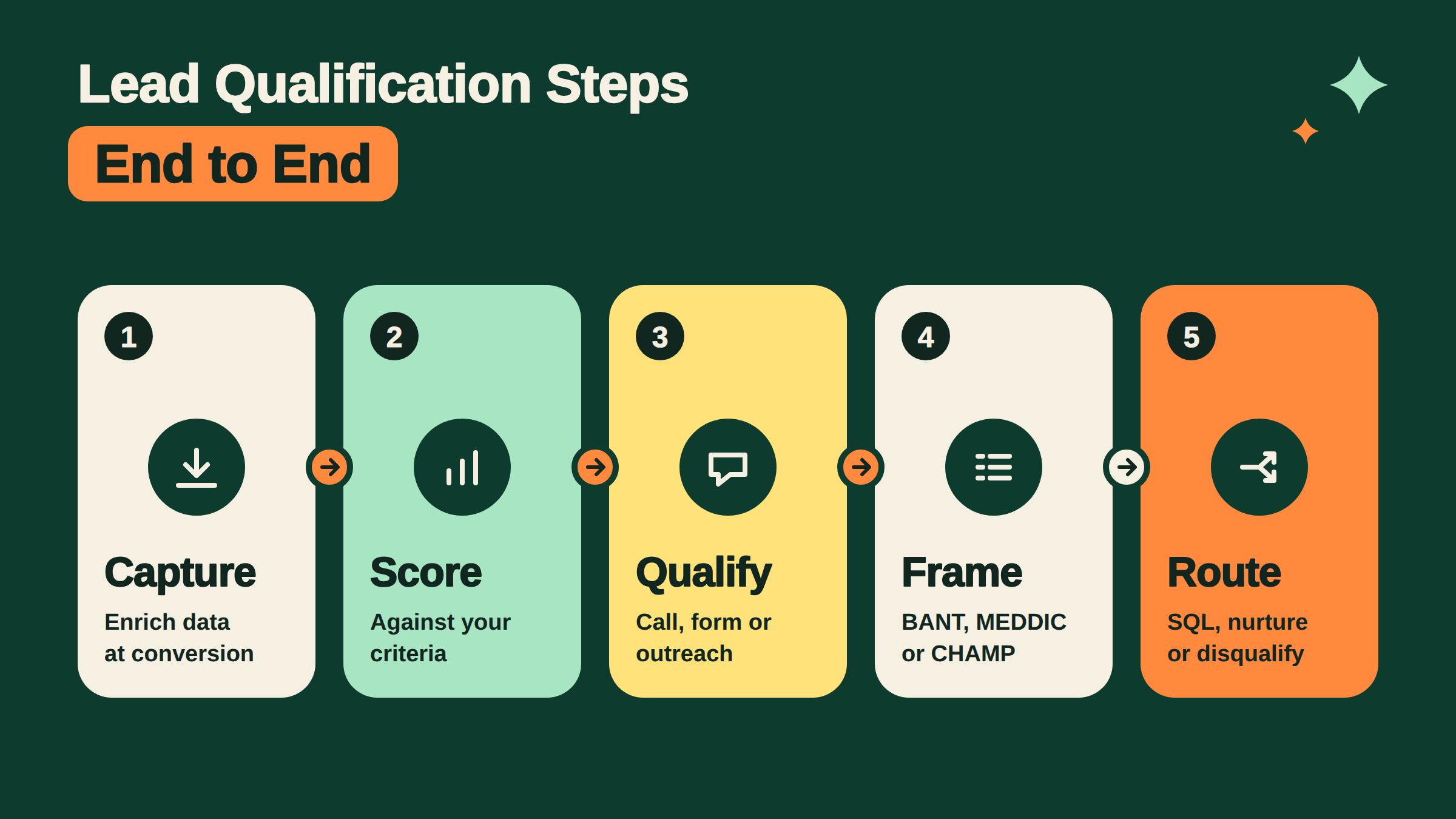
Lead qualification steps from capture to routing
Teams that run a consistently effective lead qualification process don't wing individual calls — they follow a sequence with defined handoffs at each stage. Here are the core lead qualification steps in order:
Capture and enrich lead data — pull in firmographic and demographic data at the point of conversion (form fills, ad clicks, LinkedIn inbound). Enrich automatically via your CRM or a tool like Clearbit.
Score against defined criteria — apply your lead scoring model immediately. Leads below the MQL threshold go into nurture; those above trigger a qualification review.
Run an initial qualification step — this is either a discovery call, a qualification form (for inbound), or a research-and-outreach sequence (for outbound). The goal is to confirm or reject fit against your core criteria.
Apply the qualification framework — use BANT, MEDDIC, CHAMP, or your adapted version to structure the conversation and document answers in the CRM.
Assign lead status and route accordingly — SQL goes to an account executive; not-yet-ready goes back to nurture with a re-engagement trigger; disqualified gets marked and excluded from future scoring.
💡
Pro Tip:Qualification is not a one-time gate. Build a re-qualification trigger in your CRM — if a disqualified lead re-engages with high-intent content (pricing page, case study, demo request) after 60+ days, it should automatically resurface for review rather than staying buried in a dead lead pool.
How to Qualify a Sales Lead: Key Questions to Ask
How to qualify a sales lead comes down to four question categories that map to the core qualification dimensions:
Need: "What's driving this search right now? What happens if you don't solve this in the next quarter?"
Authority: "Who else is involved in the buying decision? Is there a formal procurement process?"
Budget: "Do you have a budget allocated for this? What range are you working with?"
Timeline: "What does your decision timeline look like? Is there a go-live date or a contract renewal driving urgency?"
The order matters. Asking about budget before establishing need makes the conversation transactional before trust is built. Establish need and pain first — then budget and timeline land naturally.
When Should a Lead Be Passed to Sales
A lead should be passed to sales when it meets a pre-defined SQL threshold — not when a marketer thinks it "feels ready." Specifically: the lead has hit the minimum lead scoring threshold, has shown at least one high-intent buyer intent signal (pricing page visit, demo request, direct reply to outreach), and maps to your ideal customer profile on firmographic and role criteria. According to LeanData, companies using automated lead routing with SLA enforcement see conversion rate increases of 20–30% — which means the handoff mechanism itself is as important as the qualification criteria. Speed matters too: leads contacted within five minutes of a high-intent action convert at significantly higher rates than those followed up 24 hours later.
Lead Qualification Criteria: What to Evaluate and How to Score It
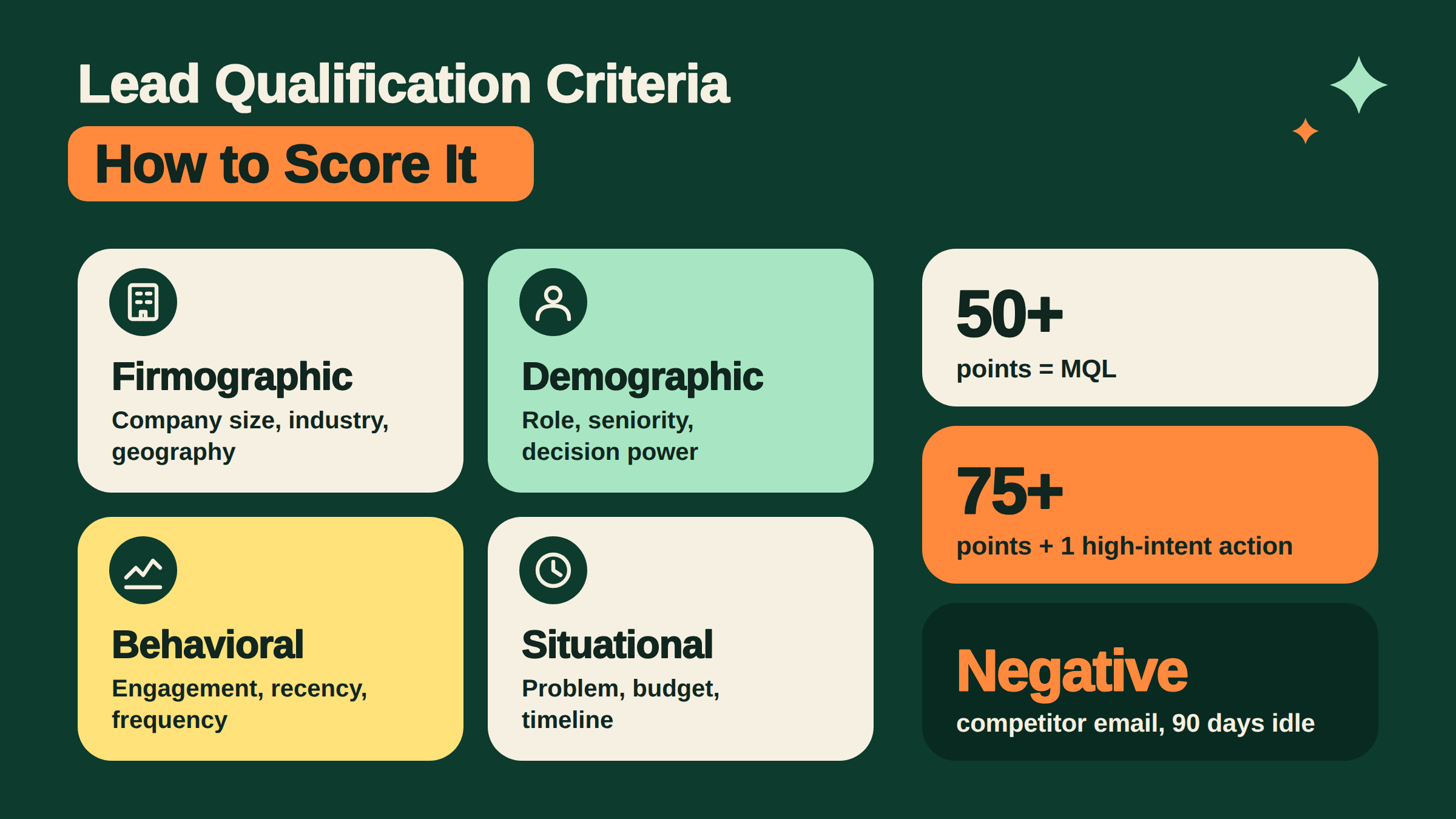
lead qualification criteria and lead scoring thresholds
Effective lead qualification criteria span four dimensions — and the most common mistake is evaluating only one or two of them:
Firmographic fit: Company size, industry, geography, tech stack. Does this company match your ICP?
Demographic fit: Role, seniority, decision-making authority. Are you talking to a buyer or an influencer?
Behavioral signals: Engagement depth, recency, frequency. Has this person visited pricing three times this week or downloaded one top-of-funnel ebook six months ago?
Situational fit: Active problem, defined budget, realistic timeline. Is there a reason to buy now?
Lead scoring — assigning numeric point values to lead attributes and actions — is the mechanism that makes these criteria operational. Without scoring, qualification depends on individual rep judgment. With scoring, a lead either clears the threshold or it doesn't. The score is defined by your criteria, not by how busy the sales team is.
Lead scoring thresholds need to be explicit: define exactly what score constitutes an MQL (example: 50+ points), what triggers an SQL review (75+ points plus one high-intent action), and what disqualifies a lead outright — competitor domain email addresses, wrong company size, unsubscribes, or zero engagement after 90 days (negative scoring).
How Do You Qualify Leads in B2B Sales
The b2b lead qualification process carries an additional layer of complexity: most B2B purchases involve multiple stakeholders. A single contact who is highly engaged may not be the economic buyer. A pattern observed across enterprise B2B deals is that teams using only individual lead behavior to qualify consistently underestimate the complexity of the buying committee — and then lose deals late in the cycle when procurement or the CFO introduces requirements that were never scoped.
In B2B qualification, the question isn't just "is this lead ready?" — it's "is this organisation ready, and do we have access to the people who will actually sign off?"
For how do you qualify leads in B2B sales: map the buying committee early. Identify the economic buyer, the technical evaluator, and the internal champion. Score at the account level — not just the contact level — and use tools like LinkedIn-driven account intelligence to understand organizational context before the first call.
Lead Qualification Frameworks Compared: BANT, MEDDIC, CHAMP and More
Three frameworks dominate real-world B2B sales qualification. Here's how they compare — and which fits which sales motion.
Framework
Best For
Complexity
Sales Motion
CRM Fit
BANT
Inbound SMB, early-stage deals
Low
Transactional
Easy to implement
CHAMP
Consultative mid-market selling
Medium
Consultative
Moderate
MEDDIC
Enterprise B2B SaaS, complex deals
High
Enterprise
Requires setup investment
BANT Lead Qualification Framework: How It Works in Practice
The BANT lead qualification framework evaluates four dimensions: Budget (does the prospect have allocated spend?), Authority (are you talking to a decision-maker?), Need (is there a real, active problem?), and Timeline (when do they need to solve it?). BANT works well for inbound SMB deals where the buying process is relatively straightforward and the rep needs a quick way to triage a high volume of leads.
The limitation: BANT was developed in a simpler sales environment. It assumes budget is defined upfront — but in many B2B deals, budget is created around the solution, not confirmed before the first call. Using BANT too rigidly disqualifies genuinely strong opportunities because the prospect hasn't yet built a business case. Use it as a starting checklist, not a pass/fail gate. Comparing BANT vs MEDDIC vs CHAMP reveals that BANT trades depth for speed — the right tradeoff for high-velocity, lower-complexity pipelines.
MEDDIC Sales Qualification: When and Why to Use It
MEDDIC sales qualification — Metrics, Economic Buyer, Decision Criteria, Decision Process, Identify Pain, Champion — is the gold standard for complex, multi-stakeholder enterprise deals. It demands that reps document not just whether a need exists, but how the prospect will measure success (Metrics), who controls the budget (Economic Buyer), what the internal evaluation process looks like (Decision Process), and whether there's an internal advocate (Champion) who will drive the deal forward.
Teams that skip this level of rigor in enterprise sales consistently find they lose deals in late stages — not because the product was wrong, but because they didn't identify the economic buyer early enough or misunderstood the decision criteria. What is the best lead qualification framework for B2B SaaS companies? For deals above $30K ACV with multiple stakeholders, MEDDIC wins consistently. For deals below that threshold, the documentation overhead slows velocity without adding proportional win-rate improvement.
⚠️
Warning:Applying MEDDIC to a high-volume SMB pipeline creates documentation overhead that slows your sales cycle without improving win rates. Match framework complexity to deal complexity — or you'll alienate reps and get compliance-by-appearance rather than genuine qualification.
Common Mistakes, Limitations and Lead Qualification Software to Know
Creators who skip a defined qualification process typically find their pipeline fills with noise — lots of activity, low conversion. But even teams with a formal process make predictable errors:
Framework rigidity: Applying a single framework to every deal type and lead source, ignoring that inbound and outbound leads have fundamentally different qualification starting points
Premature budget disqualification: Rejecting leads because budget isn't confirmed before understanding the full opportunity and whether it can be built
Rep-dependent memory: Qualification criteria that live in a rep's head rather than mandatory CRM fields — which means they disappear when reps leave
One-time gate thinking: Treating qualification as a permanent pass/fail rather than a status that updates as leads re-engage or circumstances change
On limitations: buyer intent signals can mislead. A pricing page visit signals interest — not intent. A demo request from a competitor doing competitive research is not a real opportunity. Lead scoring models also decay over time as your ICP evolves; teams that build a scoring model and never recalibrate it find their MQL quality steadily declining 12–18 months later.
Lead Qualification Software Worth Knowing
Lead qualification software falls into three categories:
CRM platforms with lead scoring: HubSpot and Salesforce both support custom scoring models, lifecycle stage enforcement, and automated routing rules — the foundational layer for any qualification process
Conversation intelligence tools: Gong and Chorus score calls against qualification criteria automatically, flagging when reps miss key MEDDIC or BANT questions
Intent data platforms: Bombora and 6sense surface buyer intent signals before a lead fills out a form — so your SDRs can prioritize outreach based on in-market behaviour, not just inbound volume
How to Build a Lead Qualification Process From Scratch
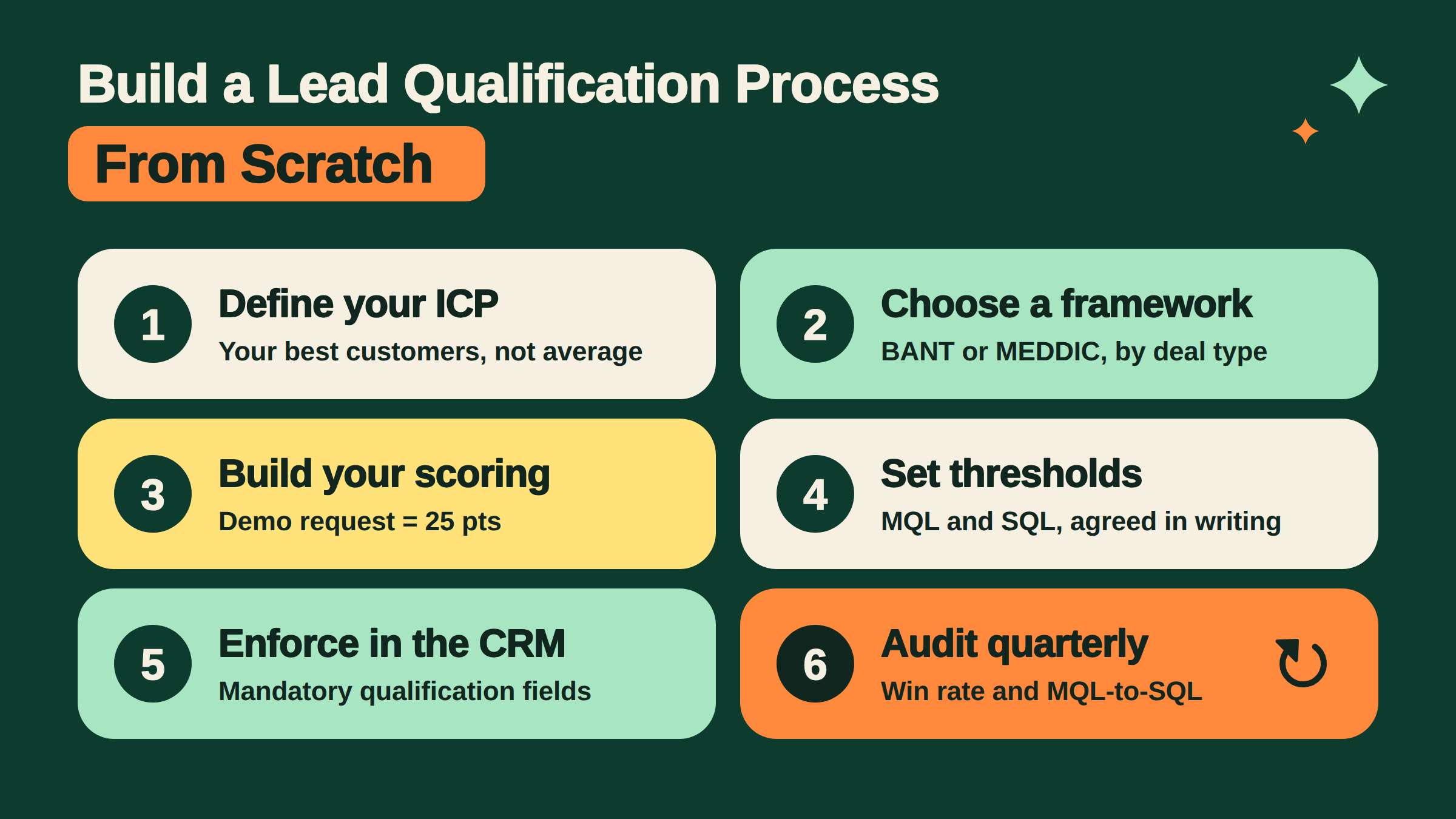
Building a lead qualification process from scratch
Building a lead qualification process from scratch follows a clear sequence. The key is to resist the urge to copy a framework template and instead design around your actual deal types and team structure:
Define your ICP explicitly — firmographic and demographic criteria that describe your best customers, not your average customers
Choose a framework matched to your primary sales motion (BANT for transactional, MEDDIC for enterprise)
Build your scoring model — assign point values to actions (demo request = 25 pts, pricing page visit = 15 pts) and attributes (target industry = 20 pts, wrong company size = -15 pts)
Set explicit MQL and SQL thresholds in writing, agreed upon by both marketing and sales leadership
Enforce criteria in the CRM — make key qualification fields mandatory before a deal can move to the next stage
Audit quarterly — compare win rates by lead source, MQL-to-SQL conversion, and sales cycle length to identify where criteria need tightening
For teams building pipeline through LinkedIn, pairing this process with structured LinkedIn lead generation automation ensures that leads entering the top of the funnel are pre-filtered for ICP fit before qualification resources are deployed. Tools like HyperClapper help surface visibility and engagement signals on LinkedIn that feed directly into this top-of-funnel filtering — so the leads you're qualifying are already warm, not cold contacts from a scraped list.
Get Better Leads Into Your Qualification Process
HyperClapper boosts your LinkedIn visibility so the right prospects find you first — warm leads that already know who you are qualify faster and close more often.
☐ICP defined in writing with explicit firmographic and demographic criteria
☐Lead scoring model built with point values for actions and attributes (including negative scoring)
☐MQL and SQL thresholds agreed upon in writing by marketing and sales leadership
☐Qualification framework chosen and matched to primary deal type (BANT / CHAMP / MEDDIC)
☐CRM fields for framework criteria are mandatory — deals cannot progress without them
☐Re-qualification trigger built for leads that re-engage after disqualification
☐Quarterly audit scheduled: MQL-to-SQL rate, win rate by lead source, average sales cycle length
Find a video: “lead qualification process BANT MEDDIC B2B sales”
Search YouTube and embed a relevant clip
↗ Search
Hyperclapper
Frequently Asked Questions About Lead Qualification
What does it mean to qualify a lead in sales?
Qualify leads meaning: to evaluate whether a prospect has the right fit, a real need, decision-making authority, and the ability and intent to buy within a reasonable timeframe. Qualifying a lead means filtering it against pre-defined criteria — so sales reps invest time in prospects that can actually close, not just those who expressed curiosity.
What is the difference between a marketing qualified lead and a sales qualified lead?
An MQL has met a defined engagement threshold — content downloads, page visits, email opens — that suggests interest. An SQL has been validated as having real purchase intent, confirmed fit, and readiness for a direct sales conversation. The boundary between the two should be a written, agreed-upon scoring threshold enforced in your CRM — not a judgment call made at the moment of handoff.
Which lead qualification framework is best for B2B SaaS companies?
For B2B SaaS deals above $30K ACV with multiple stakeholders, MEDDIC is the strongest choice because it explicitly maps the economic buyer, champion, and decision process — the elements most often missed in complex sales cycles. For lower-ACV, high-velocity SaaS pipelines, BANT or CHAMP delivers faster triage without sacrificing meaningful qualification signal.
What questions should I ask to qualify a sales lead?
Ask across four areas: need ("What's driving this search right now?"), authority ("Who else is involved in the decision?"), budget ("Do you have allocated spend for this?"), and timeline ("What's your target go-live date?"). Establish need first — asking about budget before building rapport makes the conversation transactional and causes prospects to understate their actual spend.
How do I build a lead qualification process from scratch?
Start by defining your ICP in writing, choose a framework matched to your deal type, build a lead scoring model with explicit MQL and SQL thresholds, enforce criteria as mandatory CRM fields, and schedule a quarterly audit. The audit — comparing win rates by lead source and MQL-to-SQL conversion — is where most teams find the criteria gaps that cost them deals. See also: proven LinkedIn lead generation campaigns that feed a qualification-ready pipeline.
What are the most common signs that a lead is sales-ready?
A lead is typically sales-ready when it combines firmographic fit (matches your ICP on company size, industry, and role), a high-intent action (pricing page visit, demo request, or direct outreach), and either a defined timeline or a stated active problem. One signal alone isn't enough — the combination of fit and intent is what separates a genuinely sales-ready lead from a curious browser.
What should be on a lead qualification checklist?
A solid lead qualification checklist covers: ICP fit confirmed, lead score above MQL threshold, at least one high-intent signal recorded, key framework fields completed in the CRM (need, authority, budget, timeline), buying committee mapped for enterprise deals, and a clear next-action assigned. Without all six, the lead isn't truly qualified — it's just optimistically labelled.
What consistently separates revenue operations teams with strong pipeline health from those constantly firefighting qualification disputes is not which framework they chose — it's whether they built the criteria into the CRM so the process runs the same way whether the rep is their best closer or their newest hire.
👋
⚡ Free plan
Leaving already?
Grab 3 free boosts on your next LinkedIn post — real likes & comments from 5,000+ creators. No card, cancel anytime.