Discover the best lead generation tools for small businesses in 2026 — free options, AI-powered picks, and LinkedIn strategies that work without ad spend.
📅 ⏱ 12 min read📝 ~2200 words
The best lead generation tools for small businesses do one job well: they replace the manual grind of finding, capturing, and following up with prospects — so a lean team can compete with outfits ten times their size. A pattern observed consistently across small business marketing stacks is that the teams growing fastest aren't running more ads — they're using smarter software to turn existing traffic and LinkedIn presence into a steady stream of qualified contacts. This guide covers the tools that actually deliver, what features matter, and where most small businesses go wrong.
Key Takeaways
Lead generation software automates capture, enrichment, and nurturing — reducing manual prospecting by hours per week.
The best free lead generation tools (HubSpot Free, Apollo free tier, LinkedIn organic) are enough for most early-stage small businesses.
AI-powered tools now cut customer acquisition costs by up to 60% — the category is no longer optional for competitive SMBs.
LinkedIn is the highest-ROI organic channel for B2B small businesses — and engagement tools like HyperClapper amplify it further.
The biggest lead generation mistake isn't choosing the wrong tool — it's skipping prospect nurturing after initial capture.
Most small businesses need 2–3 integrated tools, not 10 disconnected ones.
What Is Lead Generation Software and How Does It Work?
Lead generation software is any tool that automates the process of identifying, capturing, qualifying, and nurturing potential customers — pulling them through your pipeline from first contact to sales-ready. It covers the full arc: getting someone to raise their hand, collecting their details, scoring their intent, and staying in touch until they're ready to buy.
The core mechanism runs in three stages:
Capture — forms, landing pages, live chat, and pop-ups collect contact details from visitors or outbound lists.
Enrichment & scoring — the tool appends firmographic data (company size, industry, job title) and assigns a lead score based on behaviour and fit.
Prospect nurturing workflows — automated email sequences, LinkedIn touchpoints, and retargeting ads move contacts toward a decision without manual effort at every step.
Think of it as a conveyor belt for your pipeline: raw interest goes in one end, sales-ready conversations come out the other. The software handles the repetitive steps; your team handles the human moments.
On the inbound vs outbound pipeline question: inbound attracts prospects through content, SEO, and social; outbound reaches out proactively via email, LinkedIn, or ads. Small businesses typically benefit most from a blended approach — inbound builds long-term assets, outbound drives near-term pipeline. Most lead generation tools support both.
💡
Pro Tip:Lead generation software reduces manual work — it does not replace your sales judgement. The best results come when the tool handles qualification logic and your team focuses on conversations with the top-scored contacts.
What Features Should a Lead Generation Tool Have?
What features should a lead generation tool have
When evaluating any tool, look for these core capabilities — what features should a lead generation tool have will depend on your channel mix, but these apply universally:
Lead capture: forms, pop-ups, landing page builder, or chatbot
CRM integration: syncs contacts to your sales pipeline automatically
Lead scoring: ranks contacts by fit and intent so your team focuses on the right ones
Email or outreach automation: sequences that nurture without manual follow-up
Analytics: cost per lead tracking and conversion rate optimization tactics built in
Best Lead Generation Tools for Small Businesses in 2026
60%
Lower customer acquisition costs for businesses using AI-powered lead generation tools
According to Martal (2026), businesses using AI for lead generation report a 50% increase in sales-ready leads and up to 60% lower customer acquisition costs. In practice, this means a small business spending $500/month on lead software can achieve acquisition costs that previously required a full sales team. This is why the category of ai lead generation tools has become the fastest-growing segment of the lead gen software market.
Here are the best lead generation tools across budget tiers, directly answering "best lead generation tools for small business" and "best tool for small business lead generation":
The best free lead generation tools and lead generation tools free options are more capable than most small businesses realise. HubSpot's free CRM includes contact management, form builder, live chat, and basic email — a complete lead generation software small business starter kit with zero upfront cost. Apollo.io's free tier gives 50 monthly email credits and contact search — enough to validate a B2B outbound motion before committing budget. For email capture specifically, Mailchimp's free plan handles up to 500 contacts and 1,000 sends per month.
These free tools for lead generation work best when paired with a LinkedIn presence strategy — which brings us to where most small businesses are leaving pipeline on the table.
HubSpot vs Competitors for Small Business Leads
HubSpot lead generation tools dominate the all-in-one category, but they're not always the right fit. For service-based businesses that live on relationships rather than high-volume outreach, HubSpot's free tier is genuinely strong. The paid tiers scale steeply though — the Marketing Hub Starter jumps quickly once you need automation beyond basics.
The best lead generation tool alternatives to HubSpot for small businesses include Apollo (outbound-first), MailerLite (email-first, cheaper), and tools like HyperClapper for LinkedIn-first pipelines. See our deeper comparison of lead generation tool alternatives for a full breakdown by use case. The right choice comes down to your primary channel — HubSpot wins when you need everything in one dashboard; specialists win when you have a focused growth channel.
How Small Businesses Can Generate Leads Online Without Big Ad Budgets
Small businesses generate leads online without paid advertising through four organic channels that consistently outperform their cost: SEO content, LinkedIn organic, referral programs, and lead magnets. According to Email Vendor Selection (2026), 90.7% of marketers use their websites to generate leads — meaning SEO content is the default baseline, not a differentiator. What separates top performers here is layering LinkedIn organic and referral systems on top.
For B2B lead generation tools small business teams should prioritise LinkedIn above almost any other free channel. A founder with 2,000 relevant connections posting consistently can generate more qualified pipeline than a $1,000/month ad budget targeting the same audience. The catch: LinkedIn's algorithm rewards posts that receive early engagement. Posts that sit without interaction in the first 60–90 minutes rarely get distributed beyond your immediate network.
This is where tools like HyperClapper for small business LinkedIn marketing change the equation. By connecting your posts with real engagement channels — groups of relevant professionals who like and comment — HyperClapper boosts early post velocity so LinkedIn's algorithm distributes your content further. The result is inbound interest from your target audience without running a single ad. For founders and coaches building personal brands, this is one of the most affordable lead generation tools approaches available.
💡
Pro Tip:Combine a lead magnet (free guide, checklist, or template) with a LinkedIn post boosted via HyperClapper. The post drives traffic; the lead magnet captures email addresses. Two tools, zero ad spend, sustainable pipeline.
Lead Capture Tools for Websites: Turning Visitors Into Contacts
Lead capture tools for websites — including pop-up builders, inline forms, and chat widgets — convert anonymous traffic into named contacts. Tools worth knowing: Sumo for simple pop-ups, Typeform for high-completion conversational forms, and HubSpot's native form builder (free) for CRM-connected capture. The most common cost per lead benchmarks for SMBs on inbound channels sit between $25–$75 for content-driven leads — significantly below paid search CPLs that often run $100–$300 in competitive B2B categories.
Common Lead Generation Mistakes Small Businesses Make (and How to Avoid Them)
Common Lead Generation Mistakes Small Businesses Make
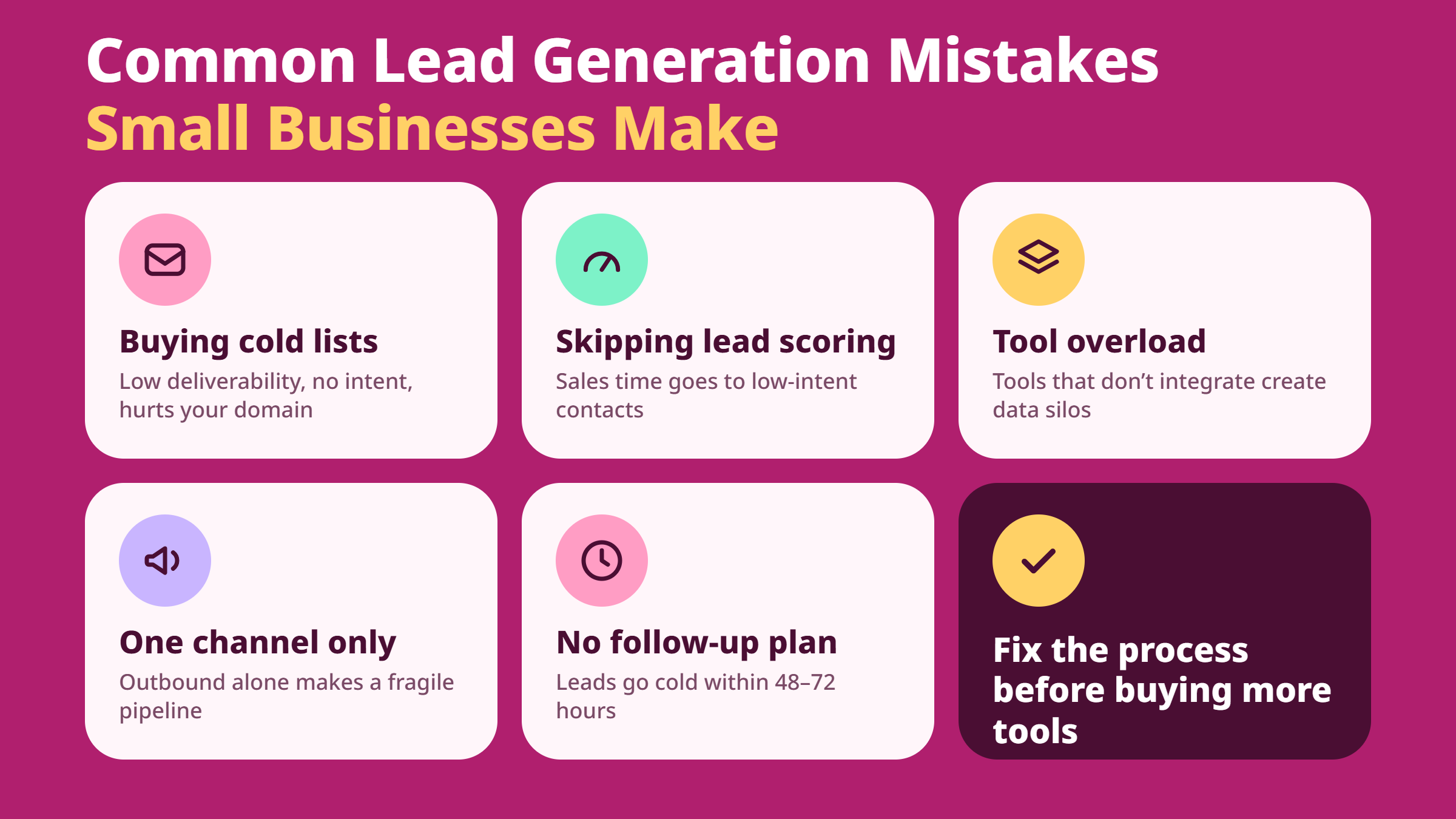
The biggest mistake in lead generation isn't a tool problem — it's a process problem. Teams that buy a lead generation tool and skip building the nurture sequence after it are essentially filling a bucket with a hole in it. Leads captured without a follow-up plan go cold within 48–72 hours; at that point, the conversion rate drops dramatically regardless of lead quality.
The most common failure modes, in order of how frequently they appear:
Buying cold contact lists — purchased lists have low deliverability, high spam rates, and no intent signal. They harm your domain reputation and rarely convert.
Skipping lead scoring — treating every contact identically wastes sales time on low-intent contacts while high-intent ones go cold.
Tool overload — small businesses often buy too many lead generation tools that don't integrate. Data silos mean no single view of the prospect journey.
Single-channel dependency — over-relying on outbound automation without building inbound assets (content, LinkedIn presence, referrals) creates a fragile pipeline.
⚠️
Warning:Marketing automation software can increase qualified leads significantly — but only when the underlying targeting and segmentation are set up correctly. Automating a broken process at scale amplifies the problem, not the results.
✓ Small Business Lead Generation Setup Checklist
☐Choose 1 CRM with a free tier (HubSpot or Apollo) and connect it to your website form
☐Set up at least one lead magnet (checklist, guide, or free consultation) on a landing page
☐Build a 3-email nurture sequence triggered immediately after lead capture
☐Post on LinkedIn 3x/week and boost posts with an engagement tool to expand reach
☐Set lead scoring rules: define what "sales-ready" looks like before handing off to outreach
☐Review cost per lead monthly — cut channels above your target CPL benchmark
Grow Your LinkedIn Pipeline Without Paying for Ads
HyperClapper helps founders and small teams boost LinkedIn post reach with real community engagement — turning content into inbound leads.
Frequently Asked Questions About Lead Generation Tools for Small Businesses
What are the best lead generation tools for a small business with a tight budget?
HubSpot Free, Apollo's free tier, and Mailchimp's free plan cover capture, CRM, and email nurture at zero cost. For LinkedIn-first businesses, HyperClapper offers affordable paid tiers with a strong ROI on organic reach. Most small businesses can run an effective lead generation stack for under $50/month total.
Which lead generation software works best for a service-based small business?
Service businesses — consultants, coaches, agencies — generate leads through relationships, not volume. HubSpot Free handles CRM and follow-up; LinkedIn organic (amplified with HyperClapper) drives inbound interest. Avoid high-volume outbound tools designed for transactional sales — they rarely fit a relationship-first model and often damage credibility.
How do I choose a lead generation tool for my small business?
Start with your primary acquisition channel. LinkedIn-first? Prioritise a LinkedIn engagement tool plus a basic CRM. Email-first? Get Mailchimp or HubSpot and a landing page builder. Map the tool to the channel before evaluating features. The right tool is the one that fits your actual workflow — not the most popular one. Check our LinkedIn automation tools guide for channel-specific advice.
Can small businesses generate leads without paid advertising using software?
Yes — and most small businesses should start there. SEO content, LinkedIn organic posting, lead magnets, and referral programs consistently generate qualified leads at a fraction of paid CPLs. Software makes it scalable: lead capture tools convert traffic, CRMs manage follow-up, and LinkedIn engagement tools like HyperClapper expand organic reach without ad spend.
What are some B2B lead generation tools for small businesses?
The strongest b2b lead generation tools for small teams are Apollo.io (contact database + outreach), LinkedIn Sales Navigator (account targeting + InMail), and HyperClapper (LinkedIn content reach + inbound pipeline). For a full comparison of best b2b lead generation tools by use case, see our LinkedIn lead generation campaigns guide. Apollo and HyperClapper both offer entry-level pricing suited to small teams.
How does lead gen work?
Lead generation works by attracting prospects, capturing their contact details, and nurturing them through a sequence until they're ready to buy. Software automates the repetitive parts — form capture, scoring, and email follow-up — so your team focuses on conversations with the highest-intent contacts. The core loop is: attract → capture → qualify → nurture → convert.
How much does lead generation software cost for a small business?
Lead generation software costs range from $0 (HubSpot Free, Apollo free tier, Mailchimp free) to $49–$150/month for paid plans with full automation. Most small businesses find a functional stack — CRM + email capture + one channel tool — costs $30–$80/month. Enterprise platforms like HubSpot Marketing Hub can exceed $800/month at scale, but that's rarely necessary at the SMB stage.
What consistently separates small businesses with a real pipeline from those stuck in feast-or-famine cycles is not budget — it's whether they've built a system that captures and nurtures leads while they're focused on delivery.
👋
⚡ Free plan
Leaving already?
Grab 3 free boosts on your next LinkedIn post — real likes & comments from 5,000+ creators. No card, cancel anytime.