A pattern observed across thousands of professional emails is that the closing does more persuasive work than the body. "Thank you for your consideration" — the default sign-off for countless job applications, cold emails, and client requests — signals deference, low confidence, and zero expectation of a reply. It originated in formal procurement and grant writing, not everyday professional correspondence. Using it in a cold email or follow-up actively suppresses your reply rate. A professional closing email should create forward motion, not close the door politely on itself.
- "Thank you for your consideration" was designed for formal bid submissions — it signals passivity in any other context.
- Emails with thankful, forward-looking closings receive up to a 62% response rate versus 46% for those without one.
- The right professional email closing depends on three factors: relationship, intent, and tone register — not one-size-fits-all etiquette.
- Most professionals default to "Best" not because it works, but because they've never been given a better framework.
- Specific, action-oriented closings outperform generic ones by embedding a soft call to action directly in the sign-off.
- The biggest mistake is using the same closing for every email — situational awareness is what separates strong communicators from forgettable ones.
- What 'Thank You for Your Consideration' Actually Signals
- The Context-Matching Framework for Professional Email Closings
- 12 Professional Email Sign-Off Alternatives
- Common Mistakes That Kill Your Professional Email Closing
- Frequently Asked Questions About Professional Email Closings
What 'Thank You for Your Consideration' Actually Signals to the Reader
"Thank you for your consideration" is a phrase that belongs in a government grant submission or a formal vendor bid — contexts where it was originally designed. In those settings, the sender genuinely has no standing to expect a reply and is formally acknowledging the recipient's power. The problem is that this phrase migrated into everyday professional email, carrying all of its submissive connotations with it.
According to data from research on email sign-offs, emails with a thankful closing see a response rate of 62%, compared to just 46% for those without one — a 16-point gap driven entirely by the closing. This means your sign-off alone can swing your reply rate by more than a third. In practice, this means a sales rep sending 50 outreach emails a day could generate 8 additional replies simply by replacing a passive closing with a forward-looking one.
Is 'Thank You for Your Consideration' Too Formal for Modern Email?

Yes — in most professional contexts. Correspondence closure psychology — the study of how endings shape the reader's emotional and cognitive response — shows that overly formal sign-offs create distance rather than connection. When a hiring manager or potential client reads "thank you for your consideration," the subliminal message is: "I don't really expect you to reply." That framing deprioritises the email immediately.
The phrase is appropriate in these narrow situations:
- Formal vendor or procurement submissions
- Grant or funding applications
- Correspondence to government bodies or regulatory agencies
- Highly formal academic or legal communications
Outside those contexts — cold outreach, client emails, follow-ups, even most job applications today — it signals that you've outsourced your closing to autopilot.
Does Your Email Sign-Off Actually Affect Reply Rate?
Unambiguously yes. The gap between passive vs assertive email language is measurable, not theoretical. According to an analysis of professional email sign-offs at Scribe-Mail, messages with a thankful closing showed a 62% response rate compared to 46% for those without — a difference large enough to redefine outreach strategy. The mechanism is simple: a closing that names a next step or expresses genuine warmth gives the recipient a social prompt to respond. A closing that doesn't creates no such prompt.
The Context-Matching Framework: Which Professional Email Closing Fits Which Situation
Most professionals default to "Best" for the same reason they default to "thank you for your consideration" — not because it works, but because nobody has given them a better decision tool. The Context-Matching Framework maps your closing choice across three axes:
- Relationship: New contact vs. established contact
- Intent: Request, follow-up, thank-you, or complaint
- Tone register: Formal, collegial, or warm
Teams that apply situational awareness to their closings consistently see higher engagement than those using blanket defaults. Think of it like dress code calibration — you wouldn't wear a three-piece suit to a startup pitch, nor a hoodie to a board meeting. The closing should match the context as precisely as the language in the body does.
Cold Emails and First Outreach: Why Cold Emails Get No Response
The most common failure mode in cold outreach is a closing that signals low expectation. "Thank you for your time" or "I hope to hear from you" both communicate that the sender doesn't genuinely expect a reply — and so the reader complies by not giving one.
For first-contact emails, use action-oriented closings that name a specific, low-friction next step:
- "Would Tuesday or Thursday work for a 15-minute call?"
- "Happy to send over a short case study if that's helpful — just say the word."
- "Let me know if this is relevant to what you're working on right now."
Follow-Ups, Client Emails, and Internal Messages: Situational Communication Register
Situational communication register — the tone and formality level appropriate to a specific professional relationship and context — is what determines whether a closing lands as confident or presumptuous. Here's a quick map:
- Follow-up (no reply yet): "Circling back in case this got buried — happy to work around your schedule."
- Client deliverable: "Let me know your thoughts when you've had a chance to review — I'm here for any questions."
- Internal colleague: "Let me know what you think — keen to get your take before Friday."
- C-suite cold outreach: "I'll keep it brief — worth 10 minutes if [specific outcome] is on your radar?"
The closing is not a formality. It is the last instruction you give the reader before they decide whether to reply, archive, or ignore your email entirely.
12 Professional Email Sign-Off Alternatives (With Templates and When to Use Each)
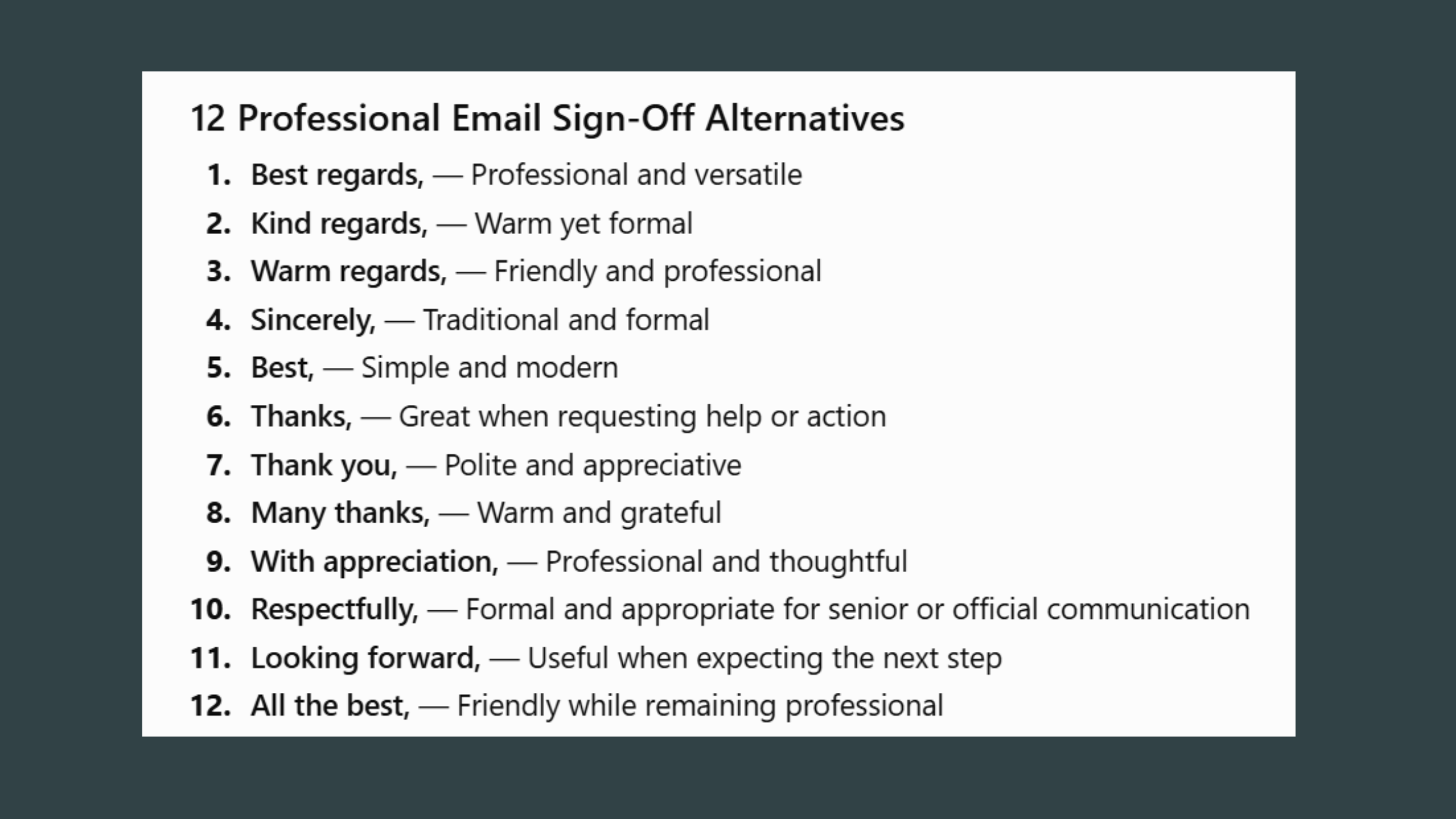
Here are email closing phrases that get replies — each matched to a situation, spanning the full spectrum from assertive-professional to warm-collegial. These are professional email closing examples drawn from patterns seen across high-performing outreach and client communication.
Confident and Action-Oriented Closings (For Requests and Outreach)
- "Looking forward to your thoughts" — Warm but expectant. Best for client deliverables or colleague reviews.
- "Let me know if [X date] works for a quick call" — Embeds a specific CTA. Ideal for cold outreach and follow-ups.
- "Happy to answer any questions — just reply here" — Lowers friction for first-contact emails.
- "Does this align with what you're working on?" — Invites a yes/no, making reply feel effortless.
- "I'll follow up [specific day] unless I hear from you before then" — Confident without being aggressive. For follow-ups only.
- "Keen to hear your take on this" — Collegial and direct. Works well for peer-to-peer outreach.
Warm and Collegial Closings (For Clients, Partners, and Established Contacts)
- "Thanks in advance for your time" — Expresses appreciation without sounding passive. Good for requests to known contacts.
- "Really appreciate your help with this" — Genuine warmth. Use with established relationships, not cold contacts.
- "Hope this is helpful — let me know either way" — Invites a reply even if the answer is no.
- "Excited to continue this conversation" — Forward-looking energy. Use after a meeting or substantive exchange.
- "Grateful for your continued support on this" — Appropriate for ongoing partnerships and long-term clients.
- "Talk soon" — Casual, warm, and only appropriate with established contacts. Never use in first-contact emails.
✓ The Professional Email Closing Checklist
- ☐Does your closing name a specific next step or invite a clear response?
- ☐Is your tone calibrated to the relationship (new vs. established)?
- ☐Have you avoided phrases that signal passivity ("I hope to hear from you", "please don't hesitate")?
- ☐Is the CTA placed before — not after — the sign-off line?
- ☐Are you using only one closing (not stacking "Thanks, Best regards, Kind regards")?
- ☐Is your email closing sentence different from the one you used in your last email to this person?
Common Mistakes That Kill Your Professional Email Closing (And How to Fix Them)
Roughly 4 in 5 professionals make at least one of these closing mistakes consistently — and most don't realise it because the cost is invisible. You don't get a notification saying "your email was deprioritised due to a weak sign-off." You just don't get a reply.
How to End a Professional Email: The Anatomy of a Strong Close
A strong email closing has three components, in order:
- The action sentence — one clear, low-friction request or next step
- The sign-off word or phrase — matched to relationship tier
- Your name and contact details — nothing extra
The most common mistakes that violate this structure:
- Burying the CTA after the sign-off. Once the reader hits "Best, [Name]," they stop reading. Your call to action belongs in the last body sentence, not as an afterthought below your signature.
- Stacking closings. "Thanks, Best regards, Kind regards, Sincerely" all in one email reads as indecision. Pick one.
- "Please don't hesitate to reach out." This is the email equivalent of a polite brush-off. It creates no forward motion and is so overused it reads as noise.
- Using "Best" as a universal default. "Best" is not wrong — but it is so generic that it adds no relational warmth and no reply momentum. If you're using it for every email regardless of context, you're leaving engagement on the table.
- Mismatching tone. A breezy "Talk soon!" to a C-suite contact you've never met signals poor judgment. A stiff "Yours faithfully" to a long-term collaborator feels oddly cold.
The same principles apply when you're managing your professional presence on LinkedIn. If your email outreach is getting replies but your LinkedIn content isn't getting visibility, platforms like HyperClapper help creators and professionals build real engagement momentum through community-driven post boosting and AI-powered replies — the LinkedIn equivalent of a strong closing sentence.

For professionals looking to improve their full communication toolkit — from email closings to LinkedIn messaging — the guidance on LinkedIn messaging tips, strategies, and templates covers the parallel principles for the platform where most B2B relationships actually form.
Your Email Gets You in the Room. Your LinkedIn Gets You the Deal.
HyperClapper helps professionals amplify their LinkedIn visibility with real engagement, AI-powered replies, and post boosting — so your content does the work between emails.
Explore HyperClapperFrequently Asked Questions About Professional Email Closings
Why does saying 'thank you for your consideration' make me sound weak in emails?
The phrase originates in formal bid and grant submissions, where the sender acknowledges they have no standing to expect a response. In a regular professional email, it unconsciously signals passivity and low expectation of a reply — which is exactly the emotional cue the reader follows. It's not rude; it's just a self-defeating default that most recipients process as a soft "don't worry about responding."
What are the best ways to end an email to get a response?
Embed a specific, low-friction next step in your closing sentence. Instead of "please don't hesitate to reach out," write "Does Tuesday or Wednesday work for a 15-minute call?" or "Let me know if this is relevant — a yes or no works." The easier you make it for the recipient to reply, the more likely they will.
Is 'thank you for your consideration' hurting my job application?
In most cases, yes — it signals that you don't expect a response, which can subtly undermine a confident application. A stronger alternative for job applications is "I'd welcome the opportunity to discuss how my background fits the role — I'm available for a call at your convenience." It's warm, professional, and forward-looking.
How does email language affect whether someone replies to you?
Significantly. Research on professional email sign-offs shows that emails with a thankful, forward-looking closing achieve a 62% reply rate versus 46% for those without — a 16-point gap. In practice, the closing gives the reader a social and cognitive cue about whether a reply is expected. Assertive, warm closings create that cue; passive ones erase it.
What is a professional closing salutation, and what are some good options?
A professional closing salutation is the sign-off phrase that appears immediately before your name — "Best regards," "Kind regards," "Sincerely," or "Thanks." Good options calibrated by context include: "Best regards" (formal, new contact), "Thanks" (collegial, established contact), "Kind regards" (neutral, mid-formality), and "Warm regards" (relational warmth, long-term clients). Avoid stacking multiple salutations in a single email.
What is a good closing line for a formal email?
For a formal email, the closing line should acknowledge the recipient's time and name a next step without being presumptuous. A reliable formula: "I would appreciate the opportunity to discuss this further at your convenience — please do let me know if you have any questions in the meantime." Follow it with "Yours sincerely" or "Kind regards."
When is 'thank you for your consideration' actually appropriate?
"Thank you for your consideration" is appropriate in formal submissions where the sender has no standing to expect a response: grant applications, vendor bids, regulatory filings, and government correspondence. In any context involving an ongoing relationship, a hiring process, or direct outreach to a peer or potential client, replace it with a more forward-looking phrase that invites a reply.
What are some friendly email closings?
Friendly closings work best with established contacts. Strong options include: "Talk soon," "Cheers," "Looking forward to chatting," "Hope you have a great week," and "Thanks so much." Match the warmth level to your actual relationship — "Talk soon" with someone you've never met reads as presumptuous, but it's perfect for a colleague or client you speak with regularly. Also see professional thank-you message formats that build real relationship equity.
What consistently separates professionals who get replies from those who don't is not writing skill, subject line tactics, or send-time optimisation — it's whether the closing sentence gives the reader a clear, frictionless reason to respond. The closing is the last thing they read. Make it do work.
The principles here extend well beyond email. If you're building relationships on LinkedIn — where your posts, messages, and comments are equally subject to the same passive-vs-assertive dynamics — explore how boosting LinkedIn engagement and follow-up email strategy reinforce each other across the full professional communication stack.
What consistently separates professionals with high reply rates from those who feel invisible in inboxes is not volume or subject line tricks — it is the recognition that the closing is a relationship tool, not an administrative formality. Accounts and professionals who treat it that way see compounding communication equity. Those who default to "Best" indefinitely typically plateau, wondering why their emails get opened but not answered.