GM almost always means "good morning" in casual texting, social media, and digital chat — but what does gm mean in text message conversations, on LinkedIn, and in gaming communities can vary wildly based on context. A recurring pattern among people confused by GM is that they encounter the same two letters in a romantic text, a crypto Discord server, and a LinkedIn feed on the same morning. The meaning is identical on the surface; the signal behind it is completely different. Look at the platform first, the relationship second, and the time of day third — and you'll decode it correctly every time.
- GM = "Good Morning" in almost all casual text and social media contexts — but also means General Manager in business and Game Master in tabletop gaming
- The GM LinkedIn morning trend is a deliberate reach strategy: posting before 9AM catches the platform's peak engagement window
- GM on LinkedIn migrated from crypto Twitter culture, where it signalled community optimism and presence — not just a greeting
- On Discord and Reddit gaming servers, GM can simultaneously mean both "good morning" and "Game Master" in the same thread
- A GM post alone won't build authority — the highest-performing versions pair it with one insight, question, or observation
- Most counterintuitive finding: receiving a GM text from someone you're romantically interested in is a low-effort but high-frequency signal — consistency matters more than the word itself
- What Does GM Mean? The Acronym Decoded
- What Does GM Mean on LinkedIn — and Why Before 9AM?
- Is Saying GM on LinkedIn Appropriate?
- GM Meaning Across Discord, Reddit, Instagram, TikTok, and Gaming
- LinkedIn Engagement Tactics: Making Morning Posts Work
- Frequently Asked Questions About GM
What Does GM Mean? The Acronym Decoded Across Every Context
GM is a context-dependent acronym — its meaning shifts completely based on where you see it. In casual texting, social media, and most digital chats, GM stands for "good morning." In business reporting, it means General Manager — a corporate title with zero warmth implied. In tabletop RPG communities playing D&D or Pathfinder, GM means Game Master — the person running the game session.
The most common failure mode is assuming the casual "good morning" reading when the context is clearly professional or gaming-related, or vice versa. What does gm mean on text from a friend at 7AM? Almost certainly a greeting. What does gm mean on text from your D&D group chat on a Saturday afternoon? Possibly a schedule question about the session's Game Master.
What Does GM Stand for in Social Media vs. Text vs. Business?
- Casual text / DMs: Good Morning — a low-effort greeting, often the opener to a longer conversation
- LinkedIn / Twitter / Instagram: Good Morning — used as a daily post ritual or engagement hook
- Crypto / Web3 communities: Good Morning — but loaded with community-identity meaning (see below)
- Business / sports media: General Manager — a leadership title, e.g. "the team's new GM"
- Discord / tabletop gaming: Game Master or Good Morning — depends on the channel topic
- Roleplay communities: What does gm mean in roleplay? Game Master — the person who controls the narrative and NPCs
Where Did GM Come From? Origin and History of the Greeting Online
The "good morning" shorthand predates smartphones — it appeared in early IRC chat rooms and SMS culture in the late 1990s and early 2000s as texting costs made brevity practical. Its modern viral life, however, starts with crypto Twitter around 2020–2021, where "GM" became a cultural handshake. Posting GM was a signal that you were optimistic about the market, active in the community, and committed to building — regardless of price action. Where did GM greeting come from online in its current form? That crypto Twitter moment is the origin point for how it spread to LinkedIn and mainstream social media.
GM went from a two-letter abbreviation to a community identity signal — the word stopped being about time of day and started being about who you were choosing to be that morning.
What does GM stand for in social media today is largely a direct inheritance from that cultural moment, diluted but still carrying traces of the "I'm here, I'm optimistic, I'm building" energy.
What Does GM Mean on LinkedIn — and Why Do People Post It Before 9AM?
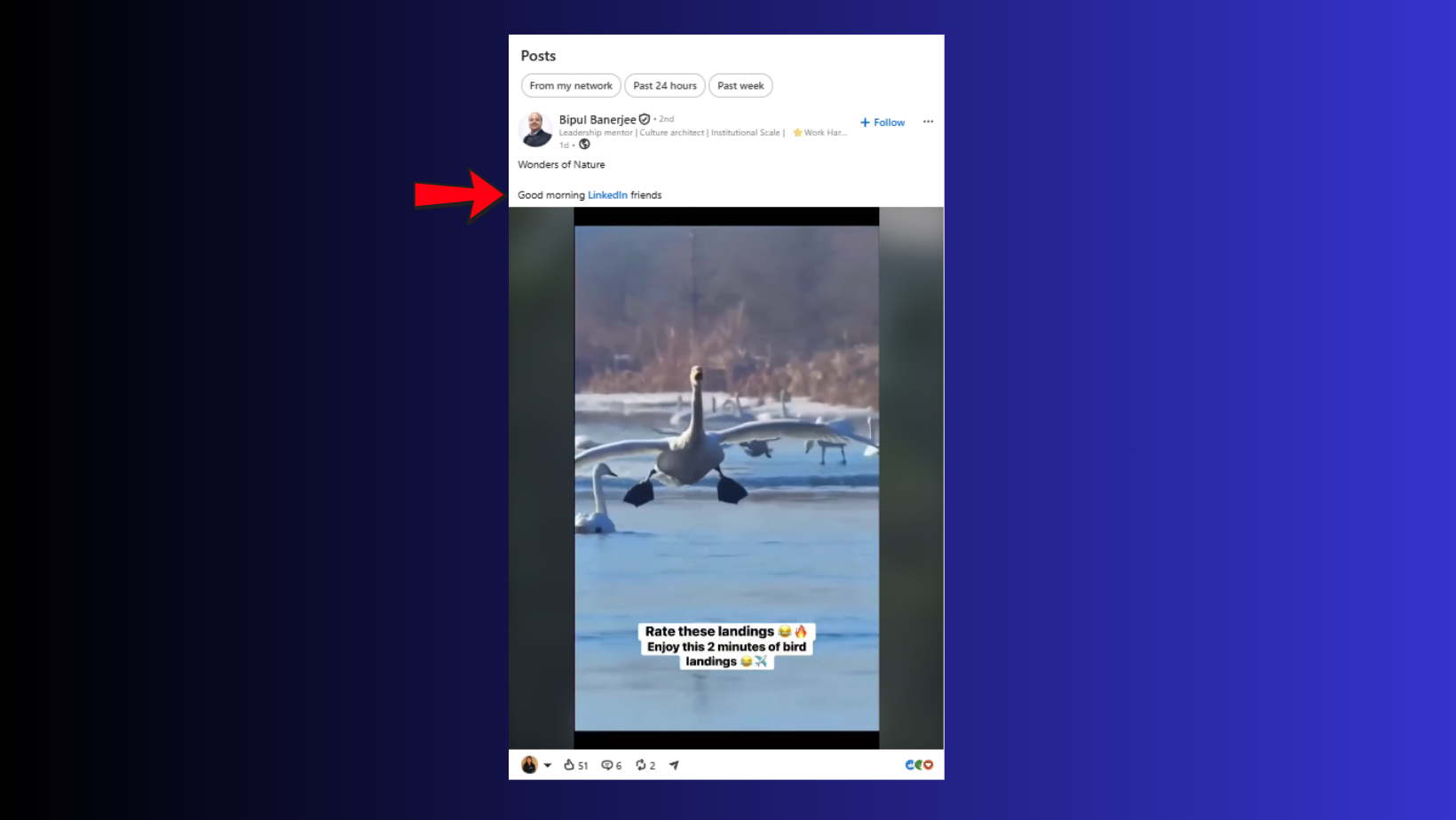
On LinkedIn, the GM LinkedIn morning trend is a deliberate engagement tactic, not just a greeting. The pattern observed across high-performing LinkedIn creator accounts is consistent: posting GM (or any content) before 9AM local time captures the platform's first major traffic spike — commuters, early risers, and professionals checking feeds before their workday starts.
LinkedIn's algorithm rewards engagement velocity — the speed at which a post receives likes and comments after publishing. A post that collects 15–20 interactions in its first 60–90 minutes gets pushed to significantly more feeds than one that sits quiet for the same period. Posting GM at 7AM is a reach strategy disguised as a casual greeting.
The GM LinkedIn morning trend is well-documented among LinkedIn creators: the first 60–90 minutes after publishing are the window that determines algorithmic distribution, making early posting a conscious reach decision rather than mere habit.
Is GM on LinkedIn a Crypto Slang Carryover or a Real Networking Trend?
Both — and that's what makes it interesting. Is GM on LinkedIn a crypto thing or a professional networking trend? It started as crypto slang, migrated to LinkedIn through Web3 founders and creator-economy crossover, and has since been adopted widely enough that most LinkedIn users now use it with zero crypto awareness. The crypto DNA still shows up in certain communities — posts paired with "WAGMI" ("we're all gonna make it") or NFT discussion — but the mainstream LinkedIn GM post is simply a morning engagement hook.
Does Posting GM on LinkedIn Increase Reach?
Does posting GM on LinkedIn increase reach? Directionally, yes — but not because of the word "GM" itself. The reach lift comes from two mechanics:
- Timing: posting in LinkedIn's peak morning window means more eyeballs immediately
- Comment replies: a GM post that asks a question generates comments, which LinkedIn's algorithm reads as a "meaningful conversation" signal and amplifies further
Teams that post GM with zero additional content typically see minimal reach lift. Teams that pair the opener with a question, a counterintuitive take, or a quick insight consistently outperform bare GM posts. Does saying GM on LinkedIn actually help your engagement depends entirely on what follows the two letters.
Is Saying GM on LinkedIn Appropriate — Or Is It a Mistake?
The honest answer: is GM appropriate on LinkedIn depends entirely on your audience. For personal brand builders, coaches, and founders building a human presence on LinkedIn, GM fits the conversational register that performs well in 2026. For B2B sales reps or executives whose buyers are C-suite decision-makers, it can read as thin content — "I showed up but brought nothing."
The most common failure mode here is using GM as an entire content strategy. It works as a community-building touchpoint or a lightweight way to maintain posting cadence on low-energy days. It won't build authority, generate inbound leads, or position you as a domain expert on its own.
Should I Say GM on LinkedIn? A Practical Decision Framework
Should I say GM on LinkedIn? Run through this quick check:
- Your audience follows you for personality + insights: GM works — pair it with something real
- Your audience follows you for specialist knowledge: Lead with the insight, not the greeting
- You're early in building your LinkedIn presence: GM posts help establish posting habit and generate first interactions
- You're already posting 3+ times per week with substantive content: GM as one of those posts is fine; GM as all of them is a problem
Interested in how format choices affect reach beyond just the opener? See how to format LinkedIn posts to increase reach and engagement — the structural choices matter as much as the content itself.
GM Meaning Across Other Platforms: Discord, Reddit, Instagram, TikTok, and Gaming
Platform-specific slang evolution means GM carries different social weight depending on where it lands. Getting the context wrong — especially in gaming communities — leads to real miscommunication.
- Discord / tabletop gaming servers: GM means both "good morning" and "Game Master" — in a D&D planning channel, "is the GM free Saturday?" has nothing to do with greetings. What does gm mean in roleplay contexts specifically? Game Master — the person running the campaign.
- What does gm mean on Snapchat: Purely "good morning" — typically a streak-maintenance greeting or the opener to a DM conversation
- Instagram / TikTok comments: "Good morning" used as an engagement prompt — creators drop GM in their own comment sections to spark replies and boost comment-section activity
- Reddit: Varies by subreddit — r/gaming and tabletop subs use Game Master; general subreddits use good morning
- Sports / business reporting: General Manager — completely different register, no greeting implied
Related Acronyms: GN, WAGMI, and the Broader Digital Shorthand Family
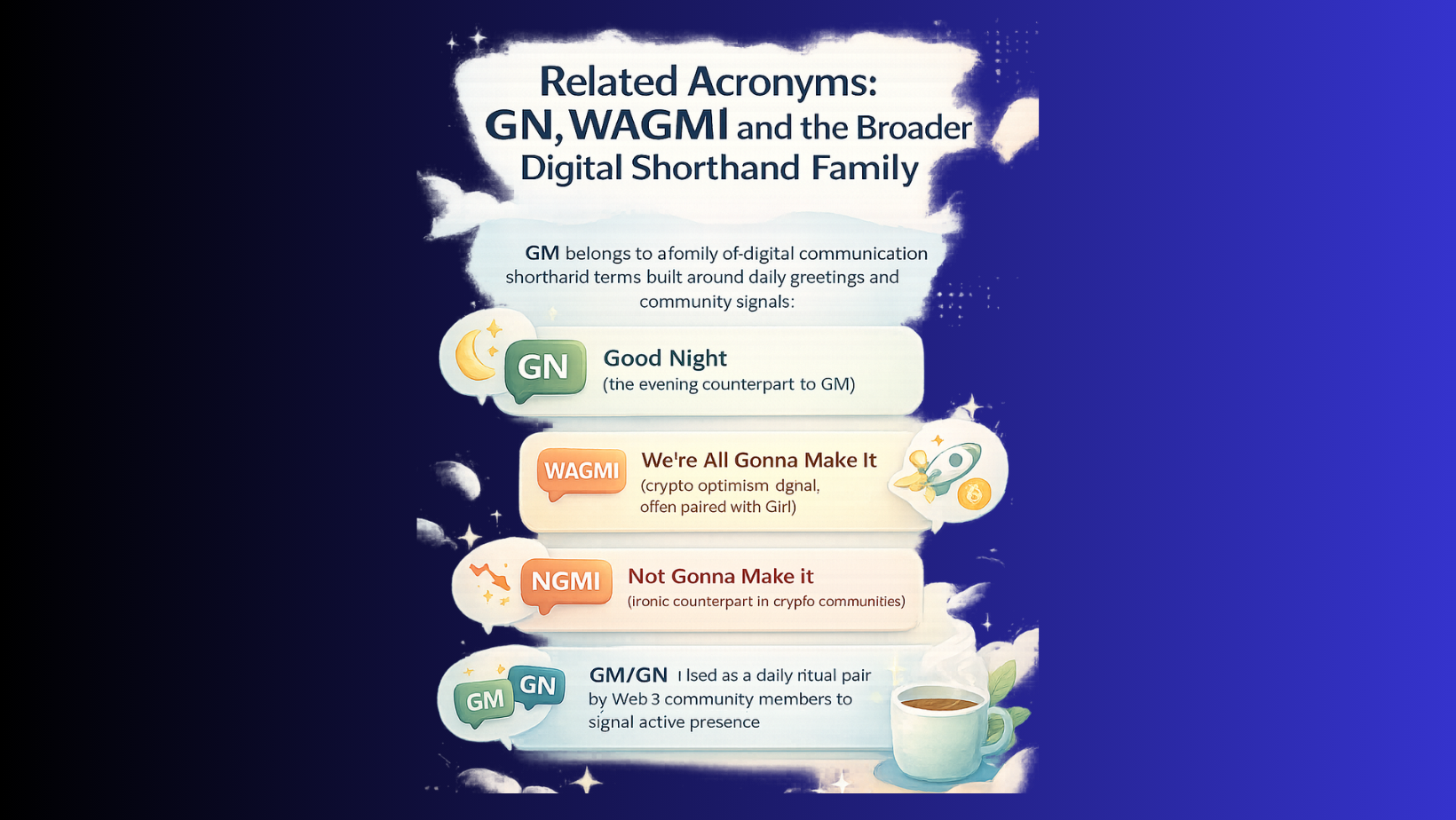
GM belongs to a family of digital communication shorthand terms built around daily greetings and community signals:
- GN — Good Night (the evening counterpart to GM)
- WAGMI — We're All Gonna Make It (crypto optimism signal, often paired with GM)
- NGMI — Not Gonna Make It (ironic counterpart in crypto communities)
- GM/GN — Used as a daily ritual pair by Web3 community members to signal active presence
Understanding GM meaning in professional networking means recognising that these acronyms serve as conversational intent signals — they communicate tone, community membership, and availability as much as their literal meaning.
LinkedIn Engagement Tactics: How to Make Morning Posts Actually Work in 2026
Timing is the entry point, not the whole strategy. What separates top-performing LinkedIn morning posts from forgotten ones is the combination of early timing, a reply-generating hook, and early engagement momentum. Accounts that nail all three see compounding reach; accounts that rely on timing alone typically plateau.
Consistency also matters more than most creators expect. Posting every weekday at the same time trains LinkedIn's algorithm — and your audience — to anticipate your content. GM posts are the easiest way to maintain that cadence on days when deeper content isn't ready. Creators who skip the cadence for even one or two weeks typically find their next substantive post underperforms because the algorithmic momentum has reset.
Using Tools Like HyperClapper to Amplify Your LinkedIn Morning Reach
The cold-start problem — the difficulty of getting early engagement when you don't yet have a large, active audience — is the biggest obstacle for new LinkedIn creators using morning posts as a reach strategy. Without early likes and comments, even well-timed posts sit quiet through the critical 60–90 minute window and get deprioritised.
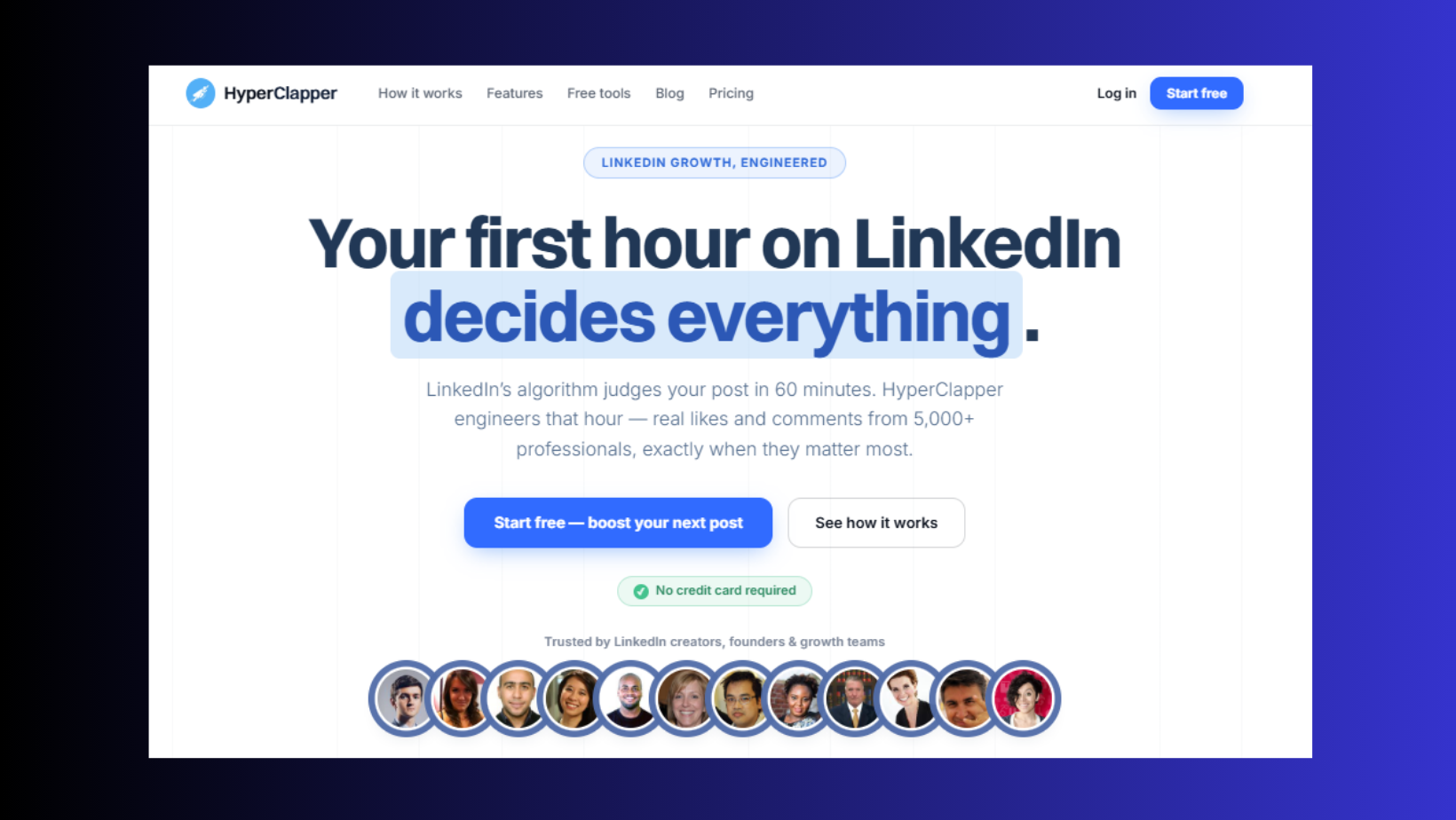
Tools like HyperClapper solve this directly. Users add their LinkedIn post to real engagement channels — groups of genuine professionals who interact with each other's content — and receive early likes and comments from real people, not bots. One channel delivers roughly 50 possible engagements; two channels, around 100. That early velocity is the algorithmic signal that drives broader distribution.
HyperClapper's AI-powered reply feature also helps maintain conversation depth after the initial push — extending post activity for 24–48 hours beyond the original publication window, which is where most morning posts lose momentum. For a deeper look at how to increase LinkedIn reach and engagement in 2026 without paid ads, the same early-engagement principle applies across every post format, not just GM posts.
Stop posting into silence every morning
HyperClapper connects your LinkedIn posts with real engagement channels — so your 7AM post gets the early momentum it needs to actually reach people.
See How HyperClapper Works✓ The LinkedIn Morning Post Checklist
- ☐Post between 6:30–8:30AM local time to catch the peak traffic window
- ☐Pair any GM-style opener with one specific question, insight, or observation
- ☐Reply to every comment within the first hour — your own replies extend reach
- ☐Use an engagement tool (e.g. HyperClapper channels) to seed early momentum if your audience is small
- ☐Post at the same time every weekday to train the algorithm and your audience's expectations
- ☐Check your analytics after 48 hours — impressions vs. comments ratio tells you if the hook worked
For a more granular look at how tagging and visibility mechanics interact with morning posts, see the guide on how to tag people on LinkedIn for maximum reach and engagement — tagging a relevant person in a GM-style post's first comment is one of the highest-leverage amplification moves available without paid promotion. And if you've seen the term CFBR on LinkedIn, it's a related engagement culture signal worth understanding alongside GM.
What consistently separates accounts with genuine reach from accounts with impressive follower counts is not posting GM at 7AM — it's the conversation that follows. The greeting is the door; the question inside it is what determines whether anyone walks through.
Frequently Asked Questions About GM in Text, Social Media, and LinkedIn
What does GM mean in slang?
In slang, GM means "good morning" — a casual, low-effort greeting used in texts, social media posts, and chat communities. In crypto and Web3 culture, it carries additional meaning as a signal of optimism and community presence, beyond just acknowledging the time of day.
What is GM Gen Z slang?
For Gen Z, GM is simply "good morning" used as a daily greeting in texts, Snapchat streaks, and Instagram DMs. It functions as a low-friction conversation opener — particularly in romantic or close-friend contexts where consistent morning contact signals interest and warmth.
What does it mean if a girl says GM?
If someone you're interested in texts you GM, it's a signal they're thinking of you first thing in the morning. The word itself is low-effort, but the consistency matters — a recurring GM text signals deliberate daily attention. One GM is friendly; GM every day for a week is intentional.
Why do LinkedIn users post good morning every day before 9AM?
LinkedIn's algorithm rewards early engagement velocity — posts that collect likes and comments within the first 60–90 minutes get pushed to significantly more feeds. Posting GM before 9AM catches the platform's peak morning traffic window, making it a deliberate reach strategy, not just a social habit.
Is GM on LinkedIn a crypto thing or a professional networking trend?
It started as crypto Twitter culture around 2020–2021, where GM was a community identity signal meaning "I'm here, I'm building, I'm optimistic." It migrated to LinkedIn through Web3 founders and creator-economy crossover and has since become mainstream enough that most LinkedIn users today use it with zero crypto awareness.
Does saying GM on LinkedIn actually help your engagement or is it spam?
A bare GM post with no additional content provides minimal reach lift and can read as filler. GM paired with a question, a counterintuitive observation, or a short insight consistently generates replies — and replies are what LinkedIn's algorithm reads as "meaningful conversation," which drives broader distribution.
What is the GM culture on LinkedIn and should I participate?
GM culture on LinkedIn is a morning posting ritual borrowed from crypto communities — professionals post GM to signal presence, optimism, and consistency. Whether to participate depends on your audience: it fits personal brand and creator accounts well; it can read as thin content for B2B or executive audiences expecting substantive expertise.
What does gm mean in text from a guy?
From a guy, GM in a text message almost always means "good morning" — a greeting to open the day. In a romantic context, receiving a consistent GM text is a relationship messaging cue: it signals you're the first person they think of when they wake up. Frequency and consistency matter more than the two letters themselves.
Curious about other LinkedIn status signals worth decoding? The green circle on LinkedIn is another visibility indicator that shapes how your activity is perceived — understanding both puts you ahead of most users still figuring out the platform's mechanics.



