Healthcare Lead Generation: B2B Strategies That Work
Master lead generation in healthcare with a compliance-first B2B framework. Strategies for hospitals, medical devices, and health systems that actually convert in 2026.
📅 ⏱ 14 min read📝 ~2700 words
Lead generation in healthcare is not simply harder than other B2B verticals — it operates under an entirely different set of rules. A pattern observed consistently across healthcare sales programs is that teams importing generic lead gen playbooks from SaaS or financial services see pipeline stall almost immediately, not because their tactics are bad, but because the compliance environment, the buyer psychology, and the sales cycle length make direct translation impossible. According to Connexu (2026), 61% of marketers say generating quality leads is their biggest challenge — and in healthcare, that challenge is compounded by multi-stakeholder procurement, regulatory scrutiny, and buyer distrust of vendors who demonstrate poor regulatory literacy.
Key Takeaways
Who this is for: B2B marketers, sales leaders, and vendors selling into hospitals, health systems, clinics, and medical practices.
Healthcare lead generation requires a compliance-first framework — HIPAA shapes every tactic from email to gated content.
The multi-stakeholder sales cycle (clinical + financial + IT) means 12–20 touchpoints per lead is normal, not a failure signal.
LinkedIn outreach, KOL partnerships, and peer referrals consistently outperform cold email in healthcare B2B.
Data platforms split into two categories: broad B2B tools (ZoomInfo) and healthcare-specific intelligence (Definitive Healthcare) — the right choice depends on your buyer type.
Counterintuitive finding: Lead-to-opportunity conversion rates in healthcare run 15–25%, roughly half of general B2B — meaning quality qualification systems matter more than volume.
Why Lead Generation in Healthcare Is Uniquely Hard (And What Most Guides Get Wrong)
Most lead generation guides treat healthcare as just another vertical with a slightly longer sales cycle. That framing misses the structural reality. B2B healthcare lead generation operates under HIPAA, state-level privacy regulations, and institutional procurement rules that actively restrict the tactics — cold email lists, retargeting pixels, form data sharing — that power lead gen in virtually every other sector. The most common failure mode is marketers who know the tactics but don't know which ones are legally usable in this environment, leaving them either paralyzed or exposed.
⚠️
Warning:Using a standard marketing automation platform to run email campaigns targeting healthcare providers without confirming HIPAA-compliant data handling can expose your organization to significant regulatory risk — even when you are the vendor, not the covered entity.
The Multi-Stakeholder Sales Cycle Explained
A multi-stakeholder sales cycle is a procurement process involving multiple decision-makers with different roles, priorities, and veto power — common in health systems, where a single vendor deal can require buy-in from a Chief Medical Officer, a CFO, a Procurement Director, and an IT Security lead simultaneously. Each stakeholder has different trust triggers: clinical staff respond to peer-reviewed evidence and KOL endorsement; financial decision-makers want ROI models and total cost of ownership; IT requires security documentation and integration specs.
According to Monday.com's healthcare sales analysis (2026), healthcare sales typically require 12 to 20 touchpoints per lead before an opportunity is created — compared to 7–10 in general B2B. This is not a problem to solve. It is the terrain to navigate.
Common Mistakes That Kill Healthcare Lead Generation Programs
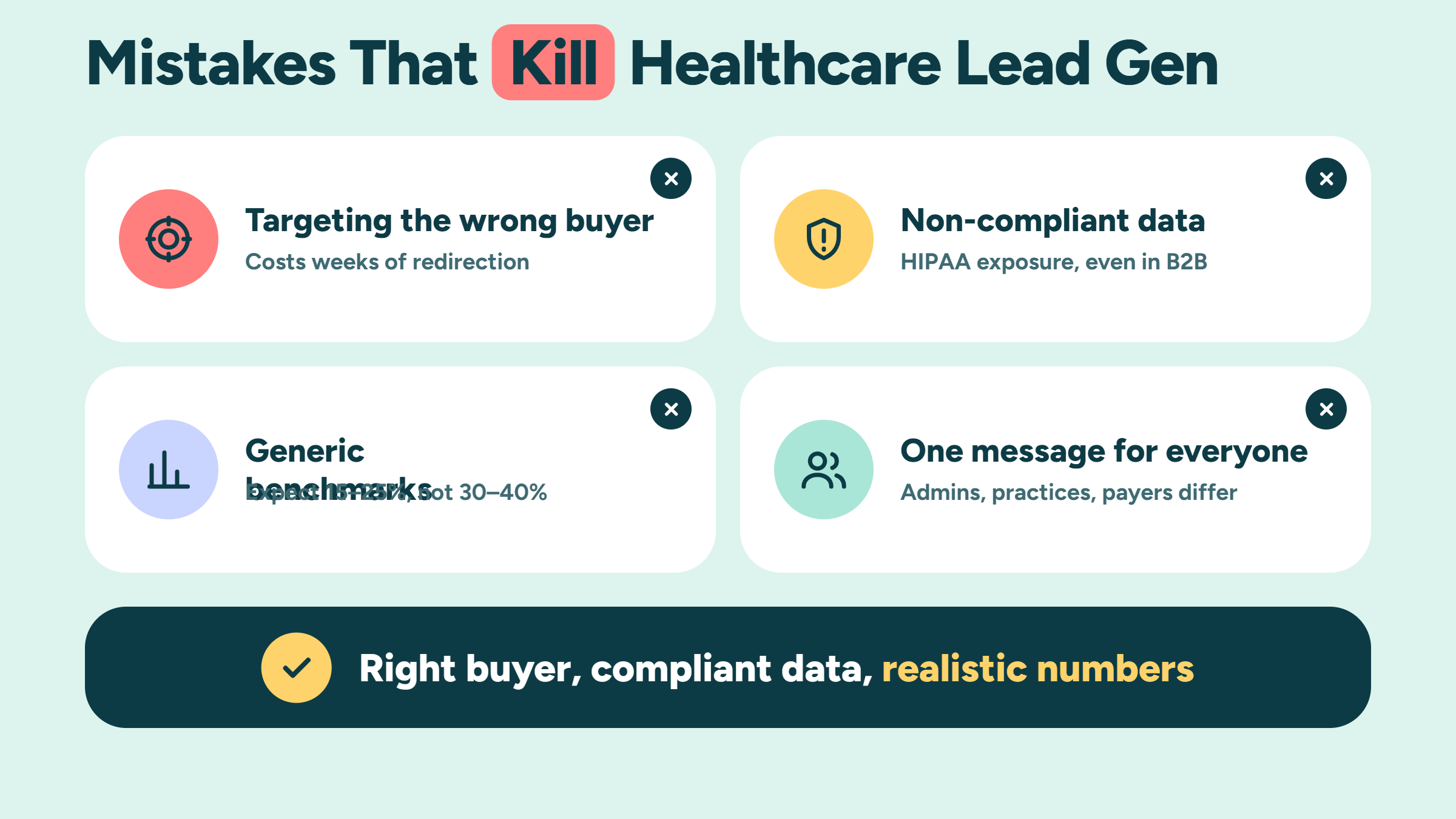
Mistakes That Kill Healthcare Lead Gen
Targeting the wrong buyer first. Sending outreach to clinicians for an administrative solution — or to procurement teams for a clinical tool — adds weeks of redirection before a conversation even starts.
Using non-compliant data sources. Purchased contact lists that include clinical staff data without proper consent documentation create HIPAA exposure, even in a B2B context.
Applying generic conversion rate benchmarks. Expecting 30–40% lead-to-opportunity conversion (general B2B norms) when healthcare conversion rates typically run 15–25% causes pipeline forecasting errors that undermine sales confidence.
Ignoring buyer persona segmentation. Hospital administrators, private practice owners, and insurance decision-makers have fundamentally different sales cycles, budgets, and trust triggers. One message targeting all three will resonate with none.
The real barrier to B2B healthcare lead generation is not finding leads — it is knowing which tactics are legally executable, which buyer type you are actually selling to, and what evidence will move them at each stage of a 12–20 touch cycle.
A Compliance-First Framework for B2B Healthcare Lead Generation
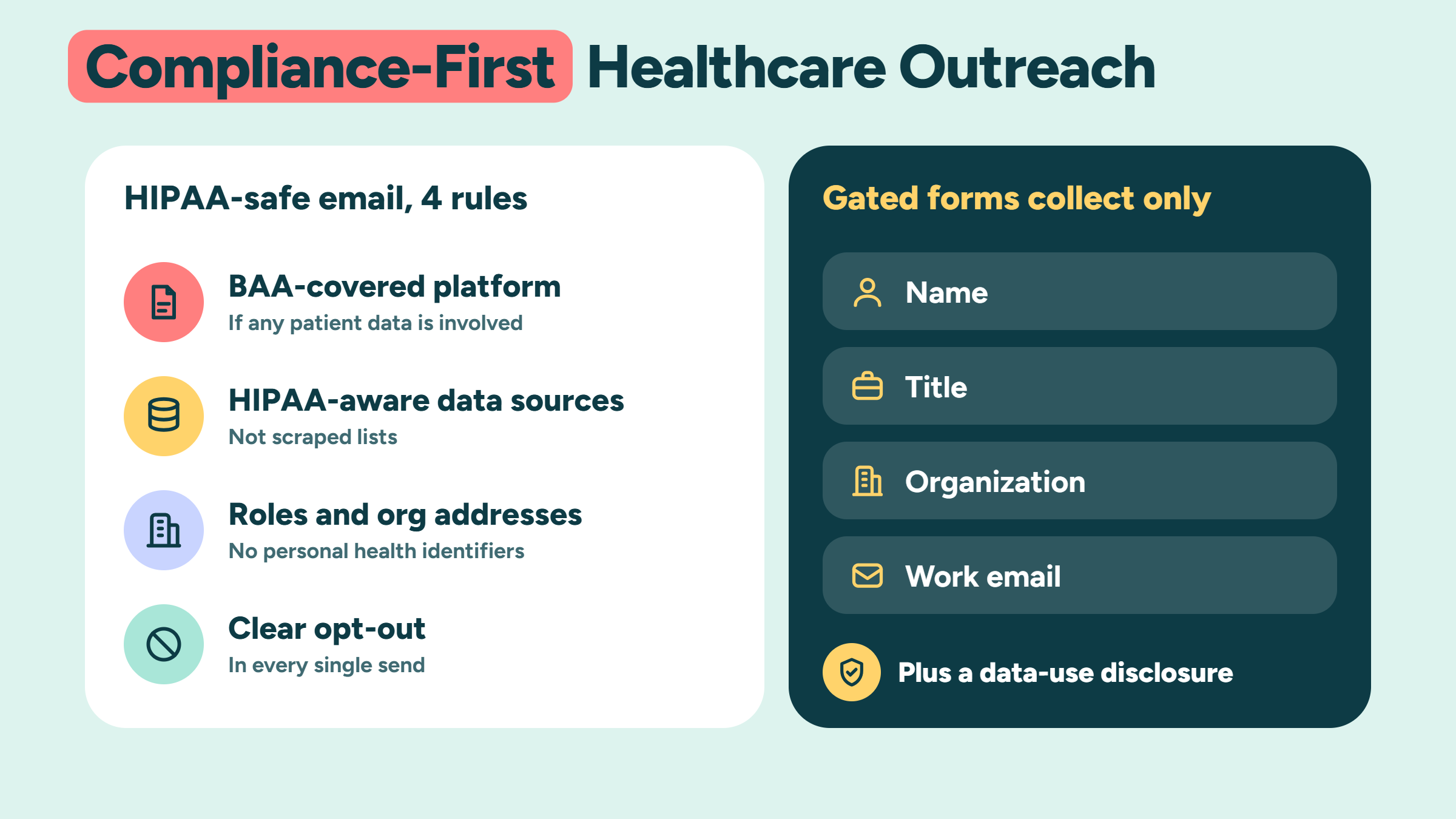
Compliance-first lead generation for healthcare vendors
The most durable healthcare sales lead generation programs are built compliance-first — meaning regulatory constraints are the architecture, not an afterthought. Teams that build HIPAA guardrails into their campaign design before selecting tactics consistently avoid the retrofitting problem that stalls or kills campaigns after launch.
HIPAA-Compliant Email Marketing for B2B Healthcare
HIPAA compliant email marketing B2B refers to email outreach that avoids handling Protected Health Information (PHI) and uses data collected through proper consent flows. In practice, this means:
Using a Business Associate Agreement (BAA)-covered email platform when any patient data could be involved.
Sourcing contact data from HIPAA-aware providers (Definitive Healthcare, verified professional directories) — not scraped lists.
Sending to professional roles and organizational addresses, not personal health-related identifiers.
Including clear opt-out mechanisms in every send.
A gated content compliance framework extends this logic to lead magnets: whitepapers, webinars, and case studies should only collect name, title, organization, and work email — and must include a disclosure about how that data will be used. This is both a legal requirement and a trust signal. Healthcare decision-makers notice vendors who demonstrate regulatory literacy and use it as a proxy for organizational quality.
Healthcare Buyer Persona Segmentation That Actually Works
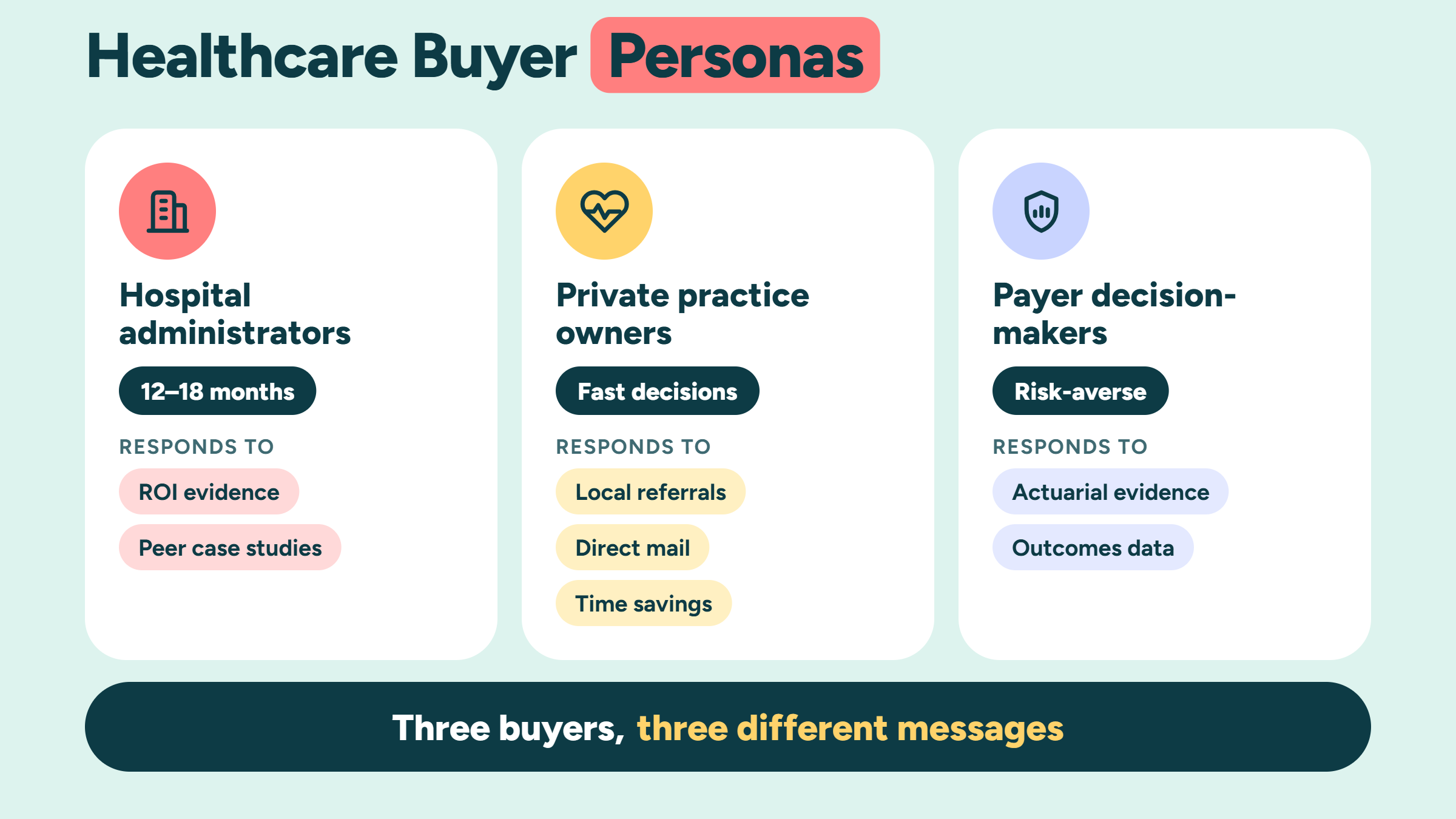
Healthcare B2B buyer personas
Healthcare buyer persona segmentation is the process of mapping distinct buyer types — by role, organization type, and purchase authority — so that messaging, content, and outreach channels are matched to each segment rather than broadcast uniformly.
Three segments require entirely different approaches:
Hospital system administrators: Long procurement cycles (12–18 months), committee-based decisions, respond to ROI evidence, case studies from peer institutions, and vendor risk profiles.
Private practice owners: Faster decisions, more price-sensitive, respond to local peer referrals, direct mail, and time-saving value propositions.
Insurance and payer decision-makers: Highly data-driven, risk-averse, respond to actuarial evidence and population health outcomes data.
💡
Pro Tip:Build a separate nurture sequence for each buyer persona — not just separate subject lines. The content type, cadence, and call-to-action should differ entirely between a hospital CMO and a private practice owner.
Best Channels and Tactics for Healthcare Sales Lead Generation in 2026
Across medical lead generation programs observed at scale, the highest-performing channel mix in 2026 combines LinkedIn authority building, conference-based networking, targeted content syndication through clinical publications, and structured referral programs. Cold email blasts to purchased lists rank last in qualified lead quality — and highest in compliance risk.
15–25%
Typical lead-to-opportunity conversion rate in B2B healthcare — roughly half the general B2B average
How to Reach Healthcare Decision Makers on LinkedIn
LinkedIn is the single most effective digital channel for b2b healthcare lead generation when used for authority building rather than cold outreach volume. What separates top performers here is a consistent content presence that demonstrates clinical and regulatory credibility — not connection request campaigns.
Healthcare sales prospecting tactics that consistently outperform cold outreach on LinkedIn:
Publishing case study content that names measurable outcomes (e.g., "reduced readmissions by 18% across 3 regional health systems")
Engaging with clinical thought leaders' posts before initiating direct conversation
Using Sales Navigator's job title and health system size filters to identify multi-stakeholder org-chart contacts
Sharing regulatory guidance content (e.g., new CMS rules, HIPAA updates) that signals vendor expertise
For teams building LinkedIn visibility at scale, platforms like HyperClapper help healthcare vendors amplify thought leadership content through real community engagement — ensuring posts reach relevant decision-makers rather than stalling at low organic distribution. Given that LinkedIn rewards early engagement velocity, this kind of structured amplification is particularly valuable for content-led B2B healthcare sales strategies. You can also explore the full breakdown of LinkedIn B2B lead generation approaches to calibrate your own program.
How to Generate Leads for Medical Device Companies
Medical device lead generation requires a channel mix that general B2B rarely uses. Clinical trust signals — peer-reviewed publication presence, clinical trial data, KOL (Key Opinion Leader) endorsements — are the primary credibility mechanisms that move device buyers from awareness to evaluation.
Medical practice lead generation strategies for device companies specifically:
Trade show and conference ROI: HIMSS, RSNA, and specialty society meetings remain top-performing lead sources for device companies — qualified buyers, compressed evaluation cycles, and warm conversation contexts.
KOL partnerships: A single respected clinician endorsing a product at a conference or in a journal can generate more qualified pipeline than months of digital outreach.
GPO and IDN channel relationships: Group Purchasing Organizations and Integrated Delivery Networks influence procurement for entire health systems — relationships here unlock enterprise-scale opportunities.
Building LinkedIn authority for healthcare sales?
HyperClapper helps B2B healthcare vendors amplify thought leadership posts with real engagement — so your content reaches the decision-makers who need to see it.
Healthcare Lead Generation Services, Software, and Tools Compared
The market for healthcare lead generation services and software divides cleanly into two categories: data and prospecting platforms that give you the contact intelligence, and full-service agencies that combine data with outreach execution. Choosing the wrong category for your internal capability level is the most expensive mistake teams make.
LinkedIn content amplification for healthcare vendors
Thought leadership reach, engagement visibility
SaaS subscription
According to A-Sales (2026), the agencies worth shortlisting for healthcare lead generation companies in 2026 include Belkins, A-Sales, SalesHive, and JMS — all with demonstrated healthcare sector experience. Managed US-based programs typically run $3,500 to $5,000 per month, with lower meeting volumes than general B2B campaigns reflecting the longer qualification cycle.
On the data platform side, the ZoomInfo vs Definitive Healthcare for prospecting decision comes down to buyer type. ZoomInfo covers the broader B2B landscape effectively. Definitive Healthcare specializes in provider and health system intelligence — including org-chart depth, physician affiliation data, claims-based utilization patterns, and facility-level financial data — making it the superior choice for teams focused on hospital system vendor marketing strategy. For practice-level sellers, neither platform is ideal without supplementary geographic and specialty filtering.
What to Look for in a Healthcare Lead Generation Partner
HIPAA-aware data practices: Can they document their data sourcing and confirm no PHI is handled?
Healthcare-specific experience: Do they understand procurement timelines, GPO structures, and clinical vs. administrative buyer differences?
CRM integration: Does their output flow cleanly into your Salesforce or HubSpot instance?
Territory and specialty coverage: Can they deliver density in your target geographies and clinical specialties?
Teams that skip the partner vetting process typically find that generic agencies generate high-volume, low-qualification leads that clog their pipeline and erode sales team confidence in marketing-sourced opportunities. The LinkedIn lead generation on autopilot approach works well as a complementary channel — keeping your brand visible while agency-sourced outreach handles direct prospecting.
✓ Healthcare Lead Generation Compliance Checklist
☐Confirm your email platform has a BAA in place if any patient data could be involved
☐Verify all contact data sources are HIPAA-aware (e.g., Definitive Healthcare, verified directories)
☐Add data usage disclosures to all gated content forms
☐Build separate nurture sequences for each buyer persona (hospital admin, practice owner, payer)
☐Set pipeline forecasts using 15–25% lead-to-opportunity benchmarks, not general B2B norms
☐Vet any agency or data partner on HIPAA practices and healthcare sector specialization before contracting
Turn your LinkedIn content into a consistent healthcare lead source
HyperClapper amplifies your thought leadership posts with real engagement so the right healthcare decision-makers see your content — without bots, spam, or compliance risk.
Frequently Asked Questions About B2B Healthcare Lead Generation
What are the most effective B2B lead generation strategies for selling to hospitals?
The most effective strategies for selling to hospitals combine LinkedIn authority content, peer referrals from existing clients, conference networking (HIMSS, specialty society meetings), and structured multi-stakeholder nurture sequences. Cold email volume is the least effective approach — hospital procurement teams are gatekept and compliance-conscious. Warm introductions through GPO relationships or mutual clinical contacts significantly compress the sales cycle. Expect 12–20 touchpoints before an opportunity is formally created.
How do I market a B2B healthcare product without violating HIPAA?
Market your B2B healthcare product by targeting professional roles and organizational contacts — not patient data or personal health identifiers. Use a BAA-covered email platform, source contacts from HIPAA-aware providers like Definitive Healthcare, add data usage disclosures to all lead capture forms, and ensure retargeting pixels are not placed on pages that could associate visitors with health conditions. The safest framing: treat regulatory compliance as a product feature, not a constraint.
What types of content generate the most leads in B2B healthcare marketing?
Gated content with high clinical specificity consistently outperforms generic whitepapers in healthcare B2B. The top-performing formats are: outcome-focused case studies from peer institutions, ROI calculators tied to reimbursement or operational metrics, regulatory guidance documents (new CMS rules, coding updates), and webinars featuring recognized clinical or operational thought leaders. Content that demonstrates regulatory literacy and quantifiable outcomes moves buyers — generic "industry trends" content does not.
Who are the key decision makers when selling to a health system?
Health system deals typically involve four stakeholder types: the clinical champion (CMO, CNO, or department head who validates the clinical case), the financial gatekeeper (CFO or VP Finance who approves budget), the procurement or supply chain lead (who manages vendor qualification and contracting), and IT/security (who reviews integration and data security). Missing any one of these in your outreach strategy means your deal will stall at that stakeholder — even if the others are fully aligned.
What do you do in healthcare marketing, and how is it different from other B2B sectors?
Healthcare marketing involves generating awareness, trust, and qualified pipeline among clinical, administrative, and financial buyers in hospitals, health systems, medical practices, and payer organizations. It differs from other B2B sectors in three ways: regulatory constraints limit which data and channels are usable; the multi-stakeholder procurement process requires persona-specific content for each buyer role; and clinical trust signals (peer evidence, KOL endorsement, published outcomes data) carry more weight than brand recognition alone.
What is a good conversion rate for healthcare leads, and how do I improve it?
A good lead-to-opportunity conversion rate in B2B healthcare is 15–25%, compared to 30–40% in general B2B — reflecting the higher qualification burden. To improve it: tighten your ideal customer profile to match your strongest existing customers, add persona-specific lead scoring that weights clinical role and organization type, and ensure your SDR team qualifies for budget authority and procurement timeline before passing to AE. Better qualification at entry beats volume-focused approaches every time.
What should I know about lead generation and appointment setting services for healthcare?
Lead generation and appointment setting services for healthcare must be evaluated differently than general B2B equivalents. Managed programs typically cost $3,500–$5,000 per month in the US, with lower meeting volume than generic B2B campaigns — a reflection of longer qualification cycles, not underperformance. Require that any agency demonstrates HIPAA-aware data practices, healthcare-specific SDR training, and experience navigating multi-stakeholder procurement before signing a contract.
What consistently separates B2B lead generation for healthcare companies that generate real, closeable pipeline from those that produce noise is not a better tactic list — it is a compliance-first architecture paired with buyer-type specificity. Teams that map their entire lead generation system around who the actual decision-maker is, what evidence moves that specific buyer, and which channels are legally executable in their regulatory context see compounding results. Teams that apply generic strategies and hope for the best typically plateau after early activity — and spend the next quarter troubleshooting compliance gaps instead of closing deals. For additional LinkedIn-based approaches that complement your healthcare outreach, the 10 proven LinkedIn B2B marketing and sales strategies for 2026 is worth reviewing alongside this framework.
👋
⚡ Free plan
Leaving already?
Grab 3 free boosts on your next LinkedIn post — real likes & comments from 5,000+ creators. No card, cancel anytime.