A pattern observed across platform transparency announcements is that the headline rarely matches the substance — and X's open source algorithm release is the clearest example in recent memory. When Elon Musk pushed the X recommendation algorithm to GitHub in 2023, it was framed as a landmark moment for Twitter algorithm transparency. What actually landed on GitHub was the ranking pipeline's skeleton: the candidate retrieval logic, the scoring model architecture, and the filtering layer. The model weights, training data, real-time tuning parameters, and trust-and-safety overlays — the components that actually determine what you see — stayed private. Understanding this gap is the difference between using the public code intelligently and being misled by the PR framing around it.
- X open sourced the architecture of its recommendation algorithm — not the trained weights, live tuning parameters, or safety overlays that govern actual feed distribution.
- Replies carry roughly 27× more weight than likes in the scoring formula — optimising for likes is the single most common wasted effort on the platform.
- Posts enter a hard scoring window of approximately 48 hours; after that, organic non-follower reach effectively ends regardless of engagement.
- X Premium verification provides a documented boost to reply ranking and candidate retrieval, but early engagement velocity still dominates over subscription status.
- A sudden reach drop is not always a global algorithm update — account-specific behavioural signals (posting gaps, reply quality, flags) cause identical symptoms.
- The most counterintuitive finding: more transparency from X has made the algorithm harder to game because it revealed how many decisive components are still completely hidden.
- What It Actually Means That X's Algorithm Is Open Source
- How the X Recommendation Algorithm Actually Works in 2026
- What X Keeps Proprietary: The GitHub Algorithm's Real Limitations
- X Premium, Verified Status, and What They Actually Do to Your Reach
- How to Diagnose Whether an Algorithm Update Hit Your Account
- Writing Content That the X Algorithm Actually Distributes
- X Algorithm vs. Other Platforms: Transparency, Reach, and Trade-Offs
- Best Tools to Analyze and Track the X Algorithm in 2026
- Frequently Asked Questions About the X Algorithm
What It Actually Means That X's Algorithm Is Open Source
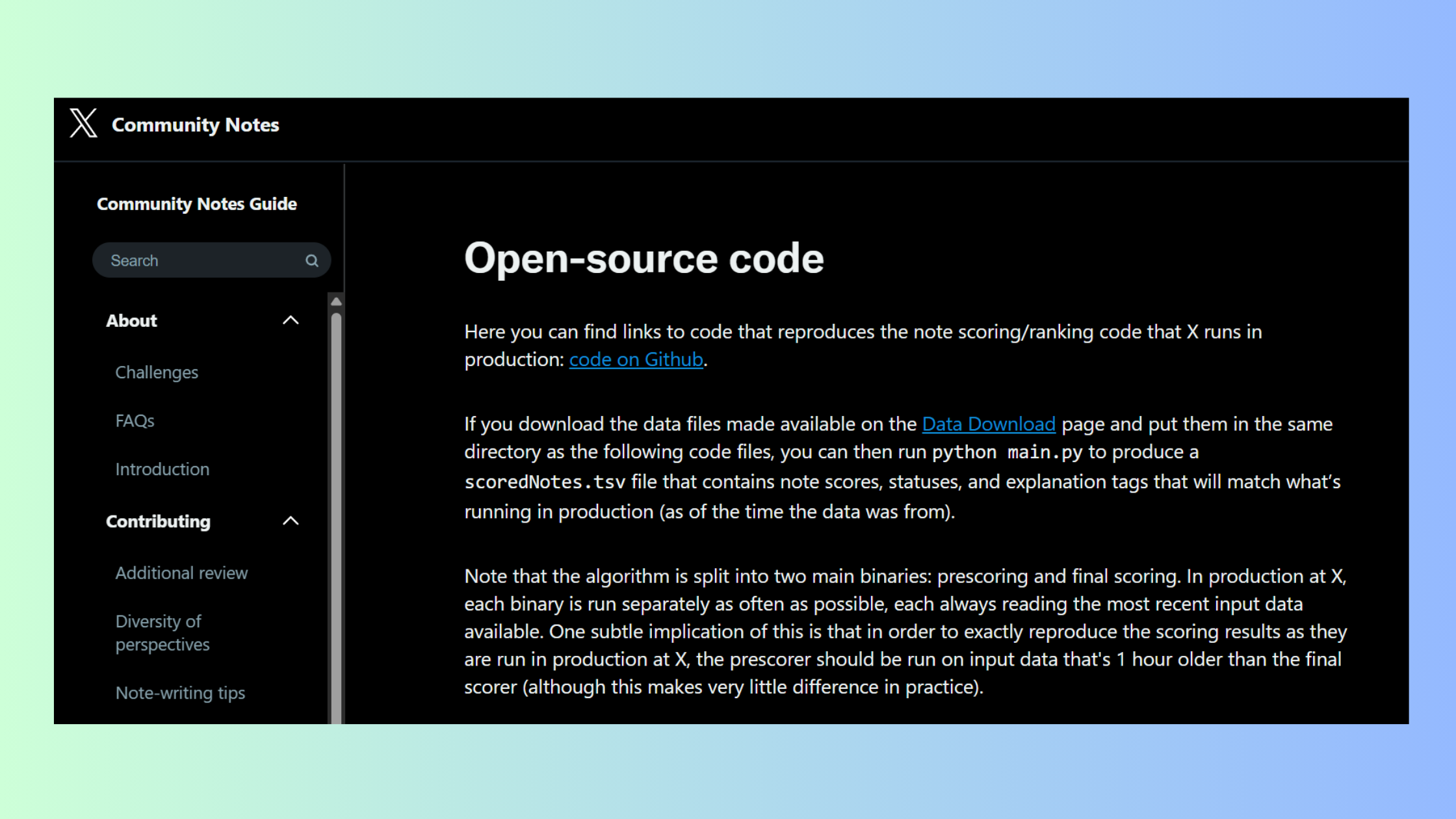
The X recommendation algorithm is partially disclosed — not genuinely open source in the way developers typically use that term. What landed on GitHub in 2023 was the ranking pipeline's code structure: the logic that describes how candidate posts are retrieved, scored, and filtered before reaching your feed. What was never published are the trained neural network weights (the actual learned parameters), the live tuning values, the trust-and-safety scoring layers, and the feedback data loops that continuously reshape the model in production.
Think of it as publishing the blueprint for an engine without including the specifications of the fuel mixture, the tolerances on each component, or the calibration settings the manufacturer actually runs. You can understand how the engine is supposed to work. You cannot replicate it, and you cannot know exactly how it is tuned right now.
Is X's Algorithm Really Open Source — or Just Partially Disclosed?
X algorithm open source is technically accurate as a description of what happened — the code is published under a public licence on GitHub. But the meaningful question is whether the disclosure enables real accountability or real reproducibility. It does neither fully. According to a deep-dive analysis of the May 2026 algorithm commit, the GitHub repository shows 187 files changed, with 18,263 additions and 926 deletions — substantial engineering activity. But what those changes do in practice requires running the model against production data that the public does not have access to.
Why did Elon Musk open source the Twitter algorithm? The stated rationale was public accountability — letting users and researchers audit why posts are promoted or suppressed. The practical effect has been more limited: researchers can confirm the existence of signals like author_is_blue_verified and the documented engagement weight multipliers, but they cannot verify whether those weights reflect what the production system actually applies on any given day.
Twitter algorithm transparency is accurate only for the skeleton. The muscle and nervous system — the weights, the safety overlays, the real-time tuning — are still entirely proprietary, and that is where the decisions that affect your reach actually live.
The most honest framing: X's GitHub release is the most extensive algorithm disclosure any major social platform has made, and it is still not enough to answer the questions that creators and researchers most need answered.
How the X Recommendation Algorithm Actually Works in 2026
The X For You feed algorithm runs a three-stage pipeline: candidate retrieval, neural net scoring, and a heuristic filtering layer. Candidate retrieval pulls a pool of posts from accounts you follow, accounts you interact with, and network-extended accounts. The neural net scorer then assigns each candidate a probability score across 19 distinct actions — likes, replies, retweets, dwell time, profile clicks, and more. The filtering layer applies policy rules, diversity controls, and suppression logic before the ranked list reaches your feed.
According to Teract AI's analysis of the X algorithm in 2026, the neural net now predicts probabilities for 19 distinct actions, with replies weighted at roughly 27× the value of a like. A post with 50 thoughtful replies will score dramatically higher than one with 500 likes and minimal conversation. This means the platform's distribution mechanics are fundamentally oriented toward conversation quality over passive engagement — a shift that most content strategies have been slow to internalise.
The Combined Scoring Formula: Engagement Weight Multipliers Explained
The documented engagement weight hierarchy from the open source code looks roughly like this:
- Replies: ~27× positive weight
- Profile clicks: ~11× positive weight
- Retweets: moderate positive weight
- Likes: ~1× (baseline)
- Dwell time: positive weight (duration-sensitive)
- "Show less often" clicks: heavy negative penalty
- Blocks and mutes from shown users: severe negative signal
In practice, a post that earns 10 replies from non-followers is algorithmically more valuable than a post that earns 270 likes from followers. This means like-optimised content — posts written to be agreeable and shareable but not genuinely conversational — is a poor investment of creative effort on X specifically.
Post Age, Frequency, and Account Age as Ranking Factors

Engagement velocity decay — the speed at which a post's scoring value decreases as it ages — is one of the most consequential and least understood mechanics on X. Posts are actively scored for non-follower distribution in roughly a 48-hour window. After that window closes, the post is effectively hard-filtered from the For You recommendation surface regardless of how strong its engagement rate was.
Account age and posting consistency compound this. Based on patterns observed across creator accounts reporting their experiences, missing 3 or more consecutive posting days appears to suppress the next 5 posts' distribution — a form of algorithmic penalty for inconsistency that resembles what has been reported across LinkedIn and YouTube. As one creator noted after 300+ days of daily posting on X: consistency at the same posting time delivers more reach per post, while posting gaps create suppression that takes multiple posts to recover from. In practice, this means a content strategy built around daily posting at a predictable time outperforms sporadic high-effort posts — even if the individual quality of the sporadic posts is higher.
What X Keeps Proprietary: The GitHub Algorithm's Real Limitations
The GitHub X algorithm limitations are more significant than the transparency narrative suggests. The repository is a snapshot, not a live mirror of the production system. According to the May 2026 algorithm update announcement, Elon Musk confirmed the latest version is now live on GitHub — but X engineers update the production model independently of the public repo, and the gap between what is published and what is running can be weeks or months.
What X keeps proprietary includes:
- The trained neural network weights — the actual learned parameters that translate input signals into output scores
- Trust and safety scoring overlays — the policy enforcement layer that can suppress accounts or content types
- Advertiser-related suppression rules — content adjacent to certain topics receives distribution limits that are not disclosed
- Real-time feedback loop data — the live engagement signals that continuously retrain the model
- Experimentation framework results — A/B test outcomes that shape current production behaviour
Can Developers Actually Modify the X Algorithm?
Developers cannot modify the X algorithm in any meaningful operational sense. The GitHub repository is read-only intelligence — it documents the architecture, but submitting a pull request does not affect how X's production feed ranks content. There is no community contribution pathway that touches live distribution.
What developers can do is use the open source code to build analytical tools that model how the scoring logic should behave, then compare predicted outputs against observed reach data to infer where the live model diverges. This is the most sophisticated use of the public code — but it is inferential, not causal, and the gap widens with every undisclosed production update. Social media algorithm transparency here is categorically different from truly open systems like Mastodon or Bluesky, where code changes by the community can actually affect how feeds rank.
X Premium, Verified Status, and What They Actually Do to Your Reach
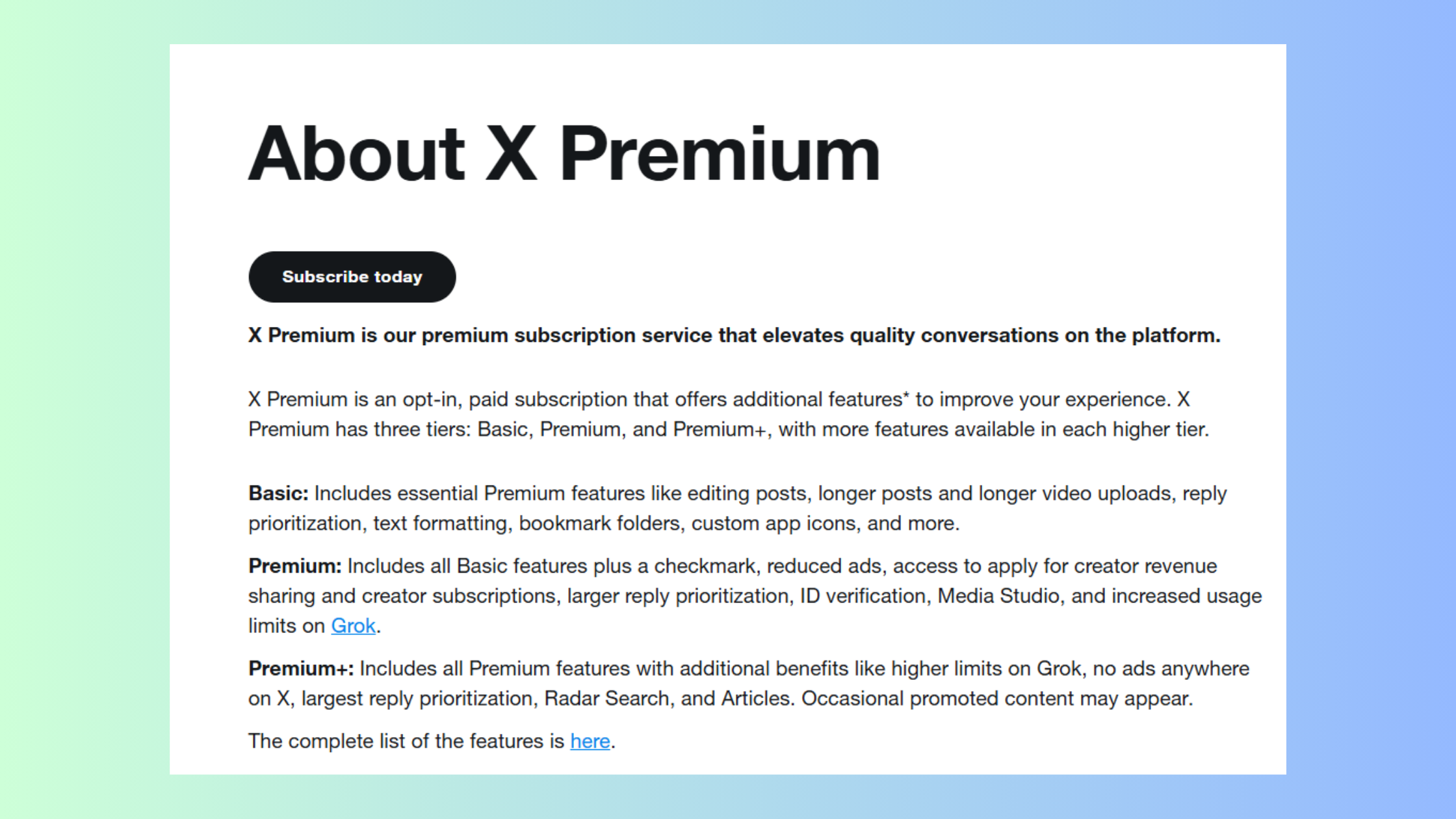
X Premium does provide a documented algorithmic advantage — the open source code confirms an author_is_blue_verified signal that positively weights a post's starting score in both candidate retrieval and reply ranking. Verified accounts appear higher in reply threads under high-reach posts, which compounds over time: more visibility in reply threads generates more profile clicks, which generate more followers, which broaden the candidate retrieval pool for future posts.
The magnitude of the Premium boost is not quantified in the public code. What the code shows is its existence as a binary positive signal, not a calibrated multiplier. In practice, teams that run both verified and non-verified accounts from similar audiences observe measurably higher non-follower reach on the verified account — but the gap narrows significantly when the non-verified account has stronger early engagement velocity.
The honest framing for agencies and brands: Premium is a floor-raising tool, not a ceiling-lifting one. It improves the starting position of every post but does not override weak engagement signals. A post from a verified account that receives no replies in the first two hours will still decay out of the For You feed faster than a post from a non-verified account that generates 20 replies in the same window. Platform distribution mechanics reward both status and engagement — and early engagement still dominates.
With the scoring fundamentals and Premium dynamics clear, the practical challenge becomes diagnosing what actually happened when your reach drops unexpectedly.
How to Diagnose Whether an Algorithm Update Hit Your Account
The most common pain point among creators in 2026 is not the algorithm itself — it is the inability to distinguish between a global algorithm update and an account-specific behavioural flag. Both produce the same symptom: sudden, unexplained reach drops with no official changelog to reference.
Here is a practical diagnostic framework:
- Compare engagement rate vs. impression trend (2 minutes): If impressions fall while your engagement rate holds steady or improves, the issue is distribution (algorithmic suppression), not content quality. If both fall together, the issue is likely content resonance.
- Check follower-only vs. non-follower impressions (5 minutes): If follower impressions hold but non-follower impressions collapse, you have been filtered from the For You feed specifically — a classic signal of an algorithmic scoring change or a post-type penalty.
- Survey your niche peers (30 seconds): If others in your topic area report no change, the issue is account-specific (posting gap, reply quality decline, flag triggered), not a global rollout. If peers report identical drops simultaneously, a platform-wide update is the likely cause.
- Audit your last 14 days of posting behaviour (10 minutes): A gap of 3+ days, a sudden shift in content type, or a spike in negative signals (blocks, mutes, "show less often") can produce reach suppression that looks identical to an algorithm update but is entirely behavioural.
Twitter Algorithm Update January 2026: What Changed and What Didn't
The Twitter algorithm update January 2026 introduced a documented shift toward conversation quality signals — specifically, increased weighting for replies from accounts the recipient follows (mutual engagement) and reduced reliance on raw retweet volume as a ranking input. According to TechCrunch's reporting, X has also tweaked its algorithm to boost visibility of posts to users' "mutuals," making the feed more relationship-weighted and less driven by viral strangers. What did not change: the primacy of replies over likes in the weighting formula, the 48-hour scoring window, and the external link penalty.
The X algorithm ranking factors that remained stable across the January update include the engagement velocity window, the author_is_blue_verified boost, and the suppression of posts that generate disproportionate negative actions relative to positive ones. Accounts that were already building reply-rich content strategies saw no meaningful disruption; accounts relying on retweet amplification or broadcast-style posting saw measurable reach compression.
Writing Content That the X Algorithm Actually Distributes
Teams that structure posts around generating replies within the first two hours consistently see higher For You feed placement than teams that post for broad appeal and passive engagement. This is not a stylistic preference — it is a direct consequence of the 27× reply weighting documented in the X recommendation algorithm.
What this looks like in practice:
- End posts with a direct, answerable question (not "what do you think?" — that is too open; "would you rather X or Y and why?" generates more responses)
- Use the first post of a thread to provoke a reaction, not to deliver the full argument
- Seed early replies yourself — replying to your own post within the first 30 minutes adds a fresh engagement signal and keeps the post active in the scoring window
- Notify your most engaged followers at posting time, not hours later
✓ The X Algorithm Distribution Checklist
- ☐Post ends with a specific, answerable question — not a vague CTA
- ☐External links moved to first reply, not main post body (avoid 30–50% reach penalty)
- ☐Posted within peak activity window for your specific audience segment
- ☐Self-reply added within 30 minutes to extend the scoring window
- ☐No posting gap longer than 2 days in the preceding 2 weeks
- ☐If using images or video, content is native (not linked from external host)
- ☐Account has posted consistently for 7+ days before expecting full For You reach
Hashtags, Posting Frequency, and Mistakes That Suppress Your Reach
Hashtag usage on X in 2026 is net-negative for most accounts. The algorithm's candidate retrieval model pulls posts based on content embeddings and engagement graph signals — not hashtag matching. Adding 3–5 hashtags to a post primarily adds visual noise and marginally increases the chance a post appears in a hashtag feed that almost nobody checks. More critically, heavy hashtag use correlates with lower average dwell time (users see hashtag-heavy posts as lower-quality), which negatively impacts the dwell time signal the neural net scores.
According to distribution data analysed across creator accounts, posts with links in the main post body receive approximately 30–50% less reach than equivalent posts with the link moved to the first reply. This is the single most actionable adjustment most accounts have not made. Move links to the reply. Keep the main post clean.
The most common failure mode is optimising for the wrong metric — measuring success by like count rather than reply count and profile click rate. An account with a 3% reply rate on 1,000 impressions is performing dramatically better algorithmically than an account with a 15% like rate on the same impressions, even though the second account's dashboard looks better at a glance.
Building engagement that actually moves metrics?
If you are focused on LinkedIn alongside X, HyperClapper provides real community engagement, AI-powered replies, and analytics — the kind of transparent, measurable engagement infrastructure that X's platform still lacks.
See How HyperClapper WorksX Algorithm vs. Other Platforms: Transparency, Reach, and Trade-Offs
Across the major platforms, X's algorithm disclosure is the most extensive on paper — but it does not translate into the most predictable distribution in practice. Here is how the landscape looks in 2026:
| Platform | Algorithm Transparency | Distribution Variance | Non-Follower Ceiling | Diagnostic Tools |
|---|---|---|---|---|
| X (Twitter) | Highest (partial code) | Extreme | Very high | Native analytics only |
| General guidance | Low–moderate | Moderate | Strong third-party ecosystem | |
| TikTok | Minimal | High | Very high | Creator Portal (limited) |
| YouTube | Moderate (blog posts) | Moderate | High | Studio Analytics (good) |
| Minimal | High | Very high (Reels) | Basic native only |
The comparison reveals something important about the X algorithm vs other platforms debate: more transparency does not mean more predictability. LinkedIn's algorithm is more predictable in practice because its ranking signals change less frequently and the engagement model is less volatile. A consistent LinkedIn strategy with strong first-hour engagement delivers reliably repeatable reach — a pattern that X's extreme distribution variance makes genuinely difficult to replicate.
For professionals deciding where to invest content effort: X offers the highest ceiling for viral non-follower reach, but the floor is much lower. Distribution variance on X is extreme — the same account can see a post reach 5,000 impressions one day and 50,000 the next, without any obvious quality difference. LinkedIn's more stable engagement model is a meaningful advantage for anyone building a long-term content strategy rather than optimising for occasional spikes. For a deeper look at what is actually working on LinkedIn in 2026, the B2B social media marketing guide covers the platform dynamics in detail.
Best Tools to Analyze and Track the X Algorithm in 2026
No third-party tool can access X's actual scoring model — every external analytics product, including the best tools to analyze X algorithm performance, is working from output signals (impressions, reach, engagement rates), not from the production model inputs. This is an important baseline: insights from these tools are inferential and directional, not causal.
With that context, here are the most useful options:
- Native X Analytics: Most accurate for impression-to-engagement ratios; lacks comparative benchmarking, algorithm-change timestamps, and historical trend depth. Use as your primary data source, not your only one.
- Audiense: Strong audience segmentation and engagement pattern analysis — useful for identifying which content types generate the highest reply rates for your specific follower composition.
- Tweetbinder: Useful for cross-referencing engagement pattern shifts against suspected algorithm update windows — helps distinguish global events from account-specific changes.
- Followerwonk: Best for timing analysis — identifying the peak activity windows of your specific audience for scheduling posts to maximise early engagement velocity.
 audiense.com
For content teams operating across LinkedIn and X simultaneously, AI-powered social media tools that combine scheduling, analysis, and engagement tracking are increasingly useful for maintaining visibility across both platforms without managing two separate workflows.
What consistently separates accounts that successfully adapt to algorithm updates from those that react too slowly is not which tool they use — it is whether they are tracking the right metrics (reply rate, profile click rate, non-follower impression share) rather than the easily visible ones (total likes, follower count). For LinkedIn teams specifically, HyperClapper demonstrates the model that X still lacks: a platform where engagement signals are community-driven, real, and analytically transparent — so you can see exactly what is driving reach rather than inferring it from outputs. Platforms that show you why your content is or isn't distributing are categorically more useful for strategy than those that show you only what happened.
The honest limitation of every X analytics tool in 2026: they measure what the algorithm produced, not what caused it. Without access to the production model weights, all third-party X analysis is a post-hoc reconstruction — educated, useful, but not definitive.
Want engagement analytics that actually explain your reach?
HyperClapper gives LinkedIn creators, founders, and teams real engagement signals, community-driven post boosting, and transparent analytics — built for people who want to understand their distribution, not just watch it.
Explore HyperClapperFrequently Asked Questions About the X Algorithm
Did the X algorithm change in 2026?
Yes, X made several documented algorithm changes in 2026. The most significant shift increased weighting for conversation quality — replies from mutual connections now carry elevated scoring. X also tweaked the algorithm to favour content shown to "mutuals," reducing battleground-style viral amplification. The 27× reply-over-likes weighting and the external link reach penalty remained in place throughout these updates.
How does the X algorithm work in 2026?
The X recommendation algorithm runs a three-stage pipeline: candidate retrieval (sourcing posts from your network and beyond), neural net scoring (ranking posts across 19 predicted action probabilities), and heuristic filtering (applying policy, diversity, and safety rules). Replies score roughly 27× higher than likes. Posts have approximately a 48-hour organic scoring window before being hard-filtered from the For You feed.
What is the new update on X?
The most recent documented X algorithm update — confirmed in May 2026 — pushed a new version of the recommendation algorithm to GitHub with 187 files changed and over 18,000 code additions. Key changes include stronger weighting for mutual engagement signals and adjustments to the experimental fairness and cache update layers. The core scoring formula and external link suppression rules remained unchanged.
What does it mean that X's algorithm is open source, and what parts are still hidden?
X open sourced its algorithm architecture — the code that describes how candidate posts are retrieved and scored. What remains hidden: the trained neural network weights, trust and safety overlays, advertiser suppression rules, and real-time retraining data. The published code is a structural skeleton; the decisive components that determine your actual feed position are still entirely proprietary.
If X open sourced their algorithm, why do people say it's not really transparent?
Because open sourcing the code architecture is not the same as open sourcing the system. Publishing the model structure without the trained weights is like sharing a recipe without the ingredient quantities — you can see what goes in, but you cannot reproduce the output. The production model is also updated independently of the GitHub repo, so the published code may lag behind what is actually running.
What are the actual proprietary components X does not include in the open source code?
The GitHub repository excludes: the trained neural network weights (the learned parameters that produce actual scores), trust and safety scoring overlays, advertiser-adjacent suppression rules, real-time feedback loop training data, and A/B experimentation outcomes. These are the components that most directly determine whether your post reaches 500 or 50,000 people — none are publicly accessible.
Should I trust X's claims about algorithm transparency?
Trust the structural claims — the engagement weighting hierarchy and pipeline architecture are verifiable in the code. Be sceptical of completeness claims. The open source release is genuine but partial, and the most decisive components remain proprietary. Use the public code as a directional guide for strategy, not as a complete picture of what the live production model is actually doing to your posts.



