What Is a Sales Engagement Platform? Close Deals Faster
A sales engagement platform automates multichannel outreach sequences so reps close deals faster. Compare top platforms, pricing, ROI, and how to choose for your stack.
📅 ⏱ 27 min read📝 ~5300 words
A sales engagement platform (SEP) is software that systematizes, automates, and tracks every touchpoint a sales rep has with a prospect — across email, phone, LinkedIn, SMS, and video — so outreach is consistent, measurable, and repeatable at scale. Unlike a CRM, which stores records, an SEP drives daily rep activity: it tells reps who to contact, when, on which channel, and it fires follow-ups automatically when humans forget. A pattern observed across hundreds of sales teams is that the moment a team moves from ad-hoc manual outreach to structured cadences, meeting booking rates improve within 30–45 days — not because the messaging changed, but because the consistency did.
Key Takeaways
What it is: A sales engagement platform orchestrates multichannel outreach sequences so no follow-up is missed and every touch is tracked.
SEP vs. CRM: A CRM stores data; an SEP drives action — they are complementary, not interchangeable.
Who benefits most: B2B SDR/BDR teams, outbound AEs, RevOps teams, recruiters, and founders doing early-stage sales.
ROI reality: Teams report 15–35% more pipeline per rep within 90 days of full adoption — but only with a clean CRM integration and a built sequence library.
Counterintuitive finding: Over-automation is the #1 failure mode — platforms amplify bad process just as effectively as good process.
The overlooked gap: How to evaluate an SEP when you're already embedded in HubSpot — a question no top-ranked article actually answers.
What Is a Sales Engagement Platform? (Clear Definition for 2026)
Sales engagement is the discipline of executing structured, repeatable outreach sequences timed to buyer behavior — not one-off manual sends whenever a rep remembers. An SEP is the software layer that makes this discipline operationally possible at scale. At its core, it handles three things: cadence management (what to do and when), activity logging (what actually happened), and performance analytics (what's converting and why).
SEPs emerged in the early 2010s precisely because CRMs were built to answer the question "what happened?" — not "what should my rep do right now?" Salesforce could tell you a deal was stalled. It could not tell the rep to send a follow-up email at 8:47 AM Tuesday because that's when this buyer's segment historically replies. That operational gap is what sales engagement software fills.
What Does a Sales Engagement Platform Actually Do Day-to-Day?
On a typical morning, an SDR opens their SEP dashboard and sees a prioritized task queue: five calls, three emails to personalize, two LinkedIn connection requests to send, and one "hot alert" on a prospect who just clicked the pricing page link in yesterday's email. Every task is pre-built from a cadence template. The rep executes; the platform logs it and advances the sequence automatically.
This is the practical answer to what does a sales engagement platform do: it removes the cognitive overhead of deciding who to contact and how, replacing it with a structured workflow that ensures every prospect gets the right touch at the right time — and that managers can see exactly what's happening across the entire team.
A sales engagement platform is not a CRM upgrade — it is the operational engine that turns a CRM's data into daily rep action.
Most platforms unify this through a single interface: a rep should never need to tab between their email client, their CRM, their dialer, and LinkedIn separately. The best SEPs collapse all of those into one task queue, reducing context-switching that can consume 20–30% of a rep's productive day.
How Sales Engagement Platforms Work: Multichannel Cadences to Closed Deals
Multichannel Cadences to Closed Deals
The core mechanism of any SEP is the cadence — a predefined series of touchpoints executed in sequence across channels and days. Think of a cadence as a recipe: email on Day 1, LinkedIn profile view on Day 2, LinkedIn connection request on Day 3, call attempt on Day 5, video message on Day 8, and a final breakup email on Day 14. Each step fires automatically (or prompts the rep to execute manually), and every interaction is tracked.
Multichannel cadence sequencing is the technical term for coordinating these touches across email, phone, LinkedIn, SMS, and video in a single unified workflow. Before SEPs existed, this coordination lived across separate tools — an email client, a desk phone, a LinkedIn tab, a spreadsheet — and the "sequence" was whatever the rep remembered to do that day.
How AI and Machine Learning Power Modern Outreach Sales Engagement Platforms
Modern platforms — including leading outreach sales engagement platform tools — have layered AI across three areas that meaningfully change outcomes:
Send-time optimization: ML models analyze when each individual prospect has historically engaged with emails and schedule sends accordingly — rather than blasting everyone at 9 AM Tuesday.
Buyer intent signal routing: Platforms ingest engagement signals — email opens, link clicks, website visit data from connected tools — and surface hot leads to reps in real time, so outreach hits when intent is highest rather than on a fixed schedule.
AI-generated personalization: Rather than fully templated emails, AI inserts personalized snippets (recent company news, job change triggers, mutual connections) at the point of send, reducing the time a rep spends on manual research from 8–12 minutes per email to under 2.
The feedback loop is what makes this compound over time: every reply, every meeting booked, every ghosted sequence feeds back into the analytics layer, allowing teams to A/B test subject lines, call scripts, and cadence timing — and retire underperformers systematically rather than by gut feel.
💡
Pro Tip:Set up at least two cadence variants from day one and let the platform A/B test them. Teams that test messaging from the start consistently outperform those who "perfect" a single sequence before launching — because real data from real prospects beats any pre-launch assumption.
Understanding how the platform executes outreach is only half the picture — equally important is understanding how it differs from the tools already in your stack.
Sales Engagement Platform vs. CRM vs. Sales Enablement: What's the Real Difference?
Three terms that get conflated constantly, each with a genuinely distinct function:
CRM (e.g. Salesforce, HubSpot): System of record. Stores deals, contacts, account history, pipeline stages. Answers: "What happened?"
Sales Engagement Platform: System of action. Drives daily rep outreach, fires cadence steps, tracks activity. Answers: "What should my rep do right now — and did they do it?"
Sales Enablement (e.g. Highspot, Seismic): System of readiness. Delivers content, training, and playbooks. Answers: "Does my rep have what they need to win this deal?"
The most common implementation failure pattern — seen consistently across teams adopting SEPs — is conflating the SEP with the CRM. Reps end up logging activities in both systems (or neither), data ownership becomes unclear, and adoption collapses within 60 days. The correct model is integration, not replacement: the SEP writes activity back to the CRM automatically, so the CRM stays the system of truth while the SEP runs execution.
What is the difference between sales engagement and sales enablement? Enablement arms reps with the right content and skills; engagement ensures those assets reach the right buyer at the right cadence step — automatically, not when the rep remembers to attach the case study.
Sales Intelligence and Engagement Platform: When the Lines Blur
A sales intelligence and engagement platform combines buyer data sourcing (company size, technographics, contact details, intent signals) with outreach execution in a single product. Tools like Apollo.io have moved aggressively into this category, combining a B2B contact database with sequencing capabilities. The advantage is fewer point solutions. The risk is that neither the intelligence layer nor the engagement layer is best-in-class — a relevant tradeoff for teams already paying for ZoomInfo or LinkedIn Sales Navigator separately.
See our detailed review of LinkedIn Sales Navigator's pricing and ROI to understand where the intelligence layer fits in a modern sales stack before adding a combined platform.
Key Features of Sales Engagement Platforms Every Buyer Should Evaluate
Not all SEPs are built equally — and demo environments reliably hide the features that matter most in day-to-day use. Here's what to evaluate with real data, not slide decks.
Non-negotiable core features:
Multichannel sequence builder — email, phone, LinkedIn, SMS steps in a single cadence workflow
Email tracking — open, click, and reply tracking with per-prospect granularity
Integrated dialer with call recording and local presence
LinkedIn step integration — at minimum, connection request and InMail steps; ideally with Sales Navigator sync
A/B testing for subject lines, email body, and call scripts
Bi-directional CRM sync — activities logged in the SEP must appear in the CRM automatically, with no manual re-entry
Advanced features that separate good from great:
AI-generated email personalization at send time
Conversation intelligence — call transcription, keyword flagging, and coaching moments surfaced to managers
Buyer intent signal routing — hot alerts when a prospect engages with content
Integration Depth: The Feature That Makes or Breaks Real-World Adoption
Teams that evaluate integration depth last — after pricing and UI — consistently regret it. The question to ask in every demo is: "Show me how a completed call in your platform appears in Salesforce/HubSpot within 60 seconds." If the answer involves any manual steps, a workflow rule, or a Zapier integration, that's adoption friction that compounds across an entire team every single day.
⚠️
Warning:Weak CRM sync is the #1 hidden cost of SEP adoption. If activity logging requires manual steps, reps skip it. Within 90 days, your CRM data is polluted, pipeline forecasting is unreliable, and leadership loses trust in both tools simultaneously.
Also evaluate compliance and safety features — which most buyers treat as afterthoughts until they're facing a CAN-SPAM penalty or a deliverability blacklisting event. Confirm the platform handles unsubscribe automation, suppression list management, and per-country sending limits (especially for GDPR-covered EU contacts) out of the box, not via a custom setup.
With the feature landscape mapped, the next natural question is whether your specific team actually needs all of this — or whether you're over-buying for your current stage.
Who Needs a Sales Engagement Platform — and Who Doesn't
The ideal buyer profile is sharper than most vendor marketing admits. B2B sales teams running outbound prospecting at volume are the primary use case — specifically:
SDR/BDR teams executing 50–200 prospect touches per rep per week
Account executives managing multi-threaded enterprise deals across multiple stakeholders
Revenue operations teams standardizing outreach behavior across a growing rep headcount
Marketers running ABM sequences for named accounts
Founders doing early-stage sales without a full team — a cadence tool prevents the classic "I forgot to follow up" deal loss
Who probably doesn't need one yet:
Solo consultants with inbound-only pipelines and fewer than 20 active prospects
Teams with no outbound motion whose entire pipeline is inbound or referral
Companies with fewer than 5 reps and very short sales cycles where a CRM contact task list genuinely suffices
When should a company invest in sales engagement software? The trigger is almost always a consistency problem: reps are following up at different rates, sequences live in personal inboxes, there's no visibility into which rep's messaging is actually converting, and deals are being lost to simple follow-up failure rather than competitive loss. That's the moment an SEP pays for itself immediately.
Building Your LinkedIn Presence While Running Outreach Sequences?
HyperClapper helps sales reps and founders build real LinkedIn credibility — so when prospects check your profile mid-sequence, they see authority, not a ghost account.
Benefits of Sales Engagement Platforms: How They Actually Close Deals Faster
Speed and consistency are the two mechanisms through which SEPs compress time-to-meeting. Every prospect who enters a cadence gets a follow-up on schedule — no deal falls through a rep's memory gap, and no hot prospect goes cold because someone was out sick on follow-up day.
2–3×
More meetings booked by teams using structured cadences vs. manual outreach
Customer data from Salesloft and Outreach consistently shows teams using structured cadences book 2–3x more meetings than those relying on manual outreach — not because the messaging is dramatically better, but because the volume and timing consistency is. In practice, this means a five-rep SDR team running structured cadences can produce the output of an eight-rep team doing manual outreach, at the same compensation cost.
The manager-side benefit is often undervalued during the buying process. Full activity visibility — call volume, email open rates by sequence step, reply rates by persona — means coaching conversations are anchored in data, not anecdote. What this tells you is that rep ramp time shortens materially when managers can identify exactly which step a new rep is struggling at (Day 5 call script? Day 1 subject line?) and correct it in real time rather than waiting for end-of-quarter pipeline reviews.
Revenue workflow automation acts as the force multiplier that makes all of this sustainable at scale. Reps typically spend 20–30% of their day on manual admin: logging calls, updating CRM fields, scheduling follow-ups, flagging hot leads for their AE. SEPs eliminate the majority of that overhead, redirecting that time to actual selling conversations.
What separates top-performing teams from average ones is not better messaging — it's the combination of consistent execution and fast feedback loops. The platform makes consistency automatic; the analytics make improvement systematic.
Sales Engagement Platform ROI: Pricing Models, Real Costs, and What to Expect
Three dominant pricing models define the market in 2026, each suited to different team profiles:
Per-seat/month (most common): Typically $75–$165/seat for mid-market tools. Salesloft and Outreach sit at the higher end; Apollo.io and similar all-in-one tools sit lower. Predictable cost, easy to budget.
Usage-based: Charged per email sent or call minute. Better for low-volume or seasonal outbound teams where per-seat costs would be wasted during slow periods.
Tiered platforms with feature gating: Starter/Pro/Enterprise tiers, where the most valuable features (AI personalization, conversation intelligence, advanced analytics) are locked behind the top tier — making the "affordable" entry price misleading for teams who need full functionality.
Salesloft vs. Outreach and the Best Sales Engagement Platforms in 2026
Salesloft and Outreach are the two dominant enterprise-grade platforms, and the comparison is genuinely close. Here's a structured breakdown of the best sales engagement platforms for different use cases:
Sales engagement platform pricing sticker price is rarely the real cost. Factor in:
CRM integration setup (often 20–40 admin hours for a clean Salesforce or HubSpot connection)
Sequence library buildout (typically 2–4 weeks before reps are running full cadences)
Rep productivity dip during a 4–8 week adoption curve
Ongoing admin time for sequence management, deliverability monitoring, and user management
On ROI: teams consistently report 15–35% improvement in pipeline generated per rep within 90 days of full adoption. The math is straightforward — if average deal size is $15K and an SEP helps each rep book one additional meeting per month, payback is typically under 60 days even at $125/seat pricing.
Salesloft vs Outreach is the most common head-to-head at the enterprise level. The honest summary: Salesloft has pulled ahead on conversation intelligence and deal management features since its acquisition of Drift's revenue intelligence capabilities; Outreach maintains an edge on raw sequence depth and analytics granularity for pure SDR-motion teams. Neither is the wrong choice at enterprise scale — the decision typically comes down to which integrates more cleanly with your existing CRM and which your top reps actually want to use after a pilot.
Knowing what tools cost is useful. Knowing how to pick the right one for your specific stack is what most buying guides skip entirely.
How to Choose the Right Sales Engagement Platform for Your Existing Stack
Start with your stack, not a vendor shortlist. The single most consistent failure mode in SEP evaluation is selecting a platform based on a demo, then discovering post-contract that it syncs poorly with an existing CRM, conflicts with the current email provider, or requires a workflow rebuild that disrupts the entire sales team for two months.
A recurring pattern among sales ops managers evaluating these tools is that they're overwhelmed by 40+ vendors all claiming identical capabilities — and every generic ranked list they find online was written for an audience that doesn't have their existing HubSpot or Salesforce investment to protect.
Use this four-filter buyer's framework — applied in order — before scheduling a single demo:
Integration depth with your CRM: Test live data sync in a trial environment, not a vendor demo. Ask specifically: "Show me a completed call in your platform appearing in Salesforce/HubSpot within 60 seconds, with all custom fields mapped." If this requires configuration, understand the setup cost before signing.
Rep adoption risk: How much does onboarding disrupt current workflows? A platform that requires reps to abandon their current email client, relearn a dialer interface, and re-enter historical prospects typically sees adoption drop below 40% within 8 weeks. Measure this by piloting with one team first.
Total cost of switching: Include data migration (exporting and re-importing sequence templates and contact history), retraining hours (at full rep cost), and the productivity dip during ramp. These costs routinely add 40–60% to year-one total cost of ownership for sales tech.
Compliance posture: Does the platform handle GDPR/CAN-SPAM unsubscribes automatically, with suppression lists that sync back to your CRM? Manual compliance management at scale is a liability, not just an inconvenience.
The HubSpot scenario (the gap no competitor article covers): If your team is embedded in HubSpot CRM, evaluate whether HubSpot Sales Hub's native engagement features meet 80% of your needs before adding a standalone SEP. The integration between a native tool and a third-party SEP introduces data duplication, field mapping conflicts, and subscription overlap that can cost more in admin hours than the SEP saves in rep time. Run the native feature audit first. Only add a standalone platform when you've identified specific, named capability gaps — not just because a vendor's demo looked impressive.
Implementation and Onboarding: Setting Up Your First Outreach Sequence Step by Step
CRM sync configuration (Days 1–3): Before any rep touches the SEP, configure and test the bidirectional CRM integration. Map all activity types, custom fields, and deal stages. Do this with a test contact, not live pipeline data. (~4–8 hours)
Sequence library buildout (Days 4–10): Build 2–3 core sequences: cold outbound, inbound follow-up, and re-engagement. Each should have 7–10 steps across at least 3 channels. Don't launch with one untested mega-sequence. (~1–2 weeks with sales manager involvement)
Deliverability warmup (Days 7–14): If sending from new domains or significantly higher volumes, run a warmup protocol — start at 20–30 emails/day per rep, scale by 20% every 3–4 days. Skipping this is the fastest path to spam folder placement.
Pilot with one team (Days 14–30): Run the first sequence with your most adaptable 3–5 reps. Measure: sequence adoption rate, CRM sync data quality, and rep satisfaction (not just meeting volume — adoption quality matters more in the first 30 days).
Full rollout with coaching framework (Days 30–60): Roll out to all reps with a defined manager review cadence — weekly sequence performance reviews based on platform analytics, not intuition.
🔴
Avoid:Launching full team rollout before a 30-day pilot is complete. Teams that skip the pilot phase see adoption rates below 50% at the 90-day mark — meaning the company is paying full licensing cost for a tool half the team has stopped using.
Risks, Limitations, and Common Mistakes to Avoid With Sales Engagement Software
Over-automation is the platform's most dangerous capability. Reps who rely entirely on templated sequences — with no manual personalization steps built into the cadence — see reply rates crater progressively over 60–90 days as buyers begin to recognize boilerplate outreach patterns. The platform amplifies good process and bad process with equal efficiency. Scale only what's already working at small volume.
The most common failure mode among teams that abandon their SEP within six months is not the tool — it's the adoption curve. Platforms with high rep adoption friction (complex UI, slow CRM sync, too many required fields per activity log) get quietly abandoned. Reps revert to email and spreadsheets; the company continues paying licensing costs. This is where total cost of ownership for sales tech bites hardest — the sunk cost of a six-month abandoned contract plus the lost productivity during implementation.
A persistent myth that causes real damage: the belief that an SEP replaces sales strategy. It doesn't. A poorly constructed sequence running at scale produces scaled rejection — not scaled pipeline. The platform executes whatever process you give it. If the ICP is wrong, the message is generic, or the offer has no differentiation, an SEP will just deliver that bad message to more people, faster. Strategy still requires human thinking.
Compliance risk is underweighted in virtually every SEP buying process. Teams that don't configure opt-out handling, sending limits, and suppression list automation face two specific consequences:
CAN-SPAM penalties (up to $51,744 per email violation under current FTC enforcement guidelines)
Deliverability blacklisting — which can take 3–6 months to reverse and affects every email sent from your domain, including non-sales communications
Confirm compliance features are active by default, not optional add-ons, before signing any contract. Moving from the risks to the execution layer — here's how to ensure your LinkedIn presence actually makes your SEP's outreach land.
Boosting LinkedIn Engagement Alongside Your Sales Engagement Platform
LinkedIn steps inside SEP cadences — profile views, connection requests, InMails, post comments — are consistently among the highest-converting touches in modern B2B outreach. The conversion lift happens because LinkedIn is the one channel where buyers actively research the person reaching out. When a prospect receives a Day 3 connection request from a rep, the first thing they do is visit that rep's profile.
What they find there determines whether the connection is accepted. A profile with active posts, real engagement, and visible thought leadership converts that sequence touch into a connection. A ghost account with three posts from 2023 and twelve followers undermines the entire cadence, regardless of how well-crafted the email copy is.
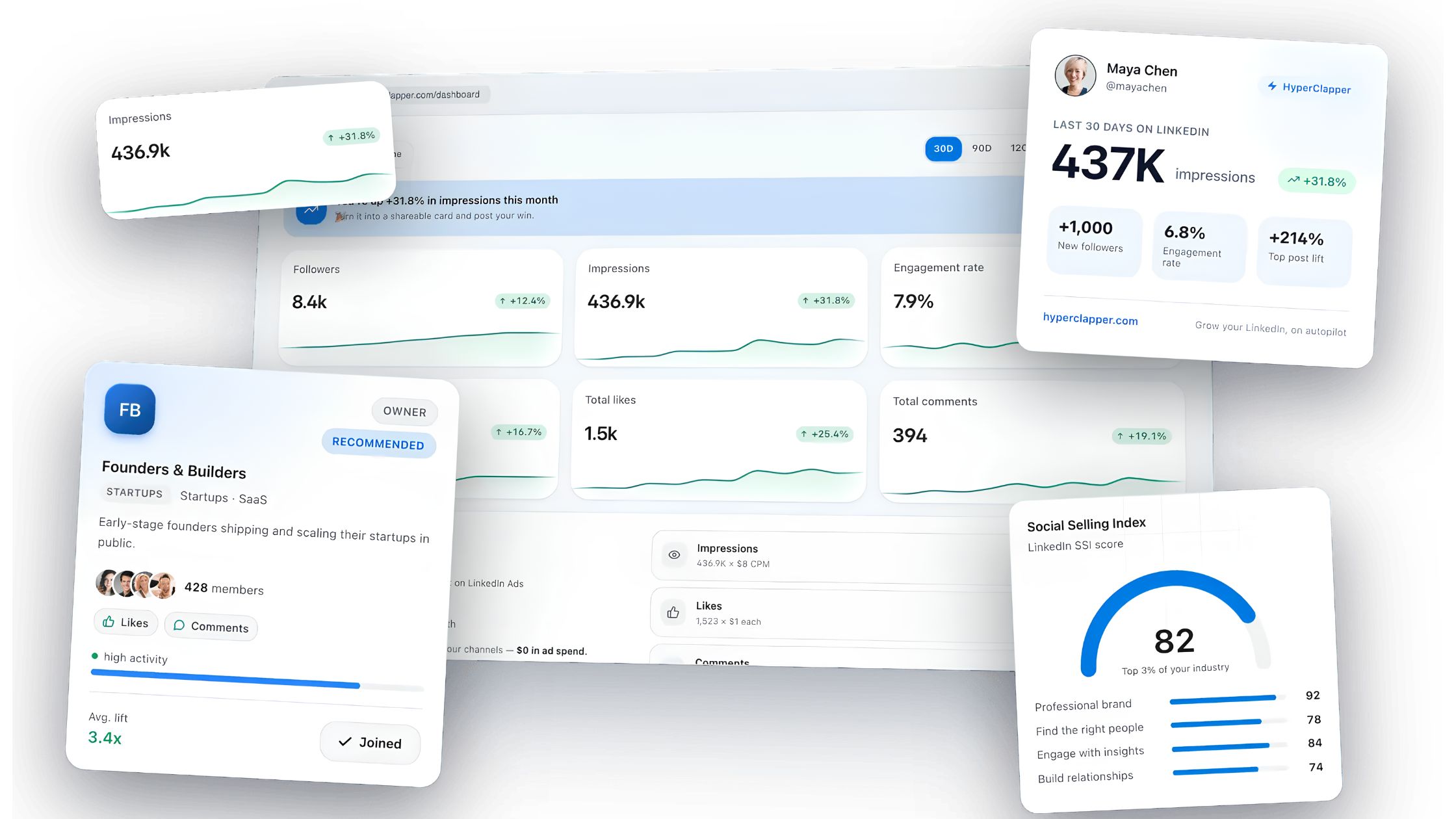
This is the practical workflow that what is sales engagement looks like at the LinkedIn layer: use your SEP to trigger the LinkedIn connection request at Day 3; use a platform like HyperClapper to ensure your LinkedIn posts are receiving real engagement — genuine likes, comments, and AI-powered replies through community channels — so that when a prospect views your profile mid-sequence, they see an active, credible expert rather than a dormant account.
For sales teams specifically, HyperClapper's post boosting through real engagement channels and AI-powered replies creates the social proof that makes cold outreach warmer. A prospect who has seen your posts appearing in their LinkedIn feed before they receive your Day 1 email is a different prospect than one encountering you for the first time in an inbox.
The LinkedIn step in a sales cadence only converts at its real potential when the rep's LinkedIn profile already has visible credibility — without it, the touch registers as cold even when the sequence context is warm.
HyperClapper's Content Guard and safer engagement system are designed to work within LinkedIn's platform guidelines — a meaningful distinction from aggressive automation tools that risk account restrictions and defeat the purpose of building a credible presence. For sales reps and founders building personal brands alongside their outbound motion, see our guide on sales techniques for LinkedIn engagement growth and our breakdown of 10 proven LinkedIn B2B marketing and sales strategies for 2026.
✓ The SEP + LinkedIn Readiness Checklist
☐CRM bidirectional sync tested with live data before rep rollout
☐At least 2 cadence variants built and A/B testing enabled
☐Opt-out and suppression list automation configured and tested
☐Email domain warmup protocol completed (if new domain or high volume increase)
☐LinkedIn profile for each rep posting actively with real engagement visible
☐30-day pilot with one team completed before full rollout
☐Manager coaching framework defined — weekly sequence performance review in place
Turn Your LinkedIn Profile Into a Deal-Closing Asset
HyperClapper boosts LinkedIn posts with real engagement through community channels — so your profile looks active and credible when every prospect checks it mid-sequence.
Frequently Asked Questions About Sales Engagement Platforms
What is a sales engagement platform and how does it help sales teams close deals faster?
A sales engagement platform is software that automates and tracks multichannel outreach sequences — email, phone, LinkedIn, SMS — so sales reps execute consistent follow-ups without manual effort. It helps teams close deals faster by eliminating follow-up gaps, surfacing hot leads in real time via buyer intent signals, and giving managers data-driven coaching levers that accelerate rep ramp time.
How is a sales engagement platform different from a CRM?
A CRM is a system of record — it stores contacts, deals, and history. A sales engagement platform is a system of action — it tells reps who to contact, when, and on which channel, then fires cadence steps automatically and logs activity back to the CRM. They are complementary tools, not alternatives. The SEP handles execution; the CRM maintains the data truth.
What features should I look for in a sales engagement tool?
Prioritize: multichannel sequence builder (email, phone, LinkedIn), bidirectional CRM sync, email open/click/reply tracking, an integrated dialer with call recording, and A/B testing for messaging. Advanced must-haves include AI-generated personalization, conversation intelligence, and automated opt-out/GDPR handling. Integration depth with your existing CRM is the single feature that determines real-world adoption success or failure.
Can a small sales team benefit from a sales engagement platform?
Yes, provided there is an outbound motion — even a 2–3 rep team doing consistent prospecting benefits from cadence structure and tracking. The breakeven point is typically when reps are managing more than 30–50 active prospects simultaneously, because that's where manual follow-up becomes unreliable. Teams smaller than 5 reps with inbound-only pipelines can usually manage with a CRM's built-in task features instead.
How do sales engagement platforms use AI to improve outreach?
Modern platforms apply AI in three ways: send-time optimization (scheduling emails when each individual prospect historically opens them), intent signal routing (alerting reps when a prospect visits the pricing page or clicks a link), and AI-generated email personalization (inserting relevant snippets — company news, job changes, triggers — at point of send). These reduce research time per email from roughly 10 minutes to under 2 minutes while improving relevance.
What is the difference between sales engagement and sales enablement?
Sales enablement equips reps with the right content, training, and playbooks — it's about readiness. Sales engagement ensures the right content reaches the right buyer at the right cadence step, automatically — it's about execution. Enablement answers "does my rep know what to say?" Engagement answers "did my rep say it, to the right person, at the right time, across the right channels?"
What is the 3-3-3 rule in sales and does it apply to sales engagement platforms?
The 3-3-3 rule is a prospecting heuristic: contact each prospect 3 times, across 3 different channels, within the first 3 days of outreach to maximize response rates while the prospect's attention is highest. Sales engagement platforms operationalize this directly — the rule maps cleanly onto a cadence structure where Day 1 is email, Day 2 is LinkedIn, and Day 3 is a call attempt, with the platform automatically firing each step on schedule.
What is the 2-2-2 rule in sales?
The 2-2-2 rule is a follow-up framework: follow up 2 days after initial contact, 2 weeks after that, and 2 months after that — designed to stay visible without being intrusive. In a sales engagement platform context, this translates to a long-tail nurture sequence that keeps non-converting prospects in an active cadence rather than dropping them entirely after initial outreach fails to generate a response.
What is the #1 CRM platform?
Salesforce is the most widely adopted CRM globally by revenue and enterprise market share, with HubSpot leading in the SMB and mid-market segments. For sales engagement salesforce integration specifically, Salesforce's native engagement features (available via salesforce sales engagement platform / Sales Engagement add-on) cover basic cadencing, while dedicated SEPs like Salesloft and Outreach offer deeper sequence capabilities for high-volume outbound teams.
What is Salesforce Sales Engagement pricing?
The salesforce sales engagement pricing for the Sales Engagement add-on (formerly High Velocity Sales) is typically bundled into Salesforce's Sales Cloud pricing tiers, starting from approximately $75/user/month on top of the base Sales Cloud license. Enterprise pricing is custom and negotiated. For teams already on Salesforce, this native salesforce sales engagement tool reduces integration complexity significantly compared to third-party SEPs.
What is Sendoso and how does it relate to sales engagement?
Sendoso b2b engagement platform for account based marketing & sales is a direct mail and gifting platform that integrates with sales engagement workflows — enabling reps to trigger physical gifts, branded swag, or eGift cards as cadence steps within platforms like Salesloft and Outreach. It extends multichannel cadence sequencing into the physical channel, which performs exceptionally well for high-value ABM target accounts where email alone generates noise rather than response.
What is the best sales incentive platform?
Sales incentive platforms (tools like Spiff, CaptivateIQ, and Xactly) are distinct from sales engagement platforms — they manage commission calculations, quota tracking, and rep motivation rather than outreach execution. The best choice depends on compensation model complexity: Spiff suits growth-stage teams with variable comp plans; Xactly suits enterprise organizations with complex multi-tier structures requiring SOX-compliant calculation auditing.
After seeing this across teams of every size and stack configuration, the pattern is consistent: accounts that combine a well-configured SEP with a credible LinkedIn presence — active posts, real engagement, visible expertise — see their LinkedIn cadence steps convert at rates that no email-only sequence can match. Accounts that invest in the platform but neglect the LinkedIn layer find that the highest-potential touchpoint in their cadence is also their weakest one. The platform executes the sequence; the LinkedIn presence determines whether anyone responds to it.
👋
⚡ Free plan
Leaving already?
Grab 3 free boosts on your next LinkedIn post — real likes & comments from 5,000+ creators. No card, cancel anytime.