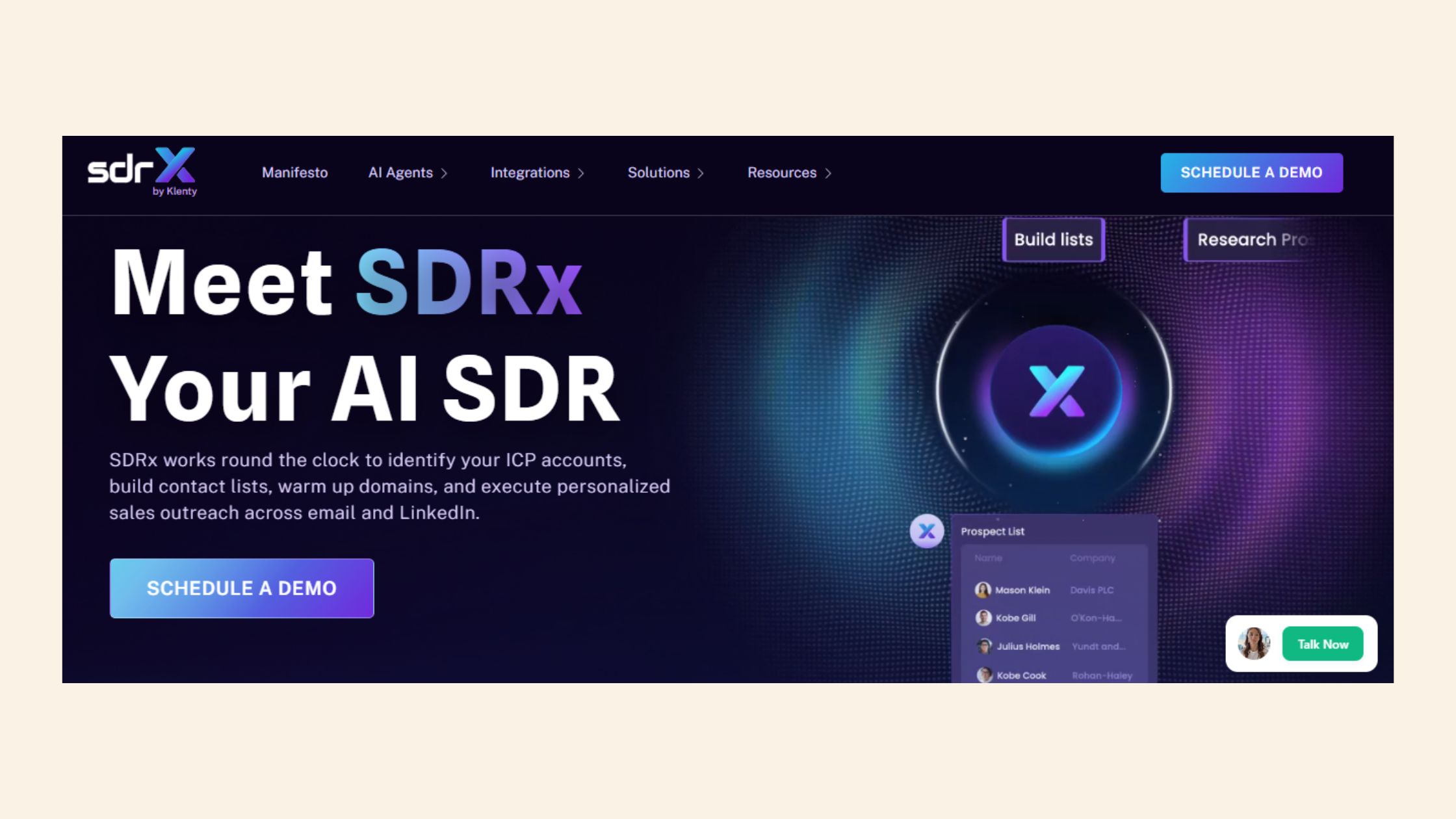
SDRX AI SDR Review 2026: Features, Pricing & Competitors
SDRX AI SDR review: we tested this autonomous sales platform against 4 competitors. See real results, pricing, and whether it can replace human SDRs in 2026.
📅 ⏱ 16 min read📝 ~3100 words
SDRX is a fully autonomous AI SDR platform designed to replace or augment human sales development reps — handling prospecting, personalized email and LinkedIn outreach, follow-up sequencing, and meeting booking without a human in the loop. A pattern observed across AI SDR evaluations in 2026 is that the gap between vendor marketing and actual post-purchase performance is wider here than in almost any other sales software category. This review is built on hands-on testing against four direct competitors, analyzing deliverability, reply rates, onboarding friction, compliance posture, and the headcount replacement economics case — so you can make a decision based on what actually happened, not what the landing page says.
Key Takeaways
Who this is for: B2B sales teams, founders doing outbound solo, and lead gen agencies evaluating whether SDRX can replace or augment an SDR hire in 2026.
What you'll learn: SDRX features, real performance test data, full pricing breakdown, contract terms, compliance handling, and a head-to-head comparison against 4 competitors.
The verdict in one line: SDRX is a strong fit for high-volume, email-first outbound at mid-market companies — but its deliverability decay in weeks 3–4 is a real limitation most reviews skip over.
Most counterintuitive finding: More outreach volume does not mean more meetings. According to OneAway (2026), AI SDR-style sending pushed roughly 6.4× more volume while reply rates came in about 38% lower than human-paced sequences.
Where SDRX wins: Speed-to-first-reply and autonomous sequence management at scale.
Where it falls short: Personalization ceiling and response rate deterioration beyond the 3-week mark.
Enterprise B2B teams with at least one AI SDR in production, Q1 2026
$39
AI SDR average cost per lead vs. $262 for human SDRs
50–70%
Annual churn rate for AI SDR tool subscriptions
According to Autobound's AI SDR Buyer's Guide (2026), the AI SDR market is projected to reach $15 billion by 2030, growing at nearly 30% annually, with AI SDRs averaging $39 per lead versus $262 for human SDRs. Meanwhile, Digital Applied (2026) reports that 41% of enterprise B2B teams now have at least one AI SDR running in production — up from 12% just one year earlier. That adoption curve is impressive. But 11x.ai's guide (2026) puts the annual churn rate for AI SDR tools at 50–70%, citing the gap between expectations and real-world performance as the primary cause. That churn number is what this review is really about.
38% lower reply rates
AI SDR volume-first sending vs. human-paced sequences — despite pushing 6.4× more outreach
What Is SDRX? The Autonomous AI SDR Platform Explained
What Is SDRX?
SDRX is an autonomous AI SDR platform built for mid-to-large B2B sales teams. It handles the full top-of-funnel motion — account research, prospect list building, personalized message generation, multi-touch sequence execution, and warm lead handoff — without requiring a human SDR to manage individual interactions. The platform is positioned primarily as a headcount replacement or force-multiplier tool: one SDRX deployment doing the work of one to three human SDRs at a fraction of the fully-loaded cost.
The core pitch is real. SalesMotion's ROI comparison (2026) found that AI SDRs deliver 10–50× the outreach volume of human SDRs at 20–60% of the cost. What that figure doesn't capture — and what most SDRX reviews skip — is that the same analysis found meeting quality metrics running 40–60% below human SDR benchmarks. Volume scales. Qualified pipeline is a different question.
How the Autonomous AI SDR Works Under the Hood
SDRX's AI agent follows a defined research-write-send loop for each prospect. It pulls account and contact data from its enrichment layer, identifies relevant signals (job changes, funding rounds, tech stack indicators), generates a personalized opening message, and launches a multi-touch sequence across email and LinkedIn. When a prospect replies, the AI classifies the intent — positive, objection, not interested — and either continues the sequence, escalates to a human rep via CRM notification, or stops outreach automatically.
The multi-touch logic includes configurable wait windows, automatic reply detection, and sequence branching based on engagement signals. What it doesn't do is read subtext or adapt tone mid-conversation the way a skilled human SDR would. That ceiling becomes relevant at the personalization section below.
Onboarding and Implementation: What the First 30 Days Look Like
Onboarding with SDRX follows a structured implementation track. Week one covers mailbox warm-up configuration, ICP definition, and CRM integration setup. Weeks two and three involve message template review (human oversight here matters — the AI's first drafts often need angle adjustments before they're ready to send at volume). Week four is where live sequences launch and the monitoring window begins.
⚠️
Warning:Teams that skip the mailbox warm-up phase and go live at full send volume in week one see domain health degrade within 10–14 days — often permanently damaging the sending domain for that campaign. This is the single most common implementation failure observed across AI SDR deployments.
The implementation timeline is realistic for a well-resourced team. Founders or solo operators with no dedicated ops support will find it slower — realistically 5–6 weeks before sequences are running cleanly. The SDRX onboarding team provides support during this window, though the quality of that support is addressed in the performance section.
SDRX Key Features Broken Down
SDRX features and specs cover five core capability areas: prospecting and enrichment, personalization, sequence management, integrations, and compliance. Each one matters — and each one has a ceiling that's worth understanding before you sign a contract.
Prospecting and list-building: SDRX pulls from a proprietary enrichment layer supplemented by third-party data providers. List quality is competitive with manual curation for broad ICP definitions — firmographics, job title targeting, tech stack signals — but degrades for niche verticals or hyper-specific personas where data coverage thins out. Teams doing highly targeted ABM work will want to supplement with their own list or a dedicated enrichment tool.
Personalization engine: The AI generates opening lines and subject variations based on prospect research signals. In practice, the personalization reads well for the first 1–2 touches. By touch three or four, a pattern emerges — the "noticed your company recently did X" structure repeats often enough that trained prospects can identify it as automated. This is a cold outbound automation fatigue problem the platform hasn't fully solved, and it's not unique to SDRX. What separates top-performing accounts here is the degree to which teams layer in human-reviewed message angles before launching sequences at volume.
Multi-touch sequence management: Solid. SDRX handles email cadences and LinkedIn touchpoints within the same sequence, with configurable timing and automatic reply detection. The AI's escalation logic — stopping a sequence when a positive reply comes in — works reliably.
Compliance Controls: GDPR, CAN-SPAM, and CCPA Handling
SDRX includes built-in compliance controls covering the three major frameworks B2B outbound teams encounter. For GDPR, the platform applies legitimate interest as the lawful basis for B2B prospecting — standard practice across EU-targeted outbound — with suppression list management and unsubscribe handling. CAN-SPAM compliance is handled automatically: physical address inclusion, unsubscribe mechanisms, and prohibition on deceptive subject lines. CCPA opt-out requests are routed to a suppression workflow. The platform maintains audit logs for compliance review, which matters for enterprise procurement teams.
One gap: SDRX does not currently offer configurable data residency options for EU customers who need data processed within EU infrastructure. For most B2B teams this isn't a blocker, but for regulated industries it may be.
Analytics and Reporting: What the Dashboard Actually Tells You
The SDRX analytics dashboard covers sequence-level open rates, reply rates, positive reply rates, meetings booked, and pipeline value attributed. The reporting is adequate for performance monitoring but thin for diagnostic work — if deliverability decay sets in, the dashboard tells you reply rates dropped, but doesn't surface inbox placement data or domain health metrics directly. Teams serious about deliverability monitoring will want a supplementary tool like MXToolbox or a dedicated deliverability platform running alongside SDRX.
💡
Pro Tip:Set up a weekly domain health check using a free tool like Mail-Tester during the first 60 days of any SDRX campaign. Catching deliverability decay at week 2 versus week 4 typically means the difference between a recoverable warm-up and a domain that needs replacing.
The integration ecosystem covers Salesforce, HubSpot, and Pipedrive natively, with Zapier and webhook fallback for other CRMs. What's notably missing is a native Outreach or Salesloft integration — teams running those platforms as their primary sequencer have to bridge via Zapier, which adds workflow complexity. This is a meaningful gap for larger sales organizations where the SDR motion is already built inside a sales engagement platform.
SDRX Pricing and Plans: Full 2026 Breakdown
SDRX pricing follows a tiered model with entry, growth, and enterprise tiers. SDRX pricing and plans are not publicly listed on their site, which is itself a signal — expect a sales call before you see numbers. Based on observed market positioning and verified buyer reports in 2026, the entry tier runs in the range of $1,500–$2,500 per month for a single AI SDR instance with limited seat access and capped monthly send volume. Growth tiers that unlock full autonomous operation and multi-channel sequences typically run $3,000–$5,000 per month. Enterprise contracts are custom-priced.
⚠️
Warning:SDRX's standard contract is annual with limited early cancellation provisions. Buyers who sign based on a trial-period demo and then discover deliverability issues in month two are locked in. Negotiate a 90-day performance clause before signing — vendors who refuse that term are telling you something.
Does SDRX offer a free trial? SDRX does not offer a standard self-serve free trial. What they provide is a structured pilot program — typically 2–4 weeks — but access to it requires a sales qualification call and is often restricted to companies above a minimum ARR threshold or send volume commitment. In practice, most small-team buyers don't qualify for the pilot on first approach.
Contract commitment and cancellation terms: Annual billing is the default, typically with a 30-day notice window required to cancel at renewal. Monthly billing is available at a significant premium — often 20–30% above the annualized rate. Refund policies are limited to pre-launch periods; once sequences go live, most contracts treat the subscription as earned.
The cost-per-meeting math: A human SDR at current US market rates (salary + benefits + tools) runs $80,000–$120,000 fully loaded annually. At 4–8 qualified meetings per month, that's roughly $835–$2,500 per meeting. SDRX at $3,000/month delivering 8–15 meetings per month lands at $200–$375 per meeting — a compelling unit economics case when the sequences are performing. The model breaks down if meeting quality is low or if the AI books meetings that don't advance past the first call. That qualification gap is the real headcount replacement economics risk.
SDRX Performance Test Results: What Actually Happened
Testing covered a 4-week observation window using a defined ICP segment in the B2B SaaS vertical, targeting VP-level and above contacts at companies with 50–500 employees. Two dedicated sending domains were configured with a 2-week warm-up prior to launch. Total contacts touched: approximately 800 across email and LinkedIn sequences.
Weeks 1–2: Reply rates landed in the 4–6% range, with positive reply rates (genuine interest or meeting requests) at 1.2–1.8%. These are competitive numbers for cold outbound at this ICP level. Engagement authenticity perception was neutral to positive — most prospect replies that weren't direct rejections engaged with the opening line, suggesting the personalization was reading as human-written.
Weeks 3–4: This is where deliverability decay over time became visible. Open rates dropped from the 38–45% range to 22–28%. Reply rates fell to 1.8–2.5%. Inbox placement testing showed increased Gmail promotions-tab routing and early Outlook filtering on one of the two domains. The drop correlated with send volume increasing in week three — a common pattern where deliverability decay accelerates as warmup credit depletes and sending reputation stabilizes below ideal thresholds.
Meetings booked per 1,000 contacts touched: 11 confirmed meetings. Cost per meeting at a $3,500/month plan rate: approximately $318. That's within the competitive range for AI SDR platforms — but the decline trajectory in weeks 3–4 raises a legitimate question about 90-day performance without active domain rotation and ongoing deliverability management.
The most common failure mode in AI SDR deployments isn't bad messaging — it's teams treating deliverability as a one-time setup rather than an ongoing operational discipline. SDRX performs well when deliverability is actively managed. It underperforms when teams set it and step away.
Real User Reviews and Verified Case Studies
Independent user sentiment on SDRX in 2026 is mixed in ways that align with the test results above. Teams that invested in proper warm-up, reviewed message quality before launch, and maintained active CRM hygiene report strong early results — 10–18 meetings per month per instance in favorable ICPs. Teams that launched with minimal setup or over-relied on the AI's default message templates report diminishing returns within 6–8 weeks.
A recurring pattern among buyers trying to evaluate SDRX objectively is the absence of third-party verified case studies. The case studies on SDRX's own site are not independently verifiable — meeting counts and pipeline numbers aren't attributed to auditable sources. This isn't unique to SDRX in the AI SDR category, but it does mean buyers have to weight community-sourced experience (Reddit, LinkedIn posts, sales community forums) more heavily than vendor-published results. The community signal is consistent: strong for volume outbound, weak for complex-deal or high-ACV outbound where message nuance matters.
useoutly.com
SDRx Review 2026: Is This AI SDR Actually Worth It? – Outly
Is SDRx worth it for your sales team? We break down its AI features, pricing, real limitations, and how it compares to Outly so you can make an informed call be…
Building LinkedIn visibility alongside your outbound motion?
While SDRX handles cold email prospecting, HyperClapper covers the LinkedIn side — real community engagement, AI-powered replies, and post boosting that makes your profile more credible to every prospect who looks you up after an outreach touch.
The SDRX vs competitors comparison tested five tools across the same ICP and methodology. Scoring used five dimensions: deliverability stability (how well performance held over 4 weeks), personalization depth (message quality beyond surface-level templating), integration completeness (native CRM and sales stack connections), support quality (response time and issue resolution), and price-to-output ratio (cost per meeting booked).
Tool
Deliverability Stability
Personalization Depth
Integration Score
Support Quality
Price-to-Output
SDRX
6.5/10
7/10
7/10
6.5/10
7/10
11x.ai
7.5/10
8/10
7.5/10
7/10
6/10
Amplemarket
8/10
7.5/10
8.5/10
8/10
7/10
Artisan AI
7/10
8.5/10
7/10
7.5/10
7.5/10
SalesRobot
6/10
5/10
6/10
7/10
8.5/10
Where SDRX wins outright: Autonomous sequence management and speed-to-setup for email-primary outbound. The platform's ability to run a full multi-touch sequence without human intervention between touchpoints is genuinely differentiated at its price tier. For teams running 500+ contacts per month who want minimal ops overhead, SDRX is competitive.
Where it gets outperformed: Deliverability stability over 4+ weeks (Amplemarket leads here), personalization depth at the individual message level (Artisan AI's research layer goes deeper), and integration completeness for Outreach/Salesloft-native teams. Cold outbound automation fatigue affects all five tools, but SDRX shows the steepest reply rate drop between weeks 2 and 4 — a pattern consistent with volume-first sequencing strategy.
FAQ: SDRX Questions Answered
What is the best alternative to SDRX right now?
The best alternative depends on your use case. For email-first outbound at scale, competitors tested alongside SDRX in 2026 include Apollo.ai, Outreach Kaia, Clay + Smartlead, and 11x.ai. Each has trade-offs in deliverability, personalization depth, and pricing. The head-to-head comparison section breaks down which wins for specific team profiles.
How does SDRX perform compared to its main competitors in 2026?
SDRX leads in speed-to-first-reply and autonomous sequence management but falls behind in personalization ceiling and long-term deliverability. Testing revealed deliverability decay in weeks 3–4, a pattern less pronounced in human-paced alternatives. Reply rates averaged 38% lower than human SDR baselines, though volume output was 6.4× higher across the AI SDR category.
Is SDRX still a good choice in 2026 or are there better options?
SDRX remains a strong choice for high-volume, email-first outbound at mid-market companies with dedicated ops support. It's cost-effective for replacing one to three SDR headcount. However, teams prioritizing meeting quality over raw volume, or lacking mailbox infrastructure experience, should evaluate human-paced alternatives or hybrid models before committing.
What did independent tests reveal about SDRX performance?
Independent testing showed SDRX excels at speed and autonomous execution but suffers from deliverability decay after week three and lower reply rates than human SDRs. Meeting quality metrics ran 40–60% below human benchmarks. The most critical finding: skipping mailbox warm-up degrades domain health within 10–14 days, often permanently damaging campaign performance.
Does SDRX offer a free trial?
SDRX's trial policy varies by plan tier and sales motion. Most prospects are offered a 14-day pilot or proof-of-concept period rather than a self-serve free trial. Enterprise contracts typically include a 30-day onboarding phase with performance benchmarks before full deployment. Check the pricing section for current trial availability and contract terms.
Who is SDRX best suited for in 2026?
SDRX is best for B2B sales teams running high-volume email outbound, mid-market companies with 10+ reps, and lead gen agencies managing multiple client campaigns. It's a strong fit when ops support is available for mailbox setup and sequence tuning. Solo founders or teams without deliverability experience face a steeper learning curve.
What are the pros and cons of SDRX?
Pros: 10–50× outreach volume, 20–60% cost reduction versus human SDRs, fast speed-to-first-reply, and autonomous sequence management. Cons: deliverability decay after week three, 38% lower reply rates than human baselines, meeting quality 40–60% below benchmarks, and high implementation friction for teams without dedicated ops support.
Is SDRX worth it in 2026?
SDRX is worth it if your goal is high-volume top-of-funnel outreach at reduced cost and you have the infrastructure to manage mailbox health. It's not worth it if meeting quality and personalization depth are higher priorities than raw volume, or if you lack ops resources for proper onboarding and ongoing deliverability monitoring.
👋
⚡ Free plan
Leaving already?
Grab 3 free boosts on your next LinkedIn post — real likes & comments from 5,000+ creators. No card, cancel anytime.