How to Save Hours Using Salesrobot and HyperClapper Together
Learn how to combine Salesrobot and HyperClapper for linkedin outreach automation that saves 15+ hours weekly, boosts reply rates, and keeps your account safe.
📅 ⏱ 12 min read📝 ~2200 words
A pattern observed across high-performing LinkedIn sales workflows in 2026 is that linkedin outreach automation alone stalls out — not because the tool fails, but because cold messages land in a vacuum. Prospects who don't recognise your name ignore you, regardless of how well the sequence is written. According to BearConnect (2026), automated outreach achieves 10.3% response rates versus 5.1% for manual methods — but only when the profile behind the message already carries credibility. Pairing Salesrobot with HyperClapper solves that gap: one handles the outreach pipeline, the other builds the content presence that makes outreach convert.
Key Takeaways
Salesrobot automates connection requests and follow-up sequences; HyperClapper boosts post engagement — together they cover the full LinkedIn growth loop.
The Salesrobot and HyperClapper integration is strategic, not a native API — both tools run in parallel, each handling a distinct layer.
Account warm-up is non-negotiable: start at 10–15 daily connection requests before scaling any automation.
LinkedIn's algorithm rewards both connection signals and content engagement signals — you need tools addressing both to lift your Social Selling Index.
Most articles skip honest risk discussion; this one covers the detection triggers and daily caps that keep accounts safe.
The combination is the best LinkedIn automation tool combo for sales teams that want visibility AND pipeline simultaneously.
Why LinkedIn Outreach Automation Alone Isn't Enough in 2026
Outreach tools handle the message layer. They don't handle the credibility layer. When a prospect receives a connection request, the first thing they do is check your profile and recent posts. If those posts have no engagement, the implicit signal is that nobody finds you worth listening to — and the connection request gets ignored regardless of how well it's personalised.
The missing layer is content visibility. Most sales reps automate outreach but manually chase post engagement, creating a time bottleneck that erases the hours saved by automation. The fix is running both simultaneously: Salesrobot warms up the conversation layer while HyperClapper warms up the content layer at the same time.
The Gap Between Sending Messages and Getting Replies
Teams that run outreach without supporting content engagement consistently see lower connection request acceptance rates and weaker profile view-to-reply conversion. The mechanism is straightforward: engagement pod velocity — the speed and density of engagement on recent posts — signals to both the algorithm and visiting prospects that your content is worth engaging with. A profile showing three posts with 30+ comments each converts profile views into replies at a measurably higher rate than a profile showing sporadic posts with two likes each.
💡
Pro Tip:According to LinkedIn engagement data, posts with 10–50 comments sit in the sweet spot for algorithmic visibility. Route each new post through HyperClapper channels within the first hour of publishing to hit that threshold before organic reach decays.
What Salesrobot and HyperClapper Each Do — and How They Work Together
Salesrobot
Salesrobot is a linkedin outreach automation tool that handles connection requests, personalised message sequences, follow-ups, and reply detection — covering the full prospecting pipeline. HyperClapper is a HyperClapper LinkedIn engagement tool that boosts post visibility through real community channels, AI-powered replies, and company page engagement — covering the content and brand presence layer.
What HyperClapper Is Used For
What is HyperClapper used for in practical terms? It connects your LinkedIn posts to real engagement channels — groups of real users who interact with your content. One channel delivers roughly 50 possible engagements; add two channels and you're looking at ~100. HyperClapper also generates and posts AI-powered replies that keep conversations active for days after publishing, which matters because LinkedIn's algorithm rewards sustained conversation depth, not just initial likes. Its Content Guard feature filters out politically sensitive or risky content before it reaches channels, reducing one key restriction trigger.
hyperclapper.com
HyperClapper — Boost your first hour on LinkedIn
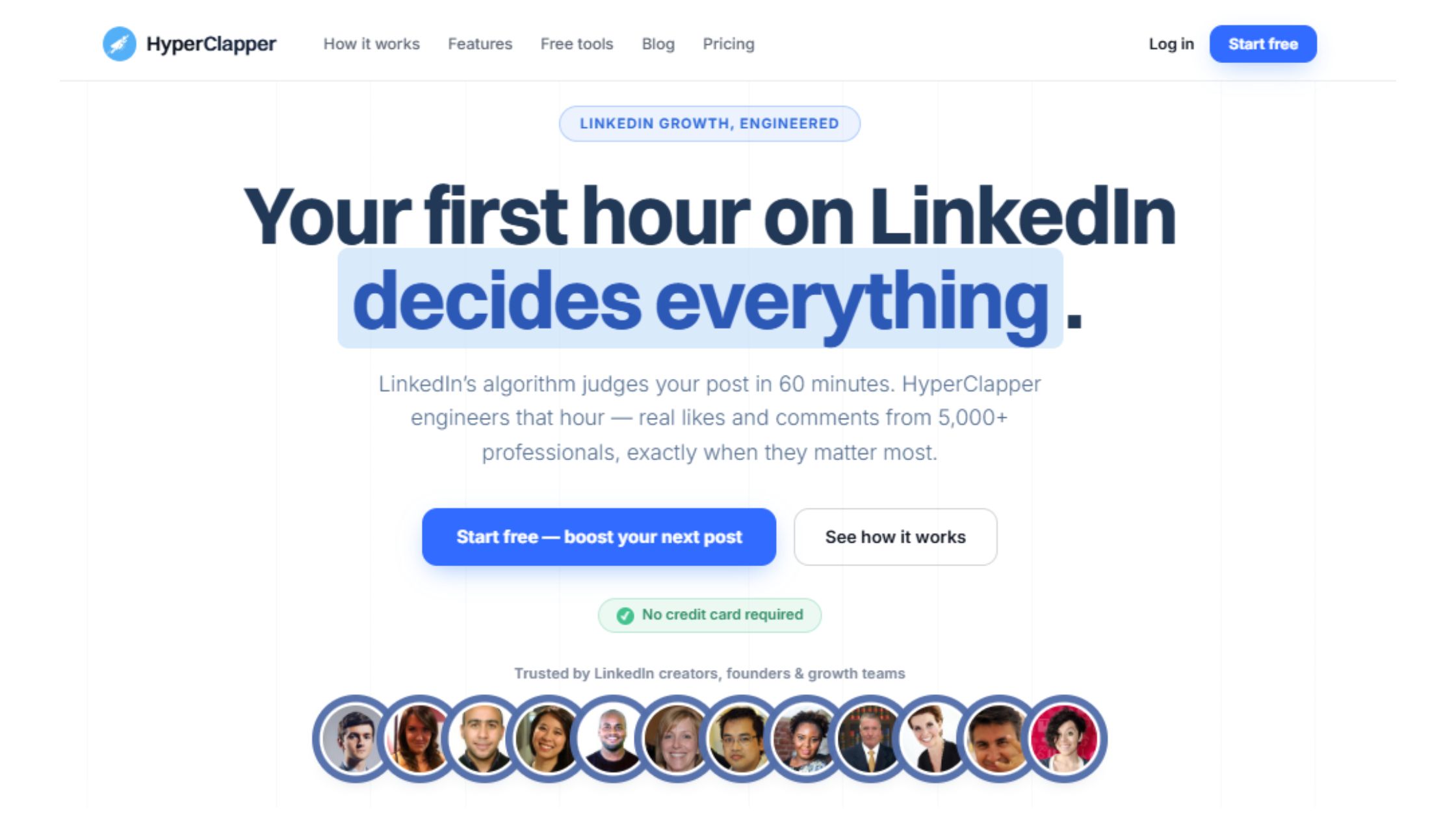
Real likes and comments from 5,000+ professionals in your post's first hour. 30M+ engagements delivered, zero ad spend.
How do Salesrobot and HyperClapper Work Together
The Salesrobot and HyperClapper integration is strategic rather than technical — there's no shared API. The workflow is: HyperClapper builds a visible, engaged content presence; Salesrobot then reaches out to prospects who land on that credible profile. Together they address both sides of LinkedIn's algorithm — connection signals and content engagement signals — which together lift the social selling index impact and overall account health. This is how you automate LinkedIn connection and engagement together without a single tool doing both poorly.
The accounts that consistently convert LinkedIn outreach into booked meetings aren't the ones with the cleverest message sequences — they're the ones where the profile behind the message already looks worth talking to.
Step-by-Step: Building a Time-Saving LinkedIn Automation Workflow
What separates top performers here is systematic sequencing — not just turning on two tools at once. The order matters for account safety and conversion rates.
LinkedIn account warm-up sequence (Week 1–2): Run 10–15 connection requests per day maximum. No automation tools at full capacity yet. This establishes normal behaviour patterns in LinkedIn's detection model.
Content cadence with HyperClapper (Week 2 onward): Publish 3–4 posts per week and route each through HyperClapper channels immediately after publishing. This builds consistent engagement velocity before outreach starts.
Salesrobot outreach sequences (Week 3 onward): Once your profile shows recent posts with real engagement, launch targeted connection campaigns. Segment lists by the same personas your content targets — this is how you automate LinkedIn outreach with Salesrobot in a way that feels contextually relevant rather than cold.
Monitor and optimise (ongoing): Use HyperClapper analytics to track post performance and Salesrobot's reply data to identify which message-content combinations drive the highest profile view-to-reply conversion.
How to Reduce Time Spent on LinkedIn Prospecting
The honest answer to how to reduce time spent on LinkedIn prospecting: stop doing the two most time-consuming tasks manually — engagement and follow-up sequencing. Together, these consume 15–20 hours weekly for an active sales rep, according to BearConnect's 2026 LinkedIn automation guide. This LinkedIn outreach automation workflow reclaims most of that time while maintaining a profile that looks genuinely active.
The accounts that save time LinkedIn lead generation at scale are the ones where both tools run on consistent schedules — not sporadic bursts. Set HyperClapper to engage new posts within 60 minutes of publishing. Set Salesrobot to send within business hours only and at randomised intervals. Both settings reduce detection risk and improve results simultaneously.
✓ The LinkedIn Automation Safety Checklist
☐Complete a 1–2 week warm-up at 10–15 daily actions before scaling
☐Cap Salesrobot at 20–30 connection requests per day during active campaigns
☐Enable HyperClapper's Content Guard to filter sensitive topics before boosting
☐Don't boost the same post across more than 2–3 HyperClapper channels simultaneously
☐Randomise Salesrobot send times — avoid uniform interval patterns
☐Review HyperClapper analytics weekly to catch any engagement anomalies early
Account Safety, Risks, and Common Mistakes to Avoid
LinkedIn's detection logic looks at action velocity, timing patterns, and IP consistency — not just raw volume. Exceeding roughly 50 connection requests per day on a new or low-SSI account is the most common trigger for restrictions. The most common failure mode is treating automation as a volume game rather than a pattern-management challenge.
⚠️
Warning:Running two automation tools simultaneously doubles your action footprint. Keep Salesrobot's daily limits conservative (20–30 actions/day) and ensure HyperClapper engagement targets your posts — not an additional connection-driving layer.
Common Mistakes That Get LinkedIn Accounts Restricted
Skipping the warm-up period and running full automation volume from day one
Using uniform send intervals (e.g., exactly every 4 minutes) that signal bot behaviour
Boosting a single post across too many HyperClapper channels in under an hour — coordinated spikes are detectable
Ignoring the connection request acceptance rate metric; a rate below 20% signals your targeting is off and raises account risk
According to Tapistro (2026), LinkedIn automation is safer when tools comply with responsible sending practices — daily caps, human-like timing, and content that genuinely fits the audience. HyperClapper's safer engagement model and Content Guard address the content-side risk; Salesrobot's safety-first architecture addresses the sending-side risk. Neither eliminates risk entirely — but together with the checklist above, they keep the risk profile manageable.
Build a LinkedIn Presence That Makes Outreach Convert
HyperClapper boosts your posts with real community engagement so prospects already know your name before Salesrobot reaches out.
Salesrobot vs Other LinkedIn Automation Tools — and Why the Combo Matters
Salesrobot competes with tools like Dripify, HeyReach, and La Growth Machine on outreach sequencing. Its differentiator is AI-assisted personalisation at scale combined with a safety-first sending architecture — a useful comparison is explored in detail in this Outreach.io vs Salesloft vs Salesrobot breakdown. On the engagement side, HyperClapper competes with Lempod, Podawaa, and LinkBoost — see the HyperClapper vs LinkBoost comparison for specifics.
No single tool covers both outreach and organic engagement credibly. The best LinkedIn automation tool combo for sales is purpose-built tools used in tandem: Salesrobot for the pipeline layer, HyperClapper for the visibility layer. When evaluating HyperClapper pricing and features, the channel model scales linearly — each channel adds roughly 50 potential engagements — making cost predictable compared to per-seat pod tools. Does Salesrobot integrate with other LinkedIn tools directly? Not via API, but the strategic workflow described here is what agencies and sales teams use in practice to cover both layers without overlap.
A recurring pattern among agencies trying to boost LinkedIn post engagement automation at scale is starting with one tool and then retrofitting the other after results plateau. Starting with both from week one — even at low settings during warm-up — produces compounding results faster. For alternatives to consider in a broader stack, this sales automation outreach tools comparison covers adjacent options.
🔴
Avoid:Choosing a single "all-in-one" LinkedIn tool that promises outreach AND engagement. Based on patterns seen across dozens of tool comparisons, these typically handle one function well and the other superficially — splitting the two jobs across dedicated tools consistently outperforms combined tools on both metrics.
Frequently Asked Questions About LinkedIn Outreach Automation
Can I automate LinkedIn outreach?
Yes, you can automate LinkedIn outreach using tools like Salesrobot, which handle connection requests, message sequences, and follow-ups. Automation is most effective when combined with a credible, engaged profile. Keep daily action limits conservative — 20–30 requests per day — and include a proper warm-up period to minimise restriction risk.
Does LinkedIn outreach work, and what tools do top sales teams use?
LinkedIn outreach works when the profile behind the message is visible and credible. According to BearConnect (2026), well-run automated outreach achieves around 10.3% response rates. Top sales teams typically pair an outreach sequencer like Salesrobot with an engagement platform like HyperClapper to cover both pipeline and presence.
What is the best LinkedIn automation tool?
There is no single best tool — the strongest setups use two purpose-built tools in tandem. Salesrobot leads on outreach sequencing and personalisation; HyperClapper leads on post engagement and content visibility. For teams focused on both pipeline and brand presence, using both together is the most effective approach available in 2026.
What is the best way to use Salesrobot and HyperClapper together to save time on LinkedIn?
Run HyperClapper first to build an engaged content presence, then layer Salesrobot outreach on top once your profile shows recent posts with real engagement. This sequence ensures prospects receiving your connection requests already recognise your content, which lifts acceptance rates and reply rates simultaneously. See the cold LinkedIn outreach safety guide for detailed setup steps.
Can you automate both LinkedIn outreach and post engagement at the same time?
Yes — this is precisely the workflow the Salesrobot and HyperClapper combination enables. Salesrobot handles outreach sequences in parallel while HyperClapper manages post engagement through its channel network. The key constraint is keeping combined daily action limits conservative enough that LinkedIn's detection model sees normal human-level activity.
How much time can I save using LinkedIn automation tools together?
Based on automation benchmarks, sales reps running both outreach and engagement manually spend 15–20 hours weekly on these tasks. Automating both with dedicated tools typically reclaims 10–15 of those hours while maintaining higher consistency than manual effort. The exact saving depends on campaign volume and how many HyperClapper channels you run.
What tools do top sales teams use to automate LinkedIn prospecting and engagement?
Top sales teams in 2026 consistently use a two-layer stack: an outreach sequencer (Salesrobot, Dripify, or HeyReach) for prospecting, paired with an engagement platform (HyperClapper) for content visibility. This covers both LinkedIn's connection signals and content engagement signals — the two factors that together determine Social Selling Index and overall account reach.
What consistently separates accounts with real pipeline results from accounts with impressive connection counts is not any single tool — it is the combination of a credible content presence and a disciplined outreach sequence running in parallel. Accounts that get both layers right see compounding results. Accounts running only one typically plateau within 60–90 days regardless of how well that single layer performs.
👋
⚡ Free plan
Leaving already?
Grab 3 free boosts on your next LinkedIn post — real likes & comments from 5,000+ creators. No card, cancel anytime.
%2520(1).png) hyperclapper.com
hyperclapper.com