A pattern observed across thousands of LinkedIn users is that the professionals who see real career momentum from the platform spend less time networking than those who don't — but they spend it far more strategically. The most effective way to network on LinkedIn if you only have 10 minutes a day is to split your time into three activities: 3 minutes engaging authentically with existing connections' posts, 4 minutes sending personalized connection requests to targeted professionals, and 3 minutes nurturing ongoing conversations. This structure works because LinkedIn's algorithm rewards consistent small actions over sporadic bursts, and relationship nurturing cadence matters more than raw connection volume. Most professionals burn out trying to "do LinkedIn properly" by spending hours crafting posts and managing dozens of conversations. The truth is that ten focused minutes daily, applied consistently for 3-6 months, builds a more valuable network than sporadic hour-long sessions.
- What Professional Networking on LinkedIn Actually Means in 2026
- Why LinkedIn Networking Is Worth Your Time (and When It Isn't)
- How to Network on LinkedIn: The 10-Minute Daily Framework
- 5 Proven LinkedIn Networking Strategies for Fast Growth
- What to Say (and Not Say) When Networking on LinkedIn
- Common LinkedIn Networking Mistakes (and How to Avoid Them)
- How Long It Actually Takes to Build a Valuable LinkedIn Network
- LinkedIn Networking Tools: Premium, Automation, and Engagement Platforms
- Frequently Asked Questions About professional network on linkedin
- Professional networking on LinkedIn means building mutually beneficial relationships through consistent, authentic engagement rather than collecting contacts
- A 10-minute daily routine split into engagement (3 min), connection requests (4 min), and conversation nurturing (3 min) delivers better results than sporadic longer sessions
- Real networking ROI takes 3-6 months minimum to materialize — this is relationship building, not lead generation
- The most successful networkers engage with content before connecting, then continue conversations after acceptance rather than going silent
- Quality beats quantity: 50 engaged connections who know what you do outperform 5,000 dormant contacts
- Tools like HyperClapper amplify visibility through real community engagement without risky automation
LinkedIn now has 1.3 billion members (Sprout Social, 2026), making it the world's largest professional network. According to LinkedIn's own global survey, almost 80% of professionals consider networking essential to career success, and 70% were hired through networking connections (WaveCnct, 2026). The platform reaches 33% of US adults, with 54% of US users earning over $100,000 annually. What separates professionals who leverage these numbers from those who don't is rarely the time invested — it's how strategically that time is spent.
What Professional Networking on LinkedIn Actually Means in 2026
A professional network on LinkedIn is the collection of meaningful, mutually beneficial professional relationships you build through consistent, authentic engagement rather than transactional contact collecting. It differs fundamentally from the business card exchanges and conference handshakes of traditional networking because it operates asynchronously — you build relationships through value exchange in content and insights rather than scheduled meetings.
The shift happening across the platform is from "building a network" to "nurturing a community." What this means in practice: professionals who treat LinkedIn like a Rolodex — adding connections but never engaging — see minimal return. Those who treat it like a professional community — commenting thoughtfully, sharing insights, making introductions — unlock compounding visibility and opportunity.
Here's why the awkwardness exists: most professionals know they should network but struggle with what to say and when to say it, making interactions feel forced or sales-driven. A recurring pattern among professionals trying to network on LinkedIn is the "connect and ghost" behavior — sending a connection request, celebrating when it's accepted, then never speaking to that person again. The relationship doesn't begin when someone accepts your request. That's when the work starts.
Professional network examples that work in 2026 look like this: a marketing consultant who comments weekly on posts from agency owners in their niche, eventually receiving inbound partnership inquiries without pitching. A software engineer who answers technical questions in LinkedIn Groups, building credibility that leads to recruiter outreach. A founder who shares customer wins and industry observations, staying top-of-mind with investors and advisors through consistent visibility.
The warm connection strategy centers on building rapport before asking for anything. Think of LinkedIn networking as preparing the soil before planting seeds, not harvesting crops on day one.
Why LinkedIn Networking Is Worth Your Time (and When It Isn't)
Three core benefits consistently emerge from strategic LinkedIn networking: career opportunities through weak ties, industry intelligence from your feed, and positioning yourself as a resource in your field.
Career opportunities through weak ties work because your close friends already know the same people you know. Your LinkedIn connections — especially second-degree contacts — represent access to entirely different professional circles. When a connection shares a job opening or makes an introduction, they're bridging networks you couldn't reach on your own.
Industry intelligence from your feed is underrated. Teams that actively engage with thought leaders in their space see market shifts, competitive moves, and emerging trends weeks or months before those insights reach broader publications. Your feed becomes a real-time market research tool.
Positioning yourself as a resource creates asymmetric returns. One thoughtful comment on a founder's post can lead to an advisory role. One introduction between two connections can generate reciprocal referrals for years.
Real networking ROI compounds slowly then suddenly — consistent effort for 3-6 months builds trust, 6-12 months generates introductions, 12+ months creates inbound opportunities without active outreach.
Here's what the timeline looks like in practice: Month 1-2, acceptance rates improve and basic visibility increases as you show up consistently. Month 3-6, conversations deepen beyond surface-level exchanges and introductions start happening organically. Month 6-12, referrals and opportunities emerge from connections who now understand what you do and who you serve. Most professionals quit at month 2 because they don't see immediate results. The compounding effect starts around month 4.
Honest limitations exist. Is networking on LinkedIn worth it? Yes, but with caveats. LinkedIn networking won't replace in-person relationships — video calls and coffee meetings still build stronger bonds. Results take 3-6 months minimum of consistent daily effort. It requires written communication skills — if you hate writing, LinkedIn will feel like a chore.
When it's NOT worth your time: if you're in a hyper-local business where all opportunities come from face-to-face interaction (local retail, neighborhood services), hate asynchronous written communication, or expect instant leads without relationship building. LinkedIn rewards patience and consistency, not get-rich-quick tactics.
How to Network on LinkedIn: The 10-Minute Daily Framework
The daily routine that works across thousands of busy professionals breaks down like this: 3 minutes engaging with existing connections' content, 4 minutes sending personalized connection requests, and 3 minutes responding to messages and nurturing conversations. This isn't arbitrary. It's calibrated to match LinkedIn's distribution algorithm and human attention patterns.
This is your LinkedIn daily routine for networking: consistent small actions trigger algorithmic visibility (LinkedIn rewards accounts that engage regularly) and keep you top-of-mind without burning you out. A professional who spends 10 focused minutes daily outperforms someone who spends 2 hours every other week because consistency beats intensity on this platform.
LinkedIn networking tips for busy professionals include batching your activity into a single session (morning coffee or lunch break), using mobile during downtime (waiting for meetings, commuting if not driving), and focusing on depth over breadth (5 meaningful interactions beat 50 superficial ones).
The relationship nurturing cadence that prevents you from being forgotten but doesn't cross into annoying territory is the "touch every 2-3 weeks" rule. After connecting with someone, engage with their content or send a brief message every 2-3 weeks. This keeps you visible without overwhelming them.
Minutes 1-3: Strategic Engagement Without Posting Content
You can grow LinkedIn network fast without ever posting your own content. Strategic engagement means commenting thoughtfully on others' posts, not just hitting the like button. What separates valuable comments from noise: add a specific observation, ask a clarifying question, or share a brief relevant experience.
Start with your existing connections' recent posts. Scroll your feed for 90 seconds, identify 2-3 posts worth engaging with (avoid political or controversial topics), and leave substantive comments. A substantive comment is 2-3 sentences minimum that demonstrate you actually read the post.
Does engaging with posts help LinkedIn networking? Absolutely. Consistent engagement accomplishes three things: it shows the original poster you're paying attention (building relationship equity), it increases your visibility to their audience (expanding your reach), and it signals to LinkedIn's algorithm that you're an active user (improving your content distribution when you do post).
For professionals wondering how to engage on LinkedIn without posting content, the answer is strategic commenting paired with connection requests. You don't need to be a content creator to build a valuable network. You need to be a thoughtful community member.
Minutes 4-7: Sending Connection Requests That Get Accepted
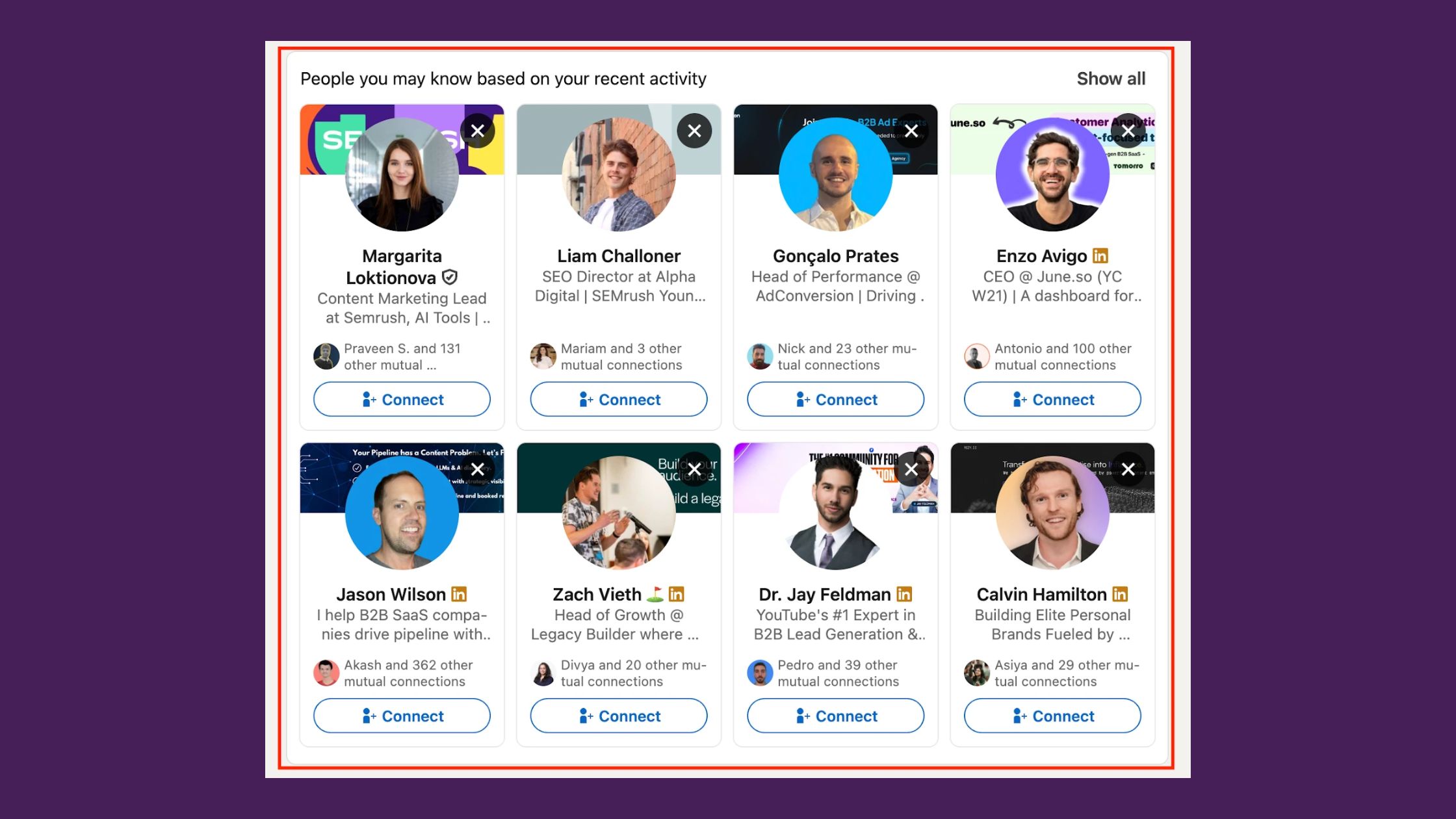
The most common question professionals ask is "how many LinkedIn connections should you send per day." LinkedIn allows roughly 100 connection requests per week for free accounts. The optimal number is 5-10 daily, sent to highly targeted people rather than mass spraying.
Quality targeting means: people in your industry, potential clients or partners, professionals one level above you who you can learn from, or people who engage with content in your niche. Avoid connecting with obvious competitors, people so senior they'll never respond, or profiles that look inactive (no recent posts or activity).
Your LinkedIn connection request message template should follow this structure:
- Line 1: Specific observation or compliment about their work (mention a recent post, shared connection, or mutual interest)
- Line 2: Brief context about yourself (one sentence max — your role and focus area)
- Line 3: Soft, no-pressure reason for connecting ("I'd enjoy following your insights on [topic]" or "Always looking to connect with professionals in [field]")
Example: "Your post about AI in recruiting caught my attention — the point about candidate experience was spot-on. I'm a talent acquisition lead at a Series B SaaS company. Would enjoy connecting and following your insights on hiring innovation."
What NOT to include: immediate asks ("Can I pick your brain?" or "Let's schedule a call"), generic flattery without specifics, overly formal language that sounds like a sales email, or anything longer than 3 sentences. For more templates and strategies, see our guide on writing LinkedIn connection requests that get accepted.
When is the best time to send LinkedIn connection requests? Data from across accounts shows Tuesday through Thursday, between 8-10 AM or 5-7 PM in your target's timezone, yields the highest acceptance rates. This is when professionals check LinkedIn during their morning routine or evening wind-down. Avoid Monday mornings (inbox overwhelm) and Friday afternoons (weekend mode).
Minutes 8-10: Nurturing Conversations After Connection
Most professionals fail at LinkedIn networking not because they can't get connections, but because they don't know what to say when networking on LinkedIn after someone accepts. The relationship starts when they accept, not when they accept and you both go silent.
Conversation frameworks that work:
- Compliment + question: "Thanks for connecting. Your experience in [specific area] is impressive. What's been your biggest learning in [relevant challenge] lately?"
- Shared observation + your take: "I noticed we're both seeing [industry trend]. In my work with [type of clients], I'm finding [specific pattern]. Are you seeing something similar?"
- Value-first offer: "Just read an article about [their interest area] that made me think of you. Sending it in case it's useful: [link]."
The mutual value exchange in action looks like offering insights from your domain, making introductions to relevant contacts in your network, or sharing opportunities (job openings, speaking slots, collaboration projects) before asking for anything in return. Position yourself as a resource rather than a taker.
What NOT to say immediately after connecting: avoid instant sales pitches ("Now that we're connected, let me tell you about my service"), generic flattery without substance ("You're so inspiring!"), asking for favors before any rapport exists ("Can you introduce me to [person in their network]?"), or overly formal corporate-speak that creates distance rather than connection.
What should you say after a connection request is accepted? Within 24-48 hours, send a brief thank-you message that opens a conversation door without requiring a response. Example: "Thanks for connecting, [Name]. Really enjoyed your recent post on [topic]. Would enjoy staying in touch as we both navigate [shared industry/challenge]." This acknowledges the connection, references something specific, and sets the stage for future interaction without pressure.
What consistently separates professionals who build valuable networks from those who accumulate contacts is post-connection follow-through — the first message after acceptance determines whether the connection goes dormant or becomes a relationship.
For professionals working on how to connect with people on LinkedIn effectively, the pattern is clear: personalize before requesting, engage after connecting, and stay visible through consistent touchpoints every 2-3 weeks. More strategies on this in our LinkedIn outreach guide.
5 Proven LinkedIn Networking Strategies for Fast Growth
Strategy 1: Engage before you connect — comment on someone's posts 2-3 times before sending a connection request to warm them up. This transforms you from a stranger to a familiar name. When your request arrives, they think "Oh, that person who left the insightful comment" rather than "Who is this random person?"
Strategy 2: Leverage LinkedIn Groups to network with niche communities. Join 3-5 active groups in your industry (look for groups with daily posts and active discussions, not ghost towns). Comment weekly on group discussions and connect with valuable contributors. Groups remain one of the most underutilized networking channels because most professionals join but never engage. Active group participants report 3-5x more targeted connection acceptances than cold outreach alone.
Strategy 3: Use video and voice messages to stand out. Short 30-second video introductions have roughly 3x higher response rates than text messages because they humanize the interaction. Record a brief, friendly video saying who you are, why you're reaching out, and what you appreciate about their work. LinkedIn native video messages show up prominently in inboxes and are novel enough that recipients watch them.
Strategy 4: Turn one-on-one conversations into introductions. After building rapport with a connection, ask "Who else should I know in [their industry]?" This unlocks second-degree network access. Most professionals are happy to make introductions when you've provided value first. This strategy compounds because every introduction potentially leads to more introductions.
Strategy 5: Boost your Social Selling Index (SSI) through consistent engagement. LinkedIn's SSI is a score from 0-100 measuring your professional brand strength, network quality, engagement with insights, and relationship building. LinkedIn SSI (Social Selling Index) and its impact on networking is significant — professionals with SSI scores above 75 create 45% more opportunities than those below 40. Improve your SSI by completing your profile fully, posting or engaging daily, and building targeted connections rather than random ones. Check your SSI at linkedin.com/sales/ssi to see where you stand.
Tools like HyperClapper amplify these strategies by helping professionals boost post visibility through real community engagement. Instead of hoping your comments get noticed, HyperClapper connects you with engagement channels where real users interact with your content, increasing the likelihood your networking efforts compound through algorithmic visibility.
What to Say (and Not Say) When Networking on LinkedIn
Conversation starter authenticity matters more than clever opening lines. What separates messages that get responses from those that get ignored: specificity, relevance, and a clear low-pressure next step.
Real message examples at each stage of how to network on LinkedIn:
Initial connection request: "Saw your comment on [Person]'s post about remote team management — your point about async communication resonated. I lead a distributed team at a fintech startup and face similar challenges. Would enjoy connecting."
First follow-up after acceptance: "Thanks for connecting, Sarah. Really appreciated your recent article on customer retention strategies. The framework you outlined aligns with what we're implementing at [Company]. Would enjoy staying in touch as we both navigate growth challenges."
Ongoing nurture (2-3 weeks later): "Hope you're well. Your post last week on pricing strategy sparked a great conversation on our team. We ended up adjusting our approach based on your point about value perception. Thought you'd enjoy knowing your insights landed."
Asking for a favor after relationship is established (3+ months in): "Quick question — I'm putting together a panel on [topic] and immediately thought of your expertise in [area]. Would you have any interest in participating? It's [date/time], audience of [type], focused on [specific angle]. Totally fine if timing doesn't work."
What NOT to say: avoid immediate sales pitches (pitching your service in the first message destroys trust before it exists), generic flattery ("Your profile is amazing!" without specifics), asking for favors before building rapport ("Can you intro me to your CEO?"), or overly formal corporate-speak that reads like a template ("I hope this message finds you well...").
Social selling without selling works through positioning yourself as a helpful resource over time. Instead of pitching your service, share relevant insights, make useful introductions, and highlight others' work. When you consistently provide value, people ask what you do rather than you having to sell them. This approach takes longer but creates sustainable opportunities rather than one-off transactions. For professionals working on how to network on LinkedIn to get a job, this same principle applies — be valuable to hiring managers and recruiters by engaging with their content and sharing relevant insights before asking about opportunities.
Common LinkedIn Networking Mistakes (and How to Avoid Them)
Mistake 1: Sending generic connection requests. Personalization increases acceptance rates by 40%+ because it demonstrates genuine interest rather than mass outreach. The failure mode: when you send "I'd like to add you to my professional network" without context, you look like every other person sending 100 requests daily. Most recipients ignore or decline these immediately.
Mistake 2: Going silent after someone accepts. The relationship starts after they accept, not when they accept. Accounts that send no follow-up message within 48 hours of connection acceptance see that relationship go dormant in roughly 85% of cases. You've done the work to get the connection — invest 60 seconds to start a conversation or you've wasted the effort.
Mistake 3: Only networking when you need something. Build relationships during good times so they exist during tough times. The pattern seen across job seekers who struggle on LinkedIn: they only activate their networking when they're laid off or job hunting. By then, their connections haven't heard from them in months or years, making every message feel transactional. The professionals who get referrals and opportunities fastest are those who stayed visible and helpful all along.
Mistake 4: Treating LinkedIn like a broadcast channel. LinkedIn networking is two-way conversation, not a megaphone. If you only post your own content without engaging with others', you're talking at people rather than with them. The algorithm penalizes this behavior by limiting your reach. Engagement-first approaches consistently outperform broadcast-only strategies.
Mistake 5: Measuring success by connection count instead of relationship depth. 50 engaged connections who know what you do and would refer you outperform 5,000 dormant contacts who vaguely remember connecting with you once. Vanity metrics (total connection count, profile views) feel good but don't generate opportunities. Real metrics that matter: reply rates to your messages, number of meaningful conversations monthly, introductions made and received, and opportunities sourced directly from LinkedIn. Learn more about managing connection quality in our guide on growing your network within LinkedIn's connection limits.
How Long It Actually Takes to Build a Valuable LinkedIn Network
How long does it take to build a LinkedIn network that generates real opportunities? A realistic timeline is 3-6 months of daily 10-minute activity to see momentum, and 12+ months to build a truly valuable network that creates inbound opportunities without active hunting.
What to expect at each stage based on patterns seen across consistent users:
Month 1-2 (Foundation Phase): Acceptance rates improve as you refine your approach. Basic visibility increases — people start recognizing your name in their feed. Conversations remain surface-level. You're planting seeds, not harvesting yet. This is where most people quit because results feel minimal.
Month 3-6 (Momentum Phase): Conversations deepen beyond pleasantries into real professional exchanges. Introductions start happening organically — connections begin referring you to others in their network. Your content (if you post) begins reaching beyond first-degree connections. The warm connection strategy starts paying off as people you engaged with months ago now respond warmly to deeper asks.
Month 6-12 (Compounding Phase): Referrals and opportunities emerge from connections who now understand what you do and who you help. They refer you without being asked because you've stayed top-of-mind. Recruiters reach out proactively. Potential clients or partners initiate conversations. This is when the investment pays off exponentially.
Month 12+ (Sustainable Phase): Your network generates consistent inbound opportunities. Introductions become routine. Your reputation in your niche means connection requests get accepted at 70%+ rates. You've built a professional asset that requires maintenance (the daily 10 minutes) but produces outsized returns.
How do you measure the success of your LinkedIn networking efforts? Move beyond vanity metrics. Track reply rates to your messages (healthy = 40%+ reply rate), conversation depth (how many exchanges go beyond initial pleasantries), introductions made and received per month (aim for 2-3), and opportunities sourced directly from LinkedIn (job interviews, partnerships, clients, speaking gigs). These are leading indicators that your network has real value, not just impressive numbers on your profile.
The warm connection strategy payoff happens when your network knows what you do and who you help well enough to refer you without prompting. This takes 6-12 months of consistent visibility through engagement, sharing insights, and helping others. You'll know you've reached this point when you start receiving "I thought of you when I saw this opportunity" messages unprompted.
LinkedIn Networking Tools: Premium, Automation, and Engagement Platforms
Is LinkedIn Premium worth it for networking? Yes, if you need InMail credits to message people outside your network, advanced search filters to find highly targeted prospects, or "Who Viewed Your Profile" data to identify people interested in you. No, if you're just starting and can succeed with organic strategies — free LinkedIn provides enough functionality to build a strong network through consistent engagement and personalized connection requests. Premium becomes valuable around the 3-6 month mark when you've maximized free tools and need more reach.
Best LinkedIn automation tools for outreach in 2026 include Sales Navigator for advanced targeting and prospecting (LinkedIn's official premium tool), and third-party options like Expandi or We-Connect for semi-automated outreach. Use these cautiously — LinkedIn actively penalizes bot-like behavior, and over-automation kills the authenticity that makes networking work. The safest automation focuses on research and organization rather than mass messaging.
For professionals seeking safer engagement amplification, HyperClapper offers a different approach: boost post visibility through real community engagement rather than risky scraping or aggressive automation. The platform connects you with engagement channels where real professionals interact with your content through likes and AI-powered replies, increasing your algorithmic reach without violating LinkedIn's terms of service. This matters because consistent visibility drives networking opportunities — when your content reaches more people, more people recognize your name and accept your connection requests.
Risks and limitations of automation: LinkedIn actively detects and penalizes automated behavior including mass connection requests, repetitive messaging patterns, and excessive profile viewing. Penalties range from temporary account restrictions to permanent bans. Connection limits exist (roughly 100 requests per week) regardless of tools used. Most importantly, over-automation destroys the authenticity that makes LinkedIn networking effective — people can tell when they're receiving templated mass outreach, and it damages your professional reputation.
When to use tools vs. manual outreach: Use tools for research, lead identification, and staying organized (CRM-style tracking of conversations). Use manual personalization for actual outreach, especially to high-value targets. A hybrid approach works best — tools identify who to reach out to, but you write personalized messages and manage conversations individually. For more on managing connections at scale, see our guide to managing LinkedIn connections with CRM tools.
Frequently Asked Questions About professional network on linkedin
What is a professional network on LinkedIn?
A professional network on LinkedIn is the collection of meaningful, mutually beneficial relationships you build through consistent engagement, not just contact collecting. It differs from traditional networking because relationships develop asynchronously through value exchange in content, comments, and insights rather than scheduled meetings or business card exchanges.
What is the point of a professional network?
A professional network provides career opportunities through weak ties, real-time industry intelligence, and positions you as a resource in your field. Your connections bridge you to entirely different professional circles, surface market trends early, and create asymmetric returns when you help others, leading to inbound opportunities without cold outreach.
Is networking on LinkedIn worth it?
Yes, LinkedIn networking is worth it if you commit to consistent effort over 3-6 months minimum. Strategic daily engagement delivers measurable career momentum, with 70% of people hired through networking connections. However, it requires patience—this is relationship building, not immediate lead generation, and sporadic activity yields minimal results.
What is the most effective way to network on LinkedIn if I only have 10 minutes a day?
Split your 10 minutes into three activities: 3 minutes engaging authentically with existing connections' posts, 4 minutes sending personalized connection requests to targeted professionals, and 3 minutes nurturing ongoing conversations. This structure works because LinkedIn's algorithm rewards consistent small actions over sporadic bursts, and relationship cadence matters more than volume.
How do I start a LinkedIn conversation with someone I don't know?
Engage with their content first by leaving thoughtful comments on 2-3 posts before connecting. When sending your connection request, reference something specific from their profile or content that resonated with you. After they accept, continue the conversation rather than going silent—the relationship begins after acceptance, not before.
Is it better to comment on posts or send connection requests to grow my LinkedIn network?
Commenting on posts is more effective for sustainable network growth because it builds visibility and credibility before you connect. Engage authentically with content from your target audience, then send connection requests to those who interact with your comments. This warm approach converts better than cold connection requests alone.
Can you really build a strong LinkedIn network without spending hours on it?
Yes, ten focused minutes daily builds a more valuable network than sporadic hour-long sessions. Consistency matters more than duration—professionals who spend less time but apply it strategically see better career momentum than those burning out on content creation. Real relationship ROI takes 3-6 months of daily micro-actions to materialize.