Lemlist vs Mailchimp: The ROI Truth No One Talks About
Compare Mailchimp vs Lemlist on real ROI — not just features. See which platform drives more revenue for your campaigns and where your budget works harder.
📅 ⏱ 16 min read📝 ~3200 words
The lemlist vs mailchimp debate persists because most comparisons treat them as competing products. They are not. Mailchimp is a permission-based email marketing platform — built to send campaigns to people who asked to hear from you. Lemlist is a sales engagement platform — built to start conversations with people who have never heard of you. A pattern observed consistently across B2B teams is that the wrong tool choice costs more in wasted time and deliverability damage than both subscriptions combined. Choose based on your motion, not the feature checklist.
Key Takeaways
Different tools, different jobs: Mailchimp manages opted-in subscriber lists; Lemlist prospects cold leads via multi-step sequences.
ROI depends on motion: Cold outreach ROI is measured in booked meetings and pipeline; email marketing ROI is measured in retention and LTV.
Deliverability is context-dependent: Mailchimp delivers well to consented lists; Lemlist's warm-up system (lemwarm) is built for cold-sending from fresh domains.
Pricing logic differs: Mailchimp charges by list size (painful at scale); Lemlist charges by seat (painful for large teams, generous on contact volume).
The most counterintuitive finding: Using Mailchimp for cold outreach doesn't just underperform — it can permanently damage your sender domain reputation before you see a single reply.
Who this is for: B2B founders, SDRs, marketers, and small business owners trying to decide where to invest their outreach budget in 2026.
What Is the Difference Between Lemlist and Mailchimp?
What Is the Difference Between Lemlist and Mailchimp?
The core difference between lemlist and mailchimp is architectural, not cosmetic. Mailchimp is built on consent — double opt-in, list management, CAN-SPAM and GDPR compliance baked into the product logic. Lemlist is built on prospecting logic — find a lead, enrich their data, run them through a timed multi-channel sequence, and detect a reply or a booked meeting as the success signal.
Mailchimp's mental model is a broadcast: one message, many recipients, measured by open rates and click rates across a campaign. Lemlist's mental model is a conversation: one prospect, a timed sequence of touches across email and LinkedIn, measured by replies and calls booked. These are not variations of the same workflow. They are different workflows entirely.
This distinction explains a pattern seen repeatedly in community forums: users who try to run cold outreach through Mailchimp watch their deliverability collapse within days. And Lemlist users who try to manage a subscriber newsletter find the tool actively fighting them — because reply detection, sending caps, and sequence logic are not built for broadcast at scale.
What Is Lemlist and What Is It Good For?
Lemlist is a sales engagement platform that enables B2B teams to build personalized, multi-step outreach sequences combining email, LinkedIn actions, and manual tasks. Its differentiating features include dynamic image and video personalization, AI-generated icebreakers, a built-in lead database, and lemwarm — its domain warm-up infrastructure. Lemlist is purpose-built for outbound prospecting: converting cold leads into conversations. According to Software Advice's 2026 comparison, Lemlist's top use cases center on sales prospecting, not email marketing campaigns.
What Is Mailchimp and What Is It Good For?
Mailchimp is a permission-based email marketing platform optimized for managing and communicating with opted-in subscriber lists. With over 13 million users, it has become nearly synonymous with email newsletters. Its strengths are a visual campaign builder, behavioral automation triggers, audience segmentation, and deep e-commerce integrations. Mailchimp is the right tool when you already have an audience and want to convert, retain, or upsell them — not when you are trying to build that audience from scratch through outbound.
Mailchimp and Lemlist are not competitors any more than a CRM and a website builder are competitors. They serve the same channel — email — but opposite ends of the customer journey.
Cold Email vs Email Marketing ROI — Why the Tool Choice Changes Everything
Cold email ROI and newsletter ROI use entirely different success metrics — and confusing them is what leads teams to declare email "doesn't work" when the real failure was tool-to-motion mismatch. Cold email ROI is measured in pipeline and booked meetings. A 3–5% reply rate on a 500-prospect sequence can generate substantial pipeline if the offer is sharp and the targeting is right. Lemlist is designed to optimize that specific funnel.
Newsletter and broadcast ROI is measured in retention, lifetime value, and conversion from warm audiences. Mailchimp's automation and segmentation tools are built precisely for that loop — triggered campaigns based on purchase behavior, abandoned cart flows, and re-engagement sequences to subscribers who already know the brand.
⚠️
Warning:Sending cold email through a broadcast platform like Mailchimp doesn't just underperform — it actively destroys your sender domain reputation. Spam complaint rates above 0.1% (one complaint per 1,000 sends) trigger ISP throttling. On a cold list, you'll hit that threshold in the first campaign.
Broadcast Newsletter vs Outbound Prospecting: Matching the Tool to the Goal
The clearest way to frame this choice:
You have a list → use Mailchimp. Subscribers opted in, open rates average 20–25% to audiences that know the brand, and automation triggers on their behavior.
You're building a list → use Lemlist. Cold sends to targeted ICP prospects, sequenced over days or weeks, with reply detection pulling them out of the queue the moment they respond.
You need both → run them in parallel with strict list separation. Lemlist owns prospects; Mailchimp owns subscribers. The handoff happens when a prospect converts.
Real benchmark context: cold email average reply rates for well-warmed domains sit around 5–8% for strong offers. Mailchimp broadcast campaigns average 20–25% open rates — but to audiences who already recognize the sender. These metrics are not comparable, and citing one as better than the other misses the point entirely.
Lemlist vs Mailchimp: Core Outreach Capabilities Compared
Side by side, the feature sets look deceptively similar. Both send email. Both offer automation. Both have analytics. The architecture underneath is what diverges.
Feature / Capability
Lemlist
Mailchimp
Best For
Multi-step sequences
✅ Email + LinkedIn + tasks
⚠️ Drip only (no LinkedIn)
Cold outreach → Lemlist
Personalization
✅ Dynamic images, video, AI icebreakers
✅ Merge tags, content blocks
Deep 1:1 → Lemlist
List/audience management
⚠️ Basic (prospect-focused)
✅ Segments, tags, behavioral filters
Subscriber mgmt → Mailchimp
Domain warm-up
✅ lemwarm built-in
❌ Not applicable
Cold sending → Lemlist
E-commerce integrations
❌ Minimal
✅ Shopify, WooCommerce, etc.
E-comm brands → Mailchimp
A/B testing
✅ At sequence level
✅ At campaign level
Both — different contexts
GDPR/CAN-SPAM compliance
⚠️ User-dependent on sourcing
✅ Built-in consent enforcement
Inbound lists → Mailchimp
Sales Engagement Sequence vs Marketing Automation: Where Each Tool Excels
A sales engagement sequence is a pre-planned series of outreach touchpoints — emails, LinkedIn connections, follow-ups — timed and personalized to move a cold prospect toward a conversation. Lemlist's entire architecture serves this workflow. Marketing automation, by contrast, is trigger-based: a subscriber opens an email, clicks a link, or makes a purchase — and Mailchimp fires the next relevant message. Both are "automation," but the triggers, goals, and compliance requirements are fundamentally different.
Personalization and Engagement: Lemlist's Differentiating Edge
Lemlist's most-cited advantage is its dynamic personalization layer. Beyond standard merge tags (first name, company), Lemlist can insert custom images with the prospect's logo or name overlaid, attach personalized video thumbnails, and generate AI-written icebreakers based on LinkedIn profile data. Teams that use these features consistently see reply rate lifts compared to plain-text sequences — because the message visually signals it was not a bulk send. The most common failure mode when switching from Mailchimp to Lemlist is ignoring these personalization features entirely and running sequences that look identical to Mailchimp newsletters.
Email Deliverability Deep Dive: Does Lemlist Beat Mailchimp?
91%
Mailchimp's average inbox placement rate to opted-in subscriber lists
According to Nutshell's deliverability research, Mailchimp averages around 91% inbox placement when sending to consented subscriber lists. That is strong — and it is the result of years of ISP relationship management, shared IP pool hygiene, and strict enforcement of permission-based sending. In practice, this means Mailchimp's deliverability is excellent for the use case it is designed for.
The deliverability comparison between the two tools is a false equivalency because they optimize for different sending contexts. Mailchimp's infrastructure is tuned for high-volume broadcast to opted-in lists. Lemlist's warm-up system (lemwarm) is tuned for cold sending from fresh domains where no sender reputation exists yet.
Email Warm-Up and Sender Reputation: How Lemlist Handles It
Email warm-up is the process of gradually increasing sending volume from a new domain or inbox so that ISPs recognize it as a legitimate sender before cold campaigns begin. Lemwarm automates this by sending real emails between a network of warm-up accounts, generating opens and replies to build positive sending history. Domains with proper warm-up history can reach inbox placement rates of 85–92% on cold campaigns. Skip this step, and you are starting with zero trust — and cold emails will land in spam at rates of 40–60% regardless of copy quality.
💡
Pro Tip:Always warm a fresh sending domain for at least 3–4 weeks before launching a cold campaign. A domain less than 30 days old with no warm-up history will trigger spam filters at major ISPs regardless of which tool you use to send.
Bounce Management, List Hygiene, and Compliance Per Tool
Mailchimp automatically suppresses hard bounces and unsubscribes, keeping list hygiene largely hands-off — a genuine operational advantage for marketing teams who don't want to manage list health manually. Lemlist monitors bounce rates and spam complaints per campaign, and the platform will flag campaigns where complaint rates climb past safe thresholds. The compliance question, however, cuts differently for each tool. Mailchimp enforces GDPR and CAN-SPAM compliance at the platform level through opt-in requirements. For Lemlist, compliance depends almost entirely on how the user sources and targets prospects — the platform enables cold outreach but does not verify that your prospect list meets applicable legal standards.
The key question teams miss: how does each tool handle bounce management? Mailchimp auto-cleans bounces from your list after two hard bounces. Lemlist pauses or removes contacts from sequences upon hard bounces and gives per-campaign visibility into deliverability metrics. Both handle it — but Lemlist requires more active monitoring because the risk profile of cold sending is higher by nature.
Lemlist Pricing vs Mailchimp Pricing: What You Actually Pay in 2026
Lemlist Pricing vs Mailchimp Pricing
The lemlist pricing vs mailchimp pricing comparison looks simple on paper and gets complicated in practice. The key is understanding that they use completely different pricing models.
According to Mailchimp's official pricing page, the Essentials plan starts at $13/month for 500 contacts with up to 5,000 monthly sends. Standard adds advanced automations starting around $20/month. Premium starts at $350+/month for high-volume or enterprise lists. The critical catch: costs escalate with list size. A 50,000-contact list on the Standard plan runs $270+/month. That number climbs every time your list grows — which means Mailchimp's pricing model can become a brake on list-building.
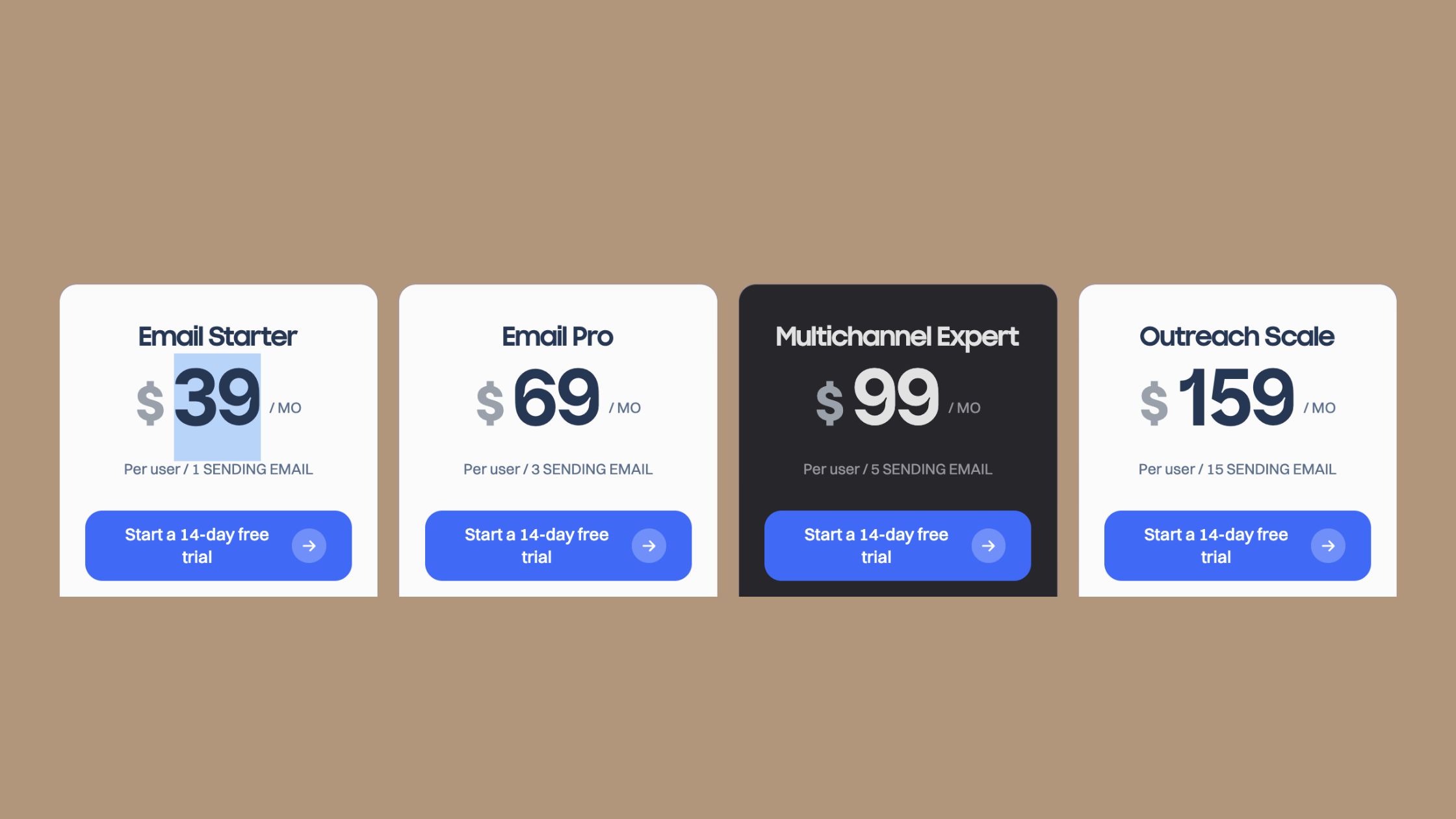
Lemlist's pricing is seat-based rather than contact-volume based:
This means you pay for sending capability and sequence features, not for storing contacts. A 3-seat Multichannel plan at ~$297/month can prospect tens of thousands of leads without incurring per-contact charges.
Mailchimp's list-size pricing model penalizes list growth. Lemlist's seat-based model penalizes team size. Choosing between them is really a question of where your bottleneck is.
Free Trial and Freemium Breakdown: What You Can Actually Test
Mailchimp offers a free tier for up to 500 contacts and 1,000 sends/month — genuinely useful for testing templates, building a list, and running small campaigns without a credit card. The free plan's limitations (no A/B testing, Mailchimp branding on emails) become real friction points quickly, but it is a legitimate starting point for new users. Lemlist offers a 14-day free trial with access to core features — enough time to run a pilot sequence and see reply rates, but you need a sending domain and warm-up infrastructure ready to make it meaningful. Neither free offering gives a full picture of the tool at production scale, but Mailchimp's free tier is usable long-term for very small operations; Lemlist's trial is better treated as a proof-of-concept window.
Quick Answer: Best Tool for Your Goal
Best for cold B2B outreach → Lemlist — multichannel sequences, domain warm-up, reply detection built-in
Best for newsletter and subscriber campaigns → Mailchimp — permission-based, list management, e-commerce integrations
Best for small budgets with an existing audience → Mailchimp free tier — 500 contacts, no commitment
Best for SaaS / agency outbound pipelines → Lemlist Multichannel — email + LinkedIn steps in one sequence
Best for LinkedIn-focused growth alongside email → Combine Lemlist outbound with HyperClapper for LinkedIn post visibility and engagement
Building pipeline on LinkedIn alongside email outreach?
HyperClapper boosts your LinkedIn post visibility through real community engagement — so your outbound efforts land on a profile that already looks authoritative.
Is Lemlist Better Than Mailchimp for Small Business and B2B Teams?
The question "is lemlist better than mailchimp for small business" resolves cleanly once you answer a simpler prior question: are you selling to strangers, or nurturing people who already know you?
For small B2B businesses running outbound — consultants, agencies, SaaS companies with SDR motions, recruiters — Lemlist is the stronger ROI play. Every dollar goes toward generating pipeline from cold leads rather than managing a list you already built. B2B founders running sub-10-person teams with no meaningful inbound volume consistently report higher revenue attribution from a single well-run Lemlist sequence than from months of Mailchimp newsletters — but only when their offer and targeting are sharp.
For small businesses with an established audience — e-commerce brands, content creators, local service businesses with an existing subscriber base — Mailchimp's ease of use, free tier, and e-commerce integrations make it the practical choice. Its setup time is minimal, and behavioral automations (abandoned cart, post-purchase sequences) generate revenue on autopilot without requiring outbound infrastructure.
When Should You Use Lemlist Instead of Mailchimp?
Use Lemlist instead of Mailchimp when:
Your pipeline depends on starting conversations with people who have never opted into anything from you
Your sales cycle involves multiple outreach touches before a meeting is booked
You want to combine email and LinkedIn steps in a single coordinated sequence
You are targeting a narrow ICP (ideal customer profile) where high personalization is essential to getting replies
Your team is measured on meetings booked or pipeline created, not on email open rates
Stick with Mailchimp when your goal is anything involving a consented subscriber list — retention campaigns, product announcements, nurture sequences, or re-engagement of past customers.
Safety, Compliance, and Account Risk: What the Comparison Articles Skip
Most lemlist vs mailchimp comparison articles treat this topic in a footnote. It deserves a dedicated section because
Frequently Asked Questions About Lemlist vs Mailchimp
Why are people leaving Mailchimp?
Most users leave Mailchimp because pricing scales aggressively with list size, making it expensive as audiences grow. Others leave after finding the automation logic too shallow for complex workflows. A growing segment of departures comes from sales teams who mistakenly used it for cold outreach and damaged their sender domain in the process.
Who is Mailchimp's biggest competitor?
For email marketing, Mailchimp's closest competitors are Klaviyo, ActiveCampaign, and Brevo, depending on use case. For cold outreach specifically, Lemlist, Instantly, and Apollo compete more directly. The distinction matters because no single tool beats Mailchimp across both categories — the right competitor depends entirely on which job you need done.
What is Lemlist good for?
Lemlist is built for B2B cold outreach — turning a list of prospects who have never heard of you into booked meetings. Its strengths are multi-channel sequences combining email and LinkedIn, dynamic personalization at scale, AI-generated icebreakers, and lemwarm for domain warm-up. It is not designed for managing opted-in subscriber newsletters.
What is a good replacement for Mailchimp?
The right replacement depends on your motion. For newsletter and broadcast email, Brevo or ActiveCampaign offer comparable features at lower list-based pricing. For B2B outbound prospecting, Lemlist or Instantly are purpose-built replacements. Switching without clarifying which job Mailchimp was doing for you is the most common reason teams end up unhappy with the alternative.
Which tool gives better ROI for cold outreach, Lemlist or Mailchimp?
Lemlist gives significantly better ROI for cold outreach. Mailchimp is not built for cold email — it flags unsolicited sending, lacks sequence logic and reply detection, and using it for cold outreach risks permanent domain reputation damage. Lemlist's warm-up infrastructure, personalization engine, and sequence logic are specifically designed to maximize cold outreach conversion rates.
Is Lemlist worth the higher price compared to Mailchimp?
Yes, if your goal is outbound prospecting. Lemlist charges per seat with generous contact volume, while Mailchimp charges by list size. For a B2B sales team running cold sequences, Lemlist's reply rates, meeting bookings, and pipeline generated typically deliver a return that justifies the premium. For newsletter management, Mailchimp's pricing is more appropriate.
What are the real differences between Lemlist and Mailchimp for sales teams?
Lemlist gives sales teams prospect sequencing, LinkedIn step integration, reply detection, and domain warm-up — none of which Mailchimp offers. Mailchimp has no multi-channel outreach, no cold-sending infrastructure, and no pipeline-focused analytics. For a sales team measured on booked meetings and pipeline, Mailchimp is functionally the wrong category of tool, not just the weaker option.
Can I use Mailchimp for cold email outreach or do I need Lemlist?
You can technically send cold email through Mailchimp, but doing so violates its Terms of Service and risks account suspension and domain blacklisting. Mailchimp's infrastructure is built for consented lists — spam complaints from cold recipients trigger automated enforcement. If cold outreach is your goal, Lemlist or a dedicated cold email platform is the only safe choice.
👋
⚡ Free plan
Leaving already?
Grab 3 free boosts on your next LinkedIn post — real likes & comments from 5,000+ creators. No card, cancel anytime.