
The best MagicPost alternatives for LinkedIn in 2026 are Taplio, Podawaa, AuthoredUp, EasyGen, and HyperClapper — each solving a different piece of the LinkedIn growth puzzle. A pattern observed across thousands of LinkedIn accounts is that most users don't leave MagicPost because it's bad at writing posts. They leave because writing a post is only half the job. Without an engagement layer — real early comments, algorithmic momentum, and consistent reach amplification — even well-crafted content quietly disappears into the feed. This guide cuts through the surface-level feature comparisons and answers the harder question: which MagicPost alternatives for LinkedIn actually move the visibility needle, and at what price?
- Who this is for: Solo founders, creators, coaches, and small teams spending under €50/month on LinkedIn tools
- What you'll learn: An honest, structured comparison of 5 MagicPost alternatives — with pricing, free plans, and best-fit use cases
- Why it matters: Most comparison articles list tools without explaining which problem each one actually solves
- Counterintuitive finding: The tool with the best AI writing often does the least for your reach — content quality and distribution are separate problems requiring separate solutions
- The real gap: MagicPost has no built-in engagement amplification — every alternative here handles that differently
- Bottom line: For most solo founders, the best setup is a free AI writer (EasyGen) paired with a real engagement layer (HyperClapper) — not one expensive all-in-one tool
- What Is MagicPost and Why Are People Looking for Alternatives in 2026?
- How We Evaluated These MagicPost Alternatives for LinkedIn
- The 5 Best MagicPost Alternatives: Compared and Ranked for 2026
- Pricing and Free Plan Comparison: LinkedIn Tool Pricing for Every Budget
- Why Your LinkedIn Reach Is Low — and How These Tools Actually Fix It
- Which MagicPost Alternative Is Right for You? A Decision Framework
- Frequently Asked Questions About MagicPost Alternatives and LinkedIn Growth
| Tool | Best For | Free Plan | Entry Price | Engagement Features |
|---|---|---|---|---|
| Taplio | Personal brand builders | Trial only | ~$49/mo | Moderate |
| Podawaa | Organic reach via pods | Yes (limited) | ~$9/mo | Strong (pods) |
| AuthoredUp | Analytics & formatting | Yes | ~$19/mo | None |
| EasyGen | AI writing for beginners | Yes (generous) | ~$29/mo | None |
| HyperClapper | Real engagement & reach | Yes | Affordable tiers | Best-in-class |
What Is MagicPost and Why Are People Looking for Alternatives in 2026?
MagicPost is an AI LinkedIn post generator — software that produces LinkedIn-formatted text from prompts or topics — targeting creators and professionals who want to post more consistently without spending hours writing. It handles content creation reasonably well at a mid-range price point. What it doesn't handle is what happens after you hit publish.
The recurring frustration across the community is specific: MagicPost produces posts, but those posts frequently go nowhere. Users report solid output quality followed by flat reach — because the tool has no engagement amplification, no algorithm-aware scheduling intelligence, and no analytics deep enough to explain why one post outperformed another by 10x. For teams budgeting under €50/month, a MagicPost review quickly reveals a core mismatch: the tool solves a writing problem when many users actually have a distribution problem.
Is MagicPost Worth It? A Feature-by-Feature Reality Check
MagicPost is worth it if your only gap is writing speed and your existing network already generates organic traction. For most solo founders and small teams, that's not the constraint. The honest pattern: users who switch away from MagicPost cite thin analytics (you can't tell which post format works), no engagement layer, and pricing that feels hard to justify at €30–40/month when free tools like EasyGen produce comparable copy. Is MagicPost worth it for LinkedIn growth in 2026? For content creation alone — possibly. For reach? It leaves you doing the hard work manually.
How We Evaluated These MagicPost Alternatives for LinkedIn
Six criteria drove the ranking: AI post quality (does the output sound LinkedIn-native or robotic?), scheduling reliability, analytics depth, engagement features, pricing, and free plan generosity. Not all criteria carried equal weight.
LinkedIn post engagement rate was weighted most heavily — a tool that writes excellent posts but contributes nothing to their distribution is solving half the problem. The real cost of LinkedIn growth compounds when you pay for writing tools that leave reach entirely to chance.
Every tool was assessed through a solo founder and small team lens: real-world budget of under €50/month, minimal setup time, and no dedicated social media manager. LinkedIn algorithm optimization factored in meaningfully — tools that understand dwell time, early engagement signals, and comment depth ranked higher than those that simply schedule posts at arbitrary times.
What separates top performers here is not the sophistication of their AI writing engine. It's whether they give you a mechanism to trigger the early engagement velocity that LinkedIn's algorithm uses to decide whether to distribute your post beyond your immediate first-degree connections.
The 5 Best MagicPost Alternatives: Compared and Ranked for 2026
Each alternative below is assessed consistently: what it is, how it works, strengths, real limitations, and the exact user profile it fits. The goal is to answer "what is the best alternative to MagicPost" by matching tool to problem — not by declaring a universal winner that suits nobody perfectly.
1. Taplio — Best AI LinkedIn Post Generator for Personal Brands
Taplio is a premium AI LinkedIn post generator — a tool that creates, schedules, and analyses LinkedIn content — aimed at thought leaders and executives building a recognisable personal brand. It is one of the most feature-complete options in this space and one of the most expensive.
Taplio's AI writing is trained specifically on high-performing LinkedIn content, which produces output that reads more natively than generic ChatGPT prompts. It includes a content inspiration feed, a CRM-lite relationship manager, and scheduling with timing recommendations. The analytics dashboard is meaningfully deeper than MagicPost's.
Limitations: At ~$49/month with no meaningful free plan, Taplio targets professionals who treat LinkedIn as a primary revenue channel. For founders spending under €50/month total on tools, it's hard to justify. It also has no built-in engagement pod mechanism — your posts still sink or swim on existing network traction. MagicPost vs Taplio: Taplio wins on AI writing quality and analytics depth; MagicPost edges it on price. Neither solves reach.
Best for: Established personal brand builders with budget, or executives whose assistant manages their LinkedIn presence.
2. Podawaa — Best LinkedIn Engagement Pod Tool for Organic Reach
Podawaa is a LinkedIn engagement pod tool — a platform that connects users in groups that mutually like and comment on each other's posts — designed primarily to trigger the early engagement signals the LinkedIn algorithm uses for wider distribution.
Unlike MagicPost, Podawaa isn't focused on writing. It's focused on reach. When a post receives comments and likes within the first 30–60 minutes of publishing, LinkedIn's algorithm interprets that as a signal of relevance and distributes it further. Podawaa automates participation in those early-engagement groups.
Limitations: Engagement pods carry a known risk profile — LinkedIn has tightened its detection of coordinated inauthentic engagement, and low-quality pods (random accounts commenting generic phrases) can now suppress reach rather than amplify it. Pod quality varies enormously. Podawaa's free plan is limited to basic pod access with a cap on weekly engagements.
Best for: Users whose primary problem is reach, not writing — and who are willing to manage pod quality carefully.
3. AuthoredUp — Best LinkedIn Content Analytics and Formatting Tool
AuthoredUp is a LinkedIn content analytics and formatting tool — a browser extension that enriches LinkedIn's native editor with post history, performance analytics, and formatting options — targeting experienced creators who want data to sharpen their content strategy.
Where MagicPost focuses on AI generation, AuthoredUp focuses on understanding what's already working. You can see your historical post performance, identify which formats and topics drove the most engagement, and format posts with text styles that aren't available in LinkedIn's standard editor (bold, italic, custom spacing).
Limitations: No AI writing, no scheduling (beyond LinkedIn's native scheduler), and no engagement amplification. AuthoredUp is a refinement tool, not a growth tool. It answers "which LinkedIn tool has the best analytics" for individual posts — but it won't help a new account build an audience from scratch. Also note: integrations with external CRM or analytics dashboards are limited.
Best for: Creators already posting consistently who want to stop guessing which content works and start optimising based on real patterns.
4. EasyGen — Best Free AI LinkedIn Post Generator for Beginners
EasyGen is purpose-built as an AI writing for social media tool — specifically trained on LinkedIn post formats — and it's the most beginner-accessible option on this list. Its free plan is genuinely generous, making it the clearest answer to "is there a free alternative to MagicPost for LinkedIn."
EasyGen generates posts from a topic or experience description and is trained on LinkedIn's native formats: storytelling hooks, list posts, insight posts, and engagement-baiting questions. The output typically requires less editing than generic AI tools because it's not trying to be a universal content platform.
Limitations: No scheduling, no analytics, and zero engagement features. EasyGen solves exactly one problem: getting words on the page fast. Teams that also need CRM integration, LinkedIn content scheduling tools, or multi-account management will outgrow it quickly. It also doesn't integrate with CRM platforms or content calendars.
Best for: Founders and professionals who are stuck at the blank page — cheap, fast, and surprisingly LinkedIn-native in output quality.
5. HyperClapper — Best LinkedIn Growth Tool for Real Engagement and Reach
HyperClapper is a LinkedIn engagement platform — a tool that amplifies post reach through real community channels, AI-powered replies, and company page boosting — built specifically for the part of LinkedIn growth that writing tools ignore entirely.
The mechanism is concrete: users submit a post to one or more channels (engagement groups of ~50 real members each). Those members engage with the post — real likes, real comments — generating the early engagement velocity that triggers LinkedIn's algorithmic distribution. One channel delivers approximately 50 engagements; three channels deliver approximately 150. That's the early signal LinkedIn needs to push content beyond your first-degree network.
What separates HyperClapper from standard engagement pods is the AI reply layer. Rather than triggering generic comments, HyperClapper's AI generates contextually relevant replies that add depth to the conversation — and users can feed more AI replies days later to keep a post active, since LinkedIn rewards sustained conversation, not just initial burst engagement. Company page boosting and reply features make it the strongest option for agencies managing multiple brand presences.
HyperClapper also includes a Content Guard moderation system that filters politically sensitive, controversial, or risky content before it enters channels — a meaningful safety feature that other pod tools lack. According to LinkedIn's own data, members who share content consistently receive 4x more profile views — HyperClapper is designed to make sure that content actually reaches enough people to generate that compound effect.
Best for: Creators, founders, agencies, and sales teams whose primary bottleneck is reach — not content creation. The strongest option when you want a safe LinkedIn growth approach that doesn't rely on bots or fake activity.
Get Real Engagement on Your Next LinkedIn Post
HyperClapper connects your posts with real engagement channels — so the LinkedIn algorithm sees early traction and distributes further.
Try HyperClapper FreePricing and Free Plan Comparison: LinkedIn Tool Pricing for Every Budget
Cost is where most comparison articles go vague. Here's the concrete LinkedIn tool pricing comparison — what each tool actually costs at entry level, what the free plan includes (if it exists), and what you give up at each tier.
| Tool | Free Plan | Entry Paid Tier | What You Get | What's Missing |
|---|---|---|---|---|
| MagicPost | Limited trial | ~€30–40/mo | AI post writing, basic scheduling | Engagement features, deep analytics |
| Taplio | 7-day trial | ~$49/mo | AI writing, analytics, CRM, scheduling | Engagement amplification, free tier |
| Podawaa | Yes — capped engagements | ~$9/mo | Engagement pods, scheduling | AI writing, analytics, content tools |
| AuthoredUp | Yes — full features, limited history | ~$19/mo | Analytics, formatting, post history | AI writing, scheduling, engagement |
| EasyGen | Yes — generous post allowance | ~$29/mo | AI LinkedIn post writing | Everything else |
| HyperClapper | Yes | Affordable tiers | Real engagement channels, AI replies, company page boosting, analytics | Native AI post writing (pairs well with EasyGen) |
The best free LinkedIn scheduling tool question deserves a direct answer: AuthoredUp's free tier is the most functional for analytics and formatting; EasyGen's free tier wins for AI writing volume. Neither solves reach. For the best LinkedIn content creation tools under a tight budget, the most cost-effective combination observed across lean solo-founder setups is EasyGen (free) for content creation plus HyperClapper's entry tier for engagement — total cost well under €50/month, with both problems addressed. Check out a deeper breakdown of free LinkedIn scheduling tools if scheduling is your primary gap.
According to LinkedIn, members who share content get 4x more profile views than those who don't. This means the return on solving the reach problem — not just the writing problem — is compounding. In practice, a post that earns early engagement reaches a far larger audience than one that's perfectly written but ignored at publication time.
Why Your LinkedIn Reach Is Low — and How These Tools Actually Fix It
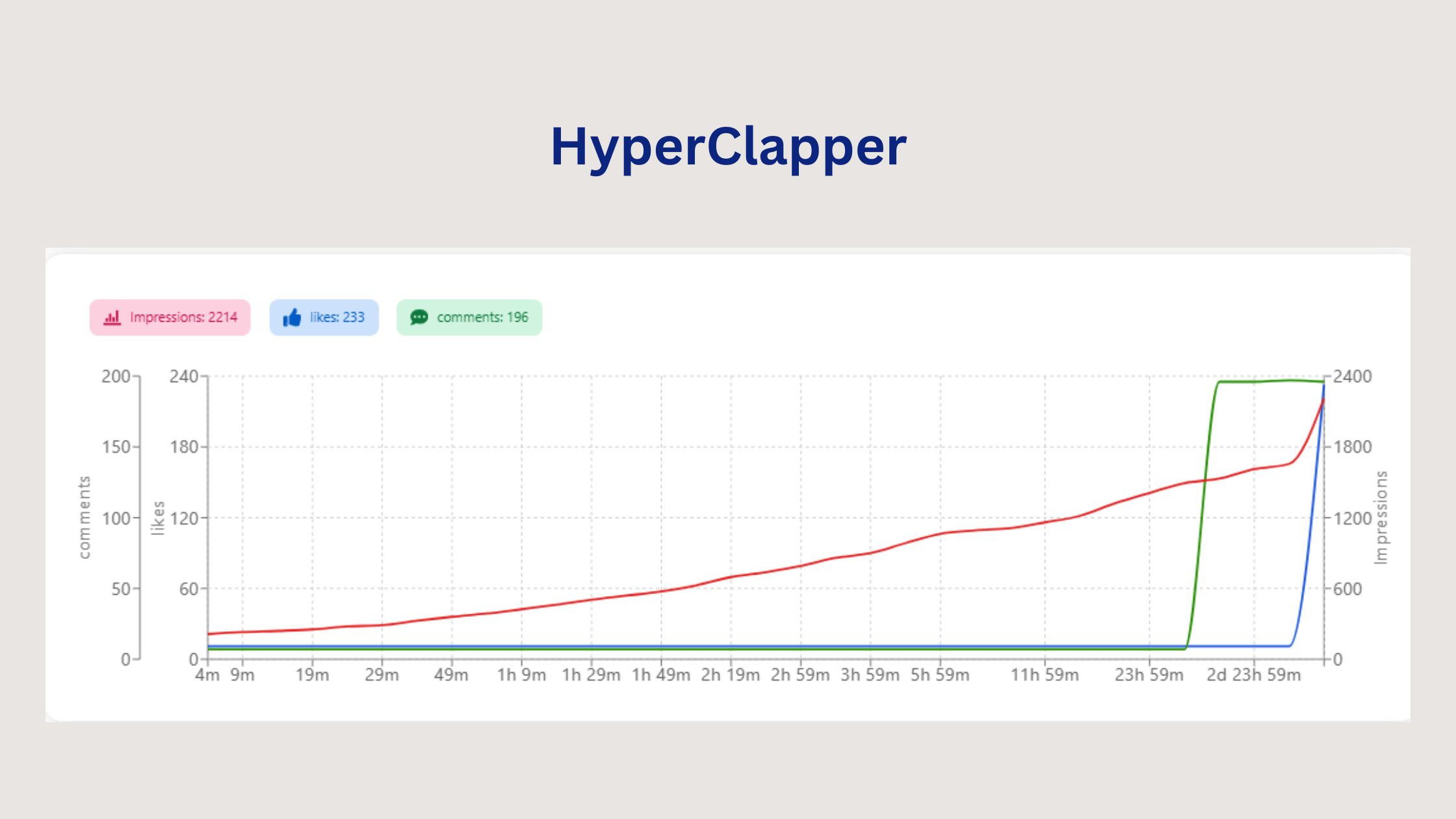
LinkedIn's algorithm makes a distribution decision about your post within the first 60–90 minutes of publishing. It looks at three signals: engagement velocity (how fast likes and comments arrive), comment depth (are comments substantive and generating replies?), and dwell time (how long people pause on your post versus scrolling past). Most LinkedIn post scheduling tools only help you post at the right time. They don't generate any of those three signals.
This is the clearest answer to "why is my LinkedIn reach so low": if nobody engages in that first window, the algorithm treats the post as low-relevance and stops distributing it. It doesn't matter how good the writing is. The most common failure mode is posting high-quality content with no early engagement strategy and then wondering why impressions plateaued at 200.
The writing is the raw material. Early engagement is the distribution mechanism. Most tools only sell you the raw material and call it a growth tool.
Here's how LinkedIn algorithm tools improve reach in concrete terms:
- Engagement pods (Podawaa, HyperClapper channels) trigger the early velocity signal by getting real people to engage within that critical first window
- AI replies (HyperClapper) add comment depth — substantive, contextual replies that generate further conversation rather than one-word reactions
- Optimal scheduling (Taplio, AuthoredUp insights) ensures your post publishes when your audience is most active — Tuesday to Thursday mornings tend to outperform weekend posts by roughly 40–60% in most B2B niches
- Feed More AI Replies (HyperClapper) keeps the conversation alive beyond day one — LinkedIn's algorithm doesn't stop watching after 24 hours
Teams that combine AI writing with a real engagement layer consistently see post performance 2–3x higher than teams relying on writing quality alone. The solo founder LinkedIn strategy that works in 2026: write well, post consistently, and ensure every post has engineered early traction — not hope-based traction.
Understanding why reach fails is the foundation — next, matching the right tool to the right problem is what actually changes the outcome.
Which MagicPost Alternative Is Right for You? A Decision Framework
The users who see the biggest results from these tools don't pick the most feature-rich option. They identify their single biggest bottleneck — content creation, consistency, or reach — and pick the tool that solves that specific problem. A recurring pattern among solo founders trying to grow on LinkedIn is purchasing the most comprehensive tool available, using 20% of its features, and blaming the tool when results are flat.
Here's the matching logic:
- Stuck at the blank page? → EasyGen (free) or Taplio (premium) for AI writing
- Posting consistently but reach is flat? → HyperClapper for real engagement amplification
- Posting consistently but don't know what's working? → AuthoredUp for post analytics and pattern recognition
- Need reach boost on a very tight budget? → Podawaa at ~$9/month for basic pod engagement
- Want the full personal brand toolkit with budget? → Taplio, accepting that reach still requires a separate layer
For agency or multi-account use, HyperClapper's company page boosting and reply features make it the strongest option — most alternatives on this list are built for single-user personal profiles. The ability to boost both personal posts and company page posts, with AI replies from company accounts, is directly relevant to agencies managing multiple brand presences. Taplio supports team collaboration at its higher tiers, but the price scales quickly. This is a gap that competitor comparison articles consistently miss: most tools are designed for solo users, and only a subset handle multi-profile or company page management at a practical price point.
On integrations: Taplio offers native CRM integrations (HubSpot, Salesforce) at higher tiers, making it the strongest option for sales teams embedding LinkedIn outreach into an existing workflow. AuthoredUp integrates with LinkedIn natively via browser extension — no external platform setup. HyperClapper's analytics feed into post-level performance tracking, useful for marketers reporting on LinkedIn as part of a broader content calendar. For teams asking how to increase LinkedIn organic reach as part of a wider demand-generation strategy, the HyperClapper + Taplio combination — one for engagement, one for writing and CRM — is the pairing most likely to deliver compound results without breaking a €50–80/month budget.
✓ The LinkedIn Growth Tool Selection Checklist
- ☐Identify your primary bottleneck: writing speed, posting consistency, or reach amplification
- ☐Confirm whether you need a free plan or can commit to a paid tier under €50/month
- ☐Check whether the tool supports your use case: personal profile, company page, or multi-account
- ☐Test AI output quality: does it sound like you, or does it need heavy editing before publishing?
- ☐Verify the engagement mechanism: real people in channels, pods, or AI replies — not fake bots
- ☐Run the tool for a minimum of 4 posts before evaluating — one post tells you almost nothing
- ☐Pair a writing tool with an engagement tool if reach is flat — they solve different problems
The best LinkedIn tool isn't the one with the most features. It's the one that eliminates the exact constraint stopping your content from reaching the right audience.
Stop Writing Posts That Nobody Sees
HyperClapper gives your LinkedIn posts real early engagement — from real people in real channels — so the algorithm distributes them further from day one.
Start Growing on LinkedInFrequently Asked Questions About MagicPost Alternatives and LinkedIn Growth
What are the best MagicPost alternatives to grow my LinkedIn audience?
The best MagicPost alternatives for LinkedIn audience growth in 2026 are HyperClapper (real engagement and reach amplification), Taplio (AI writing and analytics for personal brands), EasyGen (free AI post generation for beginners), Podawaa (engagement pods at low cost), and AuthoredUp (analytics and post formatting). The right choice depends on whether your bottleneck is content creation, reach, or analytics.
Which LinkedIn content tools use AI to write posts for you?
EasyGen, Taplio, and MagicPost all use AI to generate LinkedIn posts from prompts or topics. EasyGen is the strongest free option — its output is trained on LinkedIn-native formats and typically requires minimal editing. Taplio's AI is more sophisticated and pairs with a CRM and scheduling system, but costs ~$49/month. HyperClapper adds AI-powered replies rather than full post generation, complementing any of these writing tools.
How can I 10x my LinkedIn reach without paying for ads?
10x LinkedIn organic reach without ads by engineering early engagement velocity: submit posts to real engagement channels (HyperClapper), add substantive AI replies within the first hour (not generic comments), and publish during your audience's peak active window. LinkedIn's algorithm gates distribution on those first 60–90 minutes of signals — consistent early engagement, not ad spend, is what expands reach compounding over time. Explore free tools for LinkedIn growth that combine with this approach.
Is there a free alternative to MagicPost for LinkedIn?
Yes — EasyGen offers a generous free plan for AI LinkedIn post writing, and AuthoredUp has a functional free tier for analytics and formatting. HyperClapper also offers a free entry point for engagement. No single free tool replicates MagicPost's full feature set, but combining EasyGen (writing) with HyperClapper's free tier (engagement) covers more ground than MagicPost at zero cost. See the full list of free LinkedIn scheduling tools for additional options.
How do LinkedIn algorithm tools actually improve your reach in 2026?
LinkedIn algorithm tools improve reach by triggering the three signals LinkedIn's feed algorithm weights most: early engagement velocity (likes and comments in the first 60–90 minutes), comment depth (substantive replies that extend the conversation thread), and consistent posting patterns that establish account credibility. Tools that only schedule posts address timing; tools like HyperClapper address the engagement signals that actually drive algorithmic distribution.
Which alternative is best for agency or team use with multiple LinkedIn accounts?
HyperClapper is the strongest option for agency and multi-account use — it supports both personal profile boosting and company page boosting, with AI replies from company accounts, making it practical for agencies managing multiple brand presences. Taplio supports team collaboration at higher tiers but costs significantly more per seat. Most other tools on this list are designed for single-user personal profiles and lack multi-profile or company page management at a practical price point. For a deeper LinkedIn scheduling and growth tool comparison, see the full breakdown.
What should I look for in a LinkedIn growth tool comparison for 2024 and 2025?
In any LinkedIn growth tool comparison 2024 or 2026 evaluation, prioritise three criteria above all others: whether the tool addresses reach (not just writing), whether engagement is from real people or fake bots, and whether the pricing scales sensibly for your account stage. Analytics depth and free plan quality are secondary — valuable, but irrelevant if the tool doesn't move your post beyond your existing network.



