How to Use DealcodeAI: An Honest Review for First-Timers
Discover our honest dealcodeai review for first-timers. Learn how this AI sales tool analyzes your CRM pipeline and automates outreach to close more deals faster.
📅 ⏱ 17 min read📝 ~3200 words
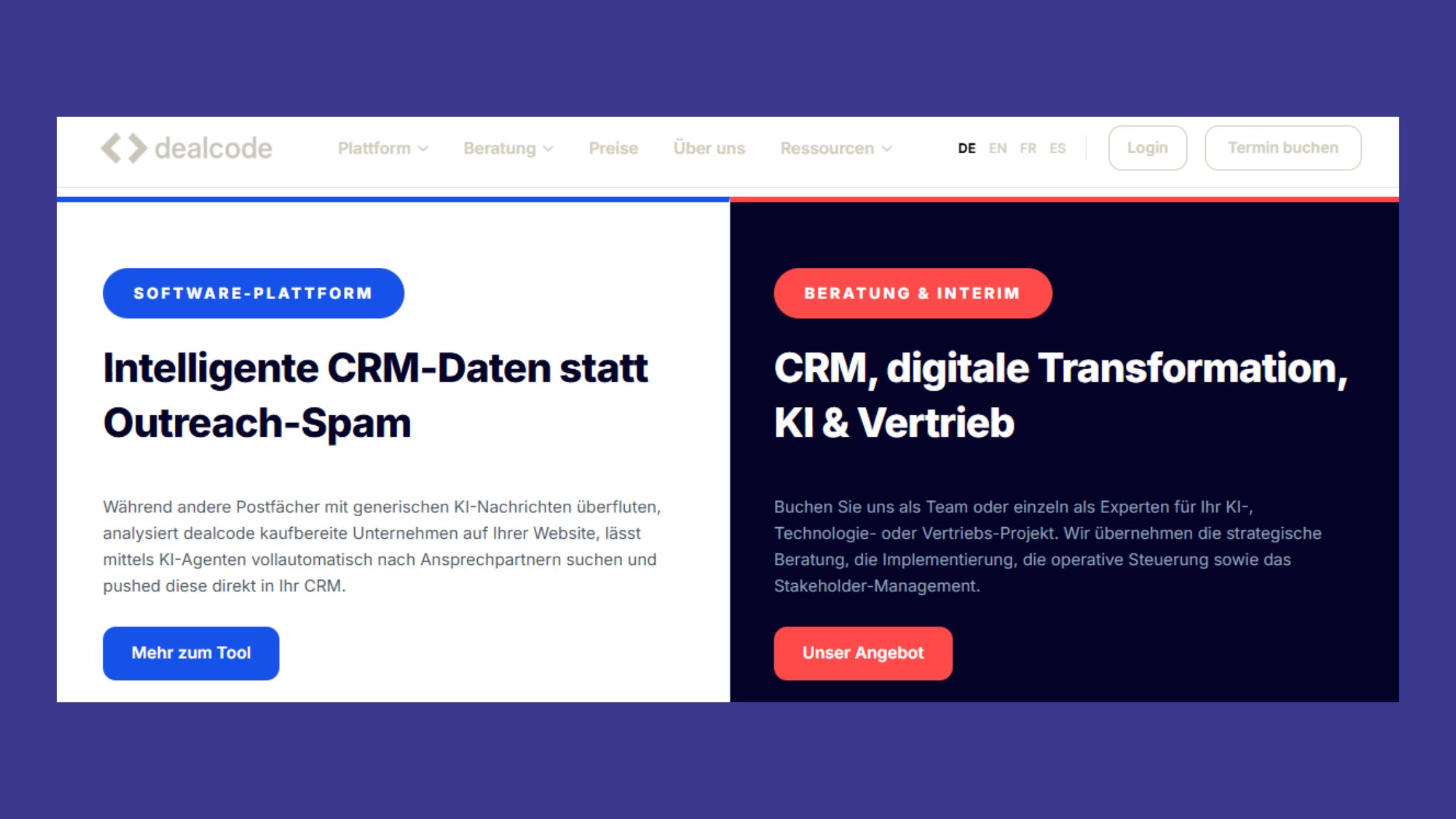
DealcodeAI is a Hamburg-based AI sales automation platform that analyzes your CRM pipeline across 150+ factors, scores each deal by close probability, and automates outreach — so your reps stop guessing and start working the deals most likely to convert. A pattern observed across B2B sales teams adopting this category of tool is that the biggest win isn't the automation itself — it's the forced prioritization. Most pipelines have more noise than signal, and DealcodeAI's scoring engine surfaces the signal fast. According to ColdIQ's 2026 tool review, users report 3x win rates and substantial time savings from DealcodeAI's personalized outreach and automation features — though results depend heavily on CRM data quality and setup.
Key Takeaways
Who it's for: Mid-market B2B sales teams, RevOps leaders, and SDR managers with 20+ active deals in pipeline
What you'll learn: How DealcodeAI works, how to set it up, what it costs, and where it falls short — with no marketing spin
Why it matters: AI deal scoring can cut pipeline review time significantly, but only if your CRM data is clean and the model is calibrated correctly
Most counterintuitive finding: The tool's weak point isn't feature depth — it's data validation. High-priority scores built on stale CRM data are no more useful than expired coupon codes: they look valid until you try to use them
GDPR note: EU-based infrastructure makes DealcodeAI a strong fit for European teams with compliance requirements
Bottom line: Strong value for established pipelines; less compelling for early-stage teams still building their CRM foundation
DealcodeAI is a German B2B sales platform that pairs website visitor identification with AI-driven contact enrichment, deal scoring, and multi-channel outreach automation. According to Slicey.ai's 2026 tool analysis, it's built around the premise that most sales teams already have the data they need to win more deals — they just lack the intelligence layer to act on it. The platform sits between your CRM and your reps, processing behavioral and historical signals to tell you which deals deserve attention today.
The AI Deal Scoring Engine Explained
Deal scoring is the process of assigning a close-probability score to each open opportunity based on historical win patterns, deal activity, and pipeline signals. DealcodeAI's engine analyzes your existing CRM data across more than 150 factors to identify what your winning deals have in common — then applies that model forward to rank active opportunities. According to Outly's DealcodeAI review, the system uses this analysis to predict pipeline health in real time, not just at quarter-end reporting.
Think of it as a chess engine that's studied all your past games — it doesn't play for you, but it tells you which moves are statistically strongest given where the board currently sits.
What separates top-performing implementations here is calibration quality. Teams that import clean, complete deal history and invest time in the initial model calibration session see scoring outputs that actually match their rep intuition. Teams that skip calibration often find the scores feel generic — because they are, until the model learns your specific deal cycle.
AI Sales Automation: What DealcodeAI Actually Automates
On the automation side, DealcodeAI handles outreach sequencing, AI-generated messaging personalized to each prospect, follow-up scheduling, and LinkedIn activity tracking. It is explicitly an AI SDR layer — meaning it augments your sales development function rather than replacing your CRM. Your deals still live in Salesforce, HubSpot, or Pipedrive; DealcodeAI adds intelligence and action on top of that foundation.
💡
Pro Tip:Before your first demo, pull a list of your last 50 closed-won and closed-lost deals. Having this data ready cuts onboarding calibration time by roughly half and gives the scoring model something real to learn from immediately.
Understanding the tool's scope sets the right expectations for setup — which is where most first-timers encounter their first friction point.
DealcodeAI Getting Started: Setup, Onboarding, and First Results
Onboarding follows a structured four-stage path: account creation, CRM connection, pipeline import, and scoring model calibration. Most teams complete initial setup in one to two days — but that timeline assumes your CRM data is reasonably clean and your primary admin is available to configure field mappings. Teams with fragmented or inconsistently maintained CRM records should expect to spend an additional day or two cleaning data before the import produces reliable scoring output.
Step-by-Step: Connecting Your CRM and Importing Pipeline Data
Create your account and complete the product tour (15–20 minutes) — the onboarding flow is guided; don't skip the product tour even if it feels slow. It surfaces configuration options that aren't obvious later.
Connect your CRM (30–60 minutes) — native connectors for Salesforce, HubSpot, and Pipedrive handle most of the field mapping automatically. Custom field mapping adds time.
Import at least 90 days of deal history — this is non-negotiable for scoring accuracy. Less history produces generic scores; more history (12+ months) produces measurably better calibration.
Run the calibration session (45–90 minutes) — this is where you tag closed-won and closed-lost deals so the model learns your win patterns. Most teams skip or rush this step and then complain that scores don't feel accurate.
Set up outreach sequences and notification rules (1–2 hours) — configure which deal-stage triggers fire automated sequences and which Slack channels receive deal alerts.
⚠️
Warning:Skipping the calibration step and trusting default scoring weights is the most common onboarding mistake. Default weights are built on aggregate industry patterns — not your deal cycle, your ICP, or your average deal size. Scores based on default weights can actively misdirect rep attention for the first 2–3 weeks.
How Long Before You See Real Results?
The first meaningful output — a scored, prioritized pipeline view — appears within 24–48 hours of completing the CRM sync. But the scoring model improves continuously as it processes more closed deals. The pattern observed across new implementations is a noticeable accuracy jump around the two-week mark, once the model has processed enough recent activity data alongside the historical import. Teams that run a deal review meeting using the scored pipeline in week two typically report the first genuine "aha moment" — when the scores start matching or beating rep intuition.
DealcodeAI Features: What You Get and What Actually Matters
The core feature set covers the full B2B sales workflow: AI deal scoring, automated outreach sequences, pipeline analytics, AI-generated messaging, and bi-directional CRM sync. That's the brochure version. Here's the honest breakdown of what actually delivers value quickly versus what takes time to unlock.
AI SDR Capabilities: Outreach, Sequencing, and Personalization
The outreach automation goes meaningfully beyond mail-merge. DealcodeAI generates personalized messages using deal context pulled from your CRM — company size, recent activity, deal stage, and rep notes all feed into the messaging layer. The result is sequences that reference actual deal context rather than generic persona templates. Teams that consistently see the strongest outreach response rates are those who feed the AI richer CRM notes — sparse records produce generic messages regardless of the model's capability.
Multi-channel sequencing covers email, LinkedIn activity tracking, and call task scheduling. The LinkedIn connector logs touches and surfaces engagement signals but does not automate LinkedIn outreach directly — that distinction matters for compliance and for setting team expectations. For teams looking to complement their LinkedIn outreach visibility with genuine engagement, tools like HyperClapper sit alongside DealcodeAI's stack by boosting LinkedIn post reach through real community engagement — a different layer of the same visibility problem.
Pipeline Analytics and Deal Intelligence
Pipeline analytics gives you cohort-level views of deal health, stage velocity, and forecast accuracy alongside the individual deal scores. The dashboard is functional and covers the metrics most RevOps leaders need day-to-day. It is not, however, a replacement for a dedicated BI tool if your team requires custom report builds, cross-object analytics, or executive-level visualizations. Most mid-market teams find it sufficient; enterprise teams with mature BI stacks will likely use it alongside Tableau or Looker rather than instead of them.
The most common failure mode in pipeline analytics isn't missing data — it's stale data treated as current. A deal scored "high priority" on last week's signals is only as useful as the data behind that score. Validation frequency matters as much as scoring depth.
Does DealcodeAI Integrate with Your CRM and Tech Stack?
DealcodeAI offers native, bi-directional integrations with Salesforce, HubSpot, and Pipedrive — the three CRMs covering the majority of mid-market B2B teams. Bi-directional means deal updates in DealcodeAI sync back to your CRM, and CRM changes push into DealcodeAI in near real time. This matters because one-way sync tools create data drift within weeks, undermining scoring reliability.
Beyond CRM, the integration ecosystem includes:
Email: Gmail and Outlook for sequence delivery and reply tracking
LinkedIn: Activity logging and engagement signal tracking (read/no-automate)
Slack: Deal alert notifications and pipeline digest messages
API: Available for custom CRM connections and internal tooling integrations
Integration depth is not uniform. Salesforce and HubSpot connectors carry the most feature parity — custom field mapping, workflow triggers, and two-way sync all work reliably. Pipedrive integration is solid for core deal data but has some field-mapping gaps worth testing before you go live. For teams using less common CRMs or entirely custom-built systems, the API path works but requires developer time to configure and maintain ongoing. That's a real cost to factor in for smaller ops teams.
GDPR Compliance and Data Privacy
DealcodeAI is headquartered in Hamburg, Germany, which places it squarely within EU jurisdiction and GDPR's regulatory framework. Data is processed and stored on EU-based infrastructure — a meaningful differentiator for European companies that need to demonstrate data residency compliance when using outreach automation tools. The platform's outreach automation handles prospect data under a legitimate interest basis, which is standard for B2B sales contexts under GDPR. Teams with strict data governance requirements should still run a DPA (Data Processing Agreement) review before full deployment — that's standard practice regardless of vendor, not a DealcodeAI-specific concern.
💡
Pro Tip:If GDPR compliance is a hard requirement for your team, ask DealcodeAI's sales team for their standard DPA during the demo process — not after signing. EU-based vendors typically have these ready; the speed of their response tells you a lot about their compliance maturity.
With integrations and compliance covered, the natural next question is whether the investment clears the bar financially.
DealcodeAI Pricing: What It Costs and Whether It's Worth It
DealcodeAI pricing is structured around team size and feature tier, but it is not publicly listed at a flat rate. Most teams go through a demo-to-quote process — which is standard for B2B sales tooling at this capability level, though it makes upfront budgeting harder. Entry-level plans cover deal scoring and basic analytics. Higher tiers unlock full AI SDR automation, advanced integrations, and multi-channel sequencing. Expect pricing to scale with seat count and the features you actually need.
3x
Win rate improvement reported by DealcodeAI users across personalized outreach and automation features
That 3x win rate figure comes from ColdIQ's 2026 review of DealcodeAI and reflects user-reported outcomes — not controlled trial data. In practice, the teams seeing the strongest ROI are those with 50 or more active deals in pipeline at any given time. At that volume, automated prioritization alone recovers meaningful rep hours weekly. For smaller teams or solo founders with fewer than 20 active deals, the cost-to-value ratio weakens considerably — lighter alternatives like Salesgear or Growbots may deliver sufficient functionality at a lower price point.
Is DealcodeAI Worth It? ROI Signals to Look For
The clearest ROI signals within the first 30 days are:
Rep time spent on pipeline review dropping by 30–40% as scored prioritization replaces manual triage
Outreach sequence response rates visibly higher than pre-DealcodeAI baselines (watch week-over-week, not day-over-day)
Fewer "surprise losses" — deals the team didn't see falling out until they were already gone
If none of those signals appear in the first 30 days, the most likely culprits are CRM data quality and skipped calibration — not the platform itself. Diagnose those before concluding the tool isn't working.
Building LinkedIn Visibility Alongside Your Sales Stack?
HyperClapper helps sales teams and founders grow LinkedIn reach through real community engagement — the layer DealcodeAI doesn't cover.
What are the pros and cons of DealcodeAI? The strongest advantages are real-time deal scoring that updates continuously (not just at weekly pipeline reviews), AI outreach personalization that uses actual deal context, and EU-based infrastructure that simplifies GDPR compliance. These three together are a genuinely differentiated combination in the mid-market AI SDR space.
The limitations are equally worth knowing upfront:
Pricing opacity — no public rate card makes budgeting conversations harder before you've invested time in a demo cycle
Data dependency — the scoring model is only as good as the CRM data it runs on; teams with messy records will need a cleanup sprint before onboarding
Analytics depth — the reporting layer handles day-to-day pipeline management well but isn't built for complex custom reporting
Onboarding investment — first-timers should budget real time for setup, not treat it as a plug-and-play tool
The issue users report most often isn't about what DealcodeAI can do — it's about what happens when the underlying data is stale. A high-priority score built on outdated CRM records is no more useful than an expired promo code: it looks valid until you try to act on it. The fix is the same in both cases — validation quality, not discovery depth.
Common Mistakes First-Timers Make with DealcodeAI
After seeing this across multiple implementations, the pattern is consistent: the same three mistakes appear in nearly every struggling rollout.
Importing incomplete deal history. Teams that import only current open pipeline (no closed deals) give the scoring model nothing to learn from. Scores in this scenario are essentially guesses.
Skipping calibration. Default weights optimized for generic B2B patterns diverge significantly from industry-specific or high-ACV deal cycles. Calibrate before trusting scores.
Treating scores as decisions. Deal scores are inputs to rep judgment, not replacements for it. Teams that auto-deprioritize any deal scoring below a threshold without rep review make systematic errors that compound over time.
DealcodeAI vs Competitors: How It Stacks Up Against Other AI SDR Tools
The competitive set for best AI tools for sales deal management in 2026 includes SalesRobot, Outreach, Salesloft, and Apollo — each positioned differently on the automation-versus-intelligence spectrum. Here's how DealcodeAI fits relative to each.
DealcodeAI's clearest edge over outreach-volume tools like SalesRobot is the deal-scoring and pipeline intelligence layer. SalesRobot optimizes for top-of-funnel outreach scale; DealcodeAI optimizes for mid-funnel deal conversion. They solve different problems. Against Outreach and Salesloft, DealcodeAI wins on accessibility and implementation speed for mid-market teams — but loses on deep workflow customization that enterprise sales ops teams typically require. Apollo competes most directly on prospecting and sequencing; DealcodeAI differentiates on the intelligence layer Apollo doesn't prioritize.
For teams evaluating LinkedIn as a channel alongside deal management, it's worth noting that
Frequently Asked Questions About DealcodeAI
Can you explain how DealcodeAI works for someone who has never used it before?
DealcodeAI connects to your existing CRM, analyzes your pipeline across 150+ factors, and assigns each open deal a close-probability score based on your historical win patterns. It also automates outreach and follow-up sequencing. Think of it as an intelligence layer that sits between your data and your reps.
Is DealcodeAI a reliable tool for managing sales deals?
DealcodeAI is reliable when your CRM data is clean and the scoring model is properly calibrated. Users report up to 3x win rate improvements, but the tool's accuracy depends directly on the quality of deal history you feed it. Stale or incomplete CRM data produces misleading scores regardless of how sophisticated the engine is.
What should I know before signing up for DealcodeAI?
You need at least 90 days of deal history in your CRM before the scoring model produces trustworthy output. Teams still building their CRM foundation will see limited value early. Also budget one to two days for setup, and expect extra time if your CRM records are inconsistently maintained before import.
How does DealcodeAI compare to using a regular CRM for deal tracking?
A standard CRM records and organizes deal data but doesn't tell you which deals to prioritize. DealcodeAI adds a predictive layer on top of your CRM, scoring deals by close probability and automating outreach. The two tools work together — DealcodeAI isn't a CRM replacement, it's an intelligence upgrade for the pipeline you already have.
Is DealcodeAI worth it for smaller or early-stage sales teams?
DealcodeAI delivers the most value to mid-market B2B teams with 20 or more active deals and an established CRM history. Early-stage teams without a mature pipeline or clean historical data will struggle to get accurate scoring output, making the investment harder to justify until that foundation exists.
What are the main pros and cons of DealcodeAI?
The biggest advantages are AI-driven deal prioritization, automated multi-channel outreach, and GDPR-compliant EU infrastructure. The main weakness is data dependency — the scoring engine is only as good as the CRM data behind it. Teams with messy pipelines should clean their data before onboarding or the scores will feel generic and unreliable.
Does DealcodeAI integrate with popular CRM platforms?
Yes, DealcodeAI offers native integrations with Salesforce, HubSpot, and Pipedrive, handling most field mapping automatically on connection. Custom field mapping is supported but adds setup time. The integration works as a layer on top of your existing CRM rather than replacing it, so your deal records stay where they already live.
👋
⚡ Free plan
Leaving already?
Grab 3 free boosts on your next LinkedIn post — real likes & comments from 5,000+ creators. No card, cancel anytime.