Crunchbase is a startup intelligence database covering funding rounds, investor profiles, acquisitions, and founder data — and a pattern observed across thousands of B2B prospecting workflows is that teams either over-pay for features they barely touch, or under-use the free tier and miss the platform's real strengths entirely. A Crunchbase review that treats all users as one audience fails immediately: founders, sales teams, and investors each extract radically different value from the same platform, at radically different price points. This breakdown separates those use cases clearly, compares Crunchbase cost against genuine alternatives, and tells you exactly when paying is worth it — and when it isn't.
- Crunchbase is legitimate and widely used — the debate is never about credibility, always about whether the price matches your specific use case.
- Three distinct audiences (founders, sales teams, investors) get completely different ROI from the same platform — and most reviews miss this entirely.
- Crunchbase Pro costs ~$49/month billed annually; Enterprise pricing is quote-based and can run thousands per seat per year.
- Contact data bounce rates of 25–40% are realistic — pairing Crunchbase with an email verification tool is standard practice for outbound teams.
- Apollo.io wins for outbound sales; PitchBook wins for institutional due diligence; Crunchbase wins on real-time US startup funding intelligence.
- A free Crunchbase profile is one of the highest-ROI moves a founder can make — investors check it before every cold reply.
- What Is Crunchbase and What Does It Actually Do?
- Crunchbase Pricing in 2026: How Much Does It Actually Cost?
- Crunchbase Data Accuracy: Can You Trust What You Find?
- Is Crunchbase Worth the Cost? ROI by Use Case
- Crunchbase vs PitchBook, Apollo.io, and ZoomInfo: Head-to-Head
- Cheaper Alternatives to Crunchbase: The Honest Shortlist for 2026
- Crunchbase API Access and Developer Use Cases
- Boosting Your Crunchbase Presence: Why Founder Visibility Still Matters
- Crunchbase Reviews: What Real Users Actually Say in 2026
- Frequently Asked Questions About Crunchbase Cost and Alternatives
What Is Crunchbase and What Does It Actually Do?
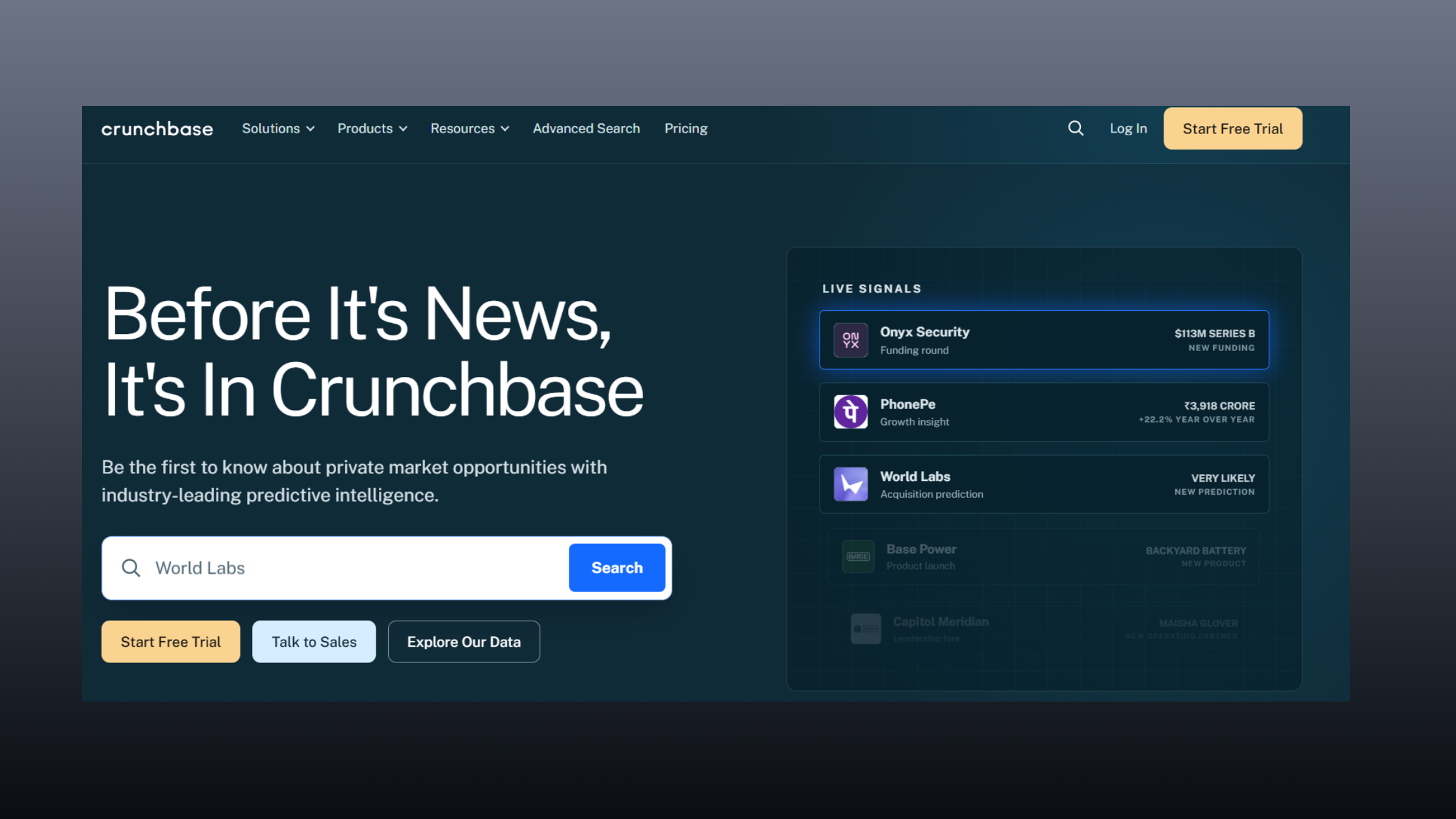
Crunchbase — what is it, exactly? It is a company and startup intelligence platform that aggregates funding rounds, investor profiles, founding team data, acquisitions, and firmographic information on millions of companies worldwide. Originally built to serve venture capital deal flow, the platform has expanded into a B2B prospecting workflow tool, a founder visibility layer, and a market research database — which is precisely where the confusion around its pricing begins.
Most Crunchbase reviews treat the platform as a single product for a single audience. That framing is why so many reviews are useless. The three core audiences — founders seeking visibility and discoverability, sales teams prospecting for funded leads, and investors researching deal flow — have almost nothing in common in terms of what they need, how often they use the platform, and what ROI justifies the cost. This article separates them clearly.
Is Crunchbase legit? Without question. The platform has been operating since 2007, is cited by major financial publications, and is used by top-tier VC firms and enterprise sales teams as a standard starting point for startup research. The legitimacy question is settled. The more useful question — is it worth the price for your specific use case — is what the rest of this article answers.
What Is Crunchbase Rank?
Crunchbase Rank is a proprietary relevance score assigned to every company on the platform. It determines how prominently a company appears in search results and category listings within Crunchbase. A higher rank means more organic discovery from investors, journalists, and potential partners browsing the platform. Rank improves with profile completeness, funding data accuracy, inbound links to the profile, and overall platform engagement. For founders, this is the single most actionable lever available entirely for free.
How Crunchbase Sources and Verifies Its Data
Crunchbase uses a hybrid data model: a combination of machine learning ingestion from public sources, contributor submissions (founders and companies can self-report), a network of data partners, and an editorial team that reviews major funding announcements. Data provenance — the documented origin and verification chain of a data point — is only partially transparent on the platform. Users can see whether a data point came from a news source or a contributor, but verification timestamps are inconsistently displayed.
The practical consequence: large funding rounds (Series A and above) from well-covered markets are highly accurate and typically appear within days of announcement. Pre-seed rounds, angel investments, and companies outside the US/UK/EU tech hubs are frequently missing, delayed, or incomplete. This is not a flaw unique to Crunchbase — it reflects the limits of any platform relying partly on crowd-sourced startup funding intelligence.
The Crunchbase App and Platform Experience
The Crunchbase app is available as a mobile application alongside the web platform. The mobile experience covers basic company searches, profile browsing, and funding alerts — it is useful for passive monitoring but not for serious list-building or prospecting workflows, which require the full desktop interface. The web platform itself is well-designed, with advanced filtering, saved searches, and CRM export options available at Pro tier and above.
Crunchbase Pricing in 2026: How Much Does It Actually Cost?
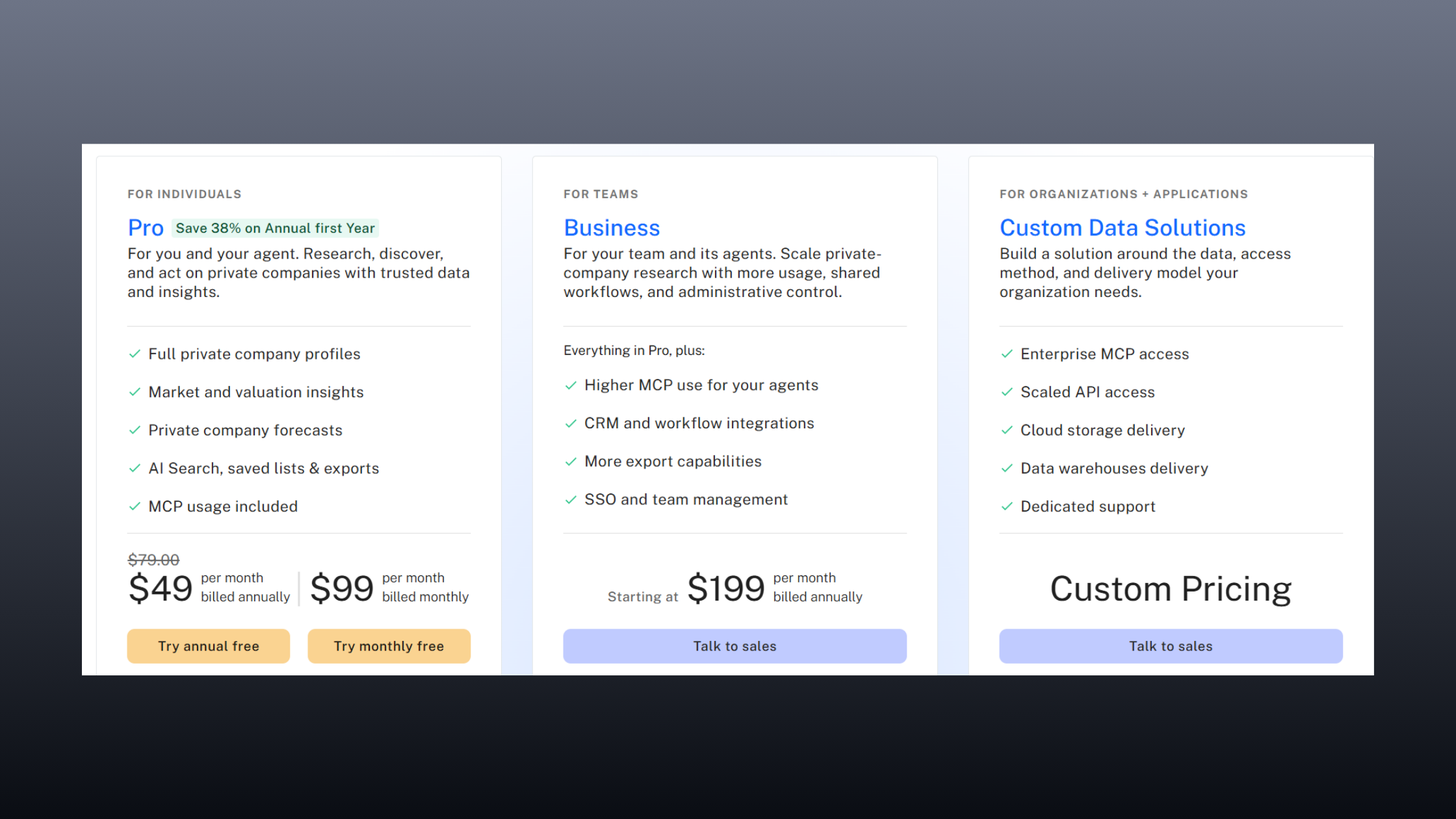
Crunchbase pricing follows a tiered model that reads straightforward on the surface but conceals significant cost jumps as you scale. How much does Crunchbase cost at each tier is a question worth breaking down precisely, because the published numbers and the real cost of meaningful usage are different things.
A Crunchbase subscription at the Pro level runs approximately $49/month billed annually — meaning you commit to roughly $588/year upfront. Month-to-month pricing is available but significantly higher. Enterprise pricing is entirely quote-based, and teams regularly report quotes ranging from $5,000 to $20,000+ annually depending on seat count, API access, and custom data needs.
Why is Crunchbase so expensive relative to some alternatives? The premium pricing reflects the depth of its funding-round dataset and investor relationship mapping — features that are genuinely difficult to replicate and that competitors like Apollo have not prioritized to the same depth. However, a pattern consistently observed across user communities is that most Pro subscribers use only 20–30% of the available feature set, which means they're paying for capability they never deploy.
Crunchbase Free Plan Limitations: What You Can and Can't Do
Can you use Crunchbase for free? Yes — but the free plan is genuinely limited. Here is what the free tier includes and excludes:
- Included free: Basic company profile search, limited profile views per month (typically 5 per day), public funding data visible on individual profiles, access to your own company's profile editing
- Not included free: Advanced search filters (funding stage, geography, investor type), bulk list export, contact data (emails/phone), CRM integration, saved searches and alerts, full investor relationship mapping
How to export Crunchbase data without paying is a common question — and the honest answer is that meaningful bulk export requires at least a Pro subscription or API access. Individual profile data can be manually copied, but any automated or batch export is paywalled. Some users combine free Crunchbase browsing with LinkedIn searches to approximate list-building, though this is time-intensive at scale.
What Is Included in Crunchbase Pro — Feature by Feature
Crunchbase Pro vs Enterprise is the comparison most teams wrestle with. Pro is the realistic entry point for individual users and small teams. Here is what Pro actually unlocks:
- Advanced search with 40+ filters (funding stage, round size, investor type, geography, headcount)
- Saved searches with email alert notifications when new companies match your criteria
- CRM export (CSV and Salesforce integration)
- Limited contact data — email addresses for key personnel, not a full contact database
- Investor portfolio mapping and relationship graphs
- Funding trend analytics by sector and geography
Enterprise adds API access, team seat management, custom data feeds, bulk export at scale, and dedicated customer support — features that only matter at team or developer scale.
Crunchbase Data Accuracy: Can You Trust What You Find?

Crunchbase data accuracy is the platform's most debated dimension — and the answer depends entirely on which type of data you're evaluating. Funding-round accuracy and contact data accuracy are two very different stories.
Contact email accuracy is where the most friction occurs. User-reported tests and independent benchmarks consistently show email deliverability from Crunchbase contact data ranging from 60–75%, meaning bounce rates of 25–40% are realistic. In practice, running a 500-contact outbound sequence built entirely from Crunchbase data without an email verification layer will typically produce deliverability problems significant enough to damage sender reputation. The standard practice among experienced outbound teams is to treat Crunchbase contacts as a starting signal and run them through a verification tool (Hunter.io, Neverbounce, or similar) before sequencing.
Crunchbase's funding data is a genuine intelligence asset. Its contact data is a starting point, not a destination. Treating them as equivalent quality is the most common and costly mistake teams make when building outbound lists.
Where Crunchbase Data Holds Up — and Where It Doesn't
Teams that separate Crunchbase's data by type — and apply appropriate verification workflows to each — consistently see better results than teams that treat the entire dataset as equally reliable.
- Strong: Series A+ funding rounds in US, UK, and major EU markets — typically accurate within days of announcement
- Strong: Investor portfolio data and relationship mapping — one of Crunchbase's clearest differentiators
- Moderate: Firmographic data (headcount, HQ location, founding year) — accurate for established companies, lagging for fast-growth startups
- Weak: Pre-seed and angel round data — frequently missing or delayed by weeks to months
- Weak: Contact-level email data — requires external verification before use
- Weak: Companies outside US/UK/EU tech ecosystems — coverage gaps are significant
The most common failure mode is sales teams buying a Pro subscription expecting ZoomInfo-level contact coverage and discovering Crunchbase's contact layer is thinner and less verified. That expectation mismatch drives the majority of negative reviews.
Is Crunchbase Worth the Cost? ROI by Use Case
Whether Crunchbase is worth the cost depends almost entirely on which of the three core audiences you belong to — and no other review draws this distinction clearly enough to be actionable. Here is the honest breakdown.
For founders seeking visibility and discoverability: a complete, well-maintained Crunchbase profile generates inbound from investors, journalists, and potential partners at zero ongoing cost. Investors routinely check Crunchbase before responding to cold outreach — an incomplete or missing profile is a credibility gap that costs deals. The free plan is sufficient for this use case entirely. There is no reason for founders to pay unless they are actively using the prospecting or alerting features.
For sales teams prospecting for funded leads: Crunchbase Pro delivers genuine ROI if your ideal customer profile (ICP) is "recently funded startup." Funding alerts that notify you within days of a round closing are a high-signal trigger most databases cannot match in real time — reaching out while a company is flush with new capital and actively building is a timing advantage worth paying for. If your ICP is broader than funded startups, however, the value proposition weakens significantly.
For investors researching deal flow and venture capital intelligence: Crunchbase is the correct starting point for initial screening and market mapping. It is not the endpoint for serious due diligence. PitchBook provides analyst-verified data with deeper private equity coverage; Crunchbase provides broader but shallower coverage at a fraction of the cost. For solo investors or associates doing early-stage screening, Pro is defensible. For institutional investment research, it supplements but does not replace PitchBook.
- Building founder visibility for free → Free plan — complete ROI at zero cost
- Prospecting recently funded startups → Crunchbase Pro at ~$49/mo — strong ROI if ICP matches
- Early-stage deal flow screening → Crunchbase Pro — useful starting point, not a standalone due diligence tool
- Outbound at scale with contact data → Apollo.io or ZoomInfo — Crunchbase contact layer is too thin
- Institutional investment research → PitchBook — Crunchbase is insufficient for this use case
Common Mistakes to Avoid When Using Crunchbase
- Treating contact data as verified: Always run emails through a verification tool before sequencing — an unverified list at scale damages your sender domain.
- Ignoring the free profile: Founders who skip optimizing their Crunchbase profile lose inbound discovery that would otherwise come for free.
- Buying Pro to replace a contact database: Crunchbase Pro is a funding intelligence tool first. If you need a full B2B contact database, Apollo or ZoomInfo is the right primary tool.
- Relying on Crunchbase alone for due diligence: Pre-seed data gaps mean investment decisions made solely on Crunchbase data carry real information risk.
Founders: Your LinkedIn Presence Amplifies Your Crunchbase Discoverability
Investors who find you on Crunchbase immediately cross-reference LinkedIn. A strong, active LinkedIn presence with real engagement signals momentum — HyperClapper helps founders build that visibility through real community engagement and AI-powered replies.
Explore HyperClapperCrunchbase vs PitchBook, Apollo.io, and ZoomInfo: Head-to-Head Comparison
Head-to-head, Crunchbase occupies a specific niche it genuinely dominates — real-time US startup funding intelligence — and loses convincingly outside that niche. Here is an honest comparison across the tools that compete most directly for the same budget.
| Tool | Best For | Contact Data Quality | Funding Data | Price Range |
|---|---|---|---|---|
| Crunchbase Pro | Funded startup prospecting, founder visibility | Moderate (60–75% deliverability) | ★★★★★ best-in-class | ~$49/mo (annual) |
| PitchBook | Institutional investment research, PE/VC | Strong (analyst-verified) | ★★★★★ deeper than Crunchbase | $15,000+/year |
| Apollo.io | Outbound sales, contact prospecting, sequencing | Strong (larger database) | ★★☆ limited depth | $49–$99/mo |
| ZoomInfo | Enterprise sales, intent data, mid-market B2B | ★★★★★ most comprehensive | ★★☆ secondary focus | $10,000+/year |
| Dealroom | European startup and VC deal flow | Moderate | ★★★★ strong in EU | Free tier available; paid from ~€500/mo |
Crunchbase vs PitchBook pricing is a 10x cost difference for a reason: PitchBook employs a team of analysts who actively verify data, provides private equity coverage that Crunchbase lacks, and offers institutional-grade data infrastructure. For early-stage startup research, Crunchbase is sufficient. For M&A due diligence or LP-level investment analysis, PitchBook is the standard.
Crunchbase vs Apollo.io is the comparison most sales teams should make before subscribing. Apollo.io offers a contact database of 275+ million contacts with built-in email sequencing, phone number data, and significantly higher deliverability at a similar per-seat price. Crunchbase wins specifically on funding-round intelligence and investor relationship data — features Apollo does not prioritize. If you are doing outbound at scale and your ICP is not explicitly "funded startups," Apollo is likely the better tool for your B2B prospecting workflow.
Free Startup Funding Database Alternatives Worth Knowing
A free startup funding database that genuinely competes with Crunchbase's free tier is rare — but several exist for specific use cases:
- Dealroom.co free tier: More generous free access than Crunchbase for European startup and VC deal flow data
- Signal.nfx.com: Free investor relationship mapping tool from NFX — limited but useful for early-stage founders
- AngelList Talent (now Wellfound): Free startup database with funding data and team information, though less comprehensive on round details
- LinkedIn + manual research: Time-intensive but zero cost, and frequently more accurate for contact data than Crunchbase's contact layer
Cheaper Alternatives to Crunchbase: The Honest Shortlist for 2026
The best Crunchbase alternatives 2024 and 2026 depend entirely on which feature you are trying to replace. No single tool does everything Crunchbase does at a lower price — but most teams only need 20–30% of what Crunchbase offers, which means targeted alternatives are usually a better fit.
What separates the teams that find genuine alternatives from those that keep paying for underutilized Crunchbase features is a clear articulation of their primary use case before evaluating tools.
Startup Database Tools Comparison: Feature and Price at a Glance
| Alternative | Best Use Case | Free Tier? | Paid Price | vs Crunchbase |
|---|---|---|---|---|
| Apollo.io | Outbound sales at scale | Yes (limited) | $49–$99/mo | Better contacts, weaker funding data |
| Dealroom | European VC deal flow | Yes (generous) | From ~€500/mo | Better EU coverage, weaker US |
| Hunter.io + LinkedIn Sales Nav | SMB prospecting stack | Hunter free tier | ~$50–$100/mo combined | Better contacts, no funding alerts |
| CB Insights | Market intelligence and trend research | Limited reports only | $1,500+/mo | Deeper analysis, much higher cost |
For sales teams with a clear funded-startup ICP, the full prospecting database tools comparison covers the complete landscape of B2B intelligence tools in more depth. The short answer: Apollo.io is the strongest direct alternative for outbound teams, and Dealroom is the strongest alternative for European venture capital deal flow research.
Crunchbase API Access and Developer Use Cases
Developer access to Crunchbase is more restricted than most teams expect. The Crunchbase API is an Enterprise-tier feature — unavailable on Starter or Pro — which creates a significant budget gap for data engineering teams building automated enrichment pipelines. A basic free API exists but carries heavy rate limits (a few hundred requests per day), making it suitable only for low-volume lookups, not production-grade data workflows.
Common developer use cases built on the Crunchbase API include:
- CRM enrichment: Automatically appending funding-round signals to Salesforce or HubSpot records when a prospect company raises a new round
- Competitive intelligence dashboards: Internal tools that alert teams when a competitor or category leader closes a funding round
- Startup scoring models: Combining Crunchbase funding velocity, investor quality, and founder track record into proprietary lead-scoring signals
- Venture capital deal flow automation: Filtering newly announced rounds by sector, geography, and round size to surface relevant opportunities
Data provenance follows the same crowd-sourced model in the API as in the UI — developers should build validation layers rather than treating API output as ground truth, particularly for contact-level data. For teams needing webhook-style funding alerts at scale or bulk historical export, PitchBook and CB Insights offer more enterprise-grade data infrastructure than Crunchbase's API currently provides.
Boosting Your Crunchbase Presence: Why Founder Visibility Still Matters
A well-optimized Crunchbase profile generates inbound from investors, journalists, and potential partners without any paid subscription. This is the most underutilized value the platform offers — and it is entirely free. Founders who invest 2 hours in profile completion and ongoing maintenance consistently report investor-initiated conversations that trace back to Crunchbase discovery.
Crunchbase Rank directly determines how discoverable your startup is in platform searches. Improving rank requires completing all profile fields (founding date, team members, funding history, website, description), keeping funding data current as new rounds close, and earning inbound links to your profile from press coverage and partner sites. Each of these is within a founder's control at zero cost.
For founders building a fundraising pipeline, the sequence that consistently performs well is:
- Complete your Crunchbase profile fully — every field, current funding data, accurate team page
- Link your Crunchbase profile from your LinkedIn profile and company LinkedIn page
- Build LinkedIn posting momentum that signals traction — investors who find you on Crunchbase check LinkedIn immediately
- Submit press coverage to Crunchbase as it appears — each coverage link improves discoverability
HyperClapper
Investors who find a startup on Crunchbase typically cross-reference LinkedIn within minutes. Using a tool like HyperClapper to build consistent LinkedIn post engagement creates a visible signal of momentum — real community engagement on posts that investors see when they look you up. A Crunchbase profile that points to a dormant LinkedIn presence undermines the credibility the profile builds. You can also learn more about LinkedIn Premium costs and whether upgrading makes sense alongside your Crunchbase presence.
The founders who show up prominently on Crunchbase and have an active, engaged LinkedIn presence simultaneously close funding conversations faster — not because either platform alone is decisive, but because the combination signals legitimate traction to investors doing 10-minute pre-call research.
Crunchbase Reviews: What Real Users Actually Say in 2026
G2 and Capterra reviews for Crunchbase cluster consistently around 3.8–4.2 out of 5. The praise concentrates in a specific area; the criticism is equally specific — and the gap between them tells you almost everything you need to know about whether Crunchbase fits your workflow.
What users consistently praise:
- Funding data breadth and alert functionality — "nothing else tells me about a new round as fast"
- Investor portfolio mapping for relationship research
- The platform's value as a free visibility layer for startups
What users consistently criticize:
- Contact data accuracy — "emails bounce too frequently to rely on without verification"
- Pricing transparency — especially the gap between Pro feature marketing and actual usage patterns
- Customer support responsiveness at Pro tier — enterprise accounts receive priority support; Pro users report slow resolution times
- Geographic and vertical coverage gaps outside US/UK/EU tech — mentioned frequently but rarely quantified in reviews
A recurring pattern among SMB sales teams trying to use Crunchbase as a full contact database is deep disappointment relative to expectation. The platform was never designed as a ZoomInfo competitor for contact coverage — but its marketing position has created that expectation in segments of its audience, driving negative reviews that reflect a product-market fit mismatch more than a genuine platform failure.
Crunchbase reviews on independent platforms align on one consistent finding: the pricing-to-value ratio has shifted unfavorably over the past two years as Apollo.io and similar tools have closed the gap on startup data quality at lower cost. The platform remains genuinely excellent at its core use case. The debate is whether that core use case is worth the subscription cost for your specific workflow — a question this article's ROI-by-use-case framework above answers directly.
For context on how Crunchbase pricing compares to other professional tools, the breakdown of LinkedIn plan pricing follows a similar tiered structure — useful comparison if you're evaluating your total professional intelligence stack budget.
Build the LinkedIn Engagement That Makes Your Crunchbase Profile Land
Investors check LinkedIn right after Crunchbase. HyperClapper gives founders, sales teams, and marketers real community engagement and AI-powered replies that signal genuine traction — not just follower counts.
Start Free on HyperClapper✓ The Crunchbase Evaluation Checklist
- ☐Define your primary use case before subscribing (founder visibility / sales prospecting / investor research)
- ☐Test the free plan fully before committing to Pro — most founder use cases need nothing more
- ☐If buying Pro for outbound: layer in an email verification tool before sequencing any exported contacts
- ☐Check the billing cycle — annual commitment is default; confirm before entering payment details
- ☐Complete every field on your company's Crunchbase profile — Crunchbase Rank improves with completeness
- ☐Compare Apollo.io side-by-side if your use case is outbound sales at volume
- ☐For developer/API use: confirm Enterprise pricing before building production pipelines on Crunchbase data
- ☐Pair your Crunchbase profile with an active LinkedIn presence — investors cross-reference both within minutes
Frequently Asked Questions About Crunchbase Cost and Alternatives
Is Crunchbase reputable?
Yes — Crunchbase is a legitimate, widely cited data source used by top-tier VCs, enterprise sales teams, and financial journalists worldwide. The platform has operated since 2007 and is considered a standard starting point for startup research. Its reputation for funding-round data is strong; its contact data quality is the area that draws more qualified criticism.
Does Crunchbase cost money, and can you use it for free?
Crunchbase offers a genuinely usable free plan with limited monthly profile views and basic search. Paid plans start at approximately $29/month (Starter) and $49/month (Pro), billed annually. Enterprise pricing is quote-based. For founders building visibility, the free plan is sufficient — the paid tiers add value primarily for prospecting and alerting workflows.
What is Crunchbase used for?
Crunchbase is primarily used for three things: startup and company research (funding rounds, investors, acquisitions), B2B sales prospecting targeting recently funded companies, and investor deal flow screening. Founders also use it as a visibility layer — a well-maintained profile generates inbound from investors and journalists who search the platform before reaching out.
Who are Crunchbase's main competitors?
Crunchbase's main competitors are PitchBook (deeper data, institutional pricing), Apollo.io (stronger for outbound sales and contact data), ZoomInfo (enterprise-grade contact and intent data), Dealroom (stronger EU startup coverage), and CB Insights (market intelligence). Each wins in a different use case — no single alternative replicates all of Crunchbase's strengths.
What is the cheapest way to get Crunchbase data?
The cheapest path is using the free Crunchbase plan for discovery, then manually cross-referencing with LinkedIn for contact details. For low-volume API lookups, the free basic API is available with rate limits. Apollo.io's free tier also includes startup funding data at lower coverage depth. Meaningful bulk data or advanced filtering requires a paid Crunchbase subscription.
Which Crunchbase alternative has the most accurate investor data?
PitchBook has the most accurate and comprehensively verified investor data, with analyst-verified records and deeper private equity coverage — but costs 5–10x more than Crunchbase Pro. For the vast majority of teams not doing institutional-grade due diligence, Crunchbase's investor relationship mapping is the best combination of accuracy and price available in a self-serve platform.
Is there a free tool that does what Crunchbase does?
No single free tool fully replicates Crunchbase's capabilities. Dealroom's free tier covers European startup and VC data more generously than Crunchbase's free plan. LinkedIn combined with manual research covers company and contact discovery. AngelList (Wellfound) provides startup profiles with some funding data. For US startup funding intelligence with alerts, a paid Crunchbase plan remains the most complete option.
How do sales teams use Crunchbase and what does it cost per seat?
Sales teams use Crunchbase to identify recently funded companies matching their ICP, then trigger outreach within days of a round closing — a high-signal timing advantage. Crunchbase Pro at approximately $49/month per seat is the standard entry point. Teams needing CRM integration, multiple seats, and API access typically negotiate Enterprise contracts, which cost significantly more per seat annually.
Can you access Crunchbase daily without a subscription?
Yes — the free plan allows daily Crunchbase access with limited profile views (typically around 5 per day). For daily prospecting workflows, research tasks, or funding alert monitoring at any meaningful volume, this limit is quickly exhausted. The Crunchbase app provides the same free-tier access on mobile, useful for passive monitoring rather than active prospecting.
What consistently separates teams that get genuine ROI from Crunchbase from those who cancel after three months is not the tool — it is the clarity of use case going in. Teams that subscribe knowing exactly what Crunchbase does better than any alternative (real-time US startup funding alerts, investor relationship mapping, founder discoverability) extract real value. Teams that subscribe hoping it will replace a full contact database almost always leave disappointed, regardless of the review scores on the box.