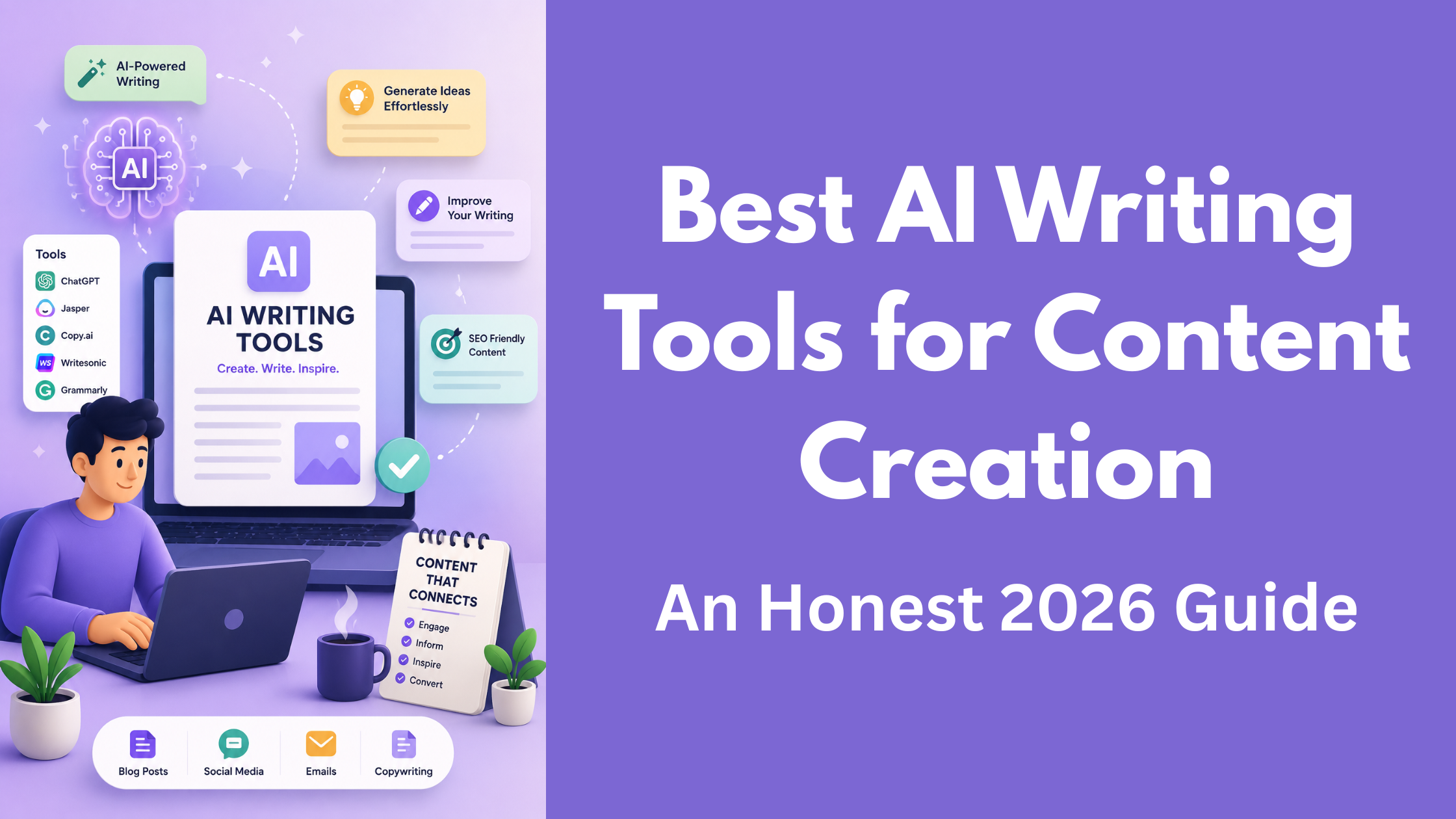
A pattern observed across thousands of content workflows is this: ai writing tools genuinely do replace hours of manual drafting — but only for specific task types, and almost never in the way the marketing promises. AI writing tools are software products powered by large language models (LLMs) that generate text from a prompt; they excel at structure, speed, and volume, and fall short on original insight, factual precision, and voice. For structured formats — FAQs, product descriptions, email sequences — the time savings are real. For bylined thought leadership or investigative content, the drafting savings shrink to near-zero once editing is factored in. The difference between tools that save you 3 hours a week and tools that waste your time is almost entirely about matching the tool to the task.
- Who this is for: content creators, freelancers, students, and teams deciding whether AI writing tools are worth adopting or paying for.
- Time savings are real but front-loaded: AI cuts first-draft time by 40–70% for templated content; long-form editorial gains shrink to 15–30% after editing.
- Free tiers are mostly lead-generation tools — nearly all are word-capped or watermarked and unsustainable as a primary workflow.
- The most counterintuitive finding: for writers producing under ~20,000 words/month, a paid AI writing subscription often costs more than the time it saves.
- AI does not replace writers — it replaces the lowest-value, highest-volume tasks and increases demand for writers who can direct and edit AI output.
- The honest verdict on ethics: AI-assisted drafting is widely accepted in 2026; passing unedited AI output as expert human analysis without disclosure is increasingly a trust issue.
- What AI Writing Tools Actually Are (And How They Work)
- How Much Time Do AI Writing Tools Actually Save?
- Best AI Writing Tools for Content Creation in 2026
- AI Writing Quality vs Human Writing: Real Limitations
- Can AI Replace Content Writers? The Honest Verdict
- Frequently Asked Questions About AI Writing Tools
What AI Writing Tools Actually Are (And How They Work)
AI writing tools use natural language generation (NLG) — a process where large language models predict the statistically most likely next word based on training data — to produce text from a prompt, brief, or outline. They are not search engines. They are not editors. And critically, they are not fact-checkers. That distinction matters enormously when evaluating what they can actually do in a professional workflow.
Most consumer-facing tools sit on top of GPT-4, Claude, or proprietary fine-tuned models. The branded interface (Jasper, Copy.ai, Writesonic) adds templates, tone controls, and CMS integrations — but the underlying model determines output quality far more than the wrapper does. This is why output quality benchmarking across tools with similar pricing but different model access can show dramatic differences in coherence and depth.
How Accurate Is AI Generated Content — and Where Does It Break Down?
How accurate is AI generated content depends almost entirely on whether the model has reliable training data for that specific topic. For well-documented subjects (general business advice, common how-tos, widely covered news), accuracy is reasonable. For niche technical topics, recent events, or proprietary knowledge, the model fills gaps with confident-sounding fabrications — a behaviour known as hallucination.
The most common failure mode is confident incorrectness: AI doesn't say "I don't know," it produces plausible-sounding wrong answers. Training data cutoffs mean any time-sensitive claim may be months or years out of date. For high-stakes content — legal, medical, financial — treating AI output as a draft to be verified, not a source to be trusted, is the only defensible approach.
How Much Time Do AI Writing Tools Actually Save — And When Should You Use Them?
According to The Digital Elevator (2026), organisations using AI writing tools report 59% faster content creation — and AI Writing Tools Statistics 2026 shows AI adopters produce 64% more content per week. Those numbers are real, but they aggregate across content types. The per-task reality is more nuanced.
AI writing tools time savings are front-loaded: the biggest gain is eliminating blank-page paralysis and generating structural scaffolding. The draft arrives in minutes. The editing — fact-checking, rephrasing for voice, adding original examples — is where the time cost reappears.
When should you use AI for writing? The clearest wins are:
- High-volume, repeatable formats: SEO briefs, FAQs, ad copy variants, meeting summaries
- First-draft structure for blog posts where you'll write the original sections yourself
- Repurposing existing content across formats (turning a webinar into a summary email)
When NOT to use it: bylined thought leadership, legally sensitive content, investigative pieces, or anything where factual precision is non-negotiable without a rigorous review pass. A subscription cost per word analysis consistently shows that for writers producing under ~20,000 words per month, a paid AI tool often costs more than the time it saves unless it's integrated deeply into an existing writing workflow integration stack.
AI Assisted Writing Workflow: What a Realistic Process Looks Like
A realistic AI assisted writing workflow for a 1,500-word blog post looks like this:
- Input your brief and keyword targets (~2 minutes) — the more specific, the better the output
- Generate a structural outline (~1 minute) — review and adjust before drafting
- Draft section by section (~5–10 minutes) — use the AI for body paragraphs; write the intro and conclusion yourself
- Fact-check every specific claim (~15–20 minutes) — this step cannot be skipped
- Edit for voice, flow, and originality (~20–30 minutes) — this is where the human value is added
Total time with AI: roughly 45–60 minutes versus 2–3 hours from scratch. That's a real saving — but only if you treat step 4 as mandatory, not optional.
Writing great content is only half the battle — getting it seen is the other half.
If you're creating content on LinkedIn, employee-generated content and real engagement are what drive reach — not just good drafts.
See How HyperClapper Boosts LinkedIn VisibilityBest AI Writing Tools for Content Creation in 2026: An Honest, Use-Case-Driven Breakdown
The most common failure mode in "best ai writing tools" roundups is treating a student writing essays, a freelancer producing 50 blog posts a month, and an enterprise content team as the same buyer. They are not. Here's a use-case-driven breakdown — the kind that affiliate-driven lists consistently skip.
| Tool | Best For | Free Tier? | Paid From | Key Limitation |
|---|---|---|---|---|
| ChatGPT | Flexible drafting, brainstorming, varied tasks | Yes (GPT-4o mini) | $20/mo | Requires prompt skill; no built-in SEO workflow |
| Jasper | Brand-consistent content teams, SEO content | 7-day trial only | $49/mo | Expensive for solo creators; outputs can feel templated |
| Claude (Anthropic) | Long-form content, nuanced writing, documents | Yes (rate-limited) | $20/mo | No native SEO integrations; web access limited |
| Notion AI | Teams already in Notion; docs and summaries | Add-on only | $10/mo add-on | Only useful if you already live in Notion |
| Writer.com | Enterprise governance, brand compliance | No | $18/user/mo | Overkill for solo creators; enterprise focus |
Jasper vs ChatGPT for Writing: Which Actually Wins?
Jasper vs ChatGPT for writing is the most common comparison search — and the honest answer is they serve different workflows. Jasper is a structured content production tool with templates, brand voice settings, and SEO integrations built in. ChatGPT is a flexible reasoning engine that handles a wider range of tasks at a lower price, but requires stronger prompting skills to produce consistent output. For a content team producing 30+ articles per month with brand guidelines, Jasper's structure pays off. For a solo freelancer or someone exploring AI writing casually, ChatGPT at $20/month — or Claude — covers most use cases for less.
According to Siege Media (2026), ChatGPT is the most trusted AI tool with an 80% selection rate, with Claude second at 55%. In practice, the tools most people pay for are not always the best fit for their specific task — selection rate reflects familiarity, not use-case fit.
SEO-Focused AI Writing Tools: How Well Do They Actually Handle Keyword Integration?
Tools marketed as best ai content writing tools for SEO — Surfer SEO's AI, Jasper with Surfer integration, NeuronWriter — generate keyword-dense drafts faster than manual writing. But teams that rely on them without a human editorial pass consistently find that the output optimises for keyword density at the expense of readability and E-E-A-T signals. The SEO score goes up; the content quality goes down. The most effective long-form content automation approach pairs an AI draft with a human who rewrites the intro, adds original data points, and cuts the padding the model inserts to hit word targets.
AI Writing Quality vs Human Writing: Real Limitations and What AI Still Cannot Do
The ceiling of AI output is statistically average writing, not exceptional writing. A model trained on the internet produces prose that sounds like everything — which means it sounds like nothing distinctive.
What can AI writing tools not do in 2026? Four things consistently beyond the reach of even the best models:
- Conduct original interviews or draw on lived professional experience
- Form genuine opinions or take a counterintuitive stance grounded in real expertise
- Access proprietary, real-time, or paywalled data
- Produce prose with a genuinely distinctive voice — the output averages towards the mean
Is AI written content good enough to publish? For informational content — how-tos, listicles, product specifications — the answer is often yes, with careful editing. For bylined expert commentary, brand storytelling, or investigative content, unedited AI output falls measurably below professional human standards. The tell is sentence rhythm: a sameness that experienced readers detect even without knowing why something feels flat.
Limitations of AI content generation beyond quality also include: training data cutoffs that make time-sensitive claims unreliable, poor handling of highly technical or genuinely niche subject matter, and the AI detection and plagiarism risk — a growing concern as publishers and clients increasingly run content through detection tools. Whether those tools are reliable is a separate debate, but the reputational risk of being flagged is real.
Common Mistakes to Avoid When Using AI Writing Software
AI writing software worth it only if you avoid these patterns that most new users fall into:
✓ AI Writing Quality Control Checklist
- ☐Fact-check every specific claim, statistic, or named source before publishing
- ☐Rewrite the introduction and conclusion in your own voice — these are what readers remember
- ☐Add at least one original data point, example, or expert observation not in the AI draft
- ☐Remove padding paragraphs — AI models insert filler to hit length targets; cut anything that doesn't add value
- ☐Check for training-data cutoff risk — any time-sensitive claim may be outdated
- ☐Run through your preferred AI detection tool if your client or publisher requires disclosure compliance
Can AI Replace Content Writers? The Ethics, the Economics, and the Honest Verdict
Economically, the answer splits cleanly by market segment. Can AI replace content writers who produce bulk SEO content at commodity rates? For many clients already buying at sub-$0.02 per word, yes — AI writing tools replace manual drafting completely in that segment, and it happened faster than most agencies expected. For clients buying expertise, distinct perspective, and accountability? No — and that market is growing precisely because AI-generated content is flooding the low end and making differentiated human voice more valuable, not less.
Will AI replace freelance writers entirely? The most consistent pattern across content teams that adopted AI in 2024–2025 is a role shift, not elimination: writers who adapt become AI directors and editors, responsible for quality-controlling and elevating AI output. Writers who don't adapt find their commodity work disappearing. The skill that doesn't get replaced is judgment — knowing what to cut, what to add, and whether a draft is actually good.
Is it ethical to use AI tools to write articles for clients? The emerging professional consensus in 2026 is that context defines the answer. Using AI to generate human-sounding LinkedIn content with genuine editing is widely accepted. Ghostwriting with AI assistance — where the human editor shapes, directs, and takes accountability for the output — sits in a long tradition of collaborative authorship. Passing unedited AI output off as expert human analysis without disclosure, especially in professional or journalistic contexts, is increasingly viewed as a trust violation. The distinction is accountability, not assistance.
AI writing tools replace manual drafting most completely where writing is functional — internal docs, templated reports, product descriptions. They replace it least where voice, credibility, and original insight are what's actually being purchased.
For content professionals, the practical middle ground most teams have landed on: AI drafts the structure and fills the well-trodden ground; humans write the lede, the original insight, and the conclusion — and the ratio shifts based on how much the reader is paying for genuine expertise. If you're creating content for LinkedIn where engagement and visibility determine reach as much as quality does, tools like HyperClapper handle the distribution side — making sure your AI-assisted (or fully human) content actually gets seen by the right people through real community engagement rather than algorithmic luck.
Great content needs an audience to matter.
HyperClapper gives your LinkedIn posts real engagement from real people — not bots — so your writing reaches the professionals it was built for.
Boost Your LinkedIn Content NowFrequently Asked Questions About AI Writing Tools
What is the best AI tool for writing?
ChatGPT (GPT-4o) is the most widely used AI writing tool in 2026, with an 80% selection rate among AI practitioners (Siege Media, 2026). For long-form content and documents, Claude (Anthropic) is a close competitor. For structured content production with SEO integrations, Jasper is the strongest purpose-built option. The "best" tool depends entirely on your task type and volume.
Is there a free AI writer that is actually usable?
Yes, but with significant limitations. ChatGPT's free tier (GPT-4o mini) is the most functional free option for general writing tasks. Claude also offers a rate-limited free tier. Nearly every other "free" AI writing tool is word-capped or feature-locked by design — they are lead-generation tools intended to convert you to a paid plan within days.
Can AI writing tools fully replace a human writer for blog posts?
No — not for quality blog posts. AI writing tools can replace the first-draft phase for structured or informational content, but they cannot replace original research, genuine expertise, distinctive voice, or reliable fact-checking. Unedited AI blog posts are detectable to experienced readers and increasingly flagged by publishers. The realistic role is AI as a drafting assistant, human as the editor and author of record.
How many hours can I save using AI to draft content?
For structured formats — product descriptions, FAQs, email sequences — AI typically cuts drafting time by 40–70%. For longer editorial content, the saving drops to 15–30% once editing is included. A realistic estimate for a 1,500-word blog post is 60–90 minutes with AI versus 2–3 hours from scratch — a genuine saving, but not the "10x productivity" often marketed.
What are the biggest weaknesses of AI writing assistants?
The four most consistent weaknesses are: hallucination (confident fabrication of facts), training data cutoffs causing outdated information, inability to access proprietary or real-time sources, and a flattening of voice that produces readable but distinctively average prose. For any content where factual accuracy or distinctive voice matters, these weaknesses require a mandatory human editorial pass.
Is it ethical to use AI tools to write articles for clients?
AI-assisted drafting with human editing, oversight, and accountability is broadly accepted as ethical in 2026. The ethical line is disclosure and accountability: using AI to accelerate work you genuinely direct and stand behind is fine; passing unedited AI output off as expert human analysis without disclosure is increasingly viewed as a professional trust violation, particularly in journalistic, academic, or advisory contexts.
Are there AI writing tools free online with no trial limits?
Genuinely unlimited free AI writing tools online are rare. ChatGPT's free tier and Claude's free tier are the most sustainable options, though both have rate limits under heavy use. Tools marketed as "free forever" typically impose word caps, remove advanced features, or watermark output. For any serious writing workflow, a paid plan — typically $20–$49/month — is the realistic entry point for unlimited, professional-grade access.
What consistently separates content teams that get real ROI from AI writing tools from those that don't is not which tool they picked — it is whether they treated AI as a drafting accelerator requiring skilled human direction, or as a replacement for that direction entirely. The former compounds over time; the latter produces a content library that looks voluminous and reads thin.



