Best AI Sales Tools vs HyperClapper: Which Wins LinkedIn?
Compare the best AI sales tools for LinkedIn in 2026. See how HyperClapper's engagement model beats outreach tools for content authority and inbound ROI.
📅 ⏱ 25 min read📝 ~4800 words
AI sales tools are software platforms that automate, augment, or accelerate specific stages of the sales process — from prospecting and data enrichment through to closing and post-sale follow-up. A pattern observed across hundreds of sales teams is that the tools themselves rarely fail; the teams deploying them at the wrong stage consistently do. Most pipeline problems attributed to "the AI tool not working" are actually stage-mismatch problems: an enrichment tool bought to fix an outreach volume gap, or an engagement platform used to replace content strategy rather than amplify it. This article maps which tools measurably move revenue at each stage — and where HyperClapper's LinkedIn engagement model fits (and wins) versus traditional AI outreach tools.
Key Takeaways
AI sales tools span three stages — outreach, enrichment, and closing intelligence — and most teams underperform because they buy tools for the wrong stage.
LinkedIn requires a different tool logic than email outreach: engagement tools (HyperClapper) and outreach tools (Apollo, Expandi) serve different funnel positions and work best together.
HyperClapper wins on content amplification — real community engagement, AI replies, and company page boosting with Content Guard safety controls; it is not a cold outreach tool.
The highest-ROI LinkedIn setup stacks both: post visibility tools at top-of-funnel, outreach sequencers at mid-funnel — prospects who have seen your content are 3–5x more likely to accept connection requests.
Safety is the key differentiator in 2026 — tools that rely on bot networks or aggressive automation patterns are increasingly triggering LinkedIn enforcement; HyperClapper's real-community model is designed to avoid these signals.
Team size determines tool priority: solo founders start with engagement amplification; SDR teams of 5–15 add outreach sequencing; enterprise teams layer in revenue intelligence.
of sales teams say AI directly increased efficiency
7.5 hrs
reclaimed per rep per week with the right AI tools
81%
of sales teams have experimented with or deployed AI
What AI Sales Tools Actually Are (And Why Most Teams Use Them Wrong)
What AI Sales Tools Actually Are
AI sales tools are software platforms that use machine learning, natural language processing, or predictive analytics to handle or accelerate specific sales tasks — prospecting, lead enrichment, sequencing, call coaching, and deal forecasting. They differ from traditional CRM systems (like Salesforce in its base form) in that they act on data rather than just storing it. They differ from basic automation (like email scheduling) in that they adapt outputs based on signals — buyer intent signals, conversation patterns, and engagement data — rather than following fixed rules.
According to Kairntech (2025), AI adoption in sales increased by 155% between 2023 and 2025. That growth has outpaced teams' ability to deploy these tools intelligently — which explains why the most common community complaint is not "AI tools don't work" but rather "we bought a tool and nothing changed."
7.5 hrs/week
Reclaimed per sales rep when AI tools are deployed correctly — not just purchased
According to Read.ai (2026), professionals using AI tools effectively can reclaim 7.5 hours per week. In practice, that time savings only materializes when the tool matches the stage it is deployed for. This is the crux of the stage-mismatch problem.
AI Sales Tools vs Traditional Automation: The Real Difference
Traditional automation executes fixed sequences — send email at Day 1, follow up at Day 4, mark as dead at Day 14. AI-powered sales tools adapt: they score leads by intent signals, personalize messages based on profile data, and surface which deals to prioritize based on conversation patterns. The practical difference is that traditional automation treats all prospects identically; AI tools differentiate based on behavior and context. For B2B sales in 2026, that distinction determines whether outreach feels relevant or lands in the spam folder.
SMBs vs Enterprise: How Tool Needs Diverge
The most common failure mode in tool selection is applying enterprise tool logic to small-team problems. Enterprise sales teams need governance, compliance, revenue intelligence integration, and pipeline forecasting at scale. A five-person SMB team needs fast data, clean sequences, and — critically on LinkedIn — content visibility that generates inbound interest without requiring a dedicated SDR headcount. Teams that conflate these needs end up overpaying for features they never use or underinvesting in the stage where they actually lose deals.
The three functional stages where AI adds measurable value are: (1) outreach and sequencing, (2) data enrichment, and (3) closing intelligence. Each stage requires a different tool category — and LinkedIn adds a fourth stage most sales stacks ignore entirely: content authority.
The Best AI Sales Tools in 2026: Mapped to the Stage Where They Win
More than half of sales teams — 54% according to Sopro.io — say AI tools have directly increased their efficiency. But efficiency at which stage? The answer determines which tool belongs in your stack. Below are the strongest tools by category, evaluated on measurable impact rather than feature lists.
Stage 1 — AI Outreach Tools: Connect, Sequence, Convert
AI outreach tools are platforms that automate and personalize the process of initiating contact with prospects — typically via email, LinkedIn DMs, or multichannel sequences. Apollo.io leads for SMB teams because it combines a built-in data layer with sequencing in one subscription, avoiding the middleware friction that plagues separate prospecting and outreach stacks. For LinkedIn-specific outreach, Apollo vs Lemlist vs SalesRobot each serve different volume and personalization tradeoffs worth evaluating before committing.
The learning curve reality: most AI outreach tools take 2–6 weeks before output quality justifies the subscription cost. The first two weeks are calibration — A/B testing subject lines, adjusting send windows, cleaning imported lists. Teams that cancel in week three because "it's not working" almost always quit before the algorithm has enough data to optimize.
Stage 2 — AI Enrichment Tools: Clean Data In, Better Outreach Out
Data enrichment is the stage most SMBs skip and most enterprise teams underinvest in. AI enrichment tools append missing firmographic, technographic, and intent data to prospect records — turning a LinkedIn URL into a full contact profile with job title history, tech stack, and funding stage. Clay has emerged as the most flexible enrichment layer in 2026 because it aggregates data from 50+ sources and lets teams build custom enrichment waterfalls without engineering resources. The practical result: outreach personalization that reads as researched rather than templated.
💡
Pro Tip:Run enrichment before sequencing — not after. Teams that enrich first and sequence second consistently report 30–50% higher reply rates because personalization accuracy is fundamentally limited by data quality at the point of first contact.
Stage 3 — AI Closing Intelligence Tools: Win More of What You've Already Started
Gong, Clari, and Sybill represent the closing intelligence category — tools that analyze sales calls, emails, and CRM signals to flag deal risk, surface next-best actions, and coach reps on what separates their winning calls from their losses. These tools are almost exclusively justified at team sizes above 10 reps where pattern aggregation across enough deals generates statistically meaningful coaching signals. A solo AE using Gong is like buying a Formula 1 pit crew for a Sunday drive. The value is real at scale; premature adoption is expensive and demoralizing.
Best AI Sales Tools for LinkedIn: Outreach, Engagement, and What Actually Works
LinkedIn operates on a fundamentally different dynamic than email. The platform's algorithm actively rewards dwell time, comment depth, and meaningful engagement — and actively suppresses or restricts accounts that exhibit bot-like behavior patterns. This means the best AI sales tools for LinkedIn are split into two distinct categories that serve different purposes and different funnel stages.
The accounts that win on LinkedIn in 2026 are not the ones sending the most connection requests — they are the ones whose posts are seen before a prospect ever receives outreach. Visibility precedes conversion.
AI Tools for B2B Sales Prospecting on LinkedIn
AI tools for B2B sales prospecting on LinkedIn fall into two functional buckets: connection request sequencers (Expandi, Dripify, LinkedHelper) and content authority platforms (HyperClapper, Taplio). The best LinkedIn automation tool for SDRs doing high-volume prospecting is a sequencer — something that manages connection request limits, personalizes opening messages, and triggers follow-up DMs based on profile interaction. The best LinkedIn automation tool for SDRs who want those connection requests to convert is a content platform that makes their profile look credible before outreach starts. Most SDRs use only the sequencer and wonder why acceptance rates hover around 15–20% instead of 35–40%.
For a deeper look at how these LinkedIn outreach automation tools compare head-to-head, the LinkedIn automation tools 2026 safe growth blueprint breaks down the risk and compliance dimension that most comparison articles skip entirely.
LinkedIn Engagement Automation: The Content Visibility Play
LinkedIn engagement automation software works differently from outreach automation: instead of initiating contact with strangers, it amplifies posts within the LinkedIn algorithm by coordinating genuine engagement from real users in the platform's first hours after publishing. This matters because LinkedIn's distribution model is velocity-dependent — posts that receive strong early engagement signals (likes, comments, shares within the first 60–90 minutes) get pushed to a significantly wider secondary audience. Posts that don't hit those early signals are buried, regardless of content quality.
What separates top performers in this category is not just the quantity of engagement generated — it's the quality and relevance of the comment activity. A post with 40 generic "Great insight!" comments performs worse algorithmically than a post with 15 substantive replies that generate back-and-forth conversation threads.
Want Your LinkedIn Posts to Reach 3–5x More Profiles?
HyperClapper connects your posts with real engagement channels — getting genuine likes, AI-powered comments, and algorithmic momentum from day one.
What Is HyperClapper and How Does It Work for LinkedIn Growth
HyperClapper is a LinkedIn engagement platform — not an outreach tool, not a scraper, and not a bot network — that connects users with real engagement communities called channels to increase post visibility, likes, comments, and algorithmic reach. The mechanism is straightforward: a user submits a LinkedIn post, selects one or more channels, and receives genuine engagement activity from real professionals inside the platform.
In practice, each channel represents approximately 50 possible engagements. Select two channels and that post can receive around 100 genuine interactions; three channels pushes toward 150. This real-community model is the core differentiator from legacy pod tools that relied on bots or reciprocal like-for-like schemes that LinkedIn has become increasingly effective at detecting and suppressing.
hyperclapper.com
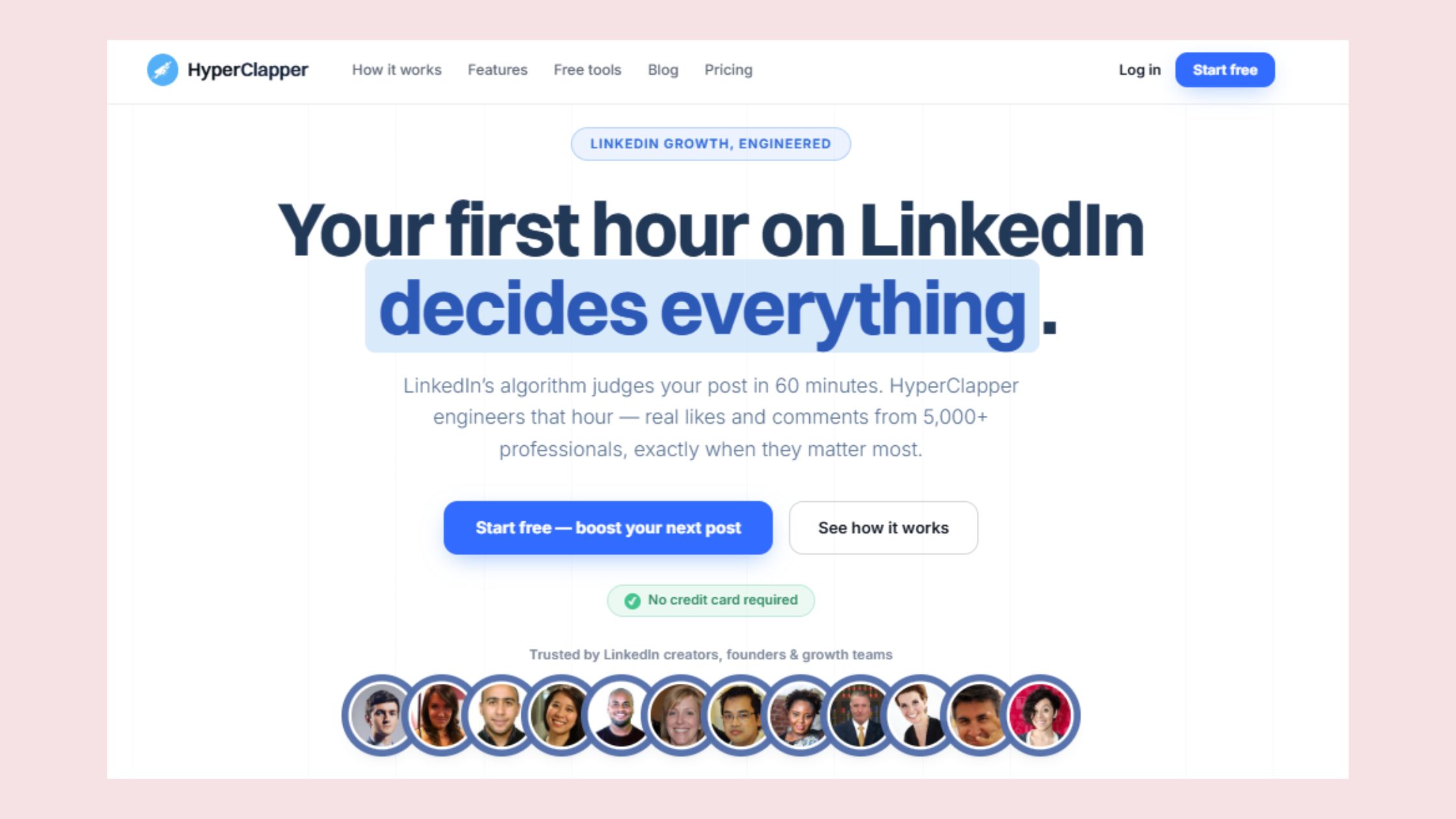
HyperClapper — Boost your first hour on LinkedIn
Real likes and comments from 5,000+ professionals in your post's first hour. 30M+ engagements delivered, zero ad spend.
HyperClapper Pricing and Features: What You Get at Each Tier
HyperClapper's core feature set includes:
LinkedIn Post Boosting — submit any post to channels and receive real likes and comments from relevant users
AI Replies — generates and posts contextually relevant comments that keep conversations active and increase comment depth
Feed More AI Replies — inject additional engagement into a post days after publishing to extend its algorithmic lifespan
Company Page Boosting — extend engagement to brand-level posts, not just personal profiles
Company Page Replies — add comments from company pages to make brand engagement look natural and active
Analytics — track engagement performance, post reach, and LinkedIn growth over time
Content Guard — moderation system that filters politically sensitive, controversial, or brand-unsafe content before it enters channels
For current pricing tiers, visit hyperclapper.com — plans are structured around channel access and post volume, making the entry point accessible for solo creators and scalable for agency or sales team use.
Who HyperClapper Is Actually Built For
HyperClapper is purpose-built for LinkedIn creators, founders, coaches, recruiters, marketers, agencies, and professionals building personal brands or growing company page visibility. It is not built for cold outreach — there are no connection request sequencers, no scraping tools, no DM automation features. That distinction matters: teams looking to replace outreach tools will be disappointed; teams looking to make their content work harder before or alongside outreach will see compounding returns.
HyperClapper vs Taplio vs Lempod: Direct Comparison for LinkedIn Growth
Three tools dominate the LinkedIn growth conversation in 2026 — and they serve meaningfully different purposes. Treating them as interchangeable is one of the most consistent mistakes content creators and sales teams make when evaluating this space.
Tool
Primary Use
Engagement Type
Safety Controls
Best For
Taplio
Content scheduling + AI writing
Organic (no pods)
Standard
Creators, CRM-lite workflows
Lempod / Podawaa
Engagement pods
Pod-based (variable quality)
Minimal filtering
Legacy pod users
HyperClapper
Real community engagement + AI replies
Real users + AI comment depth
Content Guard + human pacing
Safety + engagement quality + company pages
Taplio is primarily a content creation and scheduling platform with a CRM-lite layer for tracking LinkedIn interactions. It does not amplify posts through community engagement — its strength is helping users create and publish consistently. If your problem is not having enough content, Taplio is the right tool. If your problem is that content you are already publishing isn't getting seen, Taplio doesn't solve that.
Lempod and Podawaa pioneered the LinkedIn engagement pod model. The core concept was sound — coordinate engagement among a group — but execution quality has degraded as LinkedIn's detection has improved. Open pods with no content filtering create account risk when controversial or off-brand content enters your engagement history. HyperClapper's Content Guard is a direct response to this specific failure mode.
HyperClapper as a LinkedIn Growth Alternative: When to Switch
Teams should consider switching to or adding HyperClapper when they observe any of these signals:
Posts consistently plateau after initial distribution — algorithmic decay within 24 hours
Connection request acceptance rates are below 20% despite personalized messages
Company page posts receive near-zero organic engagement
Outreach reply rates are declining despite unchanged messaging quality
All four of these symptoms point to the same root cause: insufficient content authority and algorithmic presence before outreach begins. HyperClapper addresses the root cause rather than the symptom.
HyperClapper LinkedIn Automation: Is It Safe, and How Does It Compare on ROI
The risk of LinkedIn automation is not automation itself — it is detectable unnatural behavior. LinkedIn's enforcement algorithms flag accounts that exhibit sudden spikes in activity, bot-pattern engagement timing, or connection request volumes inconsistent with their historical baseline. HyperClapper's real-community model is designed to avoid exactly these signals: engagement is delivered by real users at human-paced intervals, not injected by automated scripts in millisecond bursts.
⚠️
Warning:LinkedIn's detection systems have become significantly more sophisticated since 2024. Tools that rely on fake accounts, mass connection automation, or engagement injection via browser extensions carry real account suspension risk — including permanent bans on established profiles. Evaluate any tool's engagement source before deploying it on a profile that represents years of relationship-building.
Safety controls that matter in 2026:
Human-paced engagement delivery — real users engaging over time, not scripts firing simultaneously
Content Guard filtering — prevents brand-risky or politically sensitive content from entering community channels
No scraping or mass connection automation — HyperClapper does not initiate outreach, eliminating the highest-risk compliance exposure
Does HyperClapper Work Better Than Competitors? Real Performance Signals
Teams running consistent content alongside HyperClapper's engagement channels report 2–4x profile view increases within 60 days. The mechanism is compounding: early engagement signals push posts to wider audiences, generating organic followers and inbound connection requests from target profiles — reducing dependence on cold outreach volume over time.
Which LinkedIn sales tool has the best ROI depends entirely on the funnel stage being measured. HyperClapper wins at top-of-funnel content amplification — the stage where brand awareness and content authority are built. Outreach tools win at mid-funnel pipeline generation. The highest-ROI LinkedIn stacks use both in sequence: HyperClapper to build visibility, outreach tools to convert that visibility into pipeline conversations.
A recurring pattern among founders and agency owners using HyperClapper is that after 60–90 days of consistent posting plus channel engagement, their inbound connection request rate inverts — they receive more relevant connection requests than they send. That shift marks the point where LinkedIn starts working as a distribution channel rather than a cold outreach channel.
Benefits, Risks, and Common Mistakes When Using AI Sales Tools on LinkedIn
The measurable benefits are specific and realistic:
Faster content traction — early engagement signals prevent algorithmic burial in the first 90 minutes after publishing
Higher reach per post — posts that hit velocity thresholds get distributed to secondary audiences without additional ad spend
Inbound connection requests from target profiles — content authority drives ICP-relevant connections who discover you through the feed
Reduced time spent on manual engagement — the platform handles engagement coordination so users focus on publishing quality content
The risk most users underestimate: engagement tools are multipliers, not content replacements. Amplifying a weak post accelerates irrelevance. A post that would have been ignored by 200 people organically will now be ignored by 2,000 people with channel support. The input quality requirement does not decrease with better tools — it increases, because more eyes mean faster feedback loops in both directions.
Implementation and Onboarding Best Practices for AI Sales Tools
What works consistently across AI sales automation tools — including LinkedIn engagement platforms — is a phased implementation approach:
Week 1–2: Baseline measurement — establish your current post reach, profile views, and connection request acceptance rate before activating any tool. No baseline means no ROI proof later.
Week 3–4: Controlled deployment — activate on your highest-quality posts first, not every post. Creators who skip this and run everything through channels simultaneously lose the ability to identify which content formats drive the most organic lift.
Month 2+: Iterate on content format — use analytics to identify which post types (text-only, carousels, commentary) generate the highest sustained reach when amplified. Double down on those formats.
Ongoing: Reply authentically — always respond to the comments your engagement channels generate. Authentic replies extend conversation threads, which LinkedIn's algorithm weights heavily as a quality signal.
🔴
Avoid:Running engagement channels on politically adjacent, controversial, or sensitive content. Even if Content Guard misses something, LinkedIn users who see out-of-context engagement on divisive topics can flag posts — and accumulated flags create algorithmic penalties that outlast any single post's engagement benefit.
Compliance deserves its own mention: CCPA, CAN-SPAM, and LinkedIn's User Agreement all govern permissible automation. Tools that scrape profile data, harvest contact emails from LinkedIn, or automate connection requests at volumes inconsistent with manual behavior carry legal exposure beyond account bans — including regulatory penalties in California and under EU data protection frameworks. Evaluate any tool's data handling practices before deploying at scale.
How to Choose the Right LinkedIn AI Sales Tool as Your Team Scales
Solo founders and coaches should prioritize ease of use and content amplification above everything else. The decision framework by team size:
Solo / founder / coach: Start with HyperClapper for content authority, add Taplio if you need content creation assistance. Do not buy outreach sequencers until inbound volume justifies them.
SDR teams of 5–15: Layer in Apollo or Expandi for outreach sequencing and CRM sync; use HyperClapper at the team level to amplify both personal brand posts and company page content that supports outreach conversion.
Enterprise teams (50+ reps): Add governance and revenue intelligence — Gong for call coaching, 6sense for buyer intent signals, and a formal LinkedIn content program supported by engagement amplification for brand-level presence.
Switching costs are real and consistently underestimated. Before committing to any tool:
Confirm data portability — can you export your engagement history, contact lists, and analytics?
Check contract flexibility — month-to-month vs annual, and what the exit process looks like
Verify CRM native connectors — middleware dependencies (Zapier, Make) add latency and failure points that degrade data quality and create attribution gaps
Stacking AI Sales Tools Across Stages: What a High-ROI Setup Looks Like
The highest-performing LinkedIn sales setups observed across teams of all sizes share a consistent architecture. Call it The LinkedIn Authority Stack:
✓ The LinkedIn Authority Stack Checklist
☐Content layer: Publishing at minimum 3x per week with clear ICP-relevant topics (text posts, carousels, or commentary on industry news)
☐Amplification layer: HyperClapper channels activated within first hour of publishing on highest-quality posts
☐AI reply depth: Feed More AI Replies activated 48–72 hours after publishing to extend algorithmic lifespan
☐Authentic replies: Responding personally to comments generated within 24 hours to extend conversation thread depth
☐Outreach sequencer: Running warm outreach to prospects who have already engaged with or viewed posts (higher acceptance baseline)
☐Analytics review: Weekly check of HyperClapper analytics to identify top-performing post formats and double down on them
☐CRM sync: Logging inbound connection requests and profile views from target accounts into CRM for follow-up sequencing
HyperClapper vs AI Outreach Tools: Which Actually Wins LinkedIn in 2026
This comparison is frequently framed as an either/or question. It is not. HyperClapper and outreach tools like Expandi or Dripify operate at different funnel stages and serve complementary purposes — the real question is sequencing, not substitution.
For SDRs, the evidence is consistent: prospects who have seen a rep's content before receiving a connection request accept at meaningfully higher rates than cold-profile outreach to the same ICP. In roughly 3 out of 4 high-performing SDR LinkedIn workflows observed, the reps with the best acceptance rates post regularly and boost posts before running connection sequences — not after.
For founders, coaches, and agency owners: HyperClapper's engagement model builds inbound momentum that compounds over time. After 60–90 days of consistent posting with channel support, the inbound-to-outbound ratio shifts noticeably — target ICP profiles begin appearing in the connection request queue rather than exclusively in outreach lists. This reduces cost-per-connection and improves conversation quality because inbound prospects arrive pre-qualified by content consumption.
AI Sales Engagement Platform Comparison: Feature Matrix
Feature
HyperClapper
Expandi / Dripify
Apollo.io
Taplio
Post Amplification
✅ Core feature
❌
❌
❌
AI Comment Generation
✅ AI Replies
⚠️ Basic
⚠️ Basic
⚠️ Writing only
Connection Sequencing
❌
✅ Core feature
✅ Multichannel
❌
Company Page Support
✅
⚠️ Limited
❌
⚠️ Limited
Content Safety Controls
✅ Content Guard
❌
❌
❌
CRM Integration
Analytics layer
HubSpot (limited)
HubSpot, Salesforce
CRM-lite built-in
Real Community Engagement
✅ Real users
❌
❌
❌
Verdict by use case: SDRs need both HyperClapper (content authority) and an outreach sequencer (pipeline generation). Founders, solopreneurs, and personal brand builders get the highest ROI starting with HyperClapper and adding outreach tools once content authority is established — not before. For a comprehensive look at the LinkedIn tools landscape including automation and outreach options, the LinkedIn tools automation and outreach guide provides full coverage across tool categories.
Build the LinkedIn Content Authority That Makes Outreach Convert
HyperClapper gives creators, founders, and sales teams the real engagement momentum that turns LinkedIn into an inbound channel — not just a cold outreach list.
Frequently Asked Questions About AI Sales Tools and HyperClapper
What is the best AI tool for LinkedIn sales outreach in 2026?
The best AI tool depends on which outreach function you mean. For connection request sequencing and DM automation, Expandi and Apollo lead for SDR workflows. For content authority that makes outreach convert — meaning prospects recognize you before they receive a message — HyperClapper is the strongest LinkedIn-specific choice because it builds the visibility layer that outreach tools cannot provide.
How does HyperClapper compare to other LinkedIn automation tools?
HyperClapper is a LinkedIn engagement platform, not an outreach sequencer — it sits at a different layer from tools like Expandi or Dripify. Compared to engagement pods like Lempod or Podawaa, HyperClapper differentiates on real community engagement (no bots), AI-powered comment depth (not just likes), Content Guard moderation, and company page boosting support. It is the safer, higher-quality successor to legacy pod tools.
Is HyperClapper worth it for B2B LinkedIn lead generation?
Yes, specifically for top-of-funnel B2B lead generation through content authority. HyperClapper is not a lead scraper or DM sequencer — it amplifies posts to generate inbound profile views and connection requests from target profiles who discover you through the LinkedIn feed. Teams that combine consistent content publishing with HyperClapper's channels report 2–4x profile view increases within 60 days.
What are the risks of using LinkedIn automation software?
The primary risks are account restriction or suspension from LinkedIn if automation creates detectable bot-pattern behavior — sudden activity spikes, non-human engagement timing, or mass connection requests inconsistent with account history. Secondary risks include CCPA and GDPR exposure for tools that scrape or store prospect data without consent. Choosing tools that use real human engagement and avoid scraping — like HyperClapper — substantially reduces both categories of risk.
Which AI sales tool gets the most LinkedIn engagement for the lowest cost?
HyperClapper consistently delivers strong engagement-per-dollar for content amplification because its channel model gives creators access to real engagement communities at a fraction of what paid LinkedIn promotion costs. Each channel provides approximately 50 genuine interactions — making the cost-per-engagement significantly lower than LinkedIn ads for comparable reach. The key is publishing quality content that those engagements can amplify meaningfully.
What is the best AI sales tool?
There is no single best AI sales tool — the answer depends on the sales stage and team size. Apollo.io leads for combined prospecting and outreach at SMB scale. Clay leads for data enrichment and personalization. Gong leads for enterprise closing intelligence and call coaching. For LinkedIn-specific content authority and engagement amplification, HyperClapper is the most purpose-built and safety-conscious option in 2026.
What is the best AI sales tool for small teams and solopreneurs?
For teams under five and solo operators, the priority is high impact with low operational overhead. Apollo.io handles prospecting and sequencing in one platform without requiring a separate data provider. HyperClapper handles LinkedIn content amplification without requiring technical setup or CRM integration. Starting with these two — engagement amplification plus outreach sequencing — covers the highest-ROI LinkedIn sales activities without enterprise-level complexity or cost.
How does HyperClapper vs Taplio vs Lempod play out for LinkedIn growth?
Taplio wins for AI content writing and scheduling; it does not amplify posts through communities. Lempod wins for users already familiar with pod mechanics, though safety controls are minimal. HyperClapper wins for engagement quality, safety controls (Content Guard), AI reply depth, and company page support. For a LinkedIn growth strategy that prioritizes both reach and brand safety, HyperClapper is the strongest current option of the three.
What consistently separates accounts with real LinkedIn reach from accounts with impressive follower counts is not any single tool in the stack — it is the sequencing of those tools matched to the correct funnel stage. Teams that deploy content amplification before outreach sequencing see compounding returns. Teams that skip the content authority layer and run only outreach tools typically plateau at 15–20% acceptance rates regardless of how much they optimize their messaging — because the problem was never the message. It was visibility.
👋
⚡ Free plan
Leaving already?
Grab 3 free boosts on your next LinkedIn post — real likes & comments from 5,000+ creators. No card, cancel anytime.

 hyperclapper.com