The Beginner's Guide to LinkedIn Engagement Platform Alternatives
Explore the best LinkedIn engagement platform alternatives in 2026. Compare Taplio, Podawaa, HyperClapper & more — with safety tips for beginners.
📅 ⏱ 17 min read📝 ~3200 words
LinkedIn engagement platform alternatives are tools that help professionals grow post visibility, attract comments, and build an audience on LinkedIn — without relying on the original wave of pod tools like Lempod, which have largely declined or shut down. A pattern observed across thousands of LinkedIn accounts is that creators who pair real community engagement with smart content strategy consistently outperform those relying purely on organic posting. This guide breaks down how the tools work, which ones are worth trying in 2026, and how to pick the right one for where you are right now.
Key Takeaways
Who this is for: Beginners, solo creators, founders, and small teams who want more LinkedIn reach without buying fake engagement.
What you'll learn: How engagement platforms work, what the risks really are, and which tools are worth using in 2026.
The compliance reality: Real-user engagement platforms sit in a gray area — they're not the same as bots, but they still carry some risk if used carelessly.
Lempod is effectively gone: Most users who relied on it have migrated to HyperClapper, Podawaa, or Taplio depending on their use case.
Counterintuitive finding: AI-powered replies often drive more algorithmic reach than raw likes — LinkedIn rewards conversation depth more than reaction counts.
Free tiers exist but are limited: Most platforms offer a trial or starter tier, though meaningful results typically require a paid plan.
What Is a LinkedIn Engagement Platform (and Why Look for an Alternative)?
LinkedIn engagement platform explained for beginners
A LinkedIn engagement platform is a tool that connects you with other real users who agree to like, comment on, and interact with each other's LinkedIn posts — amplifying reach by giving posts early momentum that the LinkedIn algorithm uses as a signal of quality content. Think of it as a coordinated reading group: everyone agrees to show up for each other's posts so the algorithm thinks the content is resonating broadly.
How LinkedIn Engagement Platforms Work
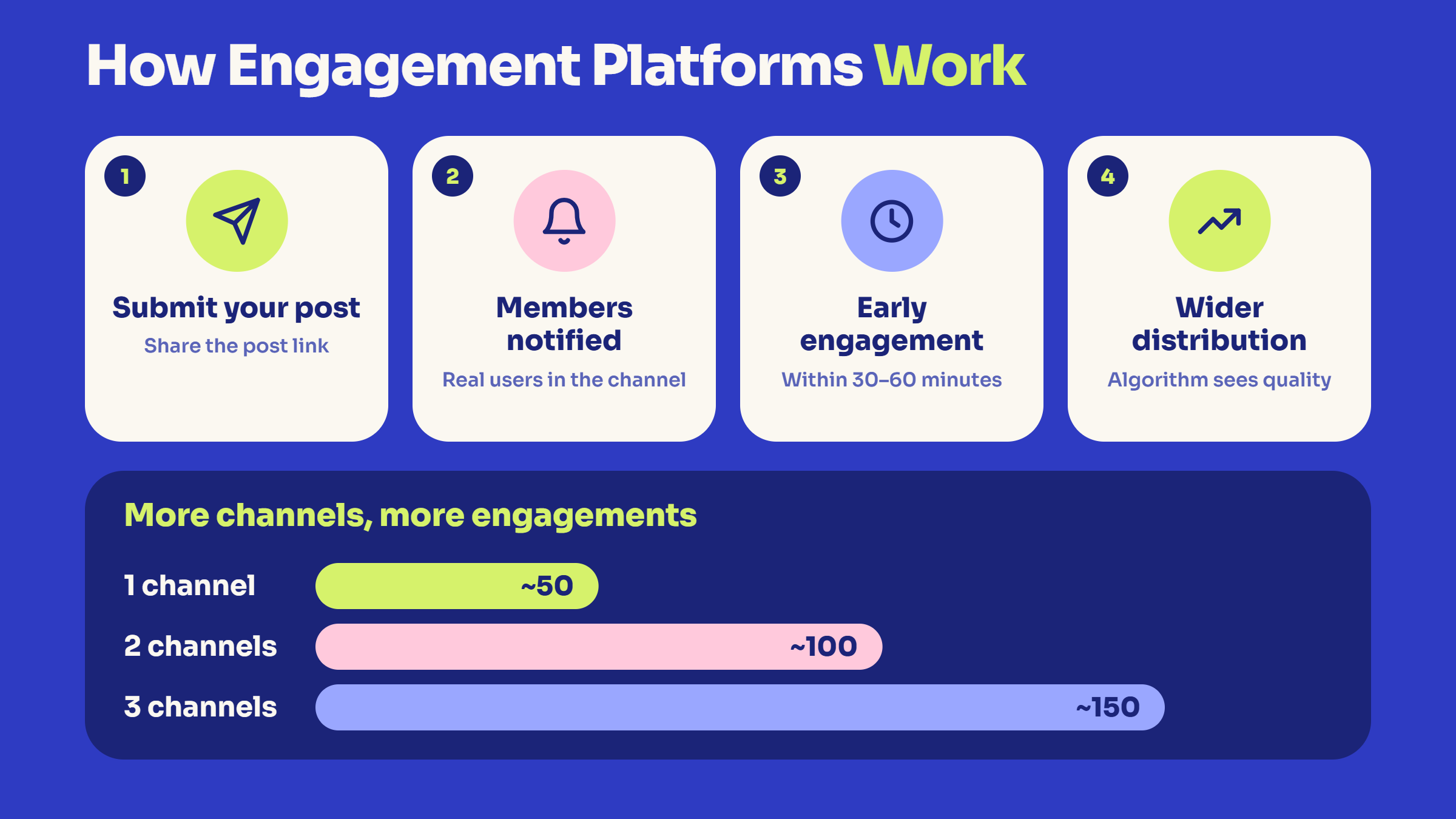
Most platforms operate through what are called engagement pods — groups of users who mutually support each other's content. When you submit a post to a pod, members of the group are notified and engage with it within a set window, typically 30–60 minutes after publishing. This early engagement burst signals to LinkedIn's algorithm that the post is worth distributing to a wider audience. The best platforms go further: they moderate content for quality, filter engagement by industry or topic relevance, and add AI-powered reply threads to simulate organic conversation depth.
Tools like HyperClapper organise this through channels — curated groups of real users where one channel delivers roughly 50 possible engagements, two channels around 100, and three channels around 150. That's meaningfully different from old-generation tools that relied on browser extensions and semi-automated clicking.
Why People Search for LinkedIn Engagement Platform Alternatives
The original tools — Lempod chief among them — dominated this space for several years. But several things changed simultaneously:
Lempod's infrastructure became unreliable, and many users reported account flags
LinkedIn tightened its detection of coordinated inauthentic behaviour
Newer tools offered AI-assisted replies and content moderation that older pods simply couldn't match
Creators began distinguishing between engagement pod tools, LinkedIn scheduling tools, LinkedIn AI writing tools, and full LinkedIn content creation tools — and realising they needed to match the right tool to the right problem
If you just need to schedule posts, Taplio or Buffer may be enough. If you need to amplify reach and build real engagement, you need a dedicated LinkedIn engagement tool alternative — which is a different category entirely. Getting this distinction wrong is one of the most common beginner mistakes in this space.
The single biggest mistake beginners make is buying a LinkedIn scheduling tool when what they actually need is a community engagement platform — these solve entirely different problems.
Understanding what category you need is the real starting point. Next, let's address the question that stops most beginners cold: is any of this actually allowed?
Are LinkedIn Engagement Pods Against the Rules — and Do They Actually Work?
Is it safe to use LinkedIn engagement pods
LinkedIn's Terms of Service explicitly prohibit bots, fake accounts, and inauthentic automated activity. Real users voluntarily engaging with each other's content sits in a grayer area — it isn't categorically banned, but coordinated engagement that appears artificial can still trigger review. The practical distinction that matters: bots and fake profiles are clearly prohibited; real people making deliberate engagement choices occupy a murkier middle ground.
LinkedIn Automation Tools Risks: What Beginners Must Know
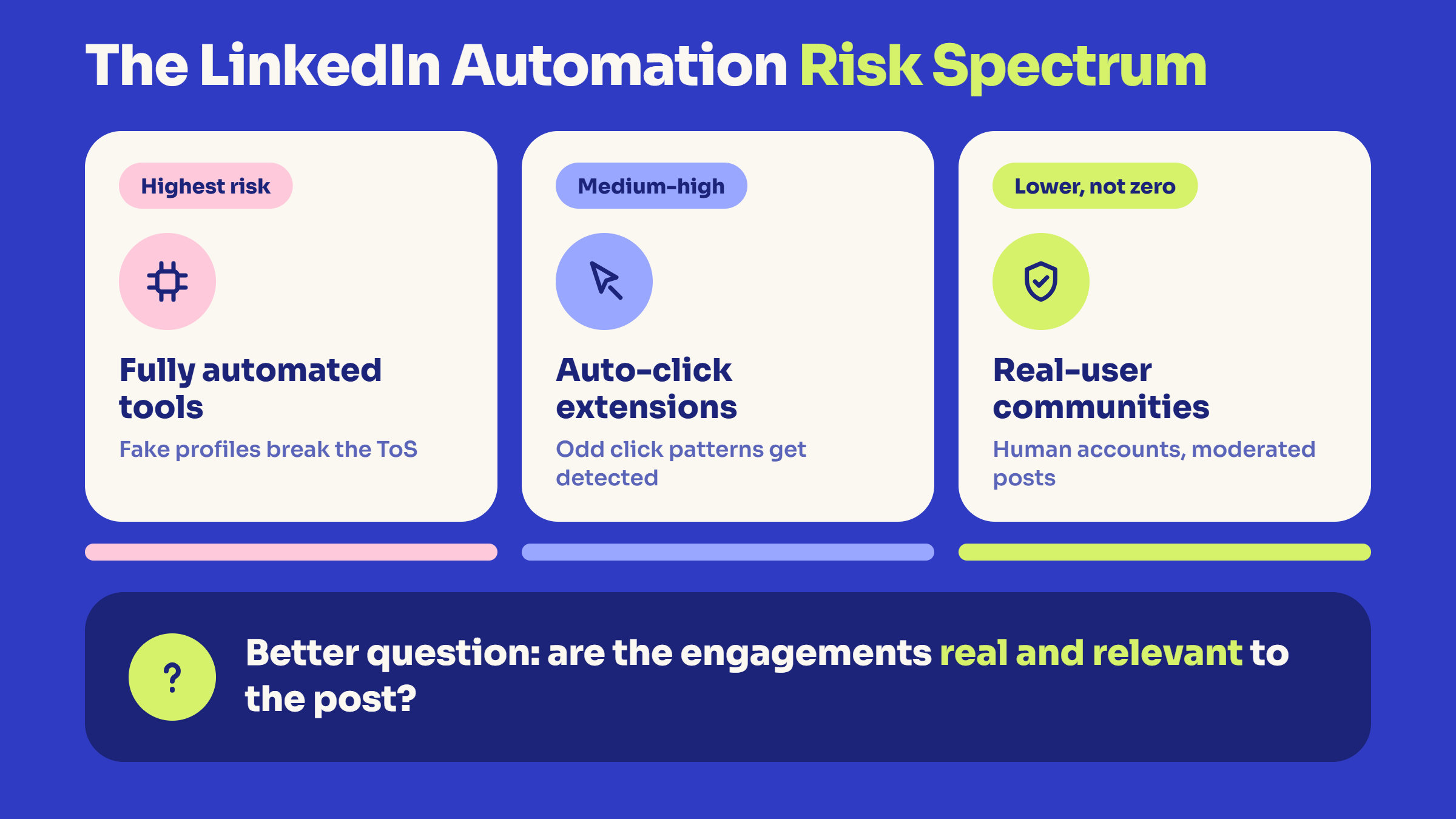
The risk spectrum looks like this — from highest to lowest concern:
Fully automated tools with fake profiles: Highest risk. These violate LinkedIn's ToS directly and account restrictions are common.
Browser extensions that auto-click engagement: Medium-high risk. LinkedIn actively detects unusual click patterns and session behaviour.
Real-user engagement communities with content moderation: Lower risk, but not zero. The key mitigating factors are real human accounts, natural engagement pacing, and content moderation that filters inflammatory or low-quality posts.
⚠️
Warning:Tools that promise hundreds of engagements per post from large anonymous groups with no content moderation are the ones most likely to generate account flags. If you can't verify that engagements come from real, identifiable LinkedIn users, treat that platform as high-risk regardless of what the sales page claims.
On the "do they work" question: according to Hootsuite's analysis of the LinkedIn algorithm (2026), posting weekly leads to a 2x lift in engagement — and early engagement signals are a key distribution factor. Platforms that deliver real, topic-relevant early engagement are effectively amplifying that organic mechanism. They work — but only when the underlying content is worth amplifying. Engagement tools cannot rescue a weak post; they can significantly accelerate a good one.
2×
Engagement lift for professionals who post consistently on LinkedIn weekly
What the LinkedIn algorithm rewards in 2026: comment depth, reply threads, dwell time, and save rates — not just raw like counts. This is why platforms that generate AI-powered comment threads often outperform those that only drive likes. It's also why are LinkedIn engagement pods against the rules is the wrong question for most beginners — the better question is: are the engagements coming from real people, and are they relevant to the post topic?
Taplio vs Podawaa vs Lempod — and the Best Alternatives in 2026
The most-compared tools in this space have very different strengths, and confusing them leads to frustration and wasted spend. Here's a direct side-by-side view:
Tool
Best For
Engagement Community
AI Replies
Free Tier
HyperClapper
Creators, founders, agencies wanting real engagement + AI replies
✅ Real users in channels
✅ Yes, with Feed More
Trial available
Taplio
Solo creators needing LinkedIn AI writing tools + scheduling
⚠️ Limited pod features
✅ Content AI focus
No (from ~$49/mo)
Podawaa
Users who want a simple pod tool with basic targeting
✅ Pod-based
❌ Limited
Yes (limited)
Lempod
Legacy tool — largely defunct
⚠️ Unreliable
❌ No
N/A
LinkBoost
B2B teams wanting reach amplification at scale
✅ Network-based
❌ No
Limited trial
Best LinkedIn Engagement Platforms for Beginners in 2026
For someone just starting out, the decision usually comes down to three questions: Does it require technical setup? Does it have content moderation (so you're not joining random groups)? And does it do more than just deliver likes?
Taplio's pricing starts at roughly $49/month and climbs from there — its strength is LinkedIn AI writing tools and post scheduling, not engagement amplification. If you've already got your content dialled in and just need more reach, Taplio is the wrong category of tool. Podawaa offers a limited free LinkedIn engagement tool experience, but the engagement quality and AI features are noticeably thinner than newer platforms.
For those evaluating the best LinkedIn growth tools for beginners, the cleaner path is a platform that combines engagement channels, AI replies, and content moderation under one roof — which is exactly what this beginner's walkthrough of LinkedIn engagement tools covers in more detail.
Social Media Management Alternatives and LinkedIn Scheduling Tools Worth Considering
If your need is scheduling and cross-platform posting rather than engagement amplification, tools like Buffer, Hootsuite, and Planable are legitimate social media management alternatives worth evaluating. They won't boost your LinkedIn algorithm signals the way an engagement platform will, but they're lower risk and excellent for consistency. The strongest setups pair a scheduling tool for content planning with a dedicated engagement platform for distribution — two tools, two distinct jobs.
💡
Pro Tip:Schedule your posts with a tool like Buffer or Taplio, then immediately submit them to HyperClapper channels when they go live. The scheduling tool handles consistency; the engagement platform handles the algorithm signal. Together they produce better results than either tool alone.
With the tool landscape mapped, the next question is practical: how do you actually use these platforms to increase LinkedIn post engagement?
Get Real LinkedIn Engagement — Without the Guesswork
HyperClapper connects your posts to real community channels so every post gets early traction when it matters most.
How to Increase LinkedIn Post Engagement: A Practical Framework
Knowing how to increase LinkedIn post engagement starts with understanding that the LinkedIn algorithm evaluates posts in two phases: an initial quality check based on early signals (first 60–90 minutes), and then a broader distribution decision based on sustained engagement. Engagement platforms target that first window. Organic strategy determines whether anything happens after it.
Using LinkedIn Engagement Tools Alongside Organic Strategy
Organic LinkedIn reach — the natural distribution of your content to followers and their networks — depends heavily on format, hook quality, and posting cadence. According to LinkedIn's own data on visual content, posts with visuals can generate 2–3x more engagement than plain text posts in some contexts. Format choices matter. But format without early engagement signals often means even good posts stall before reaching broader audiences.
The practical framework that consistently performs across high-visibility LinkedIn accounts follows this sequence:
Write a hook-first post (first line visible without clicking "see more" — make it a provocation, a specific number, or a counterintuitive claim)
Choose the right format — carousels and document posts drive save rates; text posts drive comment threads; both matter for LinkedIn algorithm signals
Submit to engagement channels immediately after publishing — the first 60 minutes is when early signals are weighted most heavily
Submit to Hyperclapper
Use AI-powered replies to sustain conversation depth after the initial engagement wave fades
Feed more AI replies on posts that are still gathering organic traction at 48–72 hours
The AI reply layer is the most underused lever in B2B content amplification — LinkedIn's algorithm actively rewards posts with substantive comment threads over those with high like counts and no discussion. HyperClapper's "Feed More" feature lets users inject additional AI replies into posts days after publishing, which extends the distribution window well beyond what most creators think is possible.
Benefits, Limitations, and Common Mistakes to Avoid with LinkedIn Engagement Platforms
Benefits and risks of LinkedIn engagement tools
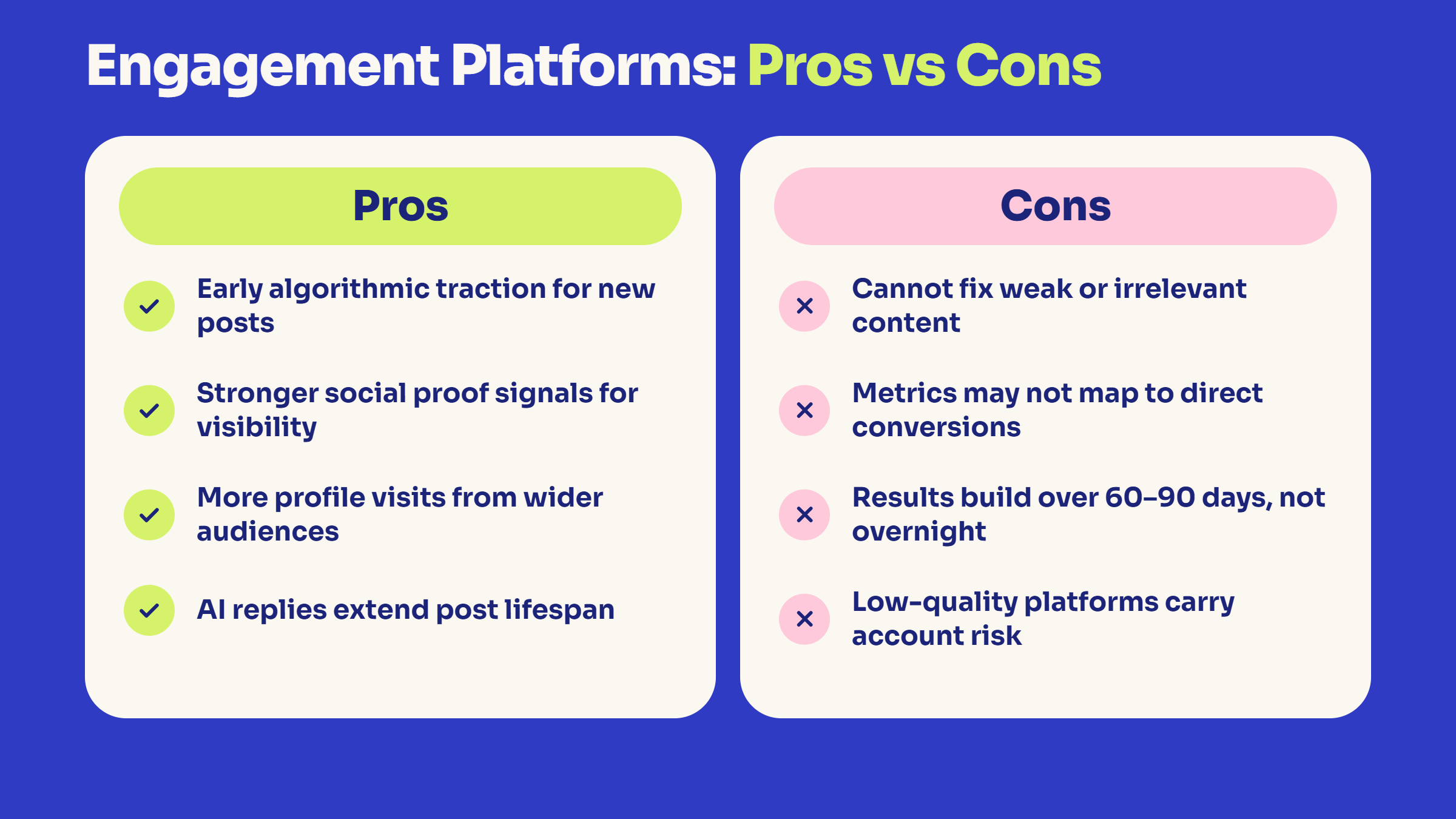
The real benefits are compounding rather than immediate. Creators who consistently use engagement platforms alongside quality content typically see measurable impression growth within 30 days and meaningful follower growth at the 60–90 day mark — not overnight leads. The mechanism is straightforward: early engagement widens initial distribution, which brings more organic views, which leads to more profile visits and follows, which strengthens future post distribution because you have a larger engaged base.
The honest limitations matter too. Engagement platforms cannot rescue weak content. A post with a vague hook and generic insight will still underperform even with 100 real engagements behind it — it just underperforms with better-looking metrics. Inflated engagement numbers that don't correspond to DMs, connection requests, or actual business outcomes are a sign that the content strategy needs work, not that the platform needs upgrading.
Common Mistakes Beginners Make When Choosing a LinkedIn Engagement Platform
Teams that jump straight to engagement tools without a content strategy in place consistently see disappointing ROI. The most common mistakes:
Choosing a tool based on price alone — the cheapest platforms often use low-quality or unmoderated engagement that looks suspicious to LinkedIn
Using an engagement-only tool when they need content help too — or vice versa, buying an AI writing tool when they actually need audience reach
Ignoring company page features — agencies and marketing teams that only boost personal posts miss significant brand visibility opportunities
Expecting instant results — dropping a tool after two weeks because follower growth hasn't exploded, when the compounding effect requires 60+ days of consistent use
Not monitoring analytics — using a platform without tracking which post types, topics, and formats are generating the best real engagement data
🔴
Avoid:Submitting every post you publish to maximum channels regardless of content quality. Engagement platforms amplify what's already there — spamming weak posts burns your channel reputation and trains your audience to stop engaging meaningfully.
How to Choose the Right LinkedIn Engagement Platform Alternative for Your Goals
Most professionals are in one of three situations, and the right tool differs meaningfully for each. Use this decision framework before subscribing to anything.
Quick Answer: Best LinkedIn Engagement Platform Alternative for Your Goal
Solo creator building a personal brand → HyperClapper — AI replies + real channels + simple UX designed for individual use
Agency or marketing team → HyperClapper with company page boosting — multi-post management, company page replies, analytics
Recruiter or sales professional → HyperClapper for profile visibility + a scheduling tool like Taplio for content consistency
Content-first creator who needs writing help more than reach → Taplio for AI writing, paired with HyperClapper for distribution
Budget-constrained beginner → Start with Podawaa's free tier to understand pods, then upgrade to HyperClapper for AI replies and moderation
Before subscribing to any LinkedIn engagement tool alternative, ask these five questions:
Are engagements from real, verifiable LinkedIn users? If the answer is unclear, treat it as a red flag.
Is there content moderation? Unmoderated pods can expose your brand to association with inflammatory or low-quality content.
Can I boost company pages, not just personal profiles? Critical for agencies and in-house marketing teams.
Does it offer AI replies, or just likes? Likes alone are algorithmically weaker than substantive comment threads.
What do the analytics show? A platform that can't tell you which posts performed and why is leaving growth insights on the table.
☐Confirmed that engagements come from real, human LinkedIn accounts (not bots or fake profiles)
☐Verified the platform has a content moderation system that filters sensitive or low-quality posts
☐Checked whether company page boosting is supported (if relevant to your use case)
☐Confirmed AI reply functionality exists — not just like-based engagement
☐Evaluated built-in analytics to track post performance and engagement quality over time
☐Checked whether a free trial or starter tier is available before committing to a paid plan
☐Aligned your content strategy first — engagement tools amplify quality content, they don't replace it
What separates accounts with sustained reach from those with inconsistent spikes is not the engagement platform they chose — it's the consistency of the content strategy they built around it.
Ready to Move Beyond Basic LinkedIn Reach?
HyperClapper gives you real engagement channels, AI-powered reply threads, and company page boosting — all in one platform designed to be safer than legacy pod tools.
Frequently Asked Questions About LinkedIn Engagement Platform Alternatives
What are the best alternatives to LinkedIn engagement platforms for someone just starting out?
For beginners, the strongest starting point is a platform that combines real community engagement, AI-powered replies, and content moderation in one place. HyperClapper is designed for exactly this use case — channels of real users, AI reply generation, and a content guard system that keeps engagement quality high without requiring technical setup.
Is it safe to use LinkedIn engagement platforms without getting banned?
No platform is completely risk-free, but real-user community platforms with content moderation carry significantly lower risk than bot-driven tools. The key factors that reduce risk: real human accounts engaging at natural pacing, content moderation that filters problematic posts, and no scraping or outreach automation. Platforms like HyperClapper are designed around these safer engagement principles rather than aggressive automation.
How do LinkedIn engagement pod tools compare to organic LinkedIn growth strategies?
Organic growth and engagement pods work best together, not as alternatives. Organic strategy determines content quality and consistency; engagement platforms provide early algorithmic momentum that organic posting alone rarely achieves quickly. The most consistent LinkedIn growth pattern observed across high-performing accounts combines both — organic content published regularly, with targeted engagement platform support for important posts.
What happened to Lempod and what should I use instead?
Lempod became unreliable over time and many users reported account instability and infrastructure issues. Most former Lempod users have migrated to HyperClapper, Podawaa, or Taplio depending on their core need. For engagement amplification specifically, HyperClapper vs. Podawaa is the most relevant comparison to explore next.
Which LinkedIn engagement platform is easiest for beginners to use?
HyperClapper is built for simplicity — you add your LinkedIn post URL, select channels, and real engagement begins. There's no browser extension to install, no complex configuration, and no requirement to manually reciprocate engagement to other members. The AI reply feature is also one-click, making it accessible even for users with no technical background.
What are some apps similar to LinkedIn, and do engagement tools work on them too?
The closest professional networking alternatives to LinkedIn include Xing (popular in German-speaking markets), Alignable (small business focus), and Lunchclub (networking-focused). Most LinkedIn engagement tools are LinkedIn-specific and won't work on these platforms. If you're building a professional network growth strategy across multiple platforms, you'll need platform-native tools for each — LinkedIn engagement platforms don't transfer.
Do LinkedIn engagement tools actually work in 2026?
Yes — when used with quality content and realistic expectations. They work by triggering LinkedIn's algorithm during the critical first 60–90 minutes after a post is published. According to Hootsuite's 2026 LinkedIn algorithm analysis, consistent engagement signals lead to measurably higher reach. Results compound over 60–90 days of consistent use, not overnight.
What is Taplio pricing and features compared to engagement-focused tools?
Taplio pricing starts at approximately $49/month and is built around LinkedIn AI writing tools and scheduling — content creation, not engagement amplification. It's an excellent choice if your main gap is content ideation and consistency. If your main gap is reach and visibility for posts you're already writing well, a dedicated LinkedIn engagement tool alternative like HyperClapper directly addresses what Taplio doesn't.
👋
⚡ Free plan
Leaving already?
Grab 3 free boosts on your next LinkedIn post — real likes & comments from 5,000+ creators. No card, cancel anytime.