How HyperClapper Outperforms Apollo.io Alternatives for LinkedIn
Comparing apolloio alternatives sales teams use in 2026 — data accuracy, LinkedIn support, pricing, and where HyperClapper wins the LinkedIn engagement layer.
📅 ⏱ 27 min read📝 ~5200 words
Sales teams evaluating apolloio alternatives sales teams typically start with the same frustration: Apollo.io's database is large but delivers too many dead contacts. A recurring pattern among SDR teams switching tools is that data quality — not pricing, not features — is what finally forces the move. Apollo.io handles email sequencing and prospecting reasonably well, but its LinkedIn capabilities are thin at best, and its contact accuracy creates real deliverability damage at scale. The right alternative depends entirely on what you need: a better B2B database, a smarter LinkedIn engagement layer, or both. This guide maps each option to the use case it actually fits.
Key Takeaways
Apollo.io's core weakness is data quality — bounce rates of 15–25% in some verticals are widely reported, damaging domain reputation and wasting SDR capacity.
Apollo.io LinkedIn limitations are significant — it cannot influence LinkedIn's algorithm, comment depth, or content engagement signals that drive inbound pipeline.
HyperClapper fills the LinkedIn gap — it's a LinkedIn-native engagement platform using real community channels, AI replies, and post boosting, not cold outreach automation.
The right 2026 stack separates functions: a verified database tool for email + HyperClapper for LinkedIn visibility + a CRM for attribution.
Most teams are over-indexed on cold email tooling and under-invested in LinkedIn — that imbalance is where the incremental pipeline opportunity sits in 2026.
Counterintuitive finding: HyperClapper and Apollo.io are not competitors — they solve different problems on different channels, and combining them beats either alone.
Why Sales Teams Are Looking Beyond Apollo.io in 2026
Apollo.io in 2026
Apollo.io's core value proposition is a large B2B contact database paired with email sequencing. On paper, that covers the outbound stack. In practice, teams running real sending volume hit the same wall: contacts that looked valid at export bounce on send, dragging domain reputation down with them. According to a Reddit evaluation thread comparing Apollo alternatives (2026), one team that tested four competing tools found a 2.4% overall bounce rate with their top performer — a meaningful contrast to Apollo's reported accuracy gaps in certain verticals.
The most common pain point across G2, Reddit, and sales community forums is not Apollo's pricing — it is SDR teams burning outreach budget on dead leads. A 10% bounce rate on a domain is enough to trigger spam classification with major email providers. Recovery takes months. That structural data quality issue, more than any pricing objection, is the real switching trigger.
There is a second, less-discussed gap: Apollo.io LinkedIn limitations are significant. Apollo supports basic LinkedIn step insertion in sequences — click a link, send a connection request manually — but it cannot drive post engagement, influence content visibility, or work with LinkedIn's content distribution algorithm. For teams where LinkedIn is a primary pipeline channel, this leaves a meaningful gap that no Apollo upgrade tier fills.
What Apollo.io Does Well (And Where It Falls Short)
Apollo.io genuinely excels at three things:
Database scale — over 275 million contacts with reasonably broad coverage across industries
Email sequencing — multi-step outbound automation with CRM sync and A/B testing built in
Prospecting filters — firmographic, technographic, and intent-signal filtering to narrow ICP lists
Where it falls short is equally clear:
Data freshness — large databases decay faster than smaller verified ones; independent tests show bounce rate variance of 15–25% in high-churn verticals
LinkedIn native support — surface-level; cannot engage posts, boost content, or influence LinkedIn's distribution signals
GDPR compliance complexity — storing and processing EU personal data at scale requires active DPA agreements and legitimate interest documentation
⚠️
Warning:A bounce rate above 5% on cold outreach can trigger spam classification from Gmail and Outlook, damaging your sending domain for 3–6 months. Verifying contacts before importing — regardless of which tool you use — is non-negotiable at scale.
Understanding where Apollo.io stops is the prerequisite for choosing what fills the gap. The next section draws that line precisely for LinkedIn.
HyperClapper vs Apollo.io for LinkedIn: A Direct Comparison
HyperClapper vs Apollo.io
Apollo.io is built for outbound email prospecting at volume. HyperClapper is built exclusively for LinkedIn visibility, post engagement, and content performance. These are different tools solving different problems — the comparison that matters is not which is better overall, but which wins on the LinkedIn layer specifically.
The answer is unambiguous: Why use a LinkedIn-specific tool over Apollo.io comes down to how LinkedIn's algorithm works. LinkedIn rewards content that generates genuine engagement signals — comments, dwell time, saves, reply threads. Apollo.io cannot create any of those signals. HyperClapper is designed specifically to generate them, through real users in community engagement channels, not bots or scraped lists.
Feature Comparison Table: HyperClapper vs Apollo.io vs Top Alternatives
LinkedIn engagement, post visibility, personal brand
⭐⭐⭐⭐⭐ Native
N/A (not a database)
Low
Apollo.io
Email outbound at volume, large ICP lists
⭐⭐ Surface-level
Moderate (15–25% bounce in some verticals)
Medium
UpLead
Verified email prospecting, SMBs
⭐⭐ Limited
High (95%+ claimed, real-time verification)
Low–Medium
Lead411
Intent-driven prospecting, SMB lists
⭐ Minimal
High (smaller, more curated dataset)
Low
SalesRobot
LinkedIn connection automation and messaging
⭐⭐⭐⭐ Automated outreach
N/A (LinkedIn-native)
Medium–High
Lusha
EMEA B2B data, compliance-conscious teams
⭐⭐ Browser extension
High in EMEA, variable elsewhere
Low–Medium
Is Apollo.io Good for LinkedIn Outreach? An Honest Assessment
Is Apollo.io Good for LinkedIn Outreach?
Is Apollo.io good for LinkedIn outreach? Not meaningfully. Apollo can remind a rep to send a LinkedIn connection request as part of a multi-step sequence, but the execution is manual — and it has zero ability to influence LinkedIn's content distribution, boost post visibility, or generate the engagement signals the algorithm uses to amplify reach. For teams treating LinkedIn as a content-led pipeline channel rather than a messaging directory, Apollo.io is structurally the wrong tool for that layer.
The honest assessment: Apollo.io is a strong email outbound tool that bolts on LinkedIn as an afterthought. Teams serious about LinkedIn prospecting engagement need a purpose-built tool for that channel.
hyperclapper.com
HyperClapper — Boost your first hour on LinkedIn
Real likes and comments from 5,000+ professionals in your post's first hour. 30M+ engagements delivered, zero ad spend.
What HyperClapper Does for LinkedIn (And How It Works)
HyperClapper is a LinkedIn engagement platform — specifically, a tool that connects users to real engagement channels where active LinkedIn members like and comment on each other's posts. It is not a scraping tool, a connection automation tool, or a contact database. Its entire mechanism is about amplifying the visibility of content already on LinkedIn, using real human activity rather than bot signals.
~50%
Increase in LinkedIn post visibility when a post receives early engagement signals, according to widely cited platform behavior data
LinkedIn's algorithm consistently rewards posts that generate engagement early — a pattern confirmed across platform behavior studies and creator testing. Posts with genuine early comments and likes are distributed to second and third-degree connections at a materially higher rate than posts that launch cold. HyperClapper's channel system is built to trigger exactly that early signal window.
What HyperClapper Does
Core Features: Post Boosting, AI Replies, Company Pages, and Analytics
HyperClapper's feature set is focused rather than sprawling. The core capabilities:
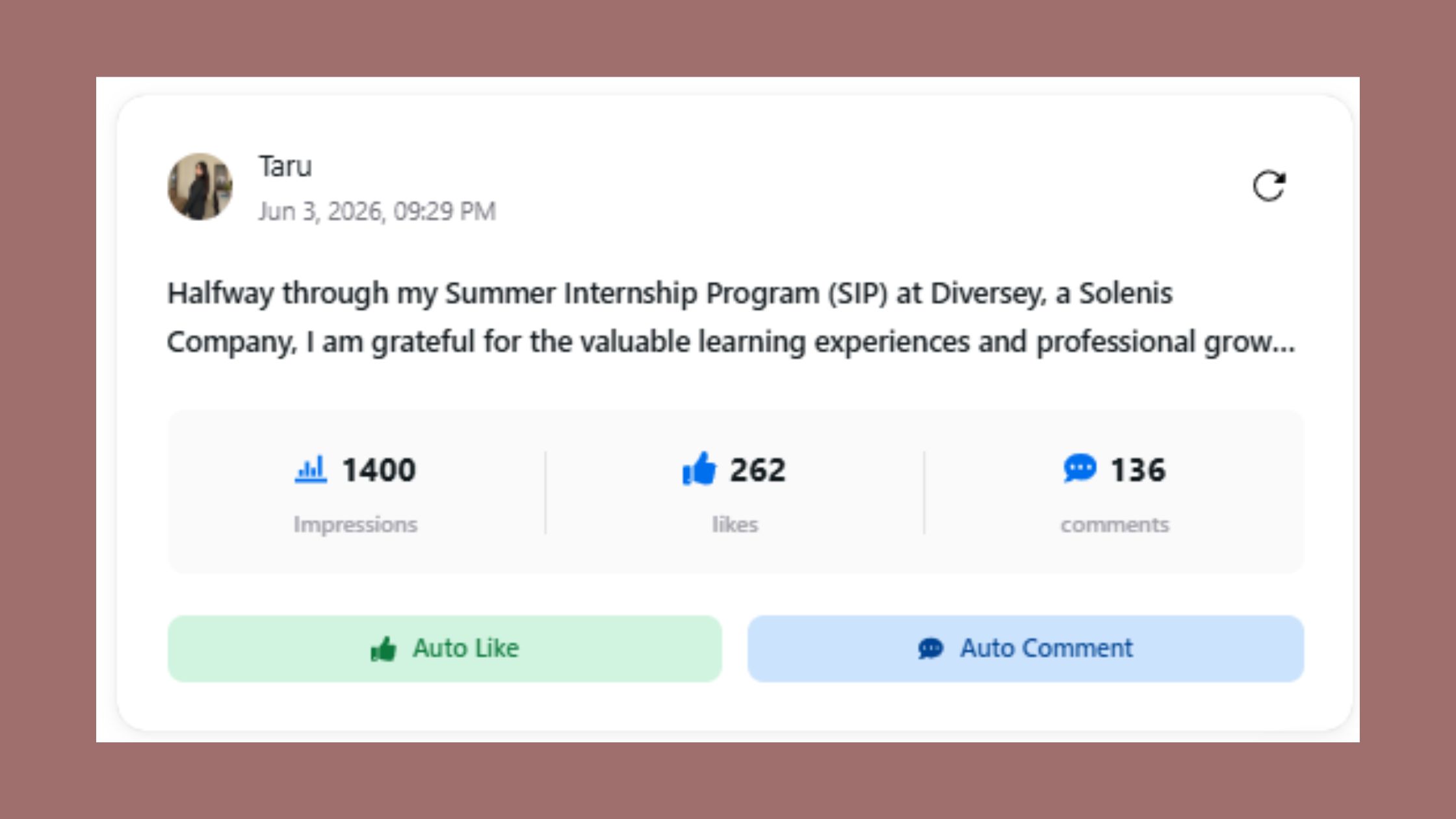
LinkedIn Post Boosting — submit a post to channels and receive real likes and comments from real users. Channel size determines engagement volume: 1 channel ≈ 50 engagements, 2 channels ≈ 100, 3 channels ≈ 150.
AI-Powered Replies — HyperClapper generates contextually relevant replies and posts them to keep conversation threads active well beyond the initial boost window.
Feed More AI Replies — users can inject additional AI replies days after initial posting, sustaining engagement depth for long-tail distribution. LinkedIn continues to resurface posts with active conversation threads.
Company Page Boosting — boost posts from brand pages, not just personal profiles — useful for agencies and marketing teams managing multiple LinkedIn presences.
Company Page Replies — add replies specifically from company pages, making brand activity look more active and organic.
Analytics — post performance tracking, engagement trends, and LinkedIn growth metrics over time.
Content Guard — automated moderation that screens posts for politically sensitive, controversial, or risky content before they enter channels, protecting brand safety.
How to Improve LinkedIn Post Engagement with HyperClapper's Automation
The practical workflow for how to improve LinkedIn post engagement with automation through HyperClapper follows four steps:
Publish the post on LinkedIn (30 seconds) — write and publish normally from your LinkedIn profile or company page.
Add the post URL to HyperClapper (30 seconds) — paste the post link into the platform dashboard at app.hyperclapper.com.
Select channels (1 minute) — choose 1–3 channels based on desired engagement volume; the platform shows estimated reach per selection.
Activate AI replies (optional, 1 minute) — enable AI reply generation to keep the conversation thread growing after initial engagement fires.
💡
Pro Tip:Submit posts to channels within the first 30–60 minutes of publishing. LinkedIn's distribution algorithm gives the highest weight to engagement that occurs in the first hour — boosting after 24 hours captures far less algorithmic lift.
Turn Your LinkedIn Posts Into Pipeline Fuel
HyperClapper connects your content to real LinkedIn users who engage — so every post gets the early signal boost the algorithm rewards.
Best Apollo.io Alternatives for LinkedIn Prospecting in 2026
The best Apollo.io alternatives for LinkedIn in 2026 fall into two distinct categories, and conflating them creates the wrong shortlist. LinkedIn automation tools for sales teams operate very differently from B2B database tools — teams that understand this distinction build better stacks.
Category 1: Outbound database tools (replacements for Apollo's contact database)
UpLead — highest claimed accuracy at 95%+, real-time email verification
Lead411 — smaller database, higher signal quality, intent data included
Lusha — strong EMEA coverage and GDPR-first compliance posture
RocketReach — broad contact coverage across social and professional profiles
Category 2: LinkedIn-native engagement tools (replacements or complements for Apollo's limited LinkedIn layer)
HyperClapper — content engagement and post visibility, real channel-based system, Content Guard moderation
SalesRobot — LinkedIn connection and message automation
Expandi — cloud-based LinkedIn outreach with behavioral safety limits
SalesRobot, Expandi, and LinkedIn Automation Tools for Sales Teams
SalesRobot and Expandi both focus on LinkedIn automation tools for sales teams in the outreach-automation sense: connection requests, follow-up messages, and sequence management through LinkedIn's messaging layer. They are functional for building connection volume but carry meaningful account ban risk because they automate actions LinkedIn explicitly prohibits at scale.
The meaningful distinction from HyperClapper: SalesRobot and Expandi automate outbound messaging (who you reach out to); HyperClapper amplifies inbound visibility (who finds you through your content). These are complementary motions, not competing ones — and the best LinkedIn outreach automation tool for a given team depends on whether the goal is reach-out or be-found.
Teams that combine all three — a verified email tool, a LinkedIn outreach tool, and HyperClapper for content visibility — typically see the strongest LinkedIn pipeline results because they're covering both the active and passive acquisition channels simultaneously.
Lead411, UpLead, Lusha, and RocketReach: Database Alternatives Compared
According to a 2026 Reddit evaluation thread comparing Apollo alternatives on data quality, one team testing four tools achieved a 2.4% overall bounce rate with their top performer — and noted 60–70% fewer contacts than Apollo for the same filters, but materially better deliverability outcomes. This is the core trade-off: Apollo offers volume; its alternatives offer quality. Which matters more depends on team size and sending velocity.
UpLead — claims 95%+ email accuracy with real-time verification at export. Best for SMBs that need clean lists fast without manual verification overhead.
Lead411 — intent signal integration, smaller but more curated contact set. Best for teams that prioritize buying intent over raw list size.
Lusha — EMEA-accurate and GDPR-compliant by design. Best for European-market teams or companies with active compliance requirements.
RocketReach — broad profile coverage including personal emails and social links. Best for agencies running diverse ICP searches across industries.
Which alternative has the largest verified B2B database in 2026? ZoomInfo claims the largest enterprise-grade database overall, but at pricing that reflects it. For teams without enterprise budgets, UpLead and Lead411 consistently outperform Apollo on the deliverability benchmarks that actually affect pipeline — which is a more useful comparison than raw contact count.
Data Accuracy, Deliverability, and the Real Cost of Bad Contacts
Outbound deliverability rate — the percentage of sent emails that reach the inbox rather than bouncing or landing in spam — is directly tied to contact data freshness. Most sales teams underestimate how fast B2B contact data decays: titles change, people switch companies, email addresses are abandoned. Industry estimates suggest B2B contact data decays at roughly 22–30% per year, meaning a database that was 95% accurate 18 months ago may be down to 70% without active refresh.
B2B Data Quality — By the Numbers
2.4%
Bounce rate achieved by top Apollo alternative in 2026 Reddit evaluation
15–25%
Invalid email rate reported in Apollo.io data for high-churn verticals
95%+
Claimed email accuracy rate from UpLead with real-time verification
~22–30%
Annual B2B contact data decay rate — the reason accuracy benchmarks matter
The practical implication: a 10% bounce rate is enough to push a sending domain into spam classification with Gmail and Outlook. Domain recovery is not a quick fix — in most cases it takes three to six months of careful low-volume sending to rehabilitate reputation, during which the entire outbound program is compromised. This means bad data is not just an efficiency problem; it is a pipeline continuity risk.
The teams that switch away from Apollo.io are rarely motivated by pricing. They switch when a high-bounce sending campaign damages their domain and they realise the database accuracy gap is structural — not fixable by buying more contacts.
Which Tool Is Best for SaaS, Staffing, Finance, and Other Verticals?
The right Apollo.io alternative for LinkedIn prospecting varies by vertical, because data decay rates and contact availability differ across industries:
SaaS — High job mobility means faster data decay. UpLead's real-time verification catches role changes before they become bounces. HyperClapper is highly effective here because SaaS buyers research vendors through LinkedIn content before engaging sales.
Staffing and recruiting — LinkedIn is the primary channel, not email. HyperClapper's post boosting for job content and thought leadership drives inbound candidate and client visibility far more efficiently than email outbound tools.
Finance and professional services — Compliance sensitivity makes GDPR-certified tools (Lusha) preferable over large US-centric databases. Content authority on LinkedIn matters disproportionately in trust-based verticals — making HyperClapper's visibility layer strategically high value.
Enterprise / F500 selling — ZoomInfo or Apollo.io at scale, paired with HyperClapper for account-based LinkedIn content that warms decision-makers before outreach lands.
What separates top-performing teams here is not which single tool they use — it is the deliberate matching of tool to channel and use case, rather than defaulting to the largest database and hoping for the best.
LinkedIn Automation Safety, GDPR, and Compliance Considerations
LinkedIn's Terms of Service explicitly prohibit scraping, high-volume automated connection requests, and bot-driven messaging. Enforcement has materially increased since 2024, with account restrictions and bans reported across LinkedIn automation communities at higher frequency than in previous years. Teams using connection-automation tools are operating in a grey zone that carries real account risk.
GDPR compliance adds a second compliance layer for any tool that stores or transfers EU personal data. Database tools like Apollo.io and Lusha require active Data Processing Agreements (DPAs) and documented legitimate interest bases for any EU outreach. This is not a hypothetical concern — GDPR enforcement actions against B2B prospecting tools have increased, with fines tied specifically to cold email and prospecting workflows without proper consent documentation.
HyperClapper's compliance position is structurally different. The platform's channel model — where real users opt into engaging with each other's content — does not involve scraping, automated messaging, or personal data transfer at the database level. HyperClapper's Content Guard system adds an additional moderation layer, screening posts for sensitive or risky content before they circulate through channels. This combination means HyperClapper carries materially lower compliance exposure than outreach automation tools.
🔴
Avoid:Running LinkedIn connection automation tools (SalesRobot, Expandi, Dux-Soup) at maximum daily limits without randomized delays and activity caps. LinkedIn's detection has improved — accounts sending 50+ connection requests per day with no human activity variation are flagged significantly faster in 2026 than in prior years.
For teams serious about sustainable LinkedIn growth, choosing tools that work with LinkedIn's design rather than around it is the more defensible long-term position. See our guide to Waalaxy alternatives and LinkedIn automation tools for a broader view of the compliance landscape across tools.
HyperClapper Pricing vs Apollo.io Pricing: What You Actually Get
Apollo.io's pricing model is contact-volume and seat-based. The free tier is genuinely useful for low-volume prospecting, but paid tiers scale steeply once teams start exporting contacts at volume — and the cost compounds as SDR headcount grows. Enterprise plans with CRM sync, advanced filtering, and full API access represent a significant annual commitment.
HyperClapper pricing vs Apollo.io pricing involves comparing fundamentally different cost models. HyperClapper charges for LinkedIn engagement capacity (channels), not database access or contact exports. The incremental cost of adding HyperClapper to an existing stack is typically far lower than upgrading an Apollo.io tier — and it delivers a capability Apollo cannot provide at any price.
ROI framing that changes the calculus for LinkedIn-first teams: calculate the cost-per-verified-contact in Apollo.io (subscription cost ÷ usable contacts after bounce filtering), then compare it to the cost-per-LinkedIn-impression through HyperClapper. For teams where LinkedIn is a meaningful pipeline source, the impression-to-conversation conversion through warm content engagement typically outperforms cold email at equivalent spend.
Budget-practical view:
Under $100/month — HyperClapper entry tier; covers LinkedIn engagement for solo founders and small teams without additional database tool cost
$100–$500/month — HyperClapper + Lead411 or UpLead; covers both LinkedIn visibility and clean email prospecting for growing SDR teams
$500+/month — Full stack with CRM integration (HubSpot or Salesforce), a verified database tool, HyperClapper for LinkedIn, and a sequencing platform for multi-channel outreach
For teams already paying for a CRM and an email tool, adding HyperClapper as a dedicated LinkedIn engagement layer is typically lower incremental cost than upgrading Apollo.io tiers — and solves a problem that no Apollo upgrade actually addresses.
Who Should Use HyperClapper: Use Cases by Role and Team Size
Who Should Use HyperClapper
Teams that consistently get the highest return from HyperClapper LinkedIn engagement tool features share one characteristic: they already have content on LinkedIn and want that content to work harder, not just generate it into a void. The platform amplifies existing content quality — it doesn't manufacture it.
Use Cases by Role
LinkedIn creators, founders, and coaches building personal brands — HyperClapper's post boosting and AI replies create the engagement momentum needed to break out of the "zero network" cold-start problem. Posts that would otherwise get 3–5 reactions get early engagement signals that trigger broader algorithmic distribution. For personal brand builders, this compresses the timeline to meaningful LinkedIn reach from months to weeks.
Recruiters and HR teams — Boosting job posts and employer brand content directly increases visibility among passive candidates. In competitive talent markets, a recruiter whose posts consistently reach 3x their connection count through algorithmic amplification develops inbound sourcing volume that cold-outreach-only recruiters cannot match.
Agencies and marketing teams managing multiple LinkedIn presences — Company page boosting and analytics make multi-client LinkedIn management scalable. Agencies can systematically boost content across client accounts and report on engagement growth through a single analytics interface. Check our overview of Zopto alternatives for LinkedIn automation for additional tools useful to agency teams.
Sales teams and SDRs — Content-led pipeline generation on LinkedIn is the key use case. SDRs who have a prospect see their thought leadership content in the feed before a cold outreach lands are dealing with a warmer prospect. HyperClapper's channel system creates the visibility that makes that warm-up possible at scale, rather than relying on organic posting luck.
Common Mistakes to Avoid When Using LinkedIn Engagement Tools
The most common failure mode among new HyperClapper users is treating the tool as a replacement for content quality. Amplified reach multiplies the impact of good content — and the lack of impact of bad content. Three specific mistakes to avoid:
Boosting generic content — Engagement signals get the post distributed; what the distribution audience sees determines whether they follow, comment, or convert. Bland content sees inflated reach and no downstream action.
Skipping AI replies — Initial likes and comments trigger distribution, but sustained comment threads trigger continued resurfacing. Creators who skip AI replies typically see engagement spike and drop; those who use them see a longer tail of distribution and profile visits.
Submitting posts after 24 hours — LinkedIn's algorithm weights early engagement most heavily. Submitting to channels a day after publishing captures a fraction of the algorithmic lift available in the first hour.
✓ The LinkedIn Content Boost Checklist
☐Post is published and live on LinkedIn (personal or company page)
☐Submit post URL to HyperClapper within 60 minutes of publishing
☐Select appropriate number of channels based on desired reach (1–3)
☐Enable AI replies to sustain comment thread activity
☐Content Guard has cleared the post (no flags for sensitive or controversial content)
☐Return after 48–72 hours to feed additional AI replies if conversation is still active
☐Review analytics dashboard to track engagement trend and compare to previous posts
Building the Right SDR Tech Stack: Apollo.io, HyperClapper, and What Fits Between
The strongest 2026 SDR team tech stack separates functions cleanly across three layers, and most team-level debates about "Apollo.io vs alternatives" are actually debates about which tool covers which layer — a framing that resolves most of the confusion.
Layer 1 — Data and Email Outbound: Apollo.io, UpLead, or Lead411. This layer handles ICP list building, contact enrichment, email sequencing, and CRM sync. The evaluation criteria here are data accuracy, bounce rate, and integration depth.
Layer 2 — LinkedIn Visibility: HyperClapper. This layer handles LinkedIn content amplification, engagement signals, post reach, and algorithmic distribution. Apollo.io does not meaningfully compete at this layer regardless of tier.
Layer 3 — Attribution and Pipeline Tracking: HubSpot, Salesforce, or Pipedrive. This layer connects activity across channels to pipeline stages and revenue. HyperClapper's analytics feed LinkedIn engagement data that can be referenced alongside CRM pipeline stages to show content-to-conversation attribution.
Teams choosing between Apollo.io and HyperClapper are not actually choosing between them — they are under-investing in LinkedIn if they lack Layer 2 entirely, and over-indexing on email if they are treating Apollo's limited LinkedIn steps as equivalent to a dedicated LinkedIn engagement tool.
Integration note: Apollo.io connects deeply with Salesforce, HubSpot, and Outreach for the email layer. For budget-constrained teams, replacing Apollo.io's full suite with a lighter verified-data tool (Lead411 or UpLead) plus HyperClapper for LinkedIn often delivers better LinkedIn ROI at lower total spend than a full Apollo.io paid tier. See the Mailshake alternatives guide for email sequencing options that pair well with this stack.
The teams consistently outperforming their outbound benchmarks in 2026 are not running better Apollo.io configurations — they are running cleaner data tools for email alongside a dedicated LinkedIn layer that their competitors have not built yet.
Risks and Limitations: What HyperClapper and Apollo.io Alternatives Won't Solve
No tool in this category solves the content quality problem. HyperClapper amplifies reach, but thin or generic content will not convert visibility into profile visits or conversations — the algorithm distributes it wider, and wider distribution of weak content just means more people don't engage. The engagement signal is the first step; what happens when a prospect lands on a profile after seeing the post is determined entirely by the content and the profile itself.
Apollo.io's data quality gap is structural, not a configuration issue. Upgrading tiers adds more contacts, but more contacts from the same dataset that decays at the same rate does not improve deliverability outcomes. Teams expecting that problem to solve itself at higher Apollo.io spend levels typically stay frustrated. The fix is either switching to a higher-accuracy verified database, implementing real-time verification at export, or accepting that some bounce rate is a cost of using a large unverified dataset.
LinkedIn algorithm changes are unpredictable. Tools that depend on specific behavioral patterns — connection request rates, message open signals, post interaction timing — carry ongoing risk that those patterns become detection targets as LinkedIn's enforcement evolves. Engagement-first tools like HyperClapper carry lower exposure to this specific risk because their mechanism (real users choosing to engage) aligns with what LinkedIn is trying to incentivize rather than circumvent.
Realistic expectations for HyperClapper specifically: it is a visibility and engagement multiplier, not a lead generation tool in the traditional outbound sense. Pipeline still requires outreach and conversion work downstream. The most accurate positioning is that HyperClapper shrinks the cold-start problem and warms the audience before outreach happens — it does not replace the outreach step.
⚠️
Warning:Engagement tool abuse — submitting low-quality, promotional, or controversial posts to channels — can generate community flags and violate platform norms. HyperClapper's Content Guard catches the worst cases automatically, but editorial judgement about post quality is the user's responsibility, not the platform's.
Quick-Reference: Choosing the Right Tool for Your LinkedIn and Outbound Strategy
The decision framework below is designed to resolve the most common evaluation scenario: a team with some combination of LinkedIn activity and email outbound trying to figure out which tool or combination of tools to prioritize in 2026.
Quick Answer: Best Tool for Your Goal
Primary channel is email at volume → Apollo.io, UpLead, or Lead411; evaluate on data accuracy first, feature depth second
Primary channel is LinkedIn content → HyperClapper as the core tool; add a lightweight email verifier if needed
Both channels matter → Verified database tool (Lead411 or UpLead) + HyperClapper for LinkedIn; CRM ties attribution
Compliance-sensitive or EU-heavy outreach → Lusha (GDPR-native) + HyperClapper; avoid large unverified databases for EU contacts
Budget under $200/month → HyperClapper entry tier + UpLead's pay-as-you-go; covers LinkedIn engagement and clean email without seat-based pricing overhead
The honest recommendation for most teams in 2026: the majority are over-indexed on cold email tooling and under-invested in LinkedIn visibility. Apollo.io or its email-database alternatives should handle the email layer — but if LinkedIn is not producing pipeline proportional to the audience size there, the missing piece is almost always a dedicated engagement layer, not more contacts. Rebalancing that ratio is where the incremental pipeline opportunity sits.
Ready to Build the LinkedIn Layer Your Stack Is Missing?
HyperClapper connects your LinkedIn content to real engagement communities — so every post reaches further, generates more conversations, and warms prospects before your outreach lands.
Frequently Asked Questions About Apollo.io Alternatives and HyperClapper
What is the best tool for LinkedIn outreach automation instead of Apollo.io?
The best tool depends on what "outreach" means in context. For content visibility and post engagement, HyperClapper is the strongest LinkedIn-native option — it uses real engagement channels to amplify posts rather than automating messages. For LinkedIn connection and messaging automation, Expandi and SalesRobot are the most commonly used options, though both carry higher account ban risk than content engagement tools.
How does HyperClapper compare to Apollo.io for LinkedIn lead generation?
Apollo.io does not meaningfully support LinkedIn lead generation — its LinkedIn integration is a manual step reminder in email sequences, not a native LinkedIn feature. HyperClapper generates LinkedIn leads indirectly: by amplifying content reach and driving profile visits from prospects who discover the content through expanded algorithmic distribution. The two tools operate on different mechanisms and are best used together rather than instead of each other.
Which LinkedIn engagement tools work better than Apollo.io for B2B sales?
For B2B sales teams using LinkedIn as a pipeline channel, HyperClapper works materially better than Apollo.io on the LinkedIn layer because Apollo.io cannot influence content engagement signals at all. HyperClapper's channel system drives real likes, comments, and conversation threads that LinkedIn's algorithm rewards with expanded reach — creating inbound visibility that cold outbound cannot replicate.
Can HyperClapper replace Apollo.io for LinkedIn prospecting?
Partially — but the framing is more useful as "complement" than "replace." HyperClapper replaces Apollo.io's LinkedIn layer completely and does it far better. It does not replace Apollo.io's B2B contact database or email sequencing. Teams that primarily prospect through LinkedIn content should use HyperClapper as the core tool; teams with active email outbound should keep a database tool and add HyperClapper for the LinkedIn layer.
Does Apollo.io support LinkedIn messaging automation?
Does Apollo.io support LinkedIn messaging automation? Only in a limited, manual-trigger sense. Apollo includes LinkedIn as a sequence step, but the action (sending a connection request or message) must be completed manually by the rep — Apollo queues the task and surfaces it, but does not automate the send. It is not a LinkedIn messaging automation tool in the way SalesRobot or Expandi are.
Which has the largest verified B2B database in 2026 — Apollo.io or its alternatives?
Apollo.io claims one of the largest databases by raw contact count (275M+). ZoomInfo rivals or exceeds it at enterprise scale. However, largest is not the same as most accurate. UpLead and Lead411 offer significantly smaller databases with materially higher per-contact accuracy — a more useful benchmark for teams where deliverability rate directly affects pipeline outcomes.
What does HyperClapper do for LinkedIn?
What does HyperClapper do for LinkedIn: it connects users' LinkedIn posts to real engagement channels — communities of active LinkedIn professionals who like and comment on each other's content. This triggers early algorithmic engagement signals that LinkedIn uses to distribute posts more widely. Additional features include AI-powered replies, company page boosting, analytics, and Content Guard moderation for brand safety.
Top LinkedIn prospecting tools comparison: where does HyperClapper rank?
In a top LinkedIn prospecting tools comparison, HyperClapper ranks first specifically for content engagement and post visibility. For connection and message automation, SalesRobot and Expandi lead. For B2B data and email sequencing, Apollo.io, UpLead, and Lead411 are the evaluation leaders. The tools are not directly comparable because they address different parts of the LinkedIn prospecting workflow.
👋
⚡ Free plan
Leaving already?
Grab 3 free boosts on your next LinkedIn post — real likes & comments from 5,000+ creators. No card, cancel anytime.

%2520(1).png) hyperclapper.com
hyperclapper.com