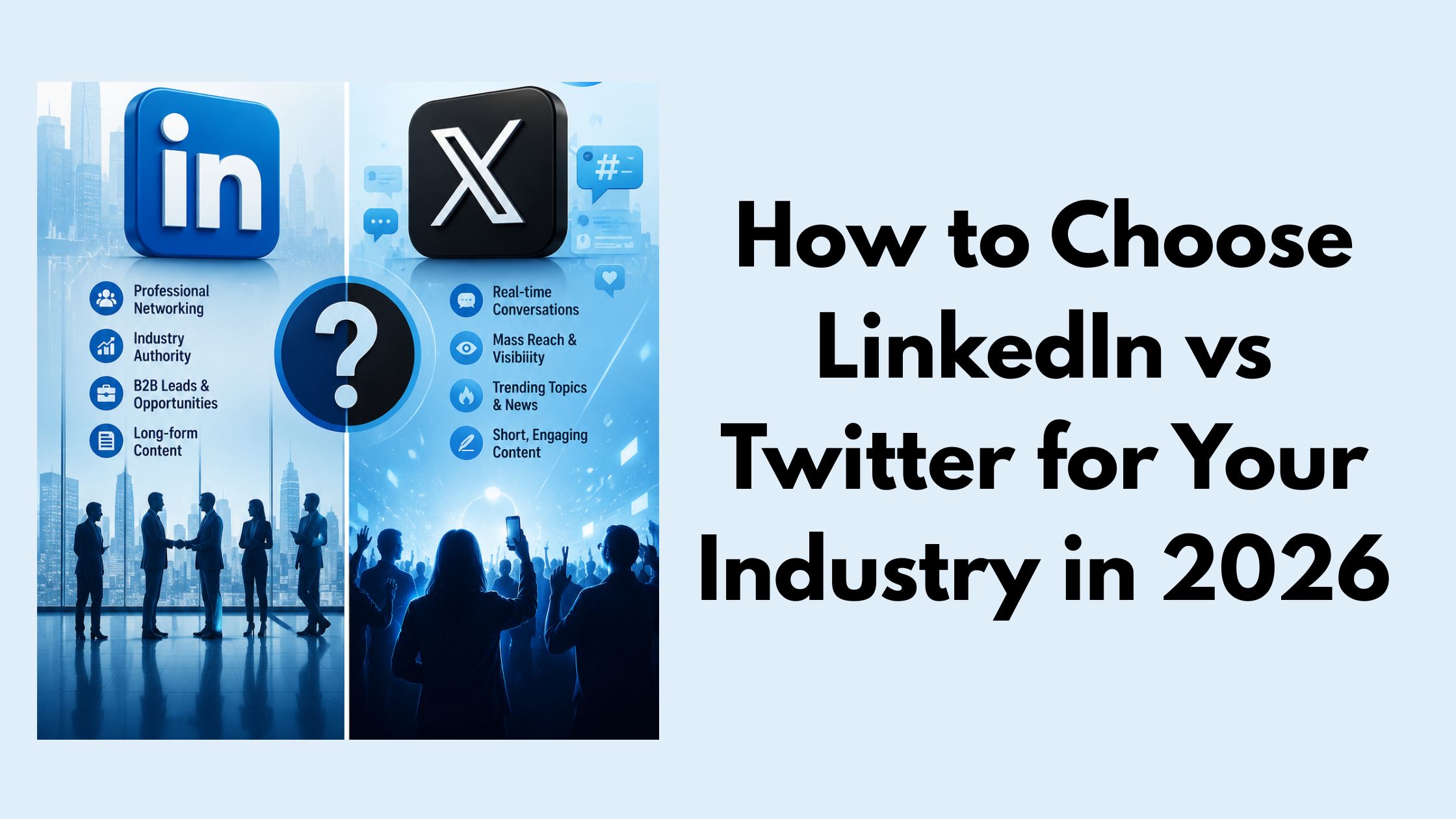
The debate between Twitter vs LinkedIn is one of the most common strategic questions professionals face — and the answer is almost never the same twice. A pattern observed across thousands of professional content accounts is that the platform "winning" for one person is actively underperforming for someone with an almost identical profile in a different industry. LinkedIn is a professional network optimised for career growth, B2B commerce, and long-form credibility; X (formerly Twitter) is a real-time conversation engine rewarding speed, wit, and mass reach. The right choice depends almost entirely on your goal and industry — and this guide maps exactly that.
- LinkedIn wins for B2B lead generation — its visitor-to-lead conversion rate is nearly 4x higher than X's.
- X wins for real-time reach and culture — tech, media, crypto, and politics live here first.
- Industry determines platform — consultants and recruiters belong on LinkedIn; journalists and developers thrive on X.
- Personal brand builders get better long-term ROI on LinkedIn — content compounds via network effects and profile SEO.
- X's algorithm is increasingly pay-to-play — organic professional reach has declined sharply since 2023.
- Most counterintuitive finding: a large X following rarely converts to leads or job offers at the same rate as a modest, active LinkedIn presence.
- LinkedIn vs Twitter: The 60-Second Verdict
- Audience Demographics and Who Is Actually on Each Platform
- Algorithm, Reach, and Content Virality Mechanics
- B2B Lead Generation, Networking, and Revenue
- Where to Build Your Personal Brand in 2026
- Analytics, Scheduling Tools, and Managing Both Platforms
- Side-by-Side: How to Make the Final Call
- Frequently Asked Questions About LinkedIn vs Twitter
LinkedIn vs Twitter (X) in 2026: The 60-Second Verdict
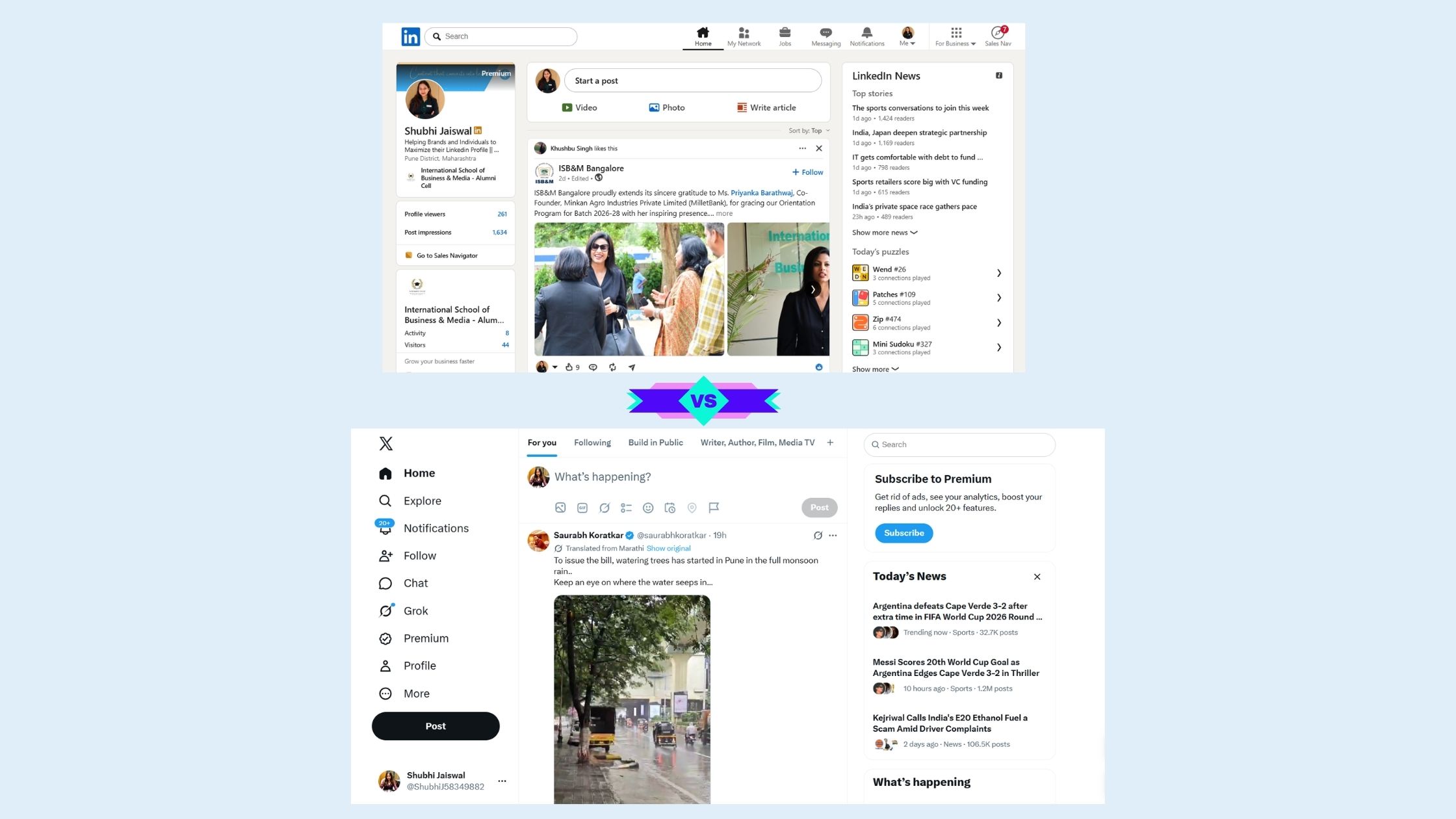
LinkedIn is a professional network of 1.3 billion members built around career identity — every piece of content, every connection, and every ad sits inside a context layer (job title, company, seniority) that makes it commercially potent. X is a real-time public conversation engine with roughly 550–600 million monthly users, built around speed and provocation. Both are legitimate platforms. Neither is universally superior.
| Goal | Winner | Why |
|---|---|---|
| B2B lead generation | Built-in professional context, 2.74% lead conversion rate | |
| Professional recruiting | Every profile is a verified CV | |
| Real-time brand awareness | X | Viral reach is faster and wider |
| Tech / media / crypto discourse | X | Community and conversation culture lives here |
| Personal brand (long-term) | Content compounds; profile ranks in Google | |
| Consumer brand virality | X | Meme culture, trending topics, faster cycle |
Choosing one platform doesn't mean abandoning the other — but spreading effort evenly across both without a strategy is how most professionals end up with weak results on both. The rest of this guide maps which factors actually determine the right call for your specific industry and goal.
Audience Demographics and Who Is Actually on Each Platform
LinkedIn's 1.3 billion member base — confirmed by ConnectSafely's LinkedIn Statistics 2026 — skews decisively toward decision-makers: roughly 65% of users are between 25 and 54, and approximately 4 in 5 members drive business decisions at their organisations. That pre-filtering is LinkedIn's single most powerful commercial advantage. You don't need to earn the right audience's attention — they're already there by definition.
X's active user base sits at an estimated 550–600 million monthly users in 2026, skewing younger and more male, with heavy representation in tech, journalism, politics, crypto, and entertainment. Engagement quality vs engagement volume is the critical distinction here: LinkedIn comments typically come from named professionals in directly relevant fields. X replies are high-volume but frequently anonymous or contextually unrelated — making lead qualification significantly harder.
What this means practically: if your buyer, employer, or collaborator is a business professional, LinkedIn's audience is already pre-filtered for you before you publish a single post.
Which Industries Perform Best on LinkedIn vs X
The industry fit question is where most platform-choice guides fall short. Here's what patterns across professional content accounts consistently reveal:
- LinkedIn-dominant industries: SaaS, management consulting, HR and recruiting, B2B services, finance, enterprise software, healthcare administration, legal, and executive coaching.
- X-dominant industries: Journalism, media production, consumer tech, crypto and Web3, political commentary, sports, and entertainment.
- Both platforms valuable: Software development (LinkedIn for jobs and credibility, X for community and open-source discourse), marketing agencies (LinkedIn for client acquisition, X for brand positioning), and founders in the AI space.
Healthcare, education, and non-profit sectors are emerging LinkedIn strongholds — Teract AI's 2026 B2B analysis found that LinkedIn generated 3x more qualified enterprise leads compared to X, while X generated 5x more broad brand awareness — a clear division of function, not quality. This is the best social media platform by industry pattern in its clearest form.
Algorithm, Reach, and Content Virality Mechanics

Sixty to ninety minutes. That's the window that determines whether a LinkedIn post reaches hundreds or hundreds of thousands of people. LinkedIn's algorithm rewards dwell time (how long people read before scrolling), meaningful comments, and early engagement velocity — the speed at which a post collects reactions and replies after publishing. Posts that trigger genuine conversation in that opening window get amplified to second- and third-degree connections, dramatically extending professional audience reach far beyond your direct followers.
X's algorithm underwent a significant overhaul post-2023. It now prioritises verified or subscribed accounts, recency, and retweet chains — meaning organic reach for unpaid accounts has declined materially. Viral threads can still spike impressively, but sustained professional reach on X is increasingly pay-to-play.
What Type of Content Works Best on LinkedIn vs Twitter
Content format is not interchangeable between platforms. The mechanics that drive content virality are fundamentally different:
- LinkedIn top performers: Personal story posts with a professional lesson, carousel documents (which average 6.60% engagement according to ConnectSafely's 2026 data), text-native posts with line breaks optimised for mobile, and polls that invite professional opinion.
- X top performers: Short, punchy takes under 280 characters, long-form threads that build an argument or story step by step, live commentary during news events, and quote-tweets with a sharp reaction.
The most common failure mode is repurposing the same content across both platforms without adapting format or tone — a polished LinkedIn carousel reads as stiff on X; a sharp X hot take reads as too casual and unsubstantiated on LinkedIn.
Platform-Specific SEO and Discoverability in 2026
LinkedIn profiles and posts index in Google. This is a significant and underappreciated advantage for personal brand visibility: a well-optimised LinkedIn profile with keyword-rich content appears in Google search results, creating a discoverability layer X simply does not offer at the same reliability. X posts occasionally surface in Google News for trending topics, but individual profile pages rank far less consistently. For professionals who want to be found — not just followed — LinkedIn's SEO advantage compounds over time in ways X cannot match.
B2B Lead Generation, Networking, and Revenue: Which Platform Converts
LinkedIn's visitor-to-lead conversion rate of 2.74% is nearly 4x better than X's 0.69%, according to Brenton Way's 2026 LinkedIn Marketing Statistics. In practice, that gap means a modest LinkedIn content strategy outperforms an aggressive X presence on revenue metrics for almost every B2B use case — not because X is bad, but because its audience intent is fundamentally different.
LinkedIn vs Twitter for B2B marketing comes down to intent: LinkedIn users arrive with professional goals active. X users arrive to be entertained or informed. The conversion gap is a reflection of context, not content quality.
Teams that focus LinkedIn lead generation effort on warm connection nurturing — engaging consistently with a prospect's posts before sending a DM — consistently see shorter deal cycles than those who treat LinkedIn as a cold outreach channel. The platform's built-in context (job title, company, tenure) makes every touchpoint commercially legible in a way X cannot replicate. Is LinkedIn or Twitter better for networking? LinkedIn wins for intentional professional networking; X networking is more serendipitous and requires an existing audience to generate momentum.
A recurring pattern among founders trying to convert social media presence into revenue: those who built significant X followings but neglected LinkedIn typically report frustration — high engagement, low conversion. The X audience is real; the professional trust that converts followers into clients or hires is built elsewhere.
Paid Advertising ROI: LinkedIn Ads vs Twitter/X Ads
LinkedIn advertising is expensive — cost-per-click typically runs $5–$15 depending on audience targeting, compared to X's $0.38–$2.00 range. But the LinkedIn vs Twitter for B2B marketing paid comparison is less about CPM and more about lead quality. LinkedIn's targeting by job title, seniority, company size, and industry means your ad reaches the actual buyer. X targeting is broader and more behavioural — better for awareness campaigns than for high-intent conversion.
- LinkedIn Ads best for: Account-based marketing, enterprise software demos, high-ticket service promotion, executive audience targeting.
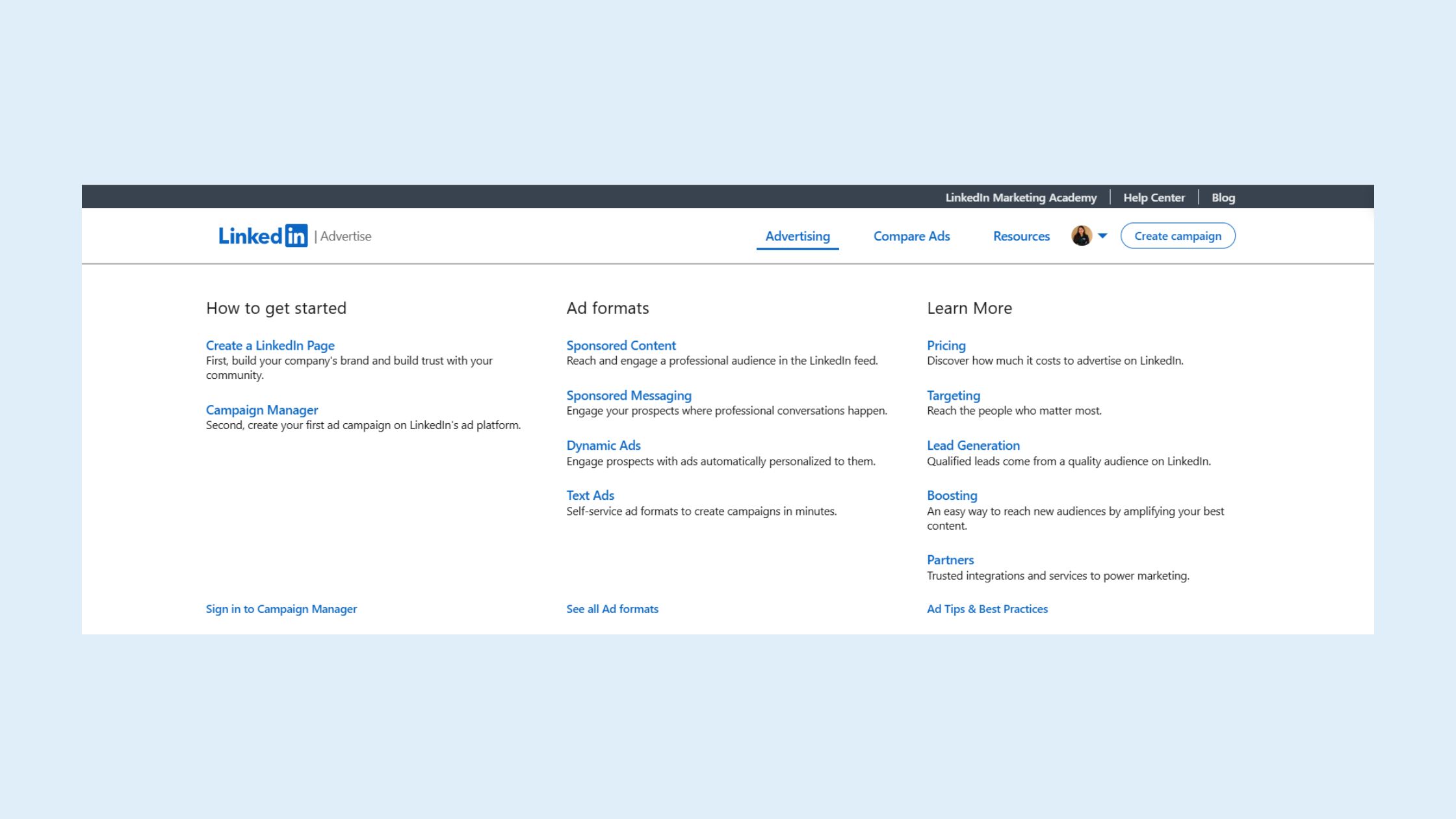
LinkedIn Ads - X Ads best for: Consumer brand awareness, event promotion, reach-based campaigns, political or news-adjacent content.
- LinkedIn Premium vs Twitter Blue for professionals: LinkedIn Premium ($39–$99/month) unlocks InMail credits, who-viewed-your-profile data, and deeper search filters — genuinely valuable for active job seekers and sales professionals. Twitter Blue (now X Premium) restores algorithmic reach for verified accounts but offers minimal professional tooling beyond that; most professionals report minimal ROI from the subscription unless content virality is the primary goal.
Getting LinkedIn traction without paid ads? Real engagement makes the difference.
HyperClapper connects your posts with real professionals through community engagement channels — boosting early engagement velocity without automation risk.
Try HyperClapper FreeWhere to Build Your Personal Brand in 2026
For most professionals, where to build personal brand 2025 and into 2026 resolves clearly in LinkedIn's favour — not because X is irrelevant, but because LinkedIn's compounding mechanics create lasting asset value. A well-written LinkedIn post from six months ago still drives profile views today. An X post from six months ago is effectively invisible. That shelf-life difference defines long-term personal brand ROI.
X is better for real-time thought leadership in fast-moving domains where being first matters more than being polished. Tech founders building in public, AI researchers sharing findings, media personalities commenting on news cycles — these are genuine X-native use cases. For everyone else, the platform's increasingly pay-to-play dynamics (algorithmic suppression of non-verified accounts, degraded analytics since 2022) make it a riskier primary investment.
For deeper guidance on building a durable LinkedIn presence, see our guide on how to build a personal brand on LinkedIn — including content frameworks, profile optimisation, and engagement strategies that compound over time.
Platform Stability and Risk: X Ownership Volatility vs LinkedIn's Institutional Stability
This is the gap most platform-comparison articles skip entirely — and it matters more in 2026 than it did two years ago.
X has experienced significant policy turbulence since Elon Musk's acquisition in late 2022: advertiser exits, API access restrictions, algorithm transparency rollbacks, and shifting content moderation standards. For professionals building an audience as a core business asset, platform risk — the probability that the platform changes rules in ways that devalue your investment — is a real strategic consideration.
- LinkedIn risk profile: Owned by Microsoft since 2016, stable governance, consistent product roadmap, institutional advertiser base — low platform volatility risk.
- X risk profile: Single-owner governance, erratic policy changes, advertiser uncertainty, API monetisation changes — higher volatility risk for long-term audience-building.
Common Mistakes Professionals Make When Choosing Between LinkedIn and X
- Treating both platforms as identical content channels — format, tone, and rhythm are fundamentally different.
- Measuring success by follower count rather than lead quality or professional opportunity generated.
- Going all-in on X because it feels more dynamic — without tracking whether any professional ROI is actually resulting.
- Abandoning LinkedIn because early organic reach feels slow — typically, LinkedIn growth accelerates significantly after the 90–120-day consistency mark.
Analytics, Scheduling Tools, and Managing Both Platforms Efficiently
LinkedIn's native analytics dashboard — covering impressions, engagement rate, follower demographics, and post reach — is genuinely robust for organic content. LinkedIn Premium adds deeper profile visitor insights and competitive benchmarking. It's the one platform where the built-in analytics are usually sufficient for most creators without a third-party tool.
X analytics have degraded noticeably since 2022. Basic post metrics remain, but the best social media scheduling tool for LinkedIn and Twitter combinations have become essential infrastructure for serious creators. In 2026, the clearest options are:
- Buffer: Handles LinkedIn and X scheduling cleanly; good for solo creators managing both platforms with limited overhead.
- Hootsuite: Enterprise-grade multi-platform management; better for agencies handling multiple client accounts.
- Taplio / AuthoredUp: LinkedIn-native with superior content analytics; ideal for creators whose primary platform is LinkedIn.
- Typefully: X-native thread scheduling and analytics; the strongest tool for serious X creators.
- Tweet Hunter: An AI-powered X content tool built specifically for growing on X — it offers tweet drafting assistance, viral tweet inspiration, and audience analytics. Best for professionals who have decided X is their primary platform and want to accelerate growth there systematically.
For LinkedIn specifically, tools like HyperClapper go beyond scheduling — they amplify post visibility through real community engagement, AI-powered replies, and post-performance analytics that native LinkedIn analytics don't surface. The distinction matters: scheduling gets content posted; engagement amplification gets content seen. What consistently separates accounts with real LinkedIn reach from accounts with impressive follower numbers is early engagement momentum — and that's where a tool like HyperClapper creates measurable difference.

For a comprehensive look at what's working in LinkedIn content right now, see our guide on LinkedIn content marketing in 2026.
✓ Platform Decision Checklist: LinkedIn vs Twitter in 2026
- ☐Identify your primary goal: lead generation, brand awareness, job search, or community building
- ☐Map your target audience: are they B2B decision-makers (LinkedIn) or consumer/tech/media community (X)?
- ☐Check your industry's dominant platform using the industry-by-industry breakdown above
- ☐Assess your content format strength: long-form and document-based → LinkedIn; short punchy takes and threads → X
- ☐Evaluate platform risk tolerance: how exposed are you if X policy changes again?
- ☐Choose a primary platform and a supporting tool (scheduling + engagement) before committing a content calendar
- ☐Set a 90-day measurement milestone — track lead quality, profile views, or inbound messages, not just likes
Side-by-Side: LinkedIn vs Twitter for Business — How to Make the Final Call
After mapping goals, industries, algorithms, and conversion data, the decision framework simplifies into four paths:
- B2B lead generation and recruiting → LinkedIn primary. No platform generates professional leads more efficiently at organic spend.
- Real-time brand presence in tech, media, or crypto → X primary. The conversation happens there first; showing up late matters in those spaces.
- Personal brand with long-term compounding → LinkedIn primary, X secondary. Content shelf life and Google indexing give LinkedIn a structural advantage for lasting visibility. Read our full breakdown of building a powerful personal brand on LinkedIn for the specific tactics.
- Consumer brand virality experiments → X primary. Meme cycles, trending topics, and community building around consumer products move faster and wider on X.
For LinkedIn vs Twitter for business 2025 and into 2026, the industry-by-industry quick reference looks like this:
- SaaS founders: LinkedIn primary, X secondary — LinkedIn for inbound leads, X for building in public.
- Journalists and media professionals: X primary — breaking news, source building, and public commentary culture lives on X.
- Consultants and coaches: LinkedIn strongly — clients search for expertise on LinkedIn, not X.
- Software developers: Both, with X for community and open-source and LinkedIn for job market credibility.
- Recruiters: LinkedIn exclusively for professional sourcing; X as a supplemental brand awareness channel only.
- Healthcare and education professionals: LinkedIn — where the professional community and institutional audience are concentrated.
Is Twitter still worth it for professionals in 2025? Yes — selectively. For professionals in tech, AI, media, and policy where real-time conversation is part of the job, X delivers genuine value. For most B2B professionals, marginal time spent deepening LinkedIn presence will outperform equivalent time on X on almost every measurable professional outcome.
On posting cadence: how often should I post on LinkedIn vs Twitter is a common question with a practical answer. LinkedIn rewards quality over volume — 3–5 posts per week is the optimal range for most creators; dropping below 3 posts weekly tends to trigger algorithmic reach decay within 10–14 days, typically requiring 3–4 weeks of consistent posting to recover. X rewards volume and recency — 1–3 posts daily maintains algorithmic presence, with threads generating significantly better reach than single tweets for most professional accounts.
For a deeper dive into the B2B strategy layer across both platforms, see our complete guide on B2B social media marketing in 2026.
Decided LinkedIn is your primary platform? Make sure your posts actually get seen.
HyperClapper boosts LinkedIn post visibility through real engagement channels — not bots, not fake activity. Real professionals engaging with your content in the first critical hour.
Start Boosting Your LinkedIn PostsFrequently Asked Questions About LinkedIn vs Twitter for Professionals in 2026
Is Twitter better than LinkedIn?
Twitter (X) is better than LinkedIn for real-time reach, tech and media discourse, and consumer brand awareness — but LinkedIn outperforms X on lead generation, professional networking, and B2B conversion. LinkedIn's visitor-to-lead rate of 2.74% is nearly 4x X's 0.69%. For most professionals, LinkedIn drives better measurable ROI; for journalists, developers, and crypto professionals, X is the stronger community platform.
What is the downside of LinkedIn?
LinkedIn's main downsides are its slower virality, higher advertising costs, and the risk of content feeling overly polished or self-promotional. Organic reach takes consistent effort over 3–6 months to build. The professional context that makes LinkedIn commercially powerful also creates a culture where authenticity can feel constrained compared to X's more casual tone.
Should I focus on LinkedIn or Twitter if I work in tech?
In tech, both platforms serve distinct purposes worth maintaining. X is where real-time community discourse, open-source conversations, and building-in-public culture happen — your peers are there. LinkedIn is where recruiters, enterprise buyers, and career opportunities exist. Most tech professionals benefit from X for community and LinkedIn for professional credibility and inbound job or client interest.
What is the difference between LinkedIn and Twitter audiences in 2025?
LinkedIn's 1.3 billion members skew toward 25–54-year-old business professionals and decision-makers, with 4 in 5 influencing business purchasing decisions. Twitter X audience demographics 2025 skew younger and broader — heavier in tech, media, politics, and entertainment, with lower average professional seniority and significantly lower B2B purchase intent per user.
How often should I post on LinkedIn vs Twitter?
On LinkedIn, 3–5 posts per week is the optimal range — quality and consistency matter more than volume, and dropping below 3 weekly posts triggers measurable reach decay. On X, 1–3 posts daily maintains algorithmic presence; threads consistently outperform single posts for professional accounts trying to build reach without paying for amplification.
How do I choose between LinkedIn and Twitter for content marketing?
Match platform to your content's commercial intent. LinkedIn content marketing works best for what type of content works best on LinkedIn answers: professional lessons, case studies, carousels, and thought leadership with a B2B audience. X content marketing works for real-time takes, product launches to consumer audiences, and community-driven engagement. If content should generate leads or professional trust — choose LinkedIn. If it should generate reach and cultural conversation — choose X.
Is LinkedIn or Twitter better for networking?
LinkedIn is better for intentional, commercially useful professional networking. Every connection carries a professional context — job title, company, shared connections — that makes relationship-building more efficient. Twitter networking is more serendipitous and personality-driven; it can produce strong connections, but it requires an existing audience and far more time investment to generate the same professional density LinkedIn offers by default.
What happens if X continues ownership and policy instability?
Professionals who have built their primary audience on X face real platform risk: algorithmic reach can be suppressed by policy changes without notice, API access has been restricted for third-party tools, and advertiser uncertainty continues to affect the platform's long-term product investment. The practical hedge is maintaining an active LinkedIn presence as a stable, Microsoft-backed alternative that is structurally lower-risk for long-term professional audience building.
After seeing the twitter vs linkedin question play out across industries, roles, and stages of career growth, the clearest pattern is this: professionals who treat platform choice as a one-time decision and never revisit it typically plateau on whichever platform they picked first, regardless of whether it was the right fit. The choice is not permanent — it should be reassessed every 6–12 months against actual results. What consistently separates professionals who generate real inbound opportunities from those who post consistently without conversion is not being on the right platform — it is being active and well-optimised on the one where their specific audience already lives.



