LinkedIn pods are reciprocal engagement communities — groups of professionals who like and comment on each other's posts to generate early engagement signals that the algorithm rewards with broader distribution. Whether they're safe depends on one thing above everything else: whether real, relevant humans are doing the engaging or whether automation is doing it for them. A pattern consistently observed across thousands of LinkedIn accounts is that the question isn't really "are pods safe?" — it's "which type of pod, used how, by whom?" The answer to that determines whether your account gains compounding reach or quietly gets suppressed.
- LinkedIn pods are groups where members engage on each other's posts to trigger the algorithm — not all are equally safe.
- Fully automated pods using bots or scripts carry real account suspension risk in 2026; LinkedIn's detection has improved significantly.
- Manual pods and AI-assisted platforms using real community engagement sit in a much lower-risk category — but still require careful use.
- LinkedIn's User Agreement explicitly prohibits "artificial inflation of engagement" — pods of any kind exist in a policy gray area.
- The most counterintuitive finding: pod-boosted posts often see short-term spikes followed by lower organic reach than accounts that never used pods at all.
- Safer alternatives — Creator Mode, consistent posting cadence, genuine comment reciprocity — often outperform pods over a 90-day window.
- What Is a LinkedIn Pod and How Does It Actually Work?
- Do LinkedIn Engagement Pods Actually Work in 2026?
- What Happens to Your LinkedIn Reach When You Use Pods?
- Can LinkedIn Actually Ban or Penalize Your Account for Using Pods?
- Comparing LinkedIn Pod Tools: Podawaa, Lempod, and HyperClapper
- Common Mistakes to Avoid When Using LinkedIn Pods
- The Best Organic Alternatives to LinkedIn Pods for Reach Growth
- So, Are LinkedIn Pods Safe? The Honest Answer
- Frequently Asked Questions About LinkedIn Pods
What Is a LinkedIn Pod and How Does It Actually Work?
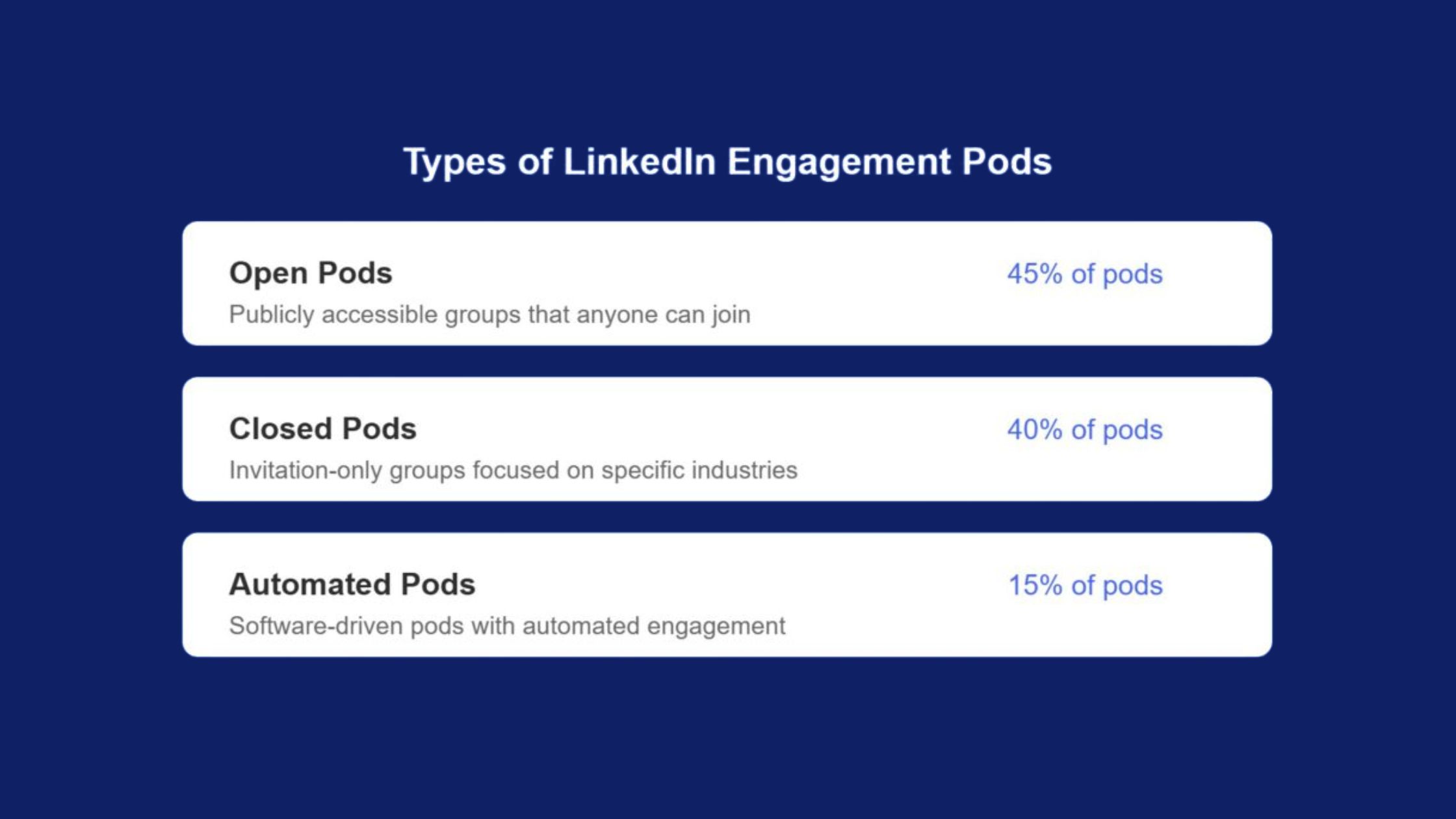
A LinkedIn engagement pod is a coordinated group of professionals who agree to like and comment on each other's posts shortly after publishing — with the express intent of creating early engagement velocity that signals relevance to LinkedIn's algorithm. Engagement velocity is the speed at which a post receives likes and comments after publishing; LinkedIn's distribution model uses this signal to decide whether to surface content to a broader audience beyond your immediate connections.
The mechanics split into two broad camps. Manual pods operate through DM groups on LinkedIn itself, or external channels like Slack or WhatsApp. Members post a link, others engage within a set window — usually 30 to 60 minutes. No software involved. Automated pods use platform-based tools (Podawaa, Lempod, HyperClapper) that handle the coordination and sometimes the engagement itself. AI-powered engagement platforms represent a third, newer category — they connect users with real human communities while using AI to generate contextually relevant replies rather than generic "Great post!" filler.
The common pain point professionals consistently describe when joining pods is this: they expect a straightforward traffic boost, but have no idea whether they're building genuine platform credibility or quietly triggering suppression signals. That uncertainty is exactly what this article resolves.
Manual Pods vs. Automated Pods vs. AI-Powered Engagement
- Manual pods: Highest authenticity, lowest scalability. Real humans, real comments — but time-consuming and hard to keep consistent.
- Automated pods: Fastest setup, highest risk. Bots or scripts engage within seconds, creating unnatural timing patterns LinkedIn can detect.
- AI-powered platforms (e.g., HyperClapper): Real community members engage, with AI generating contextual comments — balancing scale with authenticity signals.
Understanding the type of pod you're in shapes every risk decision that follows — so keep that distinction sharp as you read on.
Do LinkedIn Engagement Pods Actually Work in 2026?
They still work — but the window of effectiveness has narrowed considerably compared to 2021. Posts that accumulate meaningful engagement within the first 60 to 90 minutes are still surfaced more broadly by LinkedIn's algorithm. That core mechanic hasn't changed. What has changed is LinkedIn's ability to distinguish authentic early engagement from coordinated bursts.
The platform's detection capabilities have improved enough that a crude automated pod in 2026 is more likely to flag your content for suppression than to amplify it. The same engagement that drove reach in 2022 now triggers a different algorithmic response.
Pod-driven engagement can still generate social proof credibility signals — the visible likes and comments that encourage organic viewers to engage once they see activity. Think of it as a restaurant with tables full of people versus an empty dining room: humans use existing activity as a cue to participate. That psychology still functions.
Why LinkedIn Pods Become Less Effective Over Time
The most common failure mode is diminishing returns. Accounts relying on the same pod members repeatedly create a detectable pattern: the same 30 to 50 profiles engaging on every post, in the same time window, with similar comment structures. LinkedIn's algorithm identifies this cluster behavior. After seeing this across multiple creator accounts, the pattern is consistent — early pod adoption can produce a 2 to 4-week honeymoon period of elevated reach, followed by a gradual organic reach decline that takes months to recover from.
Rotating pod members, varying engagement timing, and prioritizing comment depth over volume are the adjustments that extend effectiveness — but they also require active management most creators don't maintain. You can read more about how to join and maximize LinkedIn engagement pods for a detailed breakdown of sustainable pod practices.
What Happens to Your LinkedIn Reach When You Use Pods?

Short-term, posts boosted by pods can see 2 to 5x higher impression counts in the first 24 hours, driven purely by early engagement velocity pushing the post into a second and third distribution wave. That number is real — but its source matters enormously for what comes next.
Medium-term, LinkedIn's algorithm may begin suppressing content if it detects an unusual engagement pattern specifically, engagement from accounts that are outside your industry, geographically inconsistent with your usual audience, or systematically timed. This means organic reach often drops below the pre-pod baseline, which is the outcome most professionals who abandon pods describe.
How LinkedIn's Algorithm Detects Pod Activity
LinkedIn uses several LinkedIn algorithm authenticity signals to evaluate whether engagement is genuine:
- Engagement timing: Natural engagement is distributed over hours; pod engagement often clusters within 5 to 15 minutes of posting.
- Audience relevance: Engagement from users outside your connection graph or industry vertical is weighted lower and flagged faster.
- Comment quality: Generic comments ("Insightful!", "Well said!") are scored lower than substantive replies — and high volumes of generic comments are a detection trigger.
- Account behavior clusters: Repeated mutual engagement between the same set of accounts across multiple posts activates coordinated inauthentic behavior detection.
The reach consequences are not just immediate — platform terms of service compliance violations can create lasting suppression that affects even strong organic content published months later.
Can LinkedIn Actually Ban or Penalize Your Account for Using Pods?
Yes — LinkedIn can and does penalize accounts for pod use, though the severity scales with how aggressively the pods are used. LinkedIn's User Agreement explicitly prohibits "artificial inflation of engagement" and "coordinated inauthentic behavior." Using pods technically violates these terms regardless of whether the engagement comes from real humans or bots.
LinkedIn Terms of Service Violations: What the Rules Actually Say
LinkedIn's User Agreement prohibits activity that "artificially boosts distribution of content" and "creates false impressions of yourself or your posts." The documented consequence spectrum looks like this:
- Content suppression: The most common outcome — posts stop receiving organic distribution without any notification to the account holder.
- Reach throttling: All future content from the account is distributed to a smaller percentage of followers, with no clear reset timeline.
- Temporary account restrictions: Login restrictions, posting limitations, or messaging blocks for accounts LinkedIn flags as high-risk.
- Permanent account suspension: Reserved for severe or repeat violations, particularly fully automated tools. LinkedIn has run enforcement waves specifically targeting high-volume pod users.
The underrated threat is professional reputation risk. Recruiters, clients, and potential partners who review your LinkedIn activity sometimes notice suspicious patterns — 80 comments on a post in 15 minutes from profiles spanning five unrelated industries is a visible signal to a careful human reader, not just an algorithm. Being associated with inauthentic engagement can damage credibility in ways that no algorithm fix can undo.
For a detailed guide on how to avoid LinkedIn account suspension and stay within safe engagement limits, the risk thresholds are covered comprehensively.
Comparing LinkedIn Pod Tools: Podawaa, Lempod, and HyperClapper

Not all pod tools carry the same risk profile. Here's an honest comparison of the three most commonly used platforms in 2026:
| Tool | Engagement Type | Risk Level (2026) | Key Differentiator |
|---|---|---|---|
| Podawaa | Automated scheduling, keyword targeting | Medium–High | Large pod network, but automation patterns are well-known to LinkedIn's detection systems |
| Lempod | Automated (reduced functionality) | High | Heavily restricted post-LinkedIn API changes; limited reliability and higher risk of triggering flags |
| HyperClapper | Real community + AI replies | Lower | Real people in channels, AI-powered contextual replies, Content Guard moderation system |
Teams that choose tools based solely on feature count rather than engagement authenticity consistently see the highest account risk. What separates top performers here is selecting platforms where real humans generate contextually relevant engagement — not platforms where automation does the work at a speed no human could match.
%2520(1).png) hyperclapper.com
hyperclapper.comHow to Use Pods Without Hurting Your Account
- Choose platforms that use real human engagement over pure automation.
- Engage only in pods where members share your industry or professional niche.
- Ensure comments are substantive — 15+ words that reference the actual post content.
- Vary your posting and engagement times to avoid creating a detectable clock-pattern.
- Use a Content Guard feature (available in HyperClapper) to prevent policy-sensitive content from being amplified through your pod activity.
You can also review a full comparison of the top 5 LinkedIn engagement pod platforms to evaluate which approach fits your risk tolerance and goals.
Want Real LinkedIn Engagement Without the Account Risk?
HyperClapper connects you with real professionals in your niche — genuine likes, contextual AI replies, and a Content Guard system designed to keep your account safe.
See How HyperClapper WorksCommon Mistakes to Avoid When Using LinkedIn Pods
4 in 5 professionals who report negative outcomes from pod use made at least one of these mistakes before they saw their reach decline:
- Mistake #1: Using fully automated tools that trigger engagement within seconds. This is the clearest algorithmic red flag. Natural human engagement takes minutes, not milliseconds — any tool that engages a post within 30 seconds of publishing is operating outside human behavioral norms LinkedIn can easily detect.
- Mistake #2: Joining irrelevant pods. Engagement from professionals outside your industry sends a confusing relevance signal. Low-relevance engagement actively hurts content distribution score.
- Mistake #3: Treating pods as a substitute for quality content. LinkedIn's algorithm rewards dwell time, saves, and shares — not just likes. A post with 50 pod-driven likes and no saves performs worse over time than a post with 20 organic likes and 10 saves.
- Mistake #4: Ignoring content moderation. Posting controversial or policy-violating content through a pod system amplifies both the content and the account risk exponentially. This is why HyperClapper's Content Guard exists — it screens posts before they enter the boost queue.
Signs Your Pod Strategy Is Hurting More Than Helping
- Impressions on non-boosted posts have dropped compared to 3 months ago.
- Your comment section looks identical across multiple posts — same names, similar phrasing.
- Your follower growth has stalled despite high engagement numbers on individual posts.
- Organic reach (views from people outside your connections) is shrinking as a percentage of total impressions.
The Best Organic Alternatives to LinkedIn Pods for Reach Growth

Creators who skip pods entirely and invest that same time in organic strategies consistently find that their reach compounds faster after 90 days than pod-dependent accounts at the same starting point. Here are the alternatives that actually work:
- Creator Mode + LinkedIn Newsletters: Activating Creator Mode switches your profile from "connect" to "follow" by default, unlocking follower-based distribution. Newsletters get pushed directly to subscriber inboxes — zero algorithm dependency, zero pod risk.
- Genuine comment reciprocity: Spending 20 to 30 minutes per day leaving substantive comments on posts from peers in your niche builds real relationships. Those peers are likely to engage back — creating authentic reciprocal engagement that looks exactly like what the algorithm rewards, because it genuinely is.
- Consistent posting cadence: LinkedIn rewards accounts that post 3 to 5 times per week with compounding organic reach over time. Accounts that drop below 3 posts per week see algorithmic reach decay within 10 to 14 days, typically requiring 3 to 4 weeks of consistent posting to recover their distribution baseline.
- Analytics-driven posting: Using a platform like LinkedIn's best automation and analytics tools for 2026 to identify your personal peak posting windows — when your specific audience is most active — reduces the need for artificial amplification entirely.
When a Safer Engagement Tool Makes More Sense Than a Pod
For professionals who need reach now — launching a product, promoting a webinar, entering a new market — waiting 90 days for organic compounding isn't always viable. In those cases, a safer engagement platform makes more sense than either a crude pod or zero amplification. The distinction: a safer tool uses real human engagement from relevant professionals, generates contextual replies that add genuine conversational value, and respects LinkedIn's content policies at every step. Tools like HyperClapper are built on this model — real people in industry-specific channels, AI-generated replies that reference actual post content, and moderation that screens out policy-sensitive material before it enters the boost queue.
So, Are LinkedIn Pods Safe? The Honest Answer
The safety of a LinkedIn pod depends entirely on three factors: whether real humans are engaging, whether that engagement is contextually relevant to your content and audience, and whether the tool you're using respects LinkedIn's terms of service at the operational level.
The honest answer in 2026 is that "LinkedIn pods" is not a single thing — it's a spectrum. Fully automated pods with bots sit at one end (high risk, declining effectiveness). Niche-relevant manual communities with substantive engagement sit at the other (low-to-medium risk, meaningful reach impact). Most professionals are using something in between, without knowing exactly where on that spectrum they land.
- Fully automated pods with bots or scripts: Not safe in 2026. Detection risk is high, consequences include reach throttling and account restrictions, and the effectiveness ceiling has dropped substantially as LinkedIn's authenticity detection has improved.
- Manual pods with real, niche-relevant professionals: Lower risk, meaningful reach impact when managed carefully — but still in a policy gray area if coordination is systematic and ongoing.
- AI-assisted platforms using real community engagement with content safeguards: The closest to a safe, scalable option available in 2026. Real people, relevant replies, no automation timing red flags — the model HyperClapper uses, built specifically around this risk profile.
✓ The LinkedIn Pod Safety Checklist
- ☐Engagement comes from real human accounts — not bots or scripts
- ☐Pod members work in your industry or a directly adjacent niche
- ☐Comments are substantive (15+ words referencing actual post content)
- ☐Engagement timing is varied — not all within 5 minutes of posting
- ☐Pod membership rotates — you're not using the same 30 accounts every post
- ☐Your tool has content moderation — controversial content is screened before boosting
- ☐You are monitoring organic reach trends monthly — not just individual post impressions
- ☐Pod use supplements quality content strategy — it does not replace it
Build LinkedIn Reach the Safe Way — Starting Today
HyperClapper's real engagement channels and AI-powered replies give you the visibility boost of a pod with the authenticity signals LinkedIn actually rewards.
Start Growing on HyperClapperWhat consistently separates accounts with real, sustainable reach from accounts with temporarily impressive numbers is not whether they used pods — it's whether the engagement they generated looked and felt like what LinkedIn's algorithm is designed to reward: relevant, substantive, authentic human interaction. Accounts that nail all three of those criteria see compounding reach regardless of how they got their initial boost. Accounts that skip any one typically plateau, or worse, decline — regardless of how much content they publish.
Frequently Asked Questions About LinkedIn Pods
What is a LinkedIn Pod?
A LinkedIn pod is a group of professionals who agree to engage on each other's posts — liking and commenting shortly after publishing — to trigger LinkedIn's algorithm into distributing the content more broadly. Pods range from informal WhatsApp groups to structured platforms with automated or AI-assisted coordination.
Is LinkedIn itself legit and safe to use?
Yes — LinkedIn is a legitimate, professionally established platform used by over 1 billion professionals worldwide. The platform itself is safe to use. Safety concerns arise specifically around third-party tools or coordinated engagement practices that violate LinkedIn's User Agreement, not from using LinkedIn itself.
Can LinkedIn ban your account for using engagement pods?
Yes. LinkedIn's User Agreement explicitly prohibits artificial inflation of engagement, and documented consequences range from content suppression and reach throttling to temporary restrictions or permanent account suspension. Fully automated tools carry the highest enforcement risk; real-human engagement platforms carry a meaningfully lower profile.
Are automated LinkedIn pods riskier than manual ones?
Significantly riskier. Automated pods trigger engagement within seconds of posting — a timing pattern no human can replicate — which LinkedIn's detection systems flag as coordinated inauthentic behavior. Manual pods with real humans engaging over minutes and hours create a pattern far closer to genuine organic activity.
What are the best alternatives to LinkedIn pods for growing reach in 2026?
The most effective alternatives are: activating Creator Mode for follower-based distribution, publishing LinkedIn newsletters for direct inbox reach, maintaining a 3 to 5 posts-per-week cadence for algorithmic compounding, and leaving substantive comments on peers' posts to build genuine reciprocal engagement without any policy risk.
How do I know if my pod is hurting my LinkedIn reach?
Watch for these signals: organic reach percentage declining over 30 days, impressions on non-boosted posts dropping below your 90-day average, and your comment sections showing the same names repeatedly. If follower growth stalls while individual post numbers look healthy, the algorithm is likely suppressing your wider distribution.