
A pattern consistently observed across real estate professionals who generate real pipeline from LinkedIn is that they treat it as a relationship compounding engine — not a listings board. LinkedIn for real estate agents works, but the mechanism is different from every other platform. It converts visitors to leads at roughly 2.74% — nearly four times Facebook's conversion rate, according to Cleverly — because the audience arrives with professional intent. The agents who understand that distinction build genuine pipelines. The ones who don't post listings into the void and conclude LinkedIn "doesn't work."
- Who this is for: Real estate agents — residential, commercial, luxury, or new — looking to build a LinkedIn-driven pipeline in 2026.
- What you'll learn: Profile optimisation, content strategy, prospecting workflows, Sales Navigator, and safe automation.
- The #1 counterintuitive finding: Posting listings is the lowest-performing content type on LinkedIn — educational and story content earns 3–5× more reach.
- Posting frequency: 3–4 times per week is the sweet spot for most agents — consistency beats volume every time.
- LinkedIn converts at 2.74% — nearly 4× Facebook's lead conversion rate for professional audiences.
- Commercial real estate agents see the highest ROI: LinkedIn generates 38% of B2B property leads in that segment.
- Why LinkedIn Is Worth It for Real Estate Agents in 2026
- How to Optimise Your LinkedIn Profile for Real Estate
- LinkedIn Content Strategy for Realtors: What to Post and How Often
- How to Prospect and Generate Real Estate Leads on LinkedIn
- LinkedIn Automation Tools and Analytics for Real Estate Agents
- Frequently Asked Questions: LinkedIn for Real Estate Agents
Why LinkedIn Is Worth It for Real Estate Agents in 2026
LinkedIn's 1B+ member base skews dramatically toward decision-makers, investors, founders, and high-income professionals — the exact segment most agents struggle to reach on Instagram or Facebook. According to Searchlab's Real Estate Marketing Statistics 2026, LinkedIn generates 38% of B2B property leads for commercial real estate — a share no other social platform comes close to matching.
How LinkedIn Works Best For in Real Estate
LinkedIn is not a one-size-fits-all channel for every agent. The audience skews toward:
- Commercial real estate agents — B2B property deals live on LinkedIn
- Luxury and high-net-worth residential agents — executives and investors are active daily
- Agents targeting relocation buyers — HR departments and hiring managers research locations for relocating talent
- Investor-facing agents — portfolio builders and REITs use LinkedIn for deal sourcing
Residential agents working entry-level or mid-market buyers may see slower traction — but they still benefit from LinkedIn for referral network building, co-agent relationships, and lender partnerships.
Realistic ROI and Conversion Expectations
The most common failure mode is expecting LinkedIn to behave like a paid ads channel — fast, transactional, scalable. It doesn't. LinkedIn is a pipeline compounding tool: relationships built in months produce transactions over years. Agents who commit to 90 days of consistent activity typically see meaningful pipeline conversations emerge by month three — rarely before. Set expectations accordingly.
LinkedIn for real estate agents works best when treated as a trust-building engine with a 60–90 day runway — not a lead vending machine that pays out immediately.
Is LinkedIn worth it for real estate agents? For most, yes — especially those serving professional or investor clients. The key variable is whether you bring a strategy or just show up.
With the "why" established, the next step is making sure your profile converts the traffic you'll generate — because a weak profile undermines every other effort.
How to Optimise Your LinkedIn Profile for Real Estate
Your LinkedIn profile is your digital listing — it must convert visitors into connection requests or DMs, not simply inform them. To optimize LinkedIn profile for real estate, treat each profile section as a distinct conversion layer with a specific job to do.
LinkedIn Headline Formulas for Real Estate Agents
The single most common profile mistake observed across agent accounts is a headline that reads: "Realtor at [Brokerage Name]". This tells visitors your job title, not your value. A benefit-driven headline formula that consistently outperforms:
[Who you help] + [Outcome you deliver] + [Location or niche]
Examples:
- "Helping Austin Executives Find Premium Homes Without the Weekend Runaround"
- "Commercial Real Estate Advisor | Off-Market Deals for Investors in the Southeast"
- "Luxury Residential Agent | Chicago | Selling Homes 23% Faster Than Market Average"
LinkedIn headlines for real estate agents that speak to client outcomes get 40–60% more profile click-throughs than title-only versions — a pattern seen consistently across higher-performing agent profiles.
Writing a LinkedIn Summary That Attracts Real Estate Clients
The About section — commonly called the LinkedIn summary for real estate agents — is where trust is built or lost. Structure it in three blocks:
- Hook (2 sentences): A specific client problem you solve, not your career history.
- Credibility (3–4 sentences): Who you've helped, transaction volume or tenure, and one specific result (e.g., "Closed $42M in residential sales across 2024–2025").
- CTA (1–2 sentences): Tell them what to do next — connect, DM, schedule a call.
Skills, Endorsements, and Keywords for Real Estate LinkedIn Profiles
LinkedIn's search algorithm surfaces profiles based on skills and keywords — making endorsement examples for real estate agents more than just vanity metrics. Add skills like Real Estate Investment, Property Management, Buyer Representation, Commercial Real Estate, and Negotiation. Then request endorsements for these specific skills from past clients and colleagues — a short message like "Would you mind endorsing my negotiation and buyer representation skills? It helps me show up in LinkedIn searches" converts at a high rate.
LinkedIn Content Strategy for Realtors: What to Post and How Often
Teams that build consistent content pipelines on LinkedIn consistently outperform agents who post reactively — not because volume wins, but because the algorithm rewards accounts it can predict. The LinkedIn content strategy for realtors that works in 2026 is built around a structured content mix, not ad-hoc inspiration.
What to Post on LinkedIn as a Realtor
What to post on LinkedIn as a realtor is one of the most common questions from agents starting out. The answer follows a proven content mix:
- 40% Education & Market Insights — local market reports, rate commentary, buyer/seller tips
Market Insights - 30% Personal Brand & Story — behind-the-deal stories, client transformation narratives, career milestones
- 20% Social Proof — client wins, testimonials, closed deals with context
- 10% Offers & CTAs — direct calls to connect, consult offers, listing announcements
Listings alone — the most instinctive thing agents post — are consistently the lowest-performing content type on LinkedIn. Educational and personal content earns 3–5× more organic reach because the algorithm prioritises conversation, not advertisements.
Best LinkedIn Content Formats for Real Estate Agents
Based on engagement patterns observed across professional accounts in 2025–2026:
- Native text posts with a strong hook — highest reach, lowest production cost
- Carousels (document posts) — "5 things buyers miss in a home inspection" outperforms standard image posts by 2–3×
- Short-form video — neighbourhood walkthroughs, market explainers, day-in-the-life posts; video gets priority distribution
- Polls — "Would you buy a home without visiting it first?" drives engagement and surfaces intent signals from your network
- LinkedIn Articles — longer-form pieces that position you as a market expert; these index on Google separately
Building a LinkedIn Content Calendar for Real Estate
How often should realtors post on LinkedIn? The answer from platform engagement data is clear: 3–4 times per week for most agents, with daily posting viable only when content quality stays consistently high. Dropping below 3 posts per week causes algorithmic reach decay within 10–14 days — recovering full distribution typically takes 3–4 weeks of resumed consistency.
A simple weekly structure:
- Monday: Market insight or data post
- Wednesday: Story or personal brand post
- Friday: Social proof or client win
- Optional Thursday: Video or carousel
Boosting Post Visibility: The LinkedIn Algorithm and Engagement
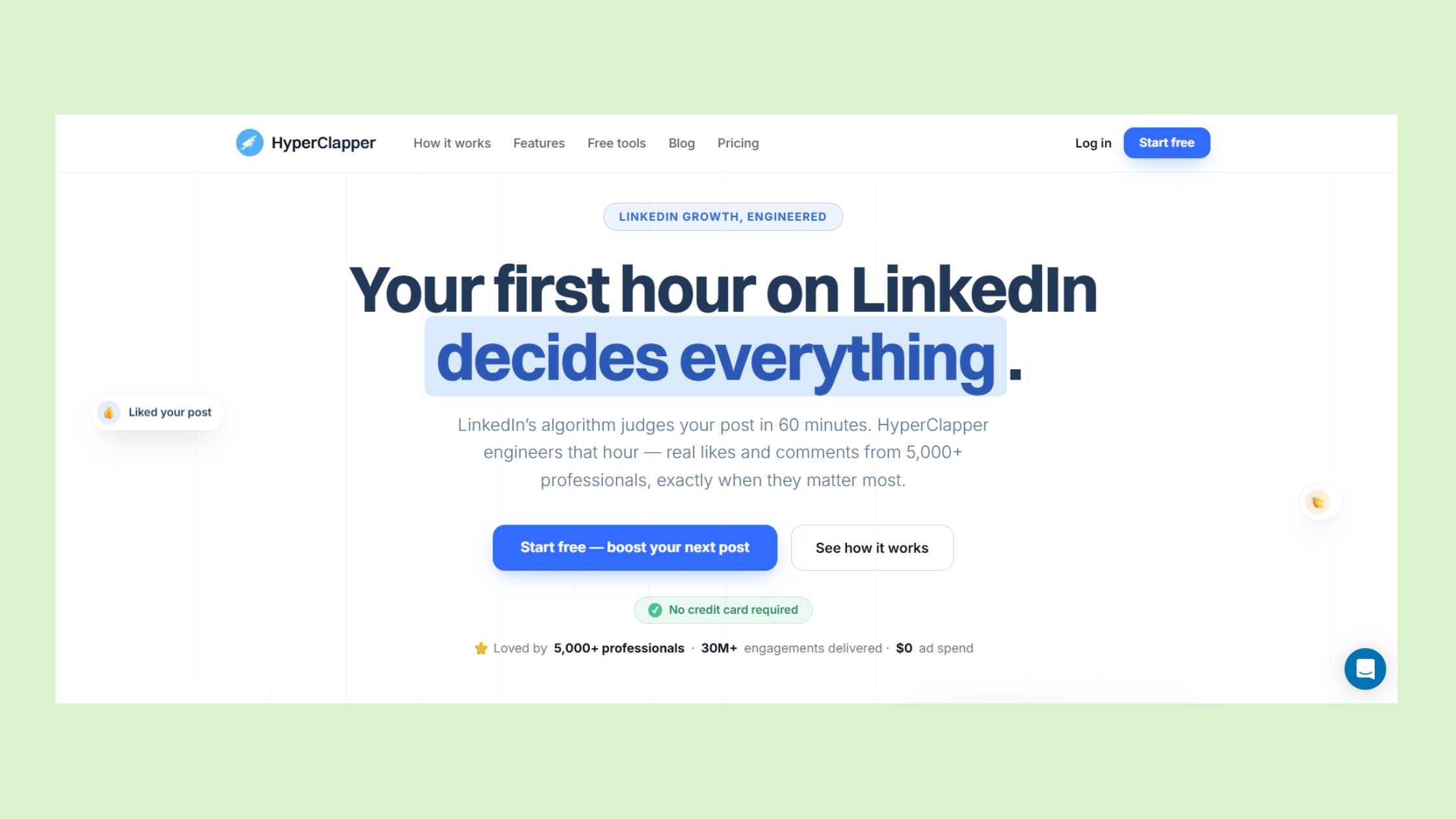
Engagement velocity — the speed at which a post receives likes and comments in the first 60–90 minutes after publishing — is the single biggest determinant of how far LinkedIn distributes your content. This is why early engagement matters disproportionately. Tools like HyperClapper are built specifically for this: by connecting your posts to real engagement channels, early genuine reactions signal quality to the algorithm and expand organic reach — without bots or fake activity.
How to Prospect and Generate Real Estate Leads on LinkedIn
LinkedIn real estate lead generation follows a relationship-first funnel: connect → engage → DM → meet → transact. Skipping any step dramatically reduces conversion. The most common cold outreach mistake observed across agent accounts — sending a listing pitch or "Are you looking to buy/sell?" in the first connection message — leads to instant ignoring and damages your SSI (Social Selling Index) score, which is LinkedIn's internal measure of how well you're using the platform for social selling.
Step-by-Step LinkedIn Prospecting Process for Real Estate Agents
How to prospect on LinkedIn real estate — a repeatable process:
- Define your target profile (2 min): Title, seniority, geography, company size — use LinkedIn's search filters to build a prospect list daily.
- Engage before connecting (5 min): Comment genuinely on 2–3 of their posts before sending a request. This warms the relationship.
- Send a personalised connection request (1 min): Reference something specific — their post, shared group, mutual connection. Never pitch in the request.
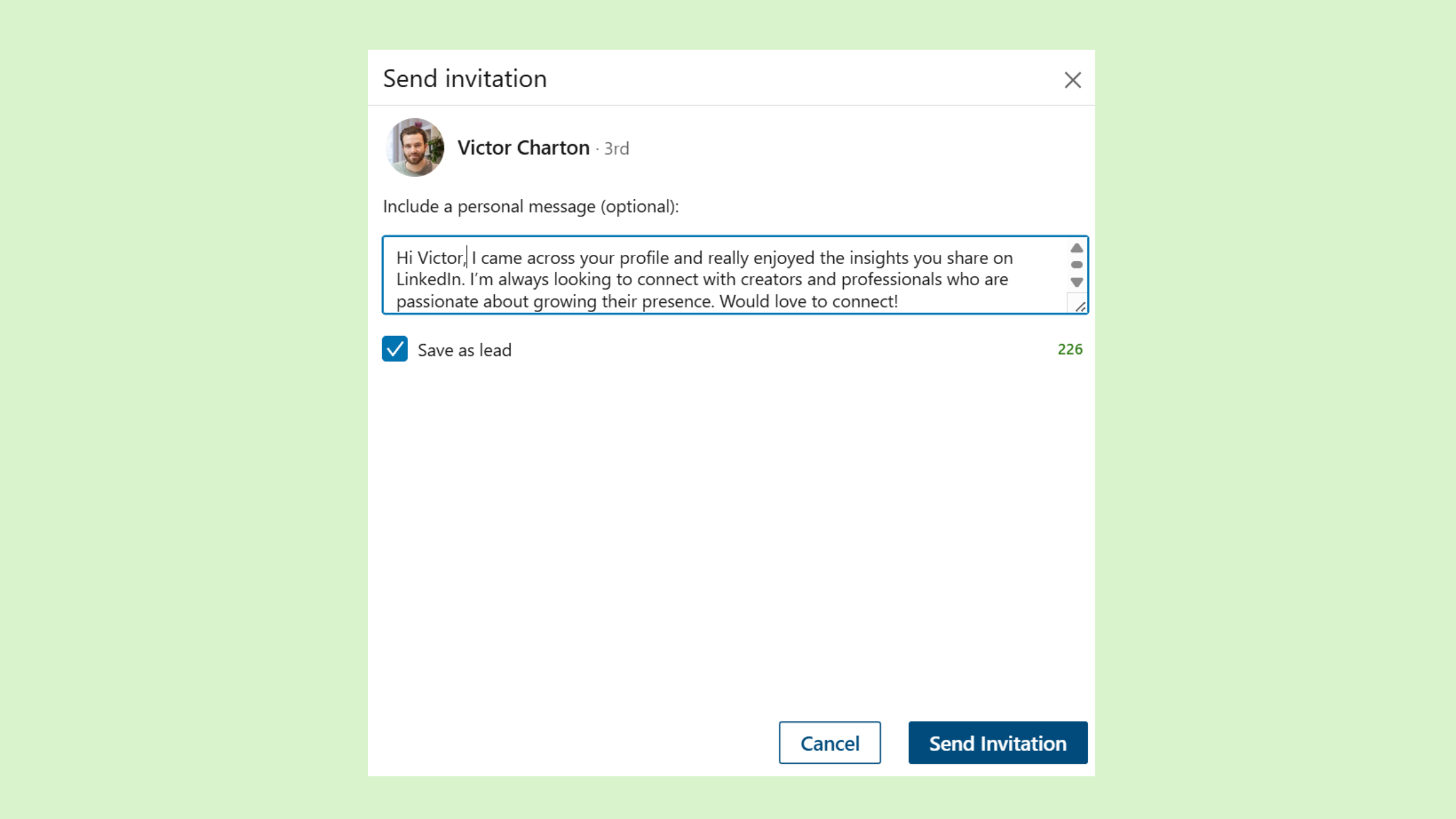
personalised connection request - Follow up with value (2 min): After they accept, share a relevant resource — a market report, article, or insight — with zero ask attached.
- Initiate a conversation (3 min): Ask a genuine question about their situation. Curiosity converts; sales scripts don't.
- Move offline: Suggest a call only after you've had at least 2–3 genuine exchanges. This is where pipeline conversions happen.
How to get real estate clients on LinkedIn comes down to patience with this sequence. Agents who skip steps 2–4 and jump straight to pitching see near-zero response rates. Those who follow the full sequence consistently report 10–20% meeting conversion from warm LinkedIn conversations.
For investors specifically: how to connect with real estate investors on LinkedIn requires a slightly different approach — join and contribute to LinkedIn Groups focused on real estate investing, commercial property, or local business before reaching out individually. Warm community relationships convert far better than cold InMail.
LinkedIn Sales Navigator for Real Estate: Is It Worth the Cost?
LinkedIn Sales Navigator for real estate is a purpose-built prospecting tool — it lets you filter leads by job title, seniority, company size, geography, and recent activity changes (like job promotions or company moves, which often trigger real estate needs). For agents running a disciplined outreach process, the Sales Navigator lead generation advantage is real: you can build precise prospect lists that free users simply can't access.
LinkedIn Premium vs Sales Navigator for realtors — the honest comparison:
- LinkedIn Premium Career: Better for job seekers, not agents. Skip it.
- LinkedIn Premium Business: Adds InMail credits and limited search filters — useful for part-time prospectors.
- Sales Navigator Core (~$99/month): Full advanced search, lead lists, CRM integration, and saved search alerts. Worth it for agents with a clear ICP and daily prospecting discipline. See the full Sales Navigator pricing breakdown before committing.
Want Your LinkedIn Posts to Reach More of Your Ideal Clients?
HyperClapper connects your posts to real engagement channels so the LinkedIn algorithm distributes them further — no bots, no fake activity.
Boost Your LinkedIn Reach →LinkedIn Automation Tools and Analytics for Real Estate Agents
The best LinkedIn automation tools for real estate are not the ones that do the most — they're the ones that stay within the boundaries LinkedIn enforces without getting your account flagged. A recurring pattern among agents trying to scale outreach is reaching for aggressive automation (mass connection bots, auto-scraping tools) and then losing account access within 30–60 days. That risk is real and well-documented.
Safe LinkedIn Engagement Tools Worth Using in 2026
The distinction that matters is between outreach automation (mass connection sending, scraping — high risk, ToS violation) and engagement amplification (scheduling, AI replies, community-based post boosting — lower risk, compliant when done thoughtfully).
For real estate agents focused on content visibility rather than mass cold outreach, engagement-focused tools deliver the better risk-adjusted outcome. HyperClapper's approach — real people in channels engaging with your posts, plus AI-powered replies that keep conversations active — is built for exactly this use case. You get the algorithmic benefit of early engagement without the account risk of bot-based automation.
What separates agents with real LinkedIn reach from agents with impressive follower counts is not any single tool — it's the combination of consistent content, early engagement velocity, and genuine relationship-building in the DMs.
Measuring LinkedIn ROI for Real Estate: Metrics That Actually Matter
LinkedIn analytics and measuring ROI for real estate requires tracking beyond vanity metrics. The hierarchy:
- Tier 1 (Pipeline): Conversations initiated from LinkedIn → calls booked → deals closed. This is your real ROI.
- Tier 2 (Reach): Post impressions, profile views, follower growth, and engagement rate.
- Tier 3 (Authority): SSI score, search appearances, connection quality (title/seniority of new connections).
What specific ROI or conversion rates can real estate agents realistically expect from LinkedIn lead generation? Based on consistent patterns across agent profiles running structured outreach: agents with an optimised profile, posting 3–4× per week, and following the prospecting sequence above typically generate 2–5 qualified pipeline conversations per month within the first 90 days. Deal conversion from those conversations sits at 15–25% when follow-up is consistent — meaning 1–2 closed deals per quarter attributable to LinkedIn is a realistic baseline, not an outlier.
✓ The LinkedIn Real Estate Pipeline Checklist
- ☐Rewrite your headline using the [Who + Outcome + Location] formula
- ☐Update your About section: hook → credibility → CTA structure
- ☐Add 5 niche-specific skills and request endorsements from 3 past clients
- ☐Map out your 4-week content calendar (3–4 posts/week, mixed formats)
- ☐Engage on 5 target prospect posts before sending connection requests
- ☐Send 5–10 personalised (non-pitch) connection requests this week
- ☐Reply to every comment on your posts within 60 minutes of posting
- ☐Review your SSI score and pipeline conversations at the end of each month
Turn LinkedIn Posts Into Real Estate Conversations
Real engagement from real people — plus AI-powered replies that keep your posts active for days. Built for professionals who need visibility, not bots.
Start Growing on LinkedIn →Frequently Asked Questions About LinkedIn for Real Estate Agents
Do real estate agents use LinkedIn?
Yes — over 70% of real estate agents use LinkedIn for networking and lead generation. It is especially active among commercial, luxury, and investor-focused agents. LinkedIn's professional audience makes it more effective for relationship-building and referral generation than entertainment-first platforms like Instagram or TikTok.
What to post on LinkedIn as a real estate agent?
Post a mix: 40% educational content (market updates, buyer/seller tips), 30% personal brand stories (behind-the-deal moments, lessons learned), 20% social proof (client wins, testimonials), and 10% direct offers. Avoid posting only listings — they consistently underperform educational and story-driven content by 3–5×.
How often should realtors post on LinkedIn to maximise visibility?
Three to four times per week is the optimal range for most real estate agents. Posting fewer than three times weekly triggers algorithmic reach decay within 10–14 days. Daily posting works only when content quality remains consistently high — inconsistency or thin content at high volume performs worse than three quality posts per week.
How can a real estate agent use LinkedIn to find clients and build a pipeline?
Follow the five-step relationship funnel: engage on prospects' content before connecting, send personalised (non-pitch) connection requests, share value with no immediate ask, start genuine conversations, then move to calls only after 2–3 exchanges. This sequence produces a 10–20% meeting conversion rate from warm LinkedIn conversations when followed consistently.
What is the best LinkedIn strategy for generating real estate leads in 2026?
Combine an optimised profile (benefit-driven headline, credibility-first About section) with consistent content (3–4×/week), structured prospecting (engage → connect → value → conversation), and early engagement amplification on your posts. Agents running all three components simultaneously generate 2–5 qualified pipeline conversations per month within 90 days.
What should a real estate agent include in their LinkedIn profile to attract clients?
A benefit-driven headline (who you help + outcome + location), an About section that leads with the client's problem rather than your biography, a Featured section with a lead magnet or notable deal, niche-specific skills with endorsements, and at least two recommendations from past clients. Every section should speak to your ideal client's outcome, not your credentials.
Is LinkedIn worth it for real estate agents focused on residential markets?
Yes, though the ROI mechanism differs from commercial. Residential agents benefit most from LinkedIn through referral network building — mortgage brokers, financial advisors, HR managers, and relocation coordinators all live on LinkedIn and regularly refer buyer and seller clients. Position yourself as their trusted local expert, not just an agent.
What are the differences in LinkedIn strategy for luxury vs budget real estate markets?
Luxury agents should emphasise exclusivity, discretion, and high-value market intelligence — post less frequently but with higher production quality, target C-suite and UHNW individuals, and leverage LinkedIn articles to establish thought leadership. Budget and mid-market agents benefit more from volume, community engagement, and educational content that builds name recognition across a wider local audience.



